Swing trading prop firm rules come down to 1 question: which of them still apply while the market is closed and your position is open? At OneStopProp the holding part is simple. Positions can stay open overnight and over the weekend on 1 Step, 2 Step and Instant, there is no time limit on the challenge and no minimum holding time. The rules that need thinking are the ones that keep running while the market is closed.
4 of them touch a swing trade directly: the daily loss limit, recalculated at 12:00 AM EST with your position still open; the max total loss, which does not move at all; the news window on a funded account, which requires every position to be closed around FOMC, Fed Chair speeches, NFP, CPI, PPI and earnings; and the consistency rule at payout, which counts a trade’s whole profit on the day you close it.
This guide walks each of those rules as written in the Help Center, then measures the part no rule controls: how far AAPL, NVDA, MSFT and SPY actually moved from 1 close to the next open across the last 60 sessions, 240 gaps in total. With that, it sizes a swing trading prop firm position so the worst gap in the sample, against a long and against a short, stays inside the daily limit on every route.
Key Takeaways
- Holding is allowed everywhere. Overnight and weekend holds are permitted on 1 Step, 2 Step and Instant, with no time limit on the challenge and no minimum holding time, per the Help Center.
- The daily loss floor is set at 12:00 AM EST from the higher of balance or equity. On a $100K 1 Step account with a $2,000 floating profit at midnight, the next day’s floor is $98,000; with a $2,000 floating loss, it is $96,000. Instant uses 2% instead of 4%.
- The max total loss is static: 6% on 1 Step, 8% on 2 Step, 5% on Instant. A gap does not get a grace period. Equity, including the open position, must not hit or fall below the line.
- Big stocks gap more than traders budget for. Over 60 sessions ending November 23, 2026, NVDA opened more than 2% away from the prior close in 19 sessions, 1 in 3. AAPL did it 3 times, MSFT 5, SPY once, and that once was a 5.0% gap up on Monday, November 23.
- The news window is a flat-trade rule, not a no-new-trade rule. On funded accounts without the News Trading Allowed Add-On, all trades must be closed 5 minutes before FOMC, Fed Chair speeches, NFP, CPI, PPI and individual stock earnings reports, and may not be opened or resumed until 5 minutes after. The working reading for earnings is the stock you hold; confirm it with support.
- A swing that books $2,000 on 1 day needs more than $8,000 of cycle profit to pay out on 1 Step and 2 Step, more than $10,000 on Instant. That is the 25% and 20% consistency rule applied to a single closing day.
What a Swing Trading Prop Firm Account Lets You Hold
The Help Center answers the holding question in 1 line: yes, you can hold trades overnight and over weekends. The answer is the same on 1 Step, 2 Step and Instant, in the challenge and in the funded phase, on every instrument in the account: U.S. stock CFDs, forex, indices, commodities, metals and crypto, executed in Match-Trader with TradingView-powered charts.
The time rules are just as simple. The challenge starts when you place your first trade and has no time limit; the Help Center’s only condition is that you remain active on the account and follow the rules. There is no minimum holding time either, so a swing that works in 2 hours can be closed in 2 hours.
1 thing to check in the platform rather than in the rulebook: the overnight financing on the instrument you plan to hold. This guide did not find a published figure, so read the instrument’s specification in Match-Trader before a multi-week hold, along with its leverage and its session hours, which can differ by instrument from the account-level numbers.
What a swing trader needs to read instead is the list of strategies that are not allowed. Hedging is not allowed, which rules out opening a short in the same instrument to “protect” a long over the weekend. Martingale is not allowed, which rules out adding to a loser after a gap because the thesis “still holds”. The page also says a stop loss is not required; the sizing section explains what a stop cannot do through a gap.
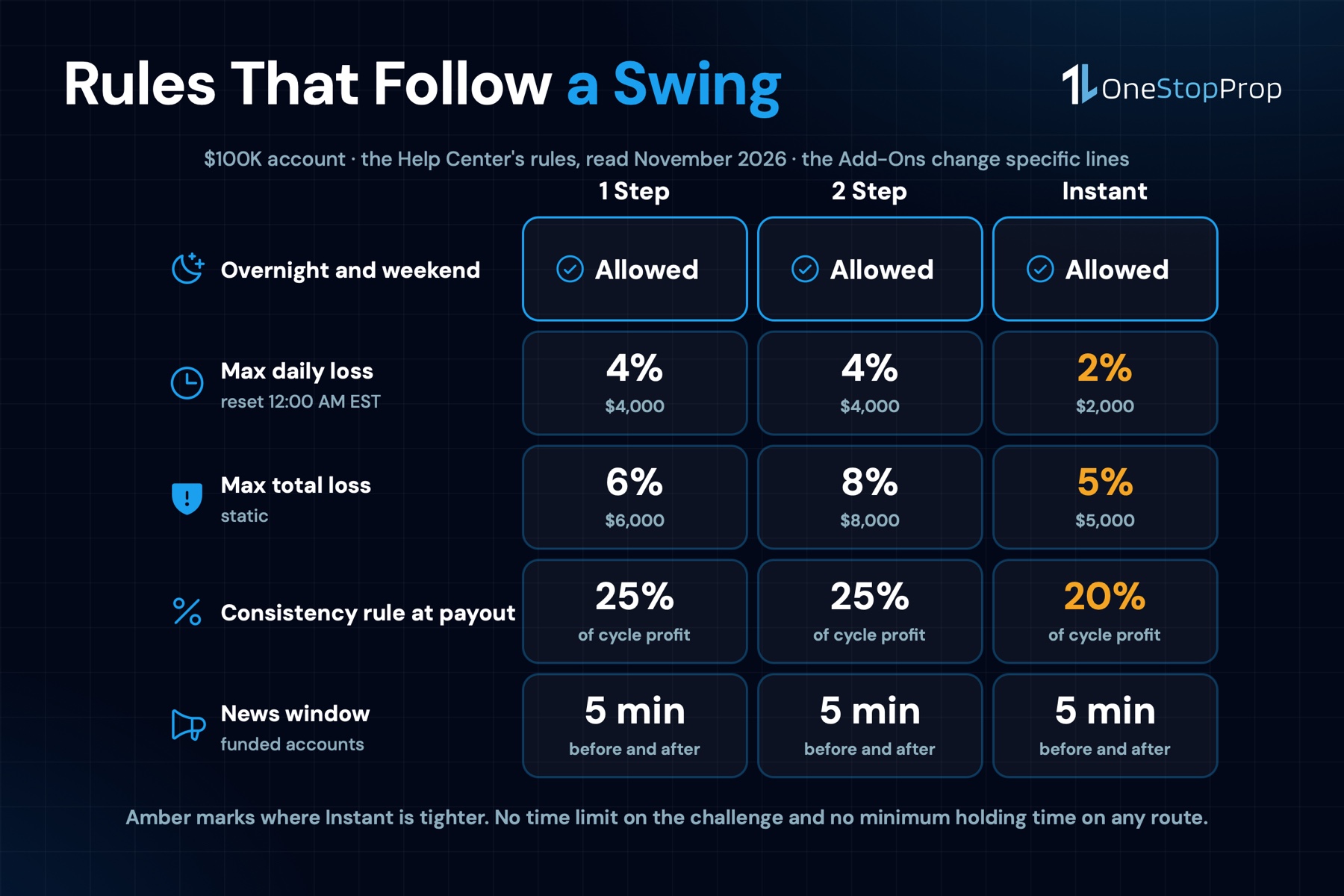
The 3 routes differ in what you are holding against. The table is the whole rulebook for a swing, on a $100K account.
| Rule, $100K account | 1 Step | 2 Step | Instant |
|---|---|---|---|
| Overnight and weekend holds | Allowed | Allowed | Allowed |
| Time limit on the challenge | None | None | No challenge |
| Max daily loss, reset 12:00 AM EST | 4% ($4,000) | 4% ($4,000) | 2% ($2,000) |
| Max total loss, static | 6% ($6,000) | 8% ($8,000) | 5% ($5,000) |
| Minimum trading days, challenge | 3 | 4 per phase | None |
| Minimum trading days, payout cycle | 6 | 6 | 8 |
| Consistency rule at payout | 25% | 25% | 20% |
| News window, funded accounts | 5 min before and after | 5 min before and after | 5 min before and after |
Everything in the table comes from the Help Center and applies to the account you buy at checkout, with the Add-Ons changing specific lines: the 12% Max Total Loss + 6% Max Daily Loss Add-On (35% on the account price) widens the loss lines, News Trading Allowed (30% on the account price) removes the window, Zero Profit Buffer (50%) removes the payout buffer and sets consistency at 15%, Faster Payouts (35%) removes the minimum trading days and the wait between payouts.
The Daily Loss Limit at Midnight, With a Position Open
The maximum daily loss is 4% of the initial balance on 1 Step and 2 Step, 2% on Instant, and it is not measured on the day’s realized losses. At the 12:00 AM EST day change, the account takes the higher of balance or equity and subtracts a fixed 4% of the initial balance (2% on Instant). That number is the equity floor for the new day, and intraday equity, floating positions included, cannot drop below it.
The Help Center gives 3 examples on a $100K account, and all 3 are about a swing trader, because only a trader with an open position has an equity different from the balance at midnight.
Floating profit of $2,000 at midnight. Equity is $102,000, balance is $100,000, the higher figure is $102,000. The floor for the next day is $102,000 minus $4,000, which is $98,000. The profit you have not taken is counted in your favor, and the full 4% sits below it.
Floating loss of $2,000 at midnight. Equity is $98,000, balance is $100,000, the higher figure is the balance. The floor is $100,000 minus $4,000, which is $96,000. The open loss is not counted against you at the reset, but you start the day only $2,000 above the floor, so a further 2% move against a $100,000 position reaches it.
No open trades at midnight. The floor is 4% below the closed balance.
The limit resets at 12:00 AM EST every day, weekends and holidays included. A stock CFD left open on Friday afternoon is measured at midnight Friday, Saturday and Sunday from a balance and equity that have not moved, so the floor does not move either. Monday’s open then lands on it in 1 print.
Pro Tip: at 11:55 PM EST, write down the higher of your balance and equity and subtract the daily amount for your route. That number, or the total loss line if it is closer, is the equity level that ends the account during the next 24 hours. A swing trader who knows it before the open can size the next trade so that even a large overnight move leaves the equity above that number.
The Max Total Loss Does Not Move
The max total loss is the second line, and it is static: 5% of the initial balance on Instant, 6% on 1 Step, 8% on 2 Step. The Help Center’s example is a $100,000 2 Step account, where 8% is $8,000, so equity, including unrealized positions, must not hit or fall below $92,000.
For a swing trader the static part matters more than the percentage. The daily floor is recalculated from your equity every night, so it follows you down. The total line stays where it was drawn on day 1. An account that has drifted to $97,000 of balance and equity on 1 Step has $3,000 of room to the $94,000 total line but $4,000 of room to its daily floor of $93,000. The total line is the binding one, and a 3% gap on a $100,000 position ends the account before the daily floor does.
That is also why “the daily limit resets, so a gap only costs 1 day” is wrong on a funded account. The gap costs the distance to the total line, and nothing resets that. The prop firm drawdown rules guide has the mechanics of both lines for a stock trader.
How Far Stocks Actually Gap Overnight, Measured
An overnight gap is the difference between 1 session’s close and the next session’s open. For an exchange-listed stock, Investor.gov’s definition of after-hours trading draws the line: regular trading hours run from 9:30 AM to 4:00 PM Eastern Time, and everything outside them is extended-hours trading, where sessions vary by venue. Earnings reports and much of the news that moves a stock arrive outside those hours, which is why a swing position reopens at a different price than it closed.
To size that, this guide took the daily open and close for AAPL, NVDA, MSFT and SPY (the S&P 500 ETF, included as the market’s reference; it is not on OneStopProp’s stock list, which carries QQQ as its index ETF) from Nasdaq’s historical data for the 60 sessions from August 31 to November 23, 2026, and computed each day’s gap as the open divided by the prior close, in percent. Weekends and holidays count as 1 gap, which is what a swing trader lives through.
| Last 60 sessions, to Nov 23, 2026 | AAPL | NVDA | MSFT | SPY |
|---|---|---|---|---|
| Average gap, either direction | 0.66% | 2.19% | 0.81% | 0.49% |
| Median gap | 0.42% | 1.30% | 0.55% | 0.31% |
| Sessions with a gap over 1% | 12 (20%) | 37 (62%) | 17 (28%) | 4 (7%) |
| Sessions with a gap over 2% | 3 (5%) | 19 (32%) | 5 (8%) | 1 (2%) |
| Largest gap down | 3.77%, Nov 3 | 13.08%, Nov 12 | 2.07%, Sep 28 | 1.04%, Oct 30 |
| Largest gap up | 2.91%, Nov 4 | 33.06%, Nov 23 | 4.44%, Nov 23 | 5.00%, Nov 23 |
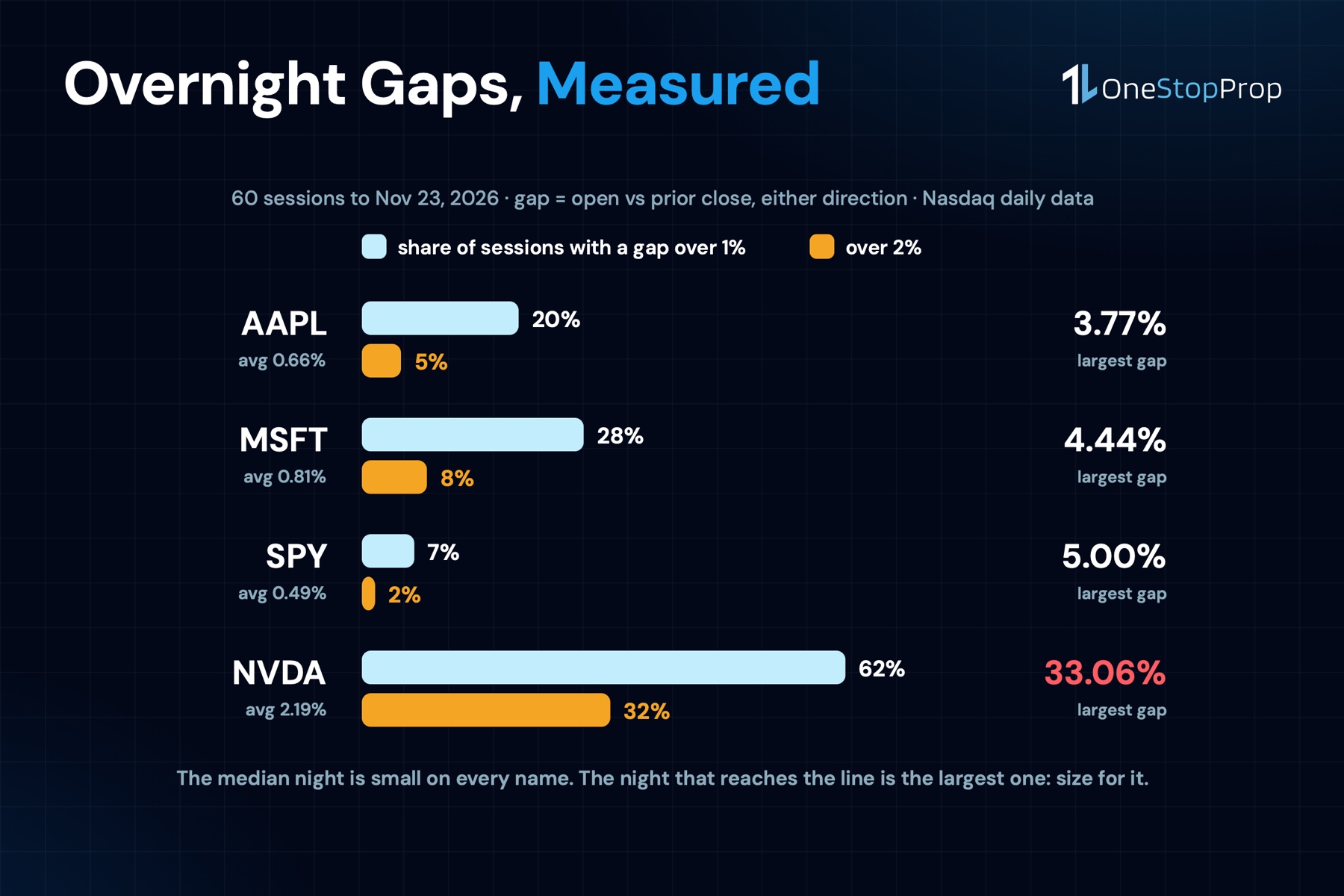
3 things in that table should change how a swing is sized.
The median lies about the tail. AAPL’s median gap was 0.42%, and its worst was 3.77%, 9 times the median, on Tuesday, November 3. MSFT’s median was 0.55% and it opened 4.44% higher on November 23. A plan built on the typical night is built on the wrong number; the line is crossed by the atypical one, and 60 sessions is a short sample: NVDA’s 33.06% was a record inside it, and the next record is not in the data yet.
NVDA is a different instrument overnight. Its gap exceeded 2% in 19 of 60 sessions, and 4 times it exceeded 5%: up 5.23% on November 6, down 7.27% on November 9, down 13.08% on November 12, the morning the CEO resignation hit, and up 33.06% on Monday, November 23. On a $100K 1 Step account, a $30,000 NVDA position, less than a third of the balance, lost $3,924 on the November 12 gap, 98% of the daily limit, before the session was 1 second old.
Weekends are not free. Monday opens were larger than weekday opens in 3 of the 4 names: MSFT averaged 1.06% on Mondays against 0.75% on other days, SPY 0.82% against 0.41%, NVDA 4.53% against 1.61%. Monday, November 23 did most of that work, with SPY opening 5.0% above Friday’s close, MSFT 4.4% and NVDA 33.1%. Take that 1 Monday out and SPY’s Monday average drops to the weekday level, which is the point: the weekend gap is small almost every week and enormous on the week it is not.
Holding over the Thanksgiving weekend
Thanksgiving week stacks a full closure and a half session back to back, which makes it the longest stretch without a full session that a stock position sees this month. The NYSE’s holidays and trading hours list Thanksgiving Day, Thursday, November 26, 2026, as a full closure and an early close at 1:00 PM on Friday, November 27, the day after. Nasdaq’s holiday schedule carries the same 2 lines. A stock CFD held past 1:00 PM on Friday is a position until 9:30 AM on Monday, November 30, with 3 midnight resets in between and no way to touch it.
The guide to whether the stock market is open on Black Friday measured the half session and the Wednesday-to-Monday move on OneStopProp’s stock list. The sizing rule below is the same for any long weekend.
Sizing a Swing Trading Prop Firm Position Against the Gap
The arithmetic is 1 division. The largest position a gap can hit without reaching the daily floor is the daily loss amount divided by the gap. Leverage is listed at 1:50 on every route, so if the stock’s own leverage in Match-Trader is 1:50 or close to it, the loss lines bind long before the margin does on a $100K account. On a $100K account:
| Adverse gap at the open | 1 Step (daily $4,000) | 2 Step (daily $4,000) | Instant (daily $2,000) |
|---|---|---|---|
| 1% | $400,000 | $400,000 | $200,000 |
| 2% | $200,000 | $200,000 | $100,000 |
| 4% | $100,000 | $100,000 | $50,000 |
| 13.08% (NVDA, Nov 12) | $30,581 | $30,581 | $15,291 |
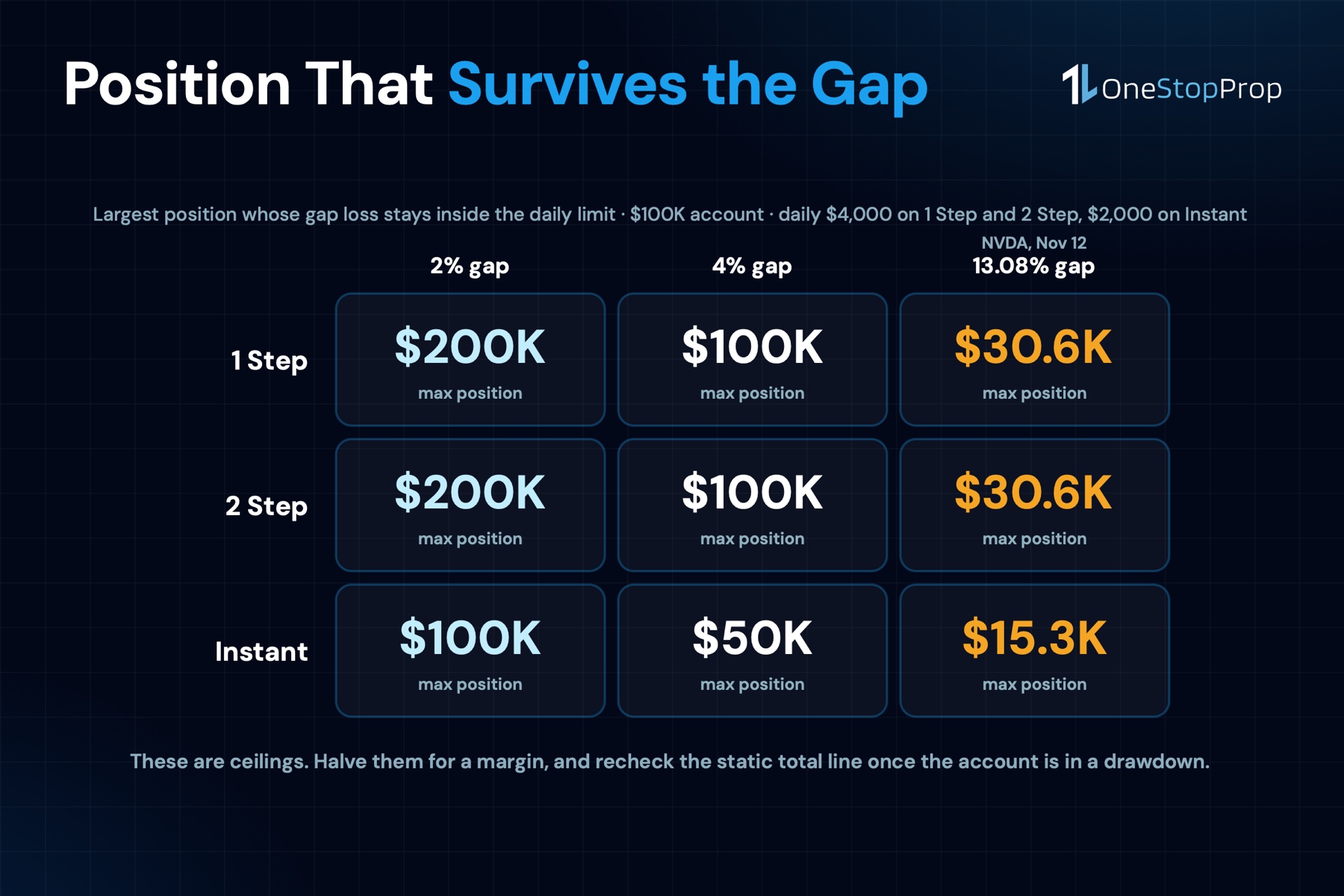
Those are ceilings, not targets: at the exact size in the table the gap loss equals the limit, which is a touch of the line. The floor is measured on intraday equity, and the first minutes after the open often travel past the opening print, so 3 adjustments bring them down to something a trader can hold.
Start from the floor you actually have. The table assumes a full 4% or 2% of room at midnight. A floating loss at the reset leaves less, because the floor is set from the balance while your equity sits below it. In the Help Center’s example, the trader with a $2,000 floating loss starts the day $2,000 above the floor, so on 1 Step and 2 Step every ceiling in the table is cut in half for that account.
On Instant a $1,000 floating loss does the same, leaving $1,000 of the $2,000, so the Instant ceilings are halved too. A $2,000 floating loss on Instant means equity sits exactly on the daily floor at the reset, and 1 tick against you breaks it: that position should not be carried into midnight at all.
Check the total line as well. On 1 Step, the gap also has to fit inside the distance to the 6% total line, and that distance shrinks with every losing trade. A 1 Step account at $97,000 has $3,000 to the total line: at a 4% gap that is a $75,000 position, not $100,000. On a fresh Instant or 2 Step account the daily line binds first; after a drawdown, recheck which one is closer.
Size for the sample’s worst gap, not its average, and for the direction you hold. AAPL’s worst gap in 60 sessions was 3.77%. On 1 Step, keeping that inside half the daily limit, $2,000, means a position of $53,000. For a long in NVDA the worst gap against it was the 13.08% drop, and the same half-limit rule gives $15,300, about 3.5 times smaller.
Sized this way, a 5% move in NVDA on $15,300 is $765, 0.77% of the account, so the rule costs performance; it covers the part of the position that is held overnight, and intraday size is a separate calculation.
A short in NVDA faces the other tail: shorting is allowed on every instrument, and the 33.06% gap up of November 23 caps a short at $12,099 against the full daily limit on 1 Step and 2 Step, $6,050 on Instant, and half of that with a margin. The risk of ruin guide shows why that number, the distance to the line divided by the risk per trade, decides more than the win rate.
A stop order does not change this arithmetic. Investor.gov’s entry on the stop order says it plainly: once the stop price is reached the order becomes a market order, and the execution price may differ from the stop price, especially in a fast-moving market. A stop 2% below Friday’s close does not fire at 2% on a Monday that opens 5% lower; it fires at the open. The stop loss vs stop limit guide covers which order type does what in that moment. Size is the only tool that works through a gap.
Pro Tip: before holding anything overnight, divide your daily loss amount by the largest gap that stock has had in the last 60 sessions, written as a decimal (3.77% is 0.0377), then halve the result. Nasdaq’s historical data pages give the daily open and close for free: copy 60 days into a spreadsheet, and for each day subtract 1 from the open divided by the previous close. If you are long, the gap that matters is the largest drop; if you are short, the largest rise. If the position you want is bigger than the number you get, close it before the session ends instead of holding it overnight.
Minimum Trading Days When You Only Hold
A swing trader can go 3 or 4 days without placing an order, and the account has day counts: 3 trading days to pass 1 Step, 4 per phase on 2 Step, and in the funded phase 6 trading days in each 14-day payout cycle on 1 Step and 2 Step, 8 on Instant, per the payout rules.
The Help Center defines the day: a trading day runs from 12:00 AM to 11:59 PM EST, and its example counts by trades placed. Trading Monday at 1:00 AM and again at 11:59 PM is 1 trading day; trading Monday morning and Tuesday morning is 2. The page does not say whether a day on which a position is only held, with nothing opened or closed, counts toward the minimum.
Until support confirms it in writing, plan as if it does not. For a swing trader that is not a burden: scaling into or out of the position across the days of the hold puts a real trade on each day you need counted. Filler trades placed only to tick a day are a different thing, and worth asking support about before relying on them. With the Faster Payouts Add-On, 35% on the account price, the minimum trading day requirements and the waiting periods between payouts go away, provided all other account criteria are met, which is the official definition.
The News Window and a Swing That Is Already Open
This is the rule most swing traders misread, so here is the Help Center’s wording on news trading for funded accounts: all trades must be closed 5 minutes before the news release, and traders must wait until 5 minutes after the release to open or resume trading. The restricted events are FOMC announcements and Fed Chair speeches, NFP, CPI, PPI, and all individual stock earnings reports, including pre-market, during market hours and post-market releases.
Read it twice. It does not say “no new trades during the window”. It says all trades must be closed before it. A swing opened 4 days earlier is a trade, and on a funded account without the Add-On it has to be flat 5 minutes before the release. The page does not carve out positions by age, and it does not limit the macro events to forex or indices, so the safe reading for a swing in any instrument is that each of those windows is a hard exit and a re-entry.
A narrower reading, for the macro events or for earnings, needs support’s confirmation in writing.
For a stock swing the consequence is a calendar of forced exits, and earnings is only 1 of them.
The page lists all individual stock earnings reports without saying whether a report in a stock you do not hold counts; this guide reads it as the stock you hold, and that reading is worth confirming with support before a hold through another company’s report. An earnings report that lands after the 4:00 PM close puts the window outside the regular session, so the practical deadline to be flat is the last regular-session close before the report; the NVIDIA earnings guide walked through that timeline for November 17.
NFP, CPI and PPI are released in the morning before the regular session, so for a stock CFD that trades only in the regular session the exit is the prior day’s close, the same as a post-market earnings report. FOMC decisions land in the afternoon during the session, which is a flat-before, re-enter-after on the same day. Without the Add-On, a multi-day stock swing is a series of exits, not a hold.
The News Trading Allowed Add-On changes the answer completely. Traders with it are exempt from these restrictions and may open, maintain or close positions during all restricted news events. For a trader whose plan is to hold a stock through its report, or to hold a position across an FOMC afternoon, the Add-On is not a convenience; it is the difference between a swing and a rule violation. It adds 30% to the account price at checkout. The Help Center page scopes the window to funded accounts.
The Consistency Rule and the Swing That Closes in 1 Day
The prop firm consistency rule applies to each payout cycle: no single trading day can account for 25% or more of the cycle’s total profit on 1 Step and 2 Step, 20% on Instant, and 15% on any account with the Zero Profit Buffer Add-On. It does not close the account. It delays the payout until total profit grows and that day’s share drops below the threshold.
The Help Center’s example makes the division explicit: a $1,250 day needs total profit of at least $5,001, because $1,250 is 25% of $5,000 and the day has to be below 25%. For a swing trader the catch is that profit is counted by trading day, and a swing’s realized profit lands on the day it is closed, however long it was held.
So take a $100K 1 Step funded account, a 6-day hold in MSFT that is closed in 1 order for a $2,000 profit, and 7 other days in the cycle that made $300 each, $2,100 in total. Cycle profit is $4,100, which clears the 4% buffer of $4,000, and the swing day is 48.8% of it. No payout until the consistency rule is met.
To get the $2,000 day below 25%, total profit has to exceed $8,000, so the account needs more than another $3,900 of profit before the request goes through. On Instant, with 20%, the same day needs the total above $10,000. With Zero Profit Buffer and 15%, above $13,333.
The fix is in the exit, not the entry. Closing the same swing in 3 pieces on 3 days that have no other profit, $700, $700 and $600, puts the largest day at $700, which is 17% of the same $4,100 and clears the rule. The trade did not change; the booking did. The price is exposure: the part still open spends more nights in the market, and the size of each piece’s profit is not something you control to the dollar, so the plan is to split the exit across days, not to hit exact numbers.
1 more line from the same payout rules page: for the first 5 payouts the maximum per request is set by account size, and its table puts a $100K account at $3,000, so a cycle that clears the consistency rule with more than $3,000 of profit is paid in more than 1 request, and without the Faster Payouts Add-On each further request waits another 14 days.
What This Means on a Funded Account
On 1 Step. The 4% daily and 6% total lines are $4,000 and $6,000 on $100K, and the total line is the one a gap reaches first once balance and equity are below $98,000, a drawdown of more than 2%. 3 trading days to pass, then 6 per 14-day cycle and the 25% rule, which reward closing in pieces. Without the News Trading Allowed Add-On, every earnings report in a held stock is a forced exit.
On 2 Step. Same daily line, widest total line at 8%, so the daily binds first and the total takes longer to become the constraint. 4 trading days per phase, then the same 6-day cycles and 25% rule as 1 Step. The extra room in the total line is the argument for running swings here if gap exposure is the worry.
On Instant. Half the daily room, $2,000 on $100K, and a 5% total line. Every ceiling in the sizing table is half the 1 Step number; the NVDA-sized gap allows a $15,291 position. 8 trading days per cycle, a 6% buffer before profits can be withdrawn, and a 20% consistency threshold, a stricter test for a single closing day than 25%. Instant is the route where a swing trader most needs to close in pieces.
On every route, payouts run every 14 days with a buffer of 4% of the account size on 1 Step and 2 Step and 6% on Instant before profits can be withdrawn. The funded account trading guide walks the whole path from challenge to first payout.
Common Mistakes
Sizing a swing like a day trade
A day trade can be closed when it moves 1% against you. A swing cannot be closed at 11:00 PM when the news hits. The size that fits a 1% intraday stop is 4 times the size that fits a 4% gap, and the account does not know which one you meant.
Treating the midnight reset as a fresh 4%
The reset recomputes the daily floor from the higher of balance or equity. A position with a floating loss at midnight starts the next day closer to the floor than 4%, and the total line never resets at all.
Holding through earnings without the Add-On
On a funded account, all trades must be closed 5 minutes before any individual stock earnings report. A swing that is open when a report lands is a rule breach, not a bold call. The News Trading Allowed Add-On is what makes that hold legal.
Booking the whole swing in 1 day before a payout
A $2,000 day on a $4,100 cycle is 49% of profit against a 25% threshold. Close in pieces across days, or accept that the payout waits until total profit passes $8,000.
Trusting a stop to cap a gap
A stop becomes a market order when the stop price is reached, and the fill in a fast market can differ from the stop price. A trailing stop loss follows the price up during the session; none of these orders trade while the market is closed.
Frequently Asked Questions
Can you swing trade at a prop firm?
At OneStopProp, yes. Positions can be held overnight and over the weekend on 1 Step, 2 Step and Instant, with no time limit to pass the challenge and no minimum holding time. What still applies to a swing trading prop firm account: the daily loss limit recalculated at 12:00 AM EST, the static max total loss, the news window on funded accounts and the consistency rule at payout.
How is the daily loss limit calculated if my position is open at midnight?
At 12:00 AM EST the account takes the higher of balance or equity and subtracts 4% of the initial balance on 1 Step and 2 Step, 2% on Instant. That is the equity floor for the next day. A $2,000 floating profit on a $100K account gives a $98,000 floor; a $2,000 floating loss gives a $96,000 floor, because the balance is the higher figure.
Does a day when I only hold a position count as a trading day?
The Help Center defines a trading day as 12:00 AM to 11:59 PM EST and counts it by the trades placed in it; it does not state whether a hold-only day counts. Until support confirms otherwise, place at least 1 trade on each day you need counted, or use the Faster Payouts Add-On, which removes the minimum trading day requirements.
Can I hold a stock through its earnings report on a funded account?
Only with the News Trading Allowed Add-On. Without it, all trades must be closed 5 minutes before the stock’s earnings report, pre-market, in-session or post-market, and may not be reopened until 5 minutes after. The same applies to FOMC announcements, Fed Chair speeches, NFP, CPI and PPI. The Help Center page does not spell out whether a report in a stock you do not hold counts; the working reading is the stock you hold, and support can confirm it in writing.
How big an overnight gap should a swing trading prop firm trader plan for?
Over the 60 sessions ending November 23, 2026, AAPL’s largest gap was 3.77%, MSFT’s 4.44%, SPY’s 5.00% and NVDA’s 33.06%, with NVDA gapping more than 2% in 1 session out of 3. Divide your daily loss amount by the largest gap in the stock’s recent history, then halve it, and that is the largest position to hold overnight.
Does the consistency rule hurt swing traders?
It hurts swings that close in 1 order. A $2,000 profit booked on 1 day needs more than $8,000 of total cycle profit on 1 Step and 2 Step, more than $10,000 on Instant, before a payout is allowed. Scaling out over several days spreads the same profit across several trading days and keeps the largest day under the threshold.
The Bottom Line
Swing trading prop firm rules at OneStopProp begin with a yes: you can hold overnight, hold through the weekend, and take as long as the challenge needs. 4 rules keep applying while the market is closed. The daily floor is reset at 12:00 AM EST from the higher of balance or equity. The total loss line never resets. The news window requires flat trades on a funded account unless the account has the News Trading Allowed Add-On. And the consistency rule counts all of a swing’s profit on the 1 day you close it, however many days you held it.
The data says the gap to size for is the largest one in the sample, not the median: 3.77% on AAPL, 4.44% on MSFT, 5.0% on SPY and 13% to 33% on NVDA inside the same 60 sessions. Divide the daily loss amount by that gap written as a decimal, halve it, and that is the largest position a swing can carry.
If you swing trade and want to do it on a funded account that allows overnight and weekend holds, pick your OneStopProp account: 1 Step and 2 Step from $10K to $300K, Instant from $25K to $200K, no time limit to pass the challenge, and U.S. stocks, forex and crypto in the same account. The rules in this guide are the ones your account will run on.
Sources
- Can I hold trades overnight and over weekends?, OneStopProp Help Center. Yes, trades can be held overnight and over weekends. https://help.onestopprop.com/faq/can-i-hold-trades-overnight-and-over-weekends/
- When does my challenge start and is there a time limit?, OneStopProp Help Center. The challenge starts with the first trade and has no time limit, provided the account stays active and follows the rules. https://help.onestopprop.com/faq/when-does-my-challenge-start-and-is-there-a-time-limit/
- Is there a minimum holding time?, OneStopProp Help Center. No minimum holding time for trades. https://help.onestopprop.com/faq/is-there-a-minimum-holding-time/
- What is the Maximum Daily Loss?, OneStopProp Help Center. 4% of the initial balance (2% on Instant), computed at the 12:00 AM EST day change from the higher of balance or equity, with the 3 examples on a $100K account. https://help.onestopprop.com/faq/what-is-the-maximum-daily-loss/
- When is the daily max limit reset time?, OneStopProp Help Center. The daily limit resets at 12:00 AM EST each day. https://help.onestopprop.com/faq/when-is-the-daily-max-limit-reset-time/
- How does max total loss work?, OneStopProp Help Center. 5% on Instant, 6% on 1 Step, 8% on 2 Step, static from the initial balance, with the $100,000 2 Step example at $92,000. https://help.onestopprop.com/faq/how-does-max-total-loss-work-on-standard-accounts/
- Is news trading allowed?, OneStopProp Help Center. On funded accounts all trades must be closed 5 minutes before FOMC, Fed Chair speeches, NFP, CPI, PPI and individual stock earnings and may not be opened or resumed until 5 minutes after; the News Trading Allowed Add-On exempts the account. https://help.onestopprop.com/faq/is-news-trading-allowed/
- Payout Information and Guidelines, OneStopProp Help Center. 14-day cycles, 6 trading days on 1 Step and 2 Step and 8 on Instant, the trading day defined as 12:00 AM to 11:59 PM EST, the 4% and 6% buffers, and the 25% and 20% consistency rule with the $1,250 example. https://help.onestopprop.com/faq/payout-rules/
- What trading strategies are not allowed?, OneStopProp Help Center. Hedging and martingale are not allowed; a stop loss is not required. https://help.onestopprop.com/faq/what-trading-strategies-are-not-allowed/
- NVDA Historical Data, Nasdaq. Nasdaq’s daily open and close, read through its data feed for AAPL, NVDA, MSFT and SPY, used to compute the 60 overnight gaps per ticker from August 31 to November 23, 2026; the NVDA page is linked as the entry point. https://www.nasdaq.com/market-activity/stocks/nvda/historical
- Holidays and Trading Hours, NYSE. Core session 9:30 AM to 4:00 PM ET; Thanksgiving Day, Thursday, November 26, 2026, closed; early close at 1:00 PM on Friday, November 27, 2026. https://www.nyse.com/markets/hours-calendars
- Stock Market Holiday Schedule, Nasdaq. Closed November 26, 2026, 1:00 PM early close November 27, 2026. https://www.nasdaq.com/market-activity/stock-market-holiday-schedule
- After-hours Trading, Investor.gov (U.S. Securities and Exchange Commission). Regular trading hours are 9:30 AM to 4:00 PM Eastern Time; trading outside them is extended-hours trading and sessions vary by venue. https://www.investor.gov/introduction-investing/investing-basics/glossary/after-hours-trading
- Stop Order, Investor.gov (U.S. Securities and Exchange Commission). A stop order becomes a market order at the stop price, and the execution price may differ from the stop price in a fast-moving market. https://www.investor.gov/introduction-investing/investing-basics/glossary/stop-order