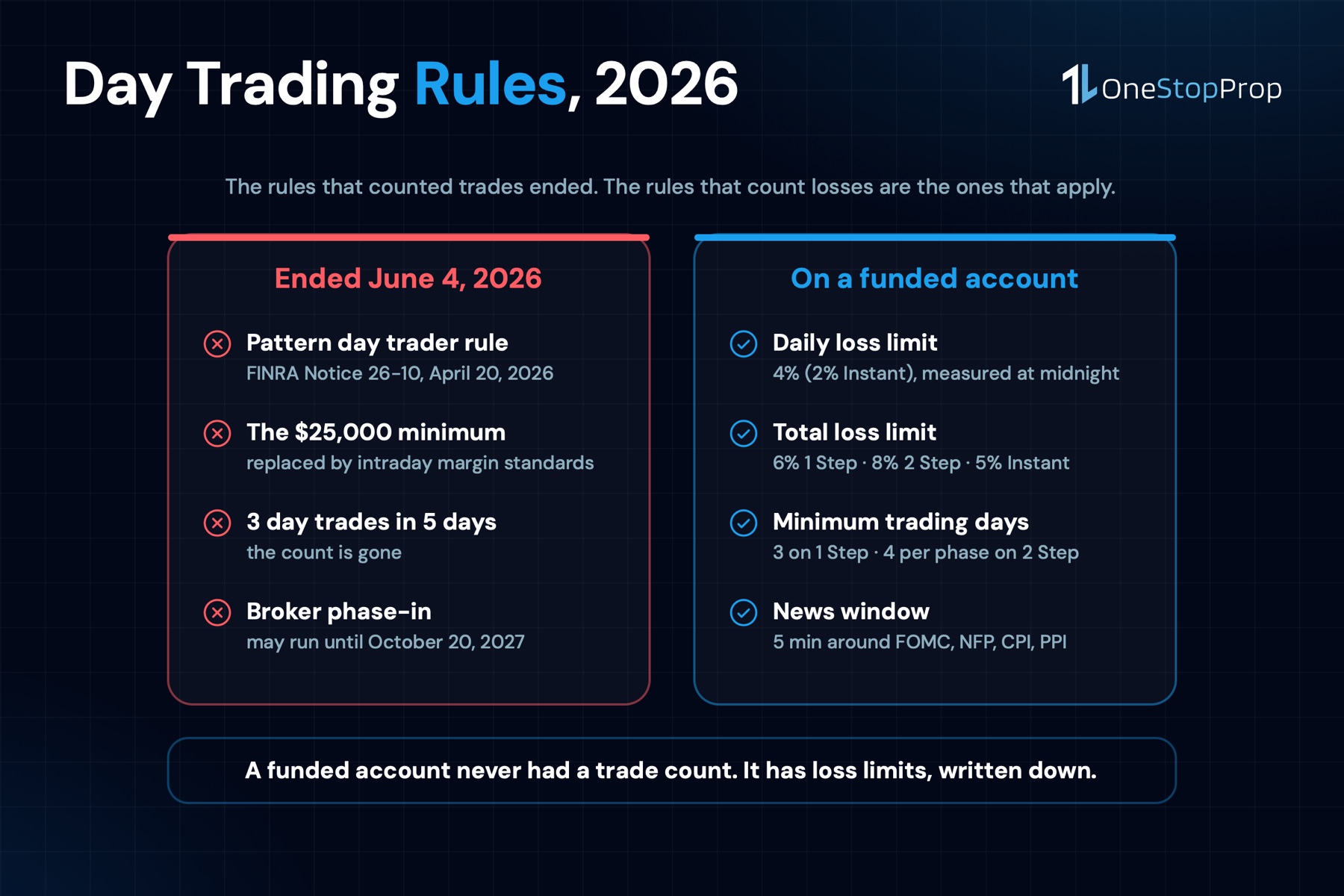
Day trading rules changed more in 2026 than in the 25 years before it. The pattern day trader rule, the $25,000 floor and the 3-trades-in-5-days count are gone, replaced on June 4, 2026 by FINRA’s intraday margin standards. Most of what gets written about day trading rules is about that old rule, and most of it is out of date.
On a funded account the old rule never applied anyway. What applies is a different set: a daily loss limit measured at midnight, a total loss limit, a minimum number of trading days, a consistency rule at payout, a 5-minute window around scheduled news, and a short list of prohibited practices. Every one of those is public, and this guide lists them with their numbers.
Then it adds the number the rules are built around: how often a stock on OneStopProp’s list actually moves the size of the daily limit in a single session. On 36,036 sessions, the answer is 1 day in 4.
Key Takeaways
- The PDT rule is gone. FINRA Regulatory Notice 26-10, published April 20, 2026 and effective June 4, 2026, replaced the day trade count, the pattern day trader designation and the $25,000 minimum with intraday margin standards. Brokers may phase in the change until October 20, 2027.
- A funded account has its own day trading rules, and they are about loss, not count. OneStopProp’s daily loss limit is 4% of the initial balance on 1 Step and 2 Step accounts and 2% on Instant, measured at 12:00 AM EST from the higher of balance or equity.
- The market moves the size of that limit often. 24% of sessions on the 143 stocks measured had a high-to-low range of 4% or more. 8% had a range of 6% or more. On OKLO, 90% of sessions did.
- The rules that are not there matter too. No time limit on the challenge, no minimum holding time, overnight and weekend holds allowed, shorting allowed on every instrument, no stop loss required.
- The news window is the day trading rule most often broken by accident. On funded accounts, trades closed 5 minutes before and none opened until 5 minutes after FOMC, NFP, CPI, PPI and earnings, unless the account has the News Trading Allowed Add-On.
The Day Trading Rule That Ended in 2026
For 25 years the day trading rules most traders knew were FINRA’s: 4 or more day trades in 5 business days in a margin account made you a pattern day trader, and a pattern day trader needed $25,000 of equity or the account was restricted. FINRA Regulatory Notice 26-10 ended that. Published April 20, 2026, effective June 4, 2026, it replaced the day trading margin requirements in their entirety, including the day trade count and the $25,000 minimum, with intraday margin standards that tie the equity a customer must hold to the exposure they carry during the day.
2 things in the notice matter for a trader reading this in November 2026. The phase-in period runs to October 20, 2027, so a broker may still be running the old count on a given account until it converts it. And FINRA’s own explainer, Frequent Intraday Trading, published on the effective date, makes the point the new standard is built on: frequent intraday trading on margin can lose some or all of an investment, and the margin now has to match the exposure in real time.
The PDT rule explained guide covers the history, the broker rollouts and the $2,000 margin minimum that stayed. The short version for this guide: the rule that counted your trades is gone, and the rules that count your losses are what is left.
The Day Trading Rules on a Funded Account
A funded account never had a trade count. It has loss limits, and they are written down. Here is every rule that applies on a OneStopProp account, from the Help Center, with the number attached.
| Rule | 1 Step | 2 Step | Instant | Source |
|---|---|---|---|---|
| Max daily loss | 4% of initial balance | 4% | 2% | Maximum daily loss |
| Daily loss measured | 12:00 AM EST, higher of balance or equity | same | same | Reset time |
| Max total loss (static, from the initial balance) | 6% | 8% | 5% | Max total loss |
| Profit target | 8% | 8% then 5% | none | Profit target |
| Minimum trading days, challenge | 3 | 4 per phase | none | Checkout page |
| Time limit on the challenge | none | none | none | Time limit |
| Leverage | 1:50 by default, 1:100 at checkout for a fee | same | same | Leverage |
| Minimum holding time | none | none | none | Holding time |
| Overnight and weekend holds | allowed | allowed | allowed | Overnight |
| Shorting | allowed on all instruments | same | same | Shorting |
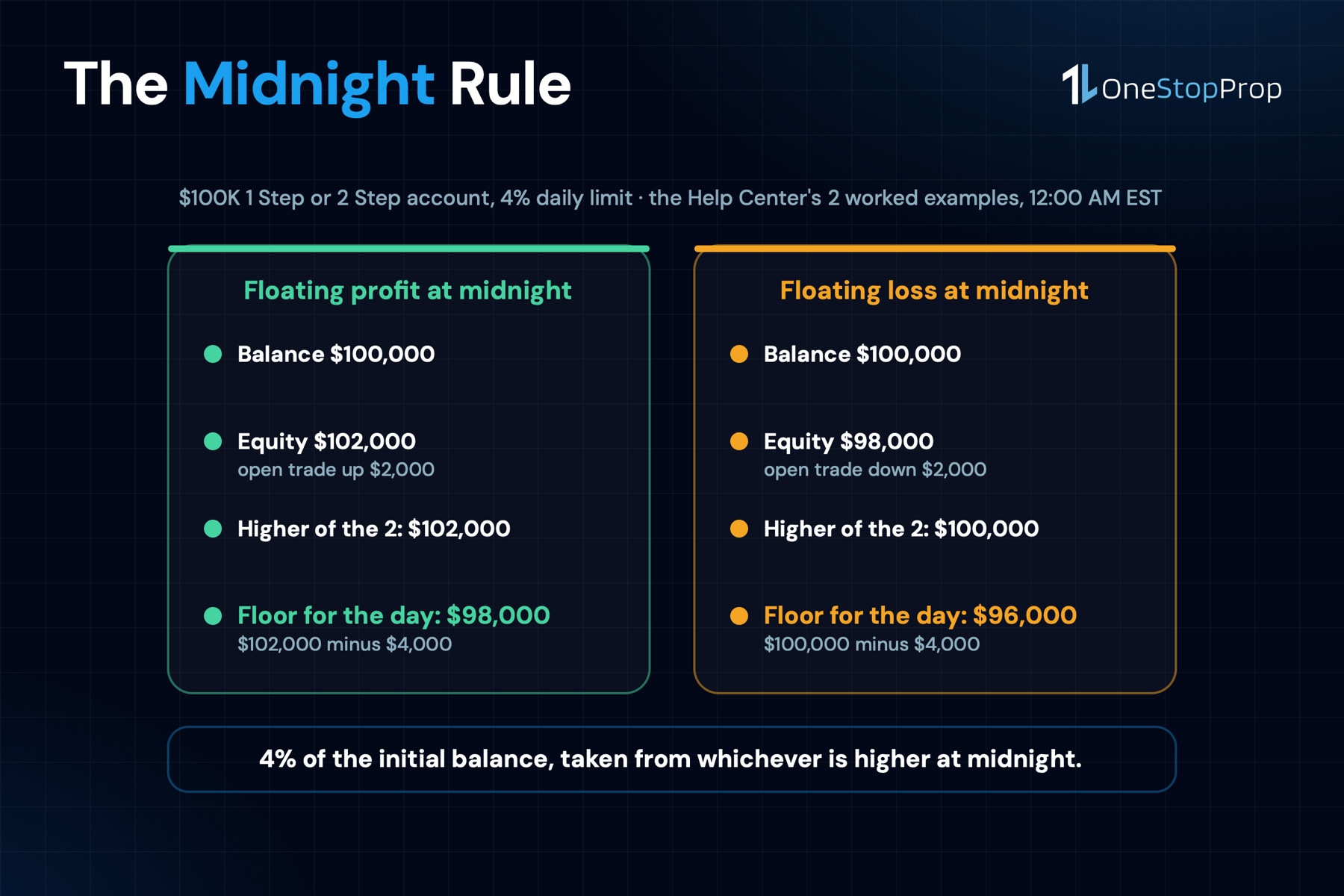
The daily limit deserves its own paragraph, because the way it is measured is the rule. The Help Center’s example: on a $100K account, if at 12:00 AM EST you have an open trade with a floating profit of $2,000, your equity is $102,000, and with a 4% limit your equity cannot drop below $98,000 the next day. If instead you have a floating loss of $2,000, the limit is taken from the $100,000 balance, which is higher, so the floor is $96,000. The limit is 4% of the initial balance, subtracted from whichever of balance or equity is higher at midnight.
The max total loss works the other way: it is fixed on day 1 at 6%, 8% or 5% of the initial balance, measured on equity including open positions, and it never moves, whatever profit the account holds. Only the daily limit trails.
The Rules at Payout
The Help Center puts the consistency rule in the payout cycle, not in the challenge, and the challenge has no time limit. The payout cycle on a funded account does have rules, and they are the ones a day trader hits first, because a day trader produces a lot of small days and the occasional very large one.
- Payouts every 14 days, with 6 trading days in the cycle on 1 Step and 2 Step and 8 on Instant, per the Help Center’s payout rules. The same page adds, under its flipping guideline, that each of those days must show a profit of at least 0.5%.
- A profit buffer before a payout can be requested: 4% of the account size on 1 Step and 2 Step, 6% on Instant.
- A consistency rule: no single day may represent 25% or more of the period’s profit on 1 Step and 2 Step, 20% on Instant, and 15% on any account with the Zero Profit Buffer Add-On. The rule does not fail the account; it holds the payout until the total grows and that day falls under the threshold. The prop firm consistency rule guide works through it in dollars.
- Faster Payouts Add-On: in the Help Center’s words, if you have the Faster Payouts Add-On, there are no minimum trading day requirements or waiting periods between payouts, provided all other account criteria are met.
For a day trader the consistency rule is the arithmetic to keep in view. A $3,000 day inside a $10,000 cycle is 30% and holds the payout; the same day inside a $14,000 cycle is 21% and clears. The fix is never to trade smaller on the good day. It is to keep trading the ordinary ones.
The Rules About How You Trade
The Help Center’s list of strategies that are not allowed is short and specific. Hedging is not allowed. Martingale is not allowed. A stop loss is not required. And a list of practices deemed malicious: grid trading, latency arbitrage, reverse arbitrage, account management, high frequency trading, tick scalping, hedging between accounts, guaranteed limit orders, data feed manipulation, trading on delayed charts, macroeconomic trading during high-impact reports with fills at unrealistic prices, using non-public information, and anything that creates regulatory issues with the broker.
3 more that a day trader meets in the first week:
The news window. On funded accounts, all trades must be closed 5 minutes before and may not be opened until 5 minutes after FOMC announcements and Fed Chair speeches, NFP, CPI, PPI and individual stock earnings reports, per Is news trading allowed?. The News Trading Allowed Add-On exempts the account. This week that means the CPI on Tuesday, November 10 and the PPI on Friday, November 13, both at 8:30 AM ET.
EAs and copiers. EAs are allowed during the challenge phases and not in the funded phase; copy trading and trade copier tools are allowed on all accounts in both phases, per Are EAs and trade copiers allowed?. VPNs and VPS are permitted but cannot be used to bypass the rules on copy trading, group trading or signal services.
Halts and abnormal conditions. The Help Center recommends closing positions during halts, flash crashes, volatility spikes and broken feeds, and says trades placed during those periods, especially in the funded phase, may be reviewed. The trading halts guide shows what a stop does inside one: nothing until the reopen.
Pro Tip: print the table above and the news calendar for the month, and keep them next to the screen. Every rule on a funded account is a number with a time attached. The traders who breach are rarely the ones who did not know the rule; they are the ones who did not have it in front of them at 8:29 AM.
How Often the Market Moves the Size of the Daily Limit
The daily loss limit is 4% of the initial balance. The question a day trader should ask is how often a stock moves 4% in a session, because that is how often a single full-size position can use the whole limit on its own.
The scan measured the daily high-to-low range, as a share of the close, on 36,036 sessions of the 143 stocks on OneStopProp’s instrument list with 2 full years of Nasdaq data, November 3, 2025 to November 3, 2026.
| Session’s high-to-low range | Share of sessions |
|---|---|
| 2% or more | 71% |
| 4% or more | 24% |
| 6% or more | 8% |
| 8% or more | 3% |
Close-to-close moves are smaller, because the range includes the reversals: 32% of sessions closed 2% or more from the previous close, 10% closed 4% or more, 4% closed 6% or more.
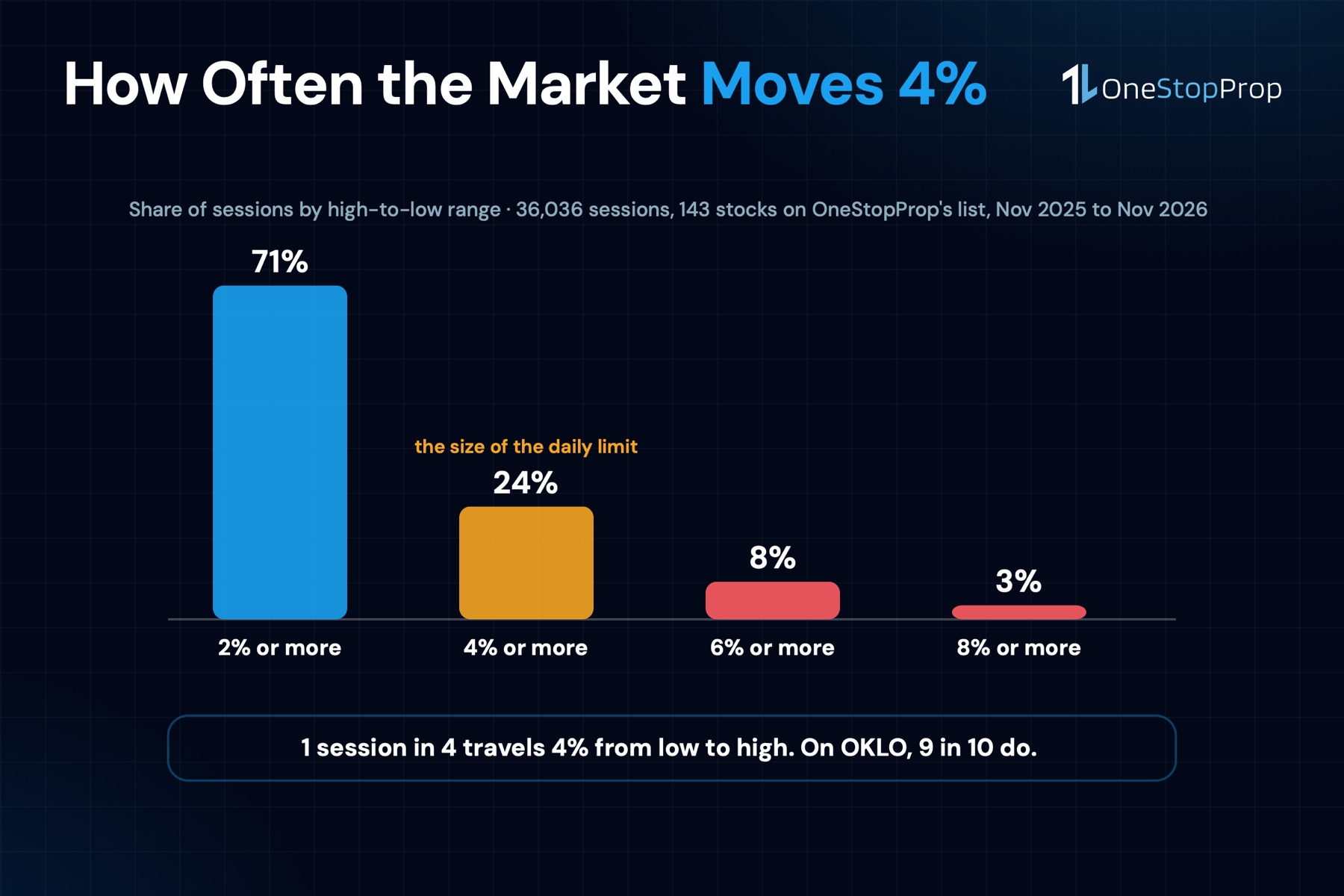
The spread between stocks is the real finding. OKLO had a range of 4% or more on 90% of its sessions, HIMS on 86%, MRNA on 85%, MSTR on 81%, SMCI and WIX on 77%. JNJ, L, PG and CVX did it on 1% of sessions. The most volatile stocks guide ranks the whole list; the point here is that “4% daily limit” means something different on every line of it.
On a $100K 2 Step account, a $20,000 position in a stock that travels 4% between its high and low is a position whose daily range equals $800, a fifth of the limit, with no decision made. 5 positions like it cover the limit in range alone. The prop firm drawdown rules guide sizes positions against both limits; the short rule is that risk per trade, not position count, is the number that has to fit.
A Day Inside the Day Trading Rules
Here is what the rules look like as a plan, on a $100K 2 Step account with a $4,000 daily limit and an $8,000 total limit.
- Personal daily stop: $2,000. Half the limit, so that 1 bad day leaves the next day’s floor intact. The limit is measured from midnight equity, so a day that ends $2,000 down starts the next morning with a $4,000 limit from a lower base.
- Risk per trade: $500, which is 0.5% of the initial balance and a quarter of the personal stop. 4 losers in a row ends the day, with the account’s limit untouched.
- Size from the stop distance. $500 divided by the distance to the stop. On a stock with a 4% range, a 1.5% stop is reasonable and buys about $33,000 of stock; on a stock with a 1% range, the same stop is too wide and the position is too small to matter.
- Flat 8:25 to 8:35 AM ET on release days. CPI and PPI this week, NFP the first Friday of the month, every FOMC day, every earnings day for a stock you hold.
- Nothing held into a halt. The Help Center’s recommendation, and the only way a stop keeps meaning anything.
- Log the day. The consistency rule is measured over the payout cycle; a day that is 30% of the cycle’s profit is a day you need to know about before you request the payout. The trading journal template has the columns.
Common Mistakes With Day Trading Rules on a Funded Account
Counting trades instead of dollars
The PDT rule trained a generation to count trades. A funded account counts losses. 10 trades at $200 of risk and 2 trades at $1,000 of risk are the same day to the rule, and very different days to the trader.
Treating 4% as the day’s budget
The limit is the account’s line, not yours. A trader who plans to use 4% uses it on the first bad morning and spends the afternoon unable to trade. Half is the budget.
Forgetting the midnight snapshot
Open profit at midnight raises the floor. A $2,000 gain held overnight and given back in the morning is $2,000 of the next day’s limit, spent before the first new trade. The trailing stop loss guide covers the exit that keeps it.
Walking into 8:30 AM with a position
The news window is the most-broken rule on a funded account because it is the one that needs a clock, not a chart. The releases are scheduled months ahead by the BLS and the Fed.
Reading the rules from a review site
Review sites copy numbers from each other and from old pages. The current rules are the table above, and the Help Center is where they change first. Read the source, not the summary of it.
Frequently Asked Questions
What are the day trading rules in 2026?
The pattern day trader rule, the $25,000 minimum and the day trade count were eliminated by FINRA Regulatory Notice 26-10, effective June 4, 2026, and replaced with intraday margin standards. Brokers may phase in the change until October 20, 2027. On a funded account the rules are loss limits, minimum trading days, a consistency rule at payout and a news window, not a trade count.
Does the PDT rule apply to a funded account?
It never did, because a funded account is not a margin account at a broker; it is a simulated account with the firm’s own rules. Since June 4, 2026 it does not apply at brokers either, subject to each broker’s phase-in.
What is the daily loss limit on a funded account?
At OneStopProp, 4% of the initial balance on 1 Step and 2 Step accounts and 2% on Instant, measured at 12:00 AM EST from the higher of balance or equity. On a $100K 2 Step account that is $4,000, subtracted from whichever of balance or equity is higher at midnight.
Is there a minimum number of trades per day?
No. The challenge has a minimum number of trading days, 3 on 1 Step and 4 per phase on 2 Step, and the payout cycle has 6 trading days on 1 Step and 2 Step and 8 on Instant. There is no minimum holding time and no time limit on the challenge.
Is news trading allowed on a funded account?
Not inside the window. On funded accounts, trades must be closed 5 minutes before and none opened until 5 minutes after FOMC, Fed Chair speeches, NFP, CPI, PPI and earnings. The News Trading Allowed Add-On exempts the account.
How often does a stock move 4% in a day?
On 36,036 sessions across OneStopProp’s 143 stocks with 2 years of data, 24% had a high-to-low range of 4% or more and 10% closed 4% or more from the previous close. OKLO did it on 90% of sessions; JNJ and PG on 1%.
The Bottom Line
The day trading rules that counted trades ended on June 4, 2026. The ones that count losses are the ones a funded trader lives with: a daily limit measured at midnight, a total limit, minimum trading days, a consistency rule at payout, a 5-minute news window and a short list of prohibited practices. Every one is a number, and the numbers are in the table above.
The market supplies the other number. 1 session in 4 on this stock list moves the size of the daily limit from high to low, and on the noisiest names nearly every session does. A plan that fits inside the rules is a plan where the risk per trade, not the trade count, is what gets written down first.
If you want to trade under rules that are written down and measured the same way every day, start a funded account at OneStopProp: 1 Step, 2 Step or Instant, from $10K to $300K, U.S. stock CFDs, forex, indices, commodities, metals and crypto in the same account, no time limit on the challenge, overnight holds allowed and shorting on every instrument.
Sources
- Regulatory Notice 26-10: FINRA Adopts New Intraday Margin Standards to Replace the Day Trading Margin Requirements, FINRA. Published April 20, 2026, effective June 4, 2026, phase-in through October 20, 2027. https://www.finra.org/rules-guidance/notices/26-10
- Frequent Intraday Trading: Understanding the Basics, FINRA, June 4, 2026. The risks of frequent intraday trading on margin under the new standards. https://www.finra.org/investors/insights/frequent-intraday-trading
- Schedule of Releases for the Consumer Price Index and for the Producer Price Index, U.S. Bureau of Labor Statistics. The October 2026 CPI on November 10 and PPI on November 13, 2026, both at 8:30 AM ET. https://www.bls.gov/schedule/news_release/cpi.htm
- Historical Quotes, Nasdaq. Daily high, low and close for the 155 stocks on OneStopProp’s instrument list, used for the 36,036-session range measurement. https://www.nasdaq.com/market-activity/quotes/historical
- What is the Maximum Daily Loss? and When is the daily max limit reset time?, OneStopProp Help Center. 4% on 1 Step and 2 Step, 2% on Instant, measured at 12:00 AM EST from the higher of balance or equity, with worked examples. https://help.onestopprop.com/faq/what-is-the-maximum-daily-loss/
- How does max total loss work?, OneStopProp Help Center. 6% on 1 Step, 8% on 2 Step, 5% on Instant. https://help.onestopprop.com/faq/how-does-max-total-loss-work-on-standard-accounts/
- Payout rules, OneStopProp Help Center. The 14-day cycle, minimum trading days, profit buffer, consistency thresholds and the Faster Payouts and Zero Profit Buffer Add-Ons. https://help.onestopprop.com/faq/payout-rules/
- What trading strategies are not allowed?, OneStopProp Help Center. Hedging, martingale and the list of prohibited practices; stop loss not required. https://help.onestopprop.com/faq/what-trading-strategies-are-not-allowed/
- Is news trading allowed?, OneStopProp Help Center. The 5-minute window and the News Trading Allowed Add-On. https://help.onestopprop.com/faq/is-news-trading-allowed/
- Are EAs and trade copiers allowed?, OneStopProp Help Center. EAs in the challenge phases only; copy trading allowed in both phases; VPN and VPS rules. https://help.onestopprop.com/faq/are-eas-and-trade-copiers-allowed/
- When does my challenge start and is there a time limit?, Is there a minimum holding time?, Can I hold trades overnight and over weekends?, Is shorting allowed? and What leverage is available?, OneStopProp Help Center. No time limit, no minimum holding time, overnight holds allowed, shorting allowed on all instruments, 1:50 leverage. https://help.onestopprop.com/faq/when-does-my-challenge-start-and-is-there-a-time-limit/
- What happens during halts or abnormal trading conditions?, OneStopProp Help Center. The recommendation to close positions during halts and abnormal conditions. https://help.onestopprop.com/faq/what-happens-during-halts-or-abnormal-trading-conditions/