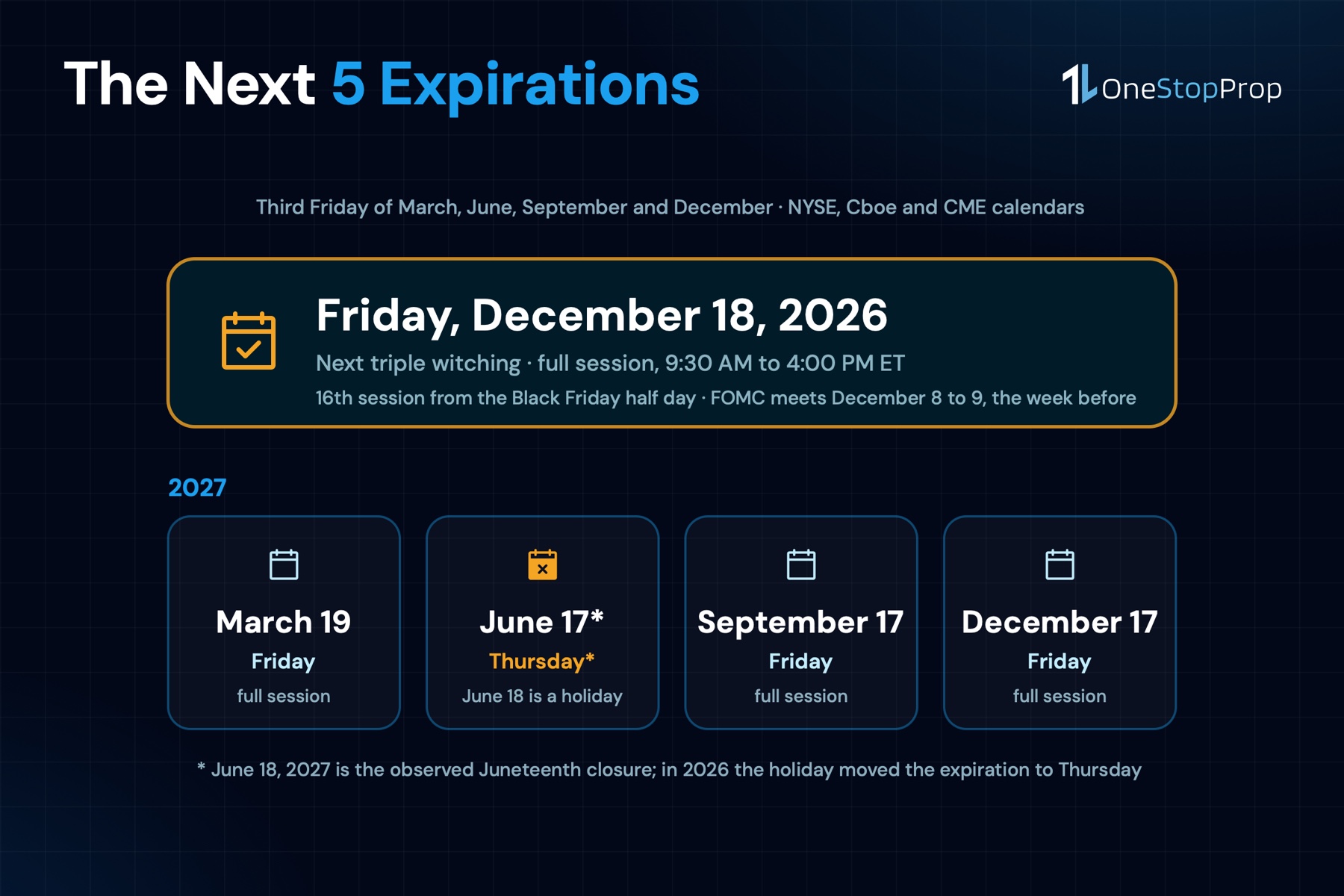
Triple witching is the third Friday of March, June, September and December, when stock options, stock index futures and the options on those futures all expire on the same day. The next one is Friday, December 18, 2026, and it is a full session: the NYSE calendar lists no holiday and no early close that day. It is the 16th session counting from the Black Friday half day.
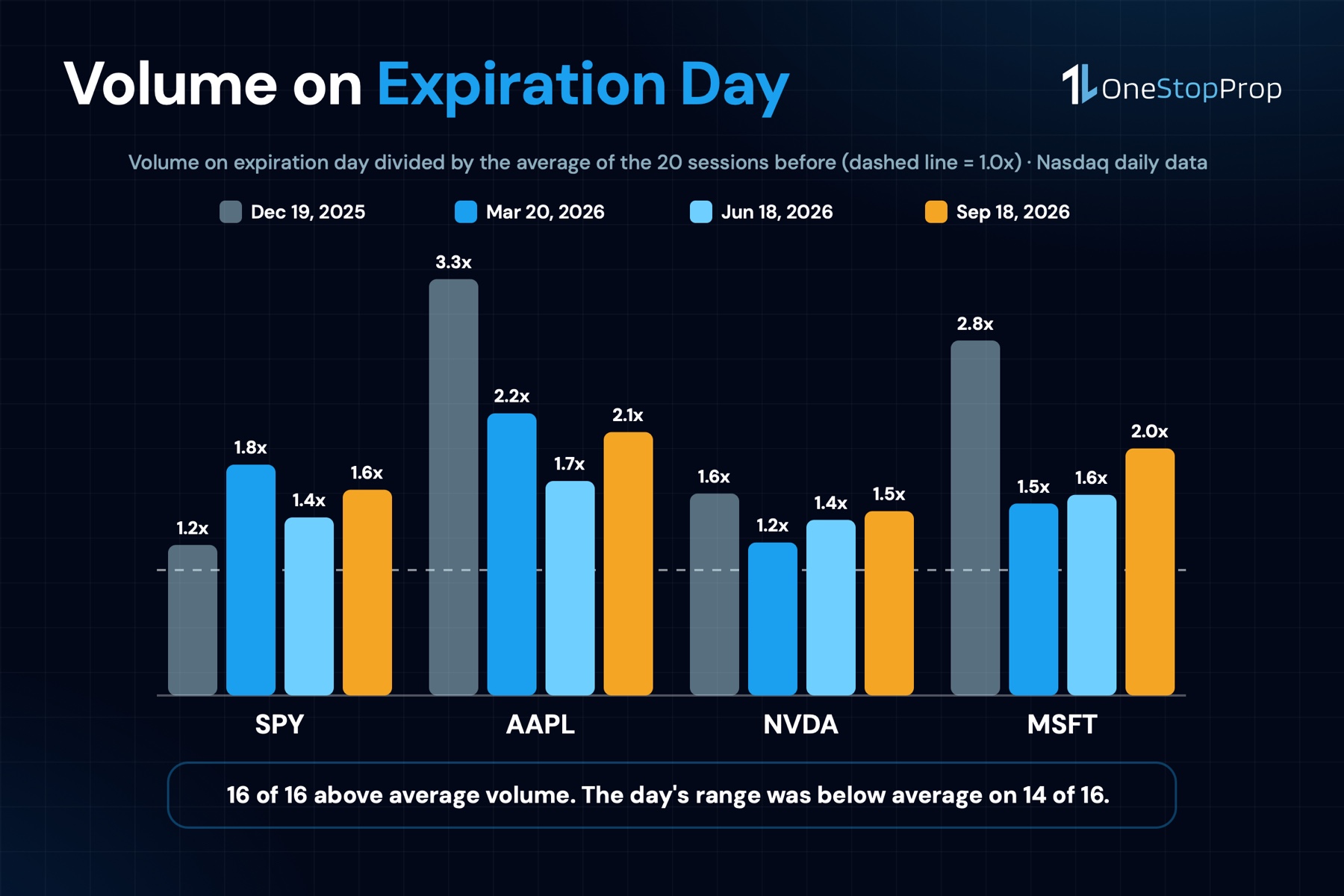
The usual description of the day is heavy volume and wild swings into the close. When we measured it, the volume part was true and the wild-swings part was not. Across the last 4 expirations, SPY, AAPL, NVDA and MSFT traded 1.2 to 3.3 times their 20-day average volume in all 16 cases we measured (4 tickers on 4 expiration dates). Their daily range was below its own 20-day average in 14 of those 16 cases.
For a stop loss on a funded account, that combination, more shares traded and less price movement, changes how you size the position, and this guide does the arithmetic. What expires and when, from the exchanges’ own calendars. What the 4 expirations did to volume, range and the Monday gap. At what times of the day the expiring contracts trade, from the closing auction timelines of the NYSE and Nasdaq. And how to size a stop against the daily loss limit on 1 Step, 2 Step and Instant accounts, so 1 bad fill on triple witching cannot end the account.
Key Takeaways
- December 18, 2026 is a normal full session. Cboe’s 2026 options calendar marks it as the standard expiration for equity, index and ETF options, CME’s E-mini S&P 500 futures terminate at 9:30 AM ET that morning, and the NYSE lists no holiday or early close. The 2027 dates are March 19, June 17 (Friday the 18th is the observed Juneteenth closure), September 17 and December 17.
- Volume rose every time. On the last 4 expirations, 16 of 16 ticker-days ran above their 20-day average volume: median 1.6x, from SPY at 1.2x on December 19, 2025 to AAPL at 3.3x the same day. SPY’s March 20, 2026 session was the 2nd heaviest of 265 in the sample.
- Range did not. 14 of the 16 ticker-days covered less than their 20-day average range, median 0.82x. The exception was March 20, 2026, a down day, when SPY ran 1.5x its usual range.
- The Monday after was ordinary 12 times and large 4 times. The median gap was 0.43% either direction, in line with a normal day, but 4 of 16 opened 1% or more away, the largest NVDA at +2.64% on March 23, 2026. Monday’s volume was below average in 12 of 16.
- The stop is a market order when it fires, so size for a slipped fill. On a $100K 1 Step or 2 Step account, 0.75% per trade with a 1-day-range stop keeps 4 slipped losses under the $4,000 daily limit, with a personal stop at 3; on Instant, with a $2,000 limit, 0.5% per trade and the same stop at 3. The 5-minute news window does not apply: expirations are not on the restricted list.
What Triple Witching Is, and What Expires on December 18, 2026
Investor.gov defines options as contracts giving the purchaser the right, but not the obligation, to buy or sell a security at a fixed price within a specific period of time. When that period ends, the contract is exercised, closed or left to expire, and every one of those choices is a trade in the underlying stock or index. 4 times a year, 3 kinds of contracts reach that point on the same day. That is the day this guide is about.
1. Stock, ETF and index options. Cboe’s 2026 Options Expiration Calendar marks the third Friday of every month as the standard expiration for equity, equity index, ETF and ETN options, and for December 2026 that square is the 18th. Standard AM-settled index options, SPX among them, trade for the last time on Thursday the 17th; Cboe’s SPX specifications say trading ordinarily ceases on the business day preceding the day the exercise-settlement value is calculated. Equity options trade in regular hours until 4:00 PM ET, per Cboe’s hours page; index options until 4:15 PM.
2. Stock index futures. CME’s E-mini S&P 500 contract specs list quarterly contracts in March, June, September and December, financially settled, and state that trading terminates at 9:30 AM ET on the 3rd Friday of the contract month. The December 2026 contract, ESZ6, stops trading at the opening bell on the 18th.
3. Options on those futures. The quarterly options on the index futures sit on the same cycle and go with them. That third leg is what turns the quarterly expiration into “triple” witching; the monthly third Friday without it is a plain options expiration.
The 4 dates a year are fixed by the calendar, and the exchange holiday schedule is what moves them. In June 2026 the third Friday, June 19, was Juneteenth, a full closure on the NYSE calendar, and Cboe’s calendar shows the standard expiration on Thursday, June 18 instead. It happens again next year: the NYSE lists Friday, June 18, 2027 as the observed Juneteenth closure.
| Expiration | Day | What the calendars say |
|---|---|---|
| December 18, 2026 | Friday | Full session. FOMC meets December 8 to 9, the week before. The NYSE closes early on December 24 and is shut on December 25. |
| March 19, 2027 | Friday | Full session on the NYSE 2027 calendar. |
| June 18, 2027 | Friday | NYSE closed, Juneteenth observed. As in 2026, expect the expiration on Thursday, June 17; Cboe’s 2027 calendar will confirm it. |
| September 17, 2027 | Friday | Full session on the NYSE 2027 calendar. |
| December 17, 2027 | Friday | Full session. Christmas is observed on Friday, December 24, 2027. |
For the trader reading this over Thanksgiving week: the stock market is closed on Thanksgiving, Thursday, November 26, and Friday, November 27 is a 1:00 PM half session, as the guide to whether the stock market is open on Black Friday lays out. From that half day to December 18 there are 16 sessions, and the Santa Claus rally window opens the week after.
What Triple Witching Did to Volume: 4 Expirations Measured
To see what the day actually does, we took the daily open, high, low, close and volume of SPY and of 3 of the most traded stocks on OneStopProp’s list, AAPL, NVDA and MSFT, from Nasdaq’s historical data, 266 sessions from November 3, 2025 to November 23, 2026 (265 for SPY, which has 1 incomplete row in Nasdaq’s data). SPY stands in for the index here; it is not on OneStopProp’s instrument list, the 3 stocks are. That window holds 4 expirations: December 19, 2025, March 20, 2026, Thursday June 18, 2026, and September 18, 2026.
For each one we measured 2 things against the 20 sessions before it, the same window the relative volume guide uses. Volume: the day’s volume divided by the 20-day average. Range: the day’s high minus low, as a percentage of the close, divided by the 20-day average of the same number. A reading of 1 is a normal day.
| Expiration | SPY | AAPL | NVDA | MSFT |
|---|---|---|---|---|
| December 19, 2025 | 1.20x volume, 0.62x range | 3.32x, 0.94x | 1.61x, 0.87x | 2.83x, 0.64x |
| March 20, 2026 | 1.84x, 1.50x | 2.25x, 0.62x | 1.22x, 1.29x | 1.53x, 0.90x |
| June 18, 2026 (Thursday) | 1.42x, 0.52x | 1.71x, 0.72x | 1.40x, 0.70x | 1.60x, 0.81x |
| September 18, 2026 | 1.64x, 0.84x | 2.10x, 0.80x | 1.47x, 0.83x | 1.97x, 0.83x |
3 things to read there.
The volume is reliable. 16 of 16 ticker-days ran above their 20-day average, with a median of 1.6x. The single stocks ran heavier than the index fund: AAPL averaged 2.3x across the 4 days, MSFT 2.0x, NVDA 1.4x, SPY 1.5x. AAPL’s December 19, 2025 session, at 144.6 million shares against a 43.6 million average, was its 2nd heaviest day of the 266, and SPY’s March 20, 2026 session was its 2nd heaviest of 265.
The range is not. 14 of 16 ticker-days covered less than their usual range, median 0.82x. On June 18, 2026, SPY traded 1.42x its normal volume inside 0.52x its normal range: 1.4 times the shares, half the movement. The 2 exceptions were both on March 20, 2026, when SPY closed 1.21% below its open and NVDA 2.98% below, and the range came with a direction the market already had that week.
Volume without range is flow, not opinion. Contracts being closed, rolled, exercised or hedged produce shares that change hands at prices that are mostly already there. That is the mechanical reading of a day where the volume doubles and the candle shrinks, and it is the opposite of a 3x relative volume day on news, where the relative volume guide found a median true range of 10% of the previous close.
The Monday after
The other number a trader who holds positions needs is the gap into the next session. Here is the open of the Monday after each expiration against the Friday close (Monday, June 22, after the Thursday expiration and the Juneteenth closure).
| Next session | SPY | AAPL | NVDA | MSFT |
|---|---|---|---|---|
| Monday, December 22, 2025 | +0.49% | -0.30% | +1.62% | +0.04% |
| Monday, March 23, 2026 | +1.46% | +2.41% | +2.64% | +0.53% |
| Monday, June 22, 2026 | +0.13% | -0.23% | +0.36% | -0.96% |
| Monday, September 21, 2026 | +0.60% | -0.25% | +0.30% | +0.24% |
The median gap across the 16 was 0.43% in either direction. The everyday median over the whole sample was 0.32% for SPY, 0.37% for AAPL, 0.92% for NVDA and 0.61% for MSFT, so the typical post-expiration gap was in line with a normal day.
The tail is the point: 4 of 16 opened 1% or more away from Friday’s close, and 3 of those 4 were the Monday after the March 20 sell-off, when the whole group gapped up. Monday’s volume was below its 20-day average (the 20 sessions before it, expiration day included) in 12 of 16: the flow did not carry over.
Pro Tip: before Friday’s open, write 2 numbers on the chart: the stock’s 20-day average range in dollars (in the TradingView charts inside Match-Trader, the ATR indicator set to 20 days is a close stand-in) and its 20-day average volume. Match-Trader’s volume is the platform’s own count, not the exchange’s, so compare it only to its own average, or use Nasdaq’s. On December 18, expect volume past the average by the close. If the price also stays inside its usual range, that is the pattern we saw in 14 of 16 cases: contracts expiring, not a breakout.
The Day Itself: Where the Flow Lands
Daily candles cannot split the session into hours, so we are not going to claim a measured share of volume for the last hour. What the exchanges publish is where the on-close interest concentrates, and that is precise.
9:30 AM ET. The December E-mini S&P 500 futures stop trading, per CME. The AM-settled index options that traded for the last time on Thursday get their settlement value from that morning. The open is the first place expiration flow lands, and on a stock with an opening gap it is the first place a resting stop becomes a market order, which the market order vs limit order guide works through session by session.
3:50 PM ET. The NYSE’s opening and closing auctions fact sheet sets 3:50 PM as the cutoff for entering Market on Close and Limit on Close orders. At that minute the exchange publishes the MOC/LOC Significant Imbalance, after which those orders can be entered only on the opposite side of the imbalance, and cannot be modified or canceled.
3:50 to 4:00 PM ET. From the cutoff until the stock closes, the NYSE disseminates an informational imbalance publication every 1 second if it differs from the previous one: the paired quantity, the unpaired quantity, the total imbalance, the closing-only interest price and the continuous book clearing price. Those 10 minutes are when the whole market can see how much stock wants to trade at the close and on which side, and they are the 10 minutes where the last-hour prints get their direction.
4:00 PM ET. The closing process begins. For Nasdaq-listed names, which includes AAPL, NVDA and MSFT, the Nasdaq Closing Cross crosses orders at a single price in the final moments of the day and sets the official closing price. Equity options stop trading at 4:00 PM, and the official close decides which expiring contracts get exercised.
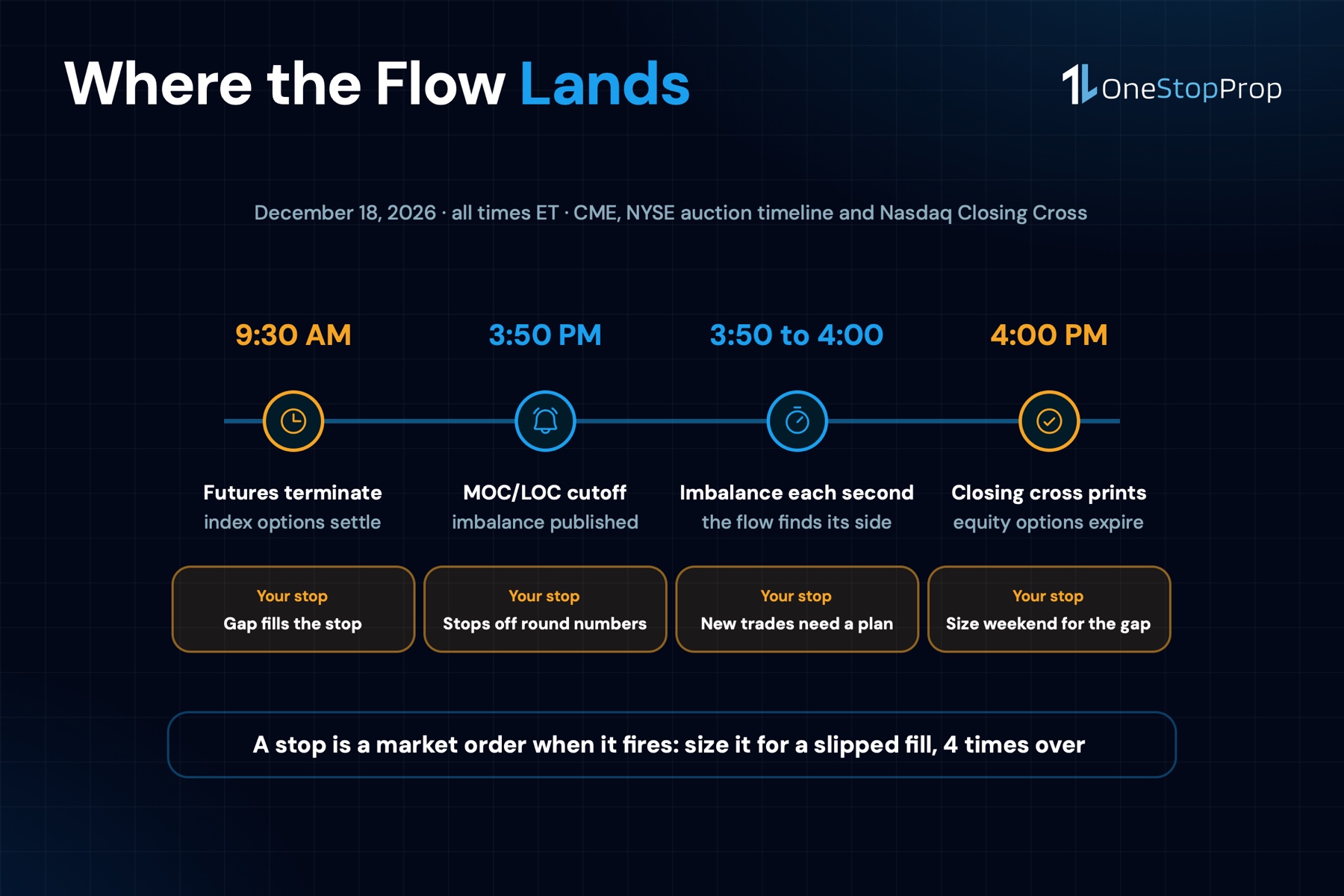
What that timeline means for a stop is simple. For most of the session, more volume inside a smaller range is better liquidity, not worse: fills near the stop price are easier. A resting stop is exposed at 2 moments: the open, if the stock gaps, and the last 10 minutes, when the imbalance publications pull the price toward where the on-close interest clears. At those 2 moments the price is set by orders that have to execute, not by a view on the stock, and that is what the slippage term in the next section pays for.
Where you see this matters. The imbalance publications are exchange data that stock brokers and data vendors carry; they are not in Match-Trader, and a CFD account has no Market on Close or Limit on Close order. What a funded trader has on December 18 is a stop or a limit on the stock CFD, whose price follows the stock’s prints, so the timeline above is for reading the clock, not for placing auction orders.
What Triple Witching Means for a Stop on a Funded Account
Investor.gov’s definition of a stop order carries the rule: when the stop price is reached, the stop order becomes a market order, and the price at which the trade is executed may differ from the stop price, especially in a fast-moving market. On a funded account the fill is measured against a line, so the sizing has to leave room for the fill, not for the stop.
The line is the maximum daily loss. OneStopProp’s Help Center sets it at 4% of the initial balance on 1 Step and 2 Step accounts and 2% on Instant, calculated at the 12:00 AM EST day change from the higher of balance or equity. On a $100K account that is $4,000 on 1 Step and 2 Step and $2,000 on Instant, and equity cannot drop below it during the day. The max total loss, 6%, 8% and 5% by route, sits behind it; the prop firm drawdown rules guide has both lines from the rulebook side.
Here is the arithmetic on a real day. AAPL closed at $336.13 on September 18, 2026, and its 20-day average range going into that session was 2.22%, which is $7.46, using that day’s close for the arithmetic. Take a stop 1 full average range away and assume the fill lands 0.3% of the price past the stop, $1.01, on a fast print. That slippage is an example, not a statistic; the point is to size for some.
| $100K account | Risk per trade | Shares ($7.46 stop) | Loss with a $1.01 slipped fill | 4 of those | Daily limit |
|---|---|---|---|---|---|
| 1 Step or 2 Step, 1% | $1,000 | 134 | $1,135 | $4,540 | $4,000: the 4th breaches |
| 1 Step or 2 Step, 0.75% | $750 | 100 | $847 | $3,388 | $4,000: fits, $612 to spare |
| Instant, 0.5% | $500 | 67 | $567 | $2,270 | $2,000: the 4th breaches; 3 of them are $1,702 |
Read the first row slowly, because it is the common plan. 1% per trade is 4 losses to the daily line on paper, $1,000 times 4, and since equity cannot drop below that line, 4 clean losses already touch it. With $1.01 of slippage on each fill, 134 shares turn each loss into $1,135, and the 4th one lands at $4,540, past the limit. The plan was fine; the fills broke it.
At 0.75%, 100 shares, the same 4 slipped losses total $3,388 and the day survives. On Instant, with half the daily room, 0.5% per trade and a personal stop at 3 losses keeps the day at $1,702 with room for the fills.
The risk of ruin guide has the general version of that count by route and risk per trade; December 18 is the day to run it with the slippage term in.
The weekend after
A position held from Friday’s close into Monday is measured by the same rule. The daily limit resets at 12:00 AM EST, so Monday’s allowance is set from the higher of balance or equity at Sunday midnight, and the whole weekend gap lands inside it at 9:30 AM. On March 23, 2026, NVDA opened at $177.26 against a Friday close of $172.70, a 2.64% gap. A 100-share short carried over that weekend was $456 against the trader before Monday’s first trade, out of $4,000 on a 1 Step or 2 Step account and out of $2,000 on Instant.
12 of the 16 post-expiration gaps were ordinary. Sizing is for the other 4.
The news window does not apply
OneStopProp’s funded accounts have a prohibited window of 5 minutes before and 5 minutes after certain releases; the Help Center’s page on news trading lists them: FOMC announcements and Fed Chair speeches, NFP, CPI, PPI, and all individual stock earnings reports, pre-market, in session and post-market. Traders with the News Trading Allowed Add-On are exempt.
Expirations are not on that list. December 18, 2026 is an unrestricted session unless a stock you hold reports earnings that day. The restricted event of the month is the FOMC meeting of December 8 to 9, on the Federal Reserve’s calendar, with its statement and press conference on the 9th, and the 5-minute window applies there, not on the 18th.
Pro Tip: on December 18, set the daily stop in losses, not in dollars: 3 losses at 0.75% on 1 Step and 2 Step, 3 losses at 0.5% on Instant. At 0.75% the 4th slipped loss still fits, $3,388 against $4,000, and stopping at 3 keeps that margin for a worse fill than the example; on Instant the 4th does not fit at all. In both cases, stop trading after the 3rd loss.
Common Mistakes on Triple Witching
Opening a new position in the last 30 minutes without a reason tied to that clock
On 14 of 16 ticker-days the range was already smaller than usual, and the last 10 minutes trade toward the imbalance, not toward a chart pattern. A trade opened at 3:35 PM because the volume looks exciting is placed into the part of the day where orders that must execute at the close, whatever the price, set the price. If the plan is to trade the close, it is a plan built on imbalance data from a feed that carries it, which Match-Trader does not; if it is not, the day trading rules guide’s advice on the last hour stands.
Stops at the round number
A stop at $335.00 on a stock trading at $336.13 is a stop at the first price every participant can see. The support and resistance trading guide measured how often levels are touched and reversed; on December 18, put the stop a measured distance past the level, sized by the 20-day average range, and accept the smaller position that comes with it.
Reading the volume as a signal
2x volume on an earnings day means the market changed its mind about the stock. 2x volume on expiration day meant, 14 times out of 16, that contracts expired while the stock covered less ground than usual. A breakout scanner does not know the difference; the calendar does. Volume on December 18 confirms the date, not the direction.
Holding into the weekend without sizing for the gap
The median post-expiration gap was ordinary, and 1 in 4 was not. The position that goes home on Friday, December 18 is sized for Monday’s open, not for Friday’s close.
Frequently Asked Questions
What is triple witching?
It is the simultaneous expiration of stock options, stock index futures and options on index futures, on the third Friday of March, June, September and December. Cboe’s calendar sets the options date and CME’s contract specs set the futures termination at 9:30 AM ET that day. When the third Friday is an exchange holiday, as on June 19, 2026, the expiration moves to the Thursday before.
Is the stock market open on December 18, 2026?
Yes, for the full session, 9:30 AM to 4:00 PM ET. The NYSE’s 2026 calendar lists no holiday or early close on December 18. The early close that month is Thursday, December 24 at 1:00 PM, and Friday, December 25 is closed.
Does the expiration make stocks more volatile?
It made them busier, not wider, in the 4 expirations we measured. Volume ran above the 20-day average on all 16 ticker-days, median 1.6x. The daily range was below its 20-day average on 14 of 16, median 0.82x. The day that was both heavy and wide, March 20, 2026, was a sell-off that was already under way.
Does OneStopProp’s 5-minute news rule apply on expiration day?
No. The restricted events on funded accounts are FOMC announcements and Fed Chair speeches, NFP, CPI, PPI and individual stock earnings reports, each with a window of 5 minutes before and after. Expirations are not on the list. In December 2026 the restricted event is the FOMC meeting of December 8 to 9.
Should I hold a position over the expiration weekend?
That is a sizing question, not a yes or no. 12 of the 16 Monday gaps we measured were ordinary, and 4 were 1% or more, up to 2.64%. The daily loss limit resets at 12:00 AM EST and the gap lands inside Monday’s allowance, so a position that goes home on Friday should be small enough that the largest gap in the table leaves most of that allowance intact.
When is the next triple witching after December 18, 2026?
Friday, March 19, 2027. The June 2027 third Friday, June 18, is the observed Juneteenth holiday on the NYSE calendar, so expect that expiration on Thursday, June 17, as happened in June 2026. September 17 and December 17, 2027 are full sessions.
The Bottom Line
Triple witching on December 18, 2026 is a full session with a known shape: the index futures stop trading at 9:30 AM, from 3:50 PM the exchange shows how much stock must trade at the close, and at 4:00 PM the closing price is set. In the last 4 expirations that shape produced 1.2x to 3.3x the normal volume on all 16 stock-and-date combinations we measured, and less than the normal range on 14 of them.
The risk to a funded account is not a wild move. It is a stop that becomes a market order at the open or in the last 10 minutes, when expiring flow sets the price, and a weekend gap that lands on Monday’s daily allowance.
The defense fits in 3 numbers: a stop sized by the 20-day average range, a risk per trade that leaves room for slipped fills (4 of them on 1 Step and 2 Step, 3 on Instant), and a weekend position sized for the largest gap in the table. On a $100K 1 Step or 2 Step account that is 0.75% per trade under the $4,000 daily limit, and stop after the 3rd loss; on Instant, 0.5% under $2,000 and the same stop at 3.
If you want to trade December 18 on a OneStopProp account, open it this week so it is already set up that day: pick your OneStopProp account, 1 Step, 2 Step or Instant, from $10K to $300K (Instant from $25K to $200K, funded from the first trade). The daily limit and the stop sizing above apply from your first trade, in the challenge and once funded. There is no time limit on the challenge, you can hold positions overnight and over the weekend, and the charts are TradingView-powered inside Match-Trader.
Sources
- 2026 Options Expiration Calendar, Cboe. The third Friday of each month as the standard expiration for equity, equity index, ETF and ETN options, December 18, 2026 included; June 2026 shown on Thursday, June 18 with Friday, June 19 as an exchange holiday. https://cdn.cboe.com/resources/options/Cboe2026OPTIONSCalendar.pdf
- U.S. Options Hours and Holidays, Cboe. Regular trading hours of 9:30 AM to 4:00 PM ET for equity options and to 4:15 PM for index options, and the 2026 and 2027 options holiday schedules, including Juneteenth Observed on June 18, 2027. https://www.cboe.com/about/hours/us-options/
- SPX Options Specifications, Cboe. Trading in SPX options ordinarily ceases on the business day, usually a Thursday, preceding the day the exercise-settlement value is calculated. https://www.cboe.com/tradable_products/sp_500/spx_options/specifications/
- E-mini S&P 500 Futures Contract Specs, CME Group. Quarterly contracts in March, June, September and December, financially settled; trading terminates at 9:30 AM ET on the 3rd Friday of the contract month. https://www.cmegroup.com/markets/equities/sp/e-mini-sandp500.contractSpecs.html
- Holidays and Trading Hours, NYSE. The 2026 and 2027 holiday calendars: Thanksgiving November 26, the 1:00 PM close on November 27 and December 24, 2026, Christmas December 25, and Juneteenth observed on Friday, June 18, 2027. https://www.nyse.com/markets/hours-calendars
- NYSE Opening and Closing Auctions, NYSE. The closing timeline: 3:50 PM cutoff for MOC and LOC entry and publication of the Significant Imbalance, imbalance information every 1 second until the close, closing process at 4:00 PM. https://www.nyse.com/publicdocs/nyse/markets/nyse/NYSE_Opening_and_Closing_Auctions_Fact_Sheet.pdf
- Nasdaq Closing Cross, Nasdaq. The facility that crosses orders at a single price in the final moments of the day and sets the official closing price for Nasdaq-listed securities. https://www.nasdaq.com/solutions/nasdaq-closing-cross
- SPY Historical Data, Nasdaq. Daily open, high, low, close and volume used for the 4 expirations, November 3, 2025 to November 23, 2026; the AAPL, NVDA and MSFT series come from the same tool. https://www.nasdaq.com/market-activity/etf/spy/historical
- Stock Market Holiday Schedule, Nasdaq. Juneteenth June 19, 2026 closed, Thanksgiving November 26, 2026 closed, 1:00 PM early closes on November 27 and December 24, 2026. https://www.nasdaq.com/market-activity/stock-market-holiday-schedule
- Stop Order, Investor.gov (U.S. Securities and Exchange Commission). When the stop price is reached the stop order becomes a market order, and the execution price may differ from the stop price in a fast-moving market. https://www.investor.gov/introduction-investing/investing-basics/glossary/stop-order
- Options, Investor.gov (U.S. Securities and Exchange Commission). Options as contracts giving the purchaser the right, but not the obligation, to buy or sell a security at a fixed price within a specific period. https://www.investor.gov/introduction-investing/investing-basics/glossary/options
- FOMC Meeting Calendars, Federal Reserve. The December 8 to 9, 2026 meeting, with a Summary of Economic Projections, and the 2027 schedule. https://www.federalreserve.gov/monetarypolicy/fomccalendars.htm
- What is the Maximum Daily Loss?, OneStopProp Help Center. 4% of the initial balance on 1 Step and 2 Step (2% on Instant), calculated at the 12:00 AM EST day change from the higher of balance or equity. https://help.onestopprop.com/faq/what-is-the-maximum-daily-loss/
- Is news trading allowed?, OneStopProp Help Center. The 5-minute windows before and after FOMC and Fed Chair speeches, NFP, CPI, PPI and individual stock earnings on funded accounts, and the News Trading Allowed Add-On exemption. https://help.onestopprop.com/faq/is-news-trading-allowed/