Prop trading is growing fast. OneStopProp data shows that global searches for “prop firm” grew from roughly 880 per month in January 2020 to over 49,500 by mid-2025, a 56-fold increase in 5 years. Most of those new traders arrive focused on profit targets and payout splits. They overlook the single rule that ends more funded accounts than any other: drawdown.
Accounts get terminated not because of a bad trade but because traders do not understand the drawdown rule that applies to their account. This is the most common way traders fail, not from losses, but from misunderstanding the rules around those losses. If you are trading stocks like Apple (AAPL), NVIDIA (NVDA), or Tesla (TSLA) through a prop firm, those stocks move fast, gap overnight, and react violently to earnings. Understanding how drawdown rules apply in that environment is non-negotiable.
Key Takeaways
- Drawdown rules are automatic trip wires, not warnings: In a prop firm, drawdown is a hard-coded rule. The moment your equity touches the drawdown floor, the account closes automatically, with no discretion and no warning shot. Therefore, set your own personal stops well before the firm’s limit.
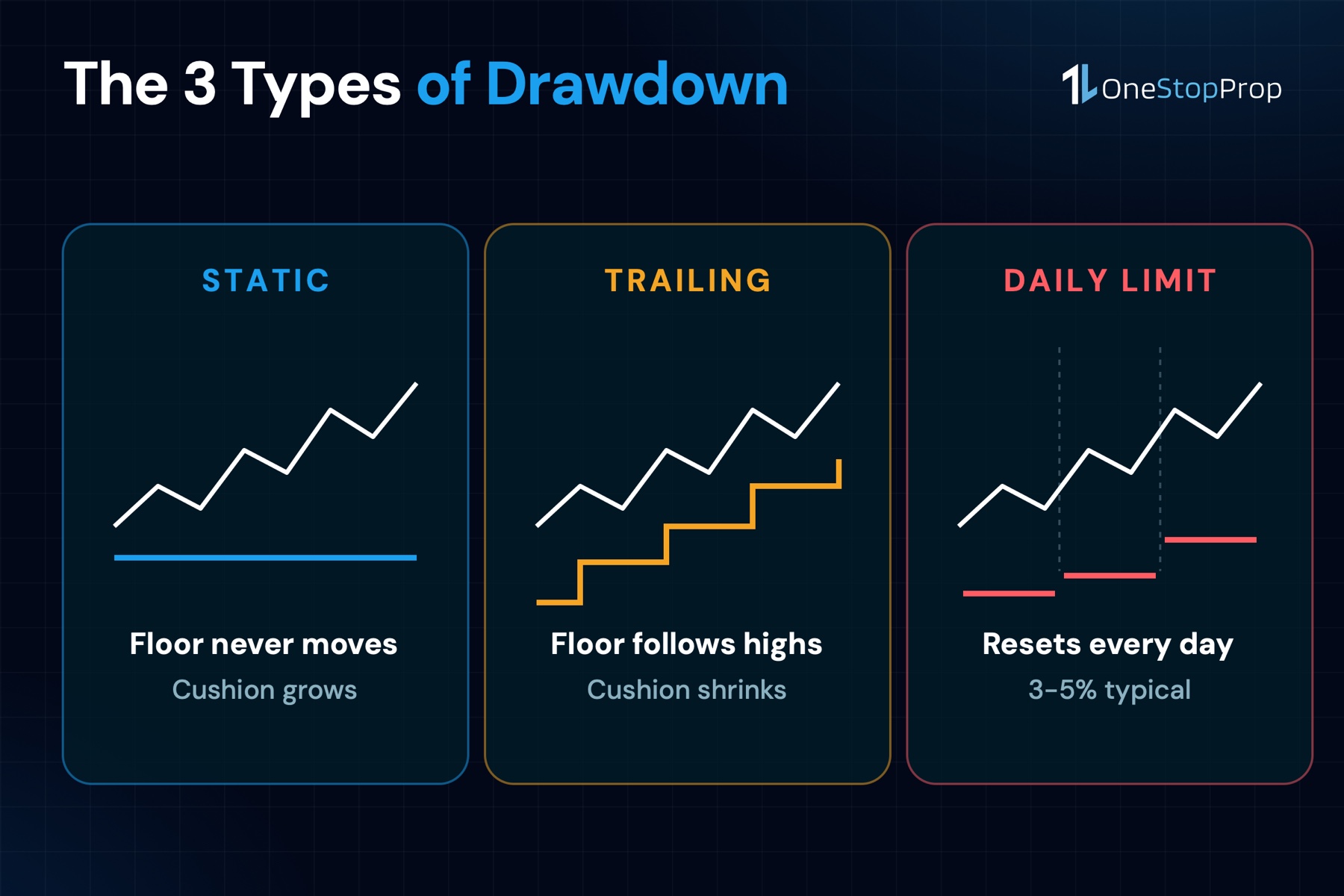
- There are 3 distinct drawdown types, each requiring a different approach: These are static drawdown trailing drawdown, and the daily loss limit. Static drawdown has a fixed floor that never moves and is the easiest to manage. Trailing drawdown follows your equity up and is where most traders get caught. Know which type your firm uses before placing a single trade.
- Industry standard limits in 2026: As of August 2026, typical numbers sit around an 8-10% profit target in Phase 1, with 4-6% daily loss limits and 6-12% maximum drawdown. Use these as benchmarks when comparing programs.
- Position sizing must work backward from the floor: At 1% risk per trade, a trader can absorb 5 consecutive losses before hitting a 5% daily cap; at 0.5%, ten. Many funded traders cap risk at 0.5-1% and limit daily trades accordingly.
- A breach costs more than the account: For evaluations, a breach ends the challenge and forfeits the fee. For funded accounts, it removes trading access and cancels pending payouts. Firms rarely grant grace periods.
Prioritization Framework: Prop Firm Drawdown Rules for Stock Traders
| Strategy | Best For | Effort Level | Time to Results |
|---|---|---|---|
| Learn your drawdown type first | All traders, all levels | Low | Before Day 1 |
| Convert limits to dollar amounts | Challenge beginners | Low | Before Day 1 |
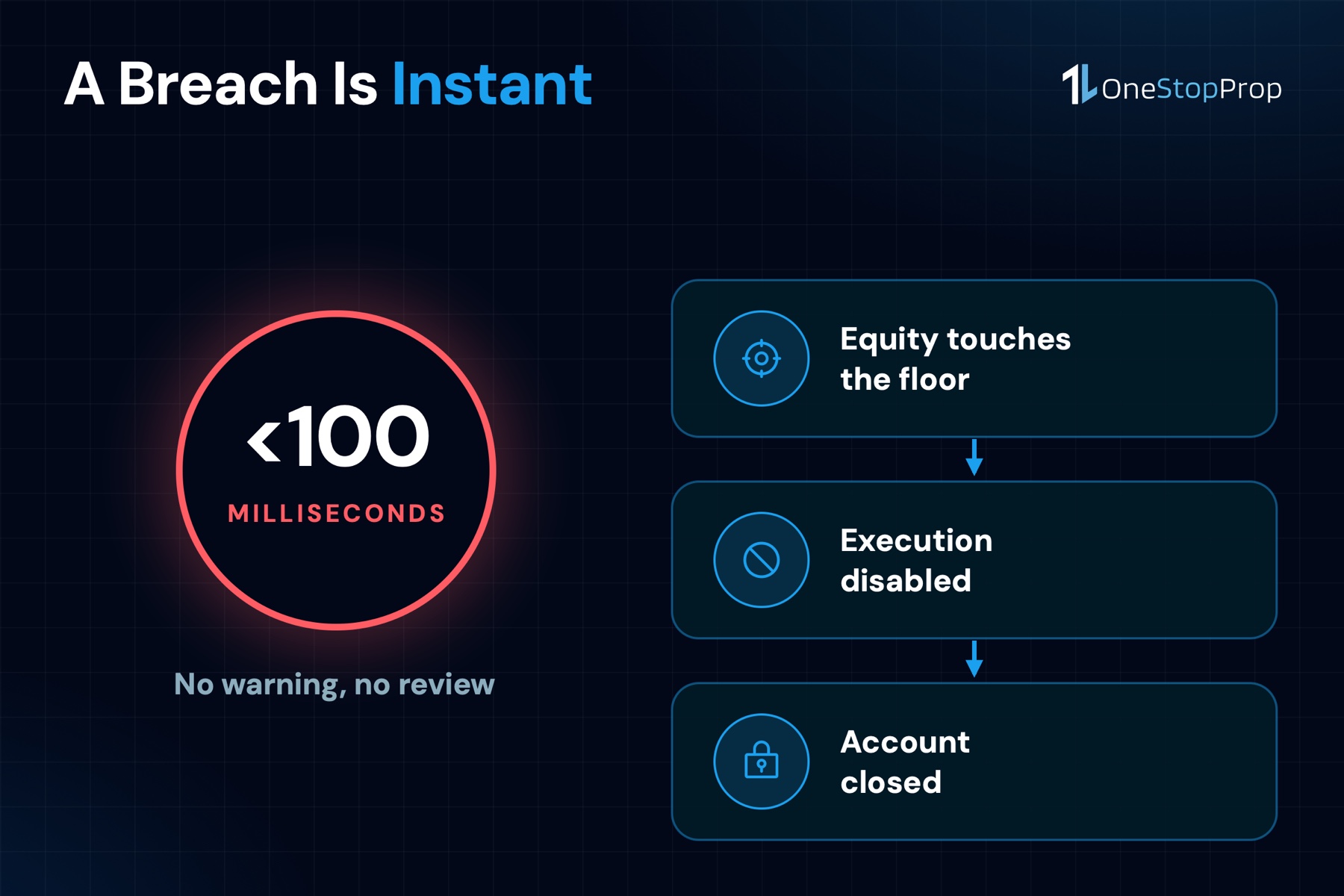
| Set personal stops at 50-60% of firm limit | Active daily traders | Low | Week 1 |
| Size positions from the daily cap, not account size | All funded traders | Medium | Week 1-2 |
| Use platform alerts at 30%, 60%, 80% of daily limit | High-frequency traders | Medium | Week 1 |
| Model trailing floor before scaling up | Trailing-drawdown accounts | High | Ongoing |
Start here if you are:
- New to prop firms: Read your firm’s rules document and convert every percentage into a dollar amount before placing your first trade. This single action removes the most common source of accidental breaches.
- Already funded but close to limits: Immediately reduce position size by half and stop trading once you hit 60% of your daily loss limit. Protect the account first; rebuild equity slowly.
- Switching firms: If you are coming from a firm where the floor never moves, switching to a trailing drawdown model requires a completely different risk approach. Do not apply the same position sizing.
What Drawdown Actually Means in Prop Trading
The Core Definition
Prop firm drawdown rules set the maximum equity loss a trader can incur before the firm closes the account. These limits operate at 2 levels: within a single session and across the account’s entire life.
A drawdown measures the decline in a trading account’s value from a prior peak. It is a key metric used by prop firms to assess risk and strategy performance. In retail trading, that metric sits in your journal as historical data. In prop trading, it operates as an automated shutdown trigger.
Prop firm rules are the risk parameters a firm applies to a simulated trading account during an evaluation and after funding, mainly a profit target, a maximum drawdown, a daily loss limit, a minimum number of trading days, and a list of banned strategies. Most are enforced automatically by the platform, and a breach closes the account the same second.
The 2 Layers Every Trader Must Track
Most prop firms apply 2 main types: the daily drawdown, which is the maximum loss allowed within a single trading day, and the overall drawdown, which is the maximum total loss allowed over the life of the account.
The daily drawdown limit caps your maximum loss for any given trading day, typically between 3% and 5% of your starting daily equity. If your account drops by this amount within a single session, all positions are automatically liquidated and you may be locked out of trading until the next day. Therefore, you must treat the daily limit as a hard ceiling, not a budget to fill.
Pro Tip: Configure platform alerts at 30% 60%, and 80% of your daily drawdown. Mental notes fail under pressure. Automated alerts don’t. Most prop firm dashboards show real-time drawdown tracking, but having your own alerts on the platform adds redundancy.
Static vs. Trailing Drawdown: The Most Important Distinction in Prop Trading
How Static Drawdown Works
Static drawdown is a prop firm loss limit fixed to your starting balance. On a $100,000 account with 10% static drawdown, the floor sits at $90,000 and never moves, no matter how much the account grows.
This structure has a key advantage: as you profit, your safety cushion actually widens. This is more forgiving than it sounds. As you profit, the gap between your current equity and the static floor widens, giving you more real room to absorb losing trades. For traders holding overnight positions in names like Amazon (AMZN) or Alphabet (GOOGL) that can gap on news, a fixed floor means a Monday morning gap does not move the goalposts you were measured against on Friday.
How Trailing Drawdown Works
Trailing drawdown is different – it moves. As your account grows, the drawdown limit trails behind, not staying fixed like static drawdown. It is a rule used in prop firm challenges that limits how much you can lose as your account grows.
Here is where it gets counterintuitive: with static drawdown, your headroom only shrinks when you lose money. With trailing drawdown, your headroom shrinks when you make money and then give some of it back. This is why trailing drawdown punishes round-trip trades, up then back down, even when the trade itself is profitable.
If you have a $100,000 portfolio that increases to $105,000 with a $5,000 trailing drawdown, the floor will rise to $100,000 and have no buffer left at all. A strong week can quietly erase the cushion a trader thought they had earned. Therefore, when using a trailing model, lock in partial profits on positions before reaching new equity peaks.
End-of-Day vs. Intraday Trailing
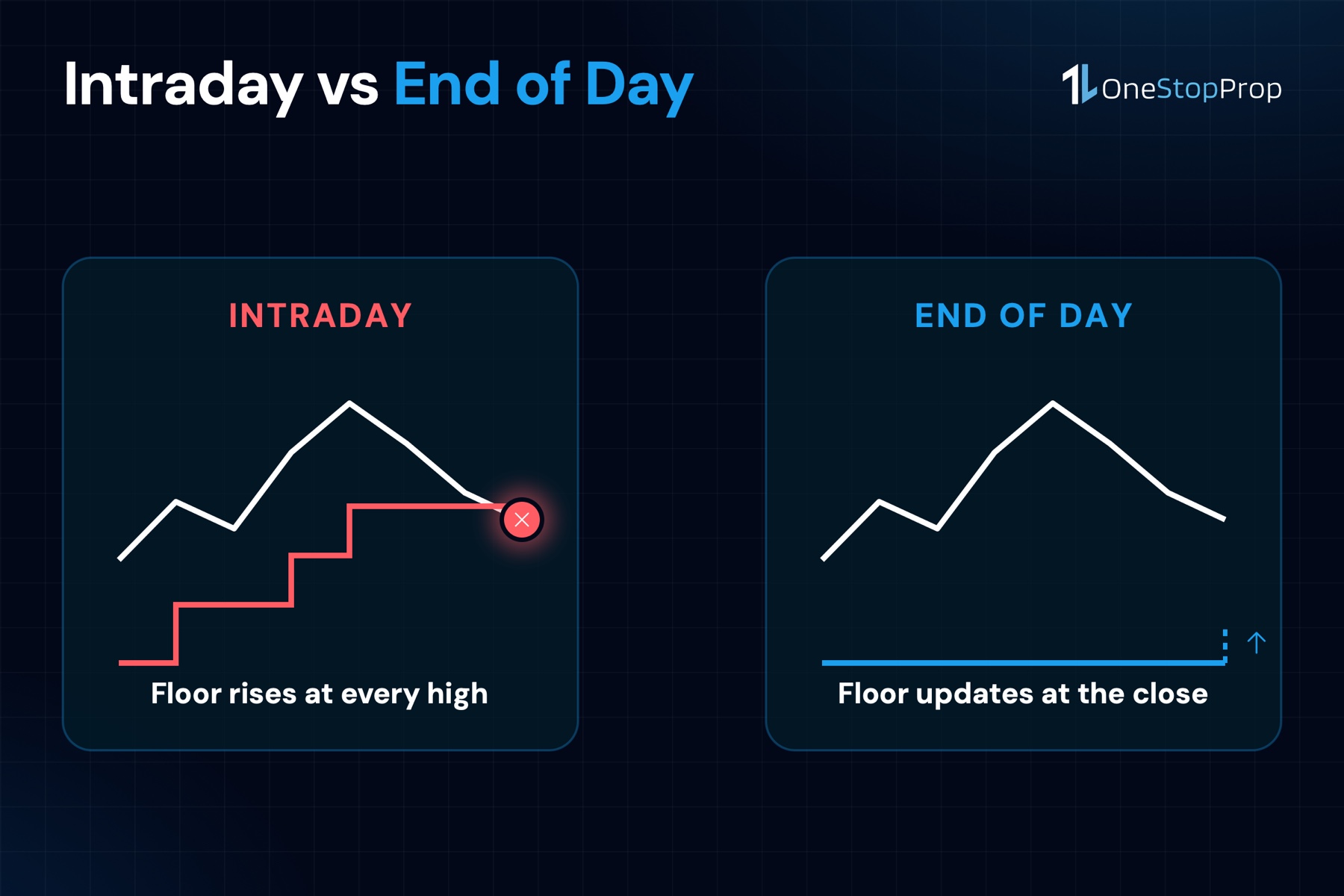
Not all trailing drawdowns are equal. End-of-day trailing generally updates once using a defined day-end value. With an end-of-day model, the threshold is recalculated after the trading session using the closing balance or another specified value, then enforced during the next session. This is structurally more forgiving than intraday trailing.
Intraday trailing drawdown tracks equity continuously and raises the floor with every high. Any decline then measures from that high. Intraday trailing lets firms control risk in real time but punishes normal pullbacks. For stock traders, this matters enormously when a name like Meta (META) or Microsoft (MSFT) posts a midday high and then sells off into the close.
Balance-Based vs. Equity-Based Calculation: The Hidden Detail
Why This Distinction Changes Everything
Balance-based drawdown is calculated from your balance, meaning realized profit or loss. If you recover losses before closing positions, your account remains safe. Swing traders often prefer this method.
Equity-based drawdown includes both realized and unrealized profit and loss when calculating the drawdown. For a stock trader holding a position in NVIDIA (NVDA) through an earnings report, this is a critical difference. A position that is down $3,000 on paper, but which you plan to hold through the announcement, can trigger a breach under equity-based rules before you have a chance to decide anything.
A daily loss limit caps how far your account can drop within a single trading day and in most rule sets it is measured on floating equity, not closed balance. An open position deep underwater can trip the breach the instant it hits the threshold, whether you have clicked close or not.
The OneStopProp Approach
OneStopProp’s platform gives traders 2 measurement options for the daily loss limit: the equity method, which bases the limit on the account’s equity and accounts for open positions and unrealized profits or losses in real time, and the initial balance method, which sets the daily loss limit relative to the account’s starting balance at the beginning of the challenge.
The max loss represents the total allowable drawdown across the account’s lifetime and is always calculated from the initial balance. If cumulative losses exceed this limit, including losses on open positions, the challenge will fail. Knowing this upfront lets you calibrate how you manage open positions on high-volatility stocks.
Unlike many prop firms OneStopProp does not hide complex rules in fine print. The parameters are straightforward: maximum daily drawdown of 4%, maximum total drawdown of 8%, and profit targets for the challenge phases of 8% and 5%. For stock traders who want clear boundaries when trading names like Tesla (TSLA), which can swing 5-10% in a single session, that clarity has real value.
Pro Tip: Before attempting any challenge, ask the firm’s support team to walk through a specific scenario with numbers. Watch for consistency rules that effectively create a de facto daily loss limit even when none is stated. Always test the exact calculation method before funding.
What Happens When You Breach a Drawdown Rule
The Mechanics of a Breach
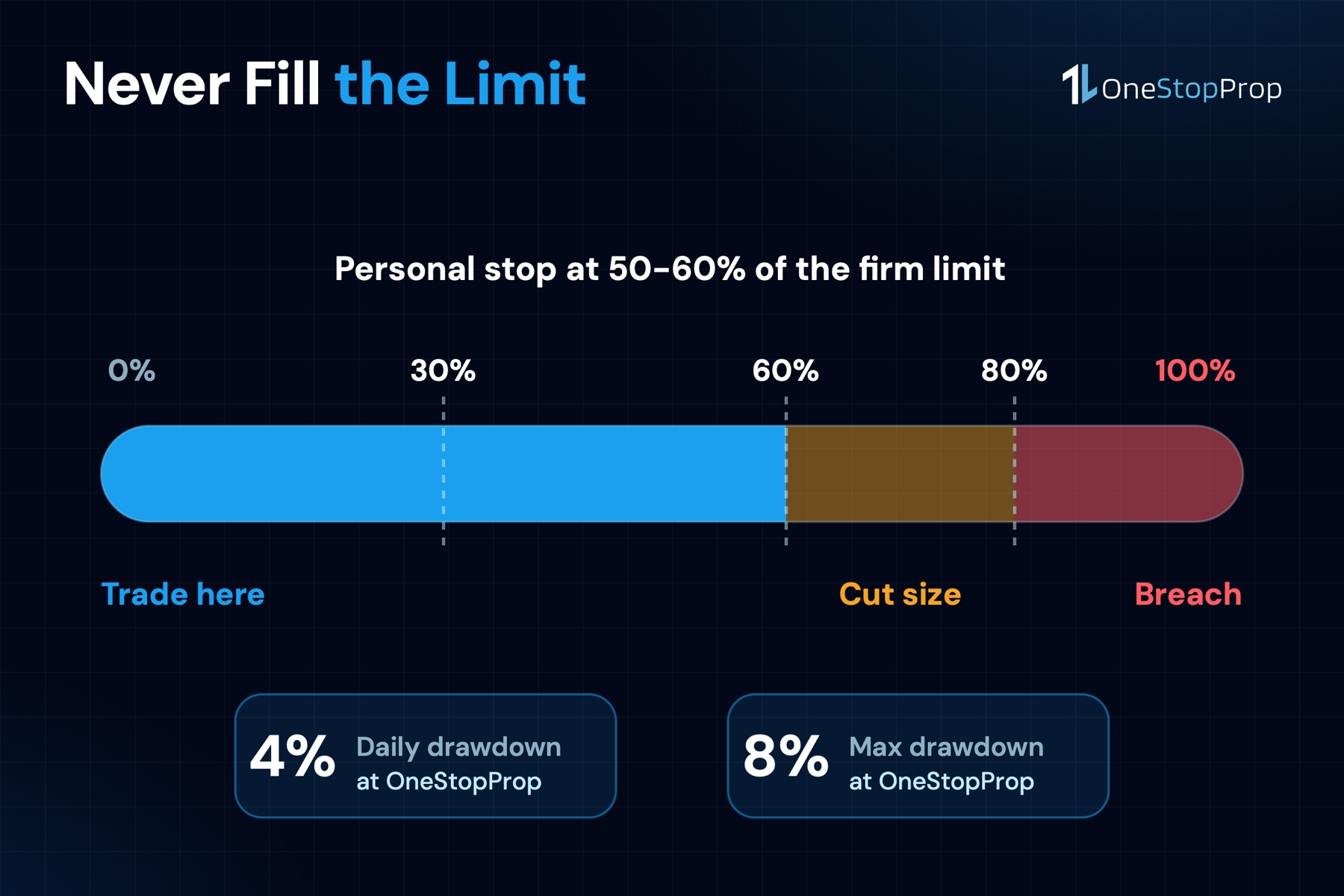
Daily drawdowns, max drawdowns and prohibited strategy patterns are detected automatically. The latency between violation and detection is typically under 100 milliseconds. There is no human review for a hard breach. The system acts before you can.
The stop-out triggers automatically, even with open trades. Unlike retail margin calls, there is no warning stage. A trader who hits the daily limit does not get a final alert, execution is simply disabled. A news spike or widening spreads can then push equity through the floor before manual exits are possible.
For stock traders specifically, this creates acute risk during earnings seasons. When Tesla (TSLA) gaps 8% overnight or NVIDIA (NVDA) surges on a blowout quarter, unrealized equity changes happen instantly at the open, before you can manually adjust size.
The Financial Consequences
You do not owe the firm any trading losses. You do not owe the difference between your account balance and the drawdown floor. You do not owe back payouts you have already received on a funded account. The challenge fee paid upfront is the maximum personal financial risk.
However, your funded account will usually be closed permanently, and your trading agreement with the firm may be terminated. In some cases, profits that have not yet been withdrawn may also be forfeited. Therefore, request payouts at the earliest eligible date rather than letting profits accumulate in an account that can be shut down instantly.
If you hit your maximum drawdown on a funded account at OneStopProp, reset options are available that allow you to restart your funded account after a drawdown, typically at a reduced fee compared to the initial challenge. This is a meaningful safety net for traders who had an isolated bad stretch but demonstrated consistent skill otherwise.
Practical Risk Management Framework for Stock Prop Traders
Sizing Positions from the Floor, Not the Account
The notional account size overstates the trader’s actual risk budget. If only $5,000 can be lost on a $100,000 account, position sizing should be based on that $5,000 allowance and the strategy’s expected losing streak, not on the $100,000 headline.
According to The5ers’ 2026 drawdown guide, many funded traders fix personal daily stops at 50-60% of the firm’s daily limit. On a $100,000 account with a 5% daily and 10% max, that translates to a personal daily ceiling of $2,500-$3,000 and a lifetime personal cap near $5,000. This buffer absorbs slippage correlated losses, and psychological errors near firm limits. The gap between personal stops and firm floors protects the account from unexpected events that could otherwise force a breach.
Keep risk per trade between 0.5% and 1% of account size to allow multiple losing trades without reaching limits. Factor in spread and slippage, especially during volatile sessions or high-impact news events. Use stop-loss orders to avoid emotional exits and protect capital automatically.
Managing the Overnight Gap Problem in Stocks
Stock prop traders face a specific risk that forex traders rarely encounter at the same scale: overnight gaps. Apple (AAPL), NVIDIA (NVDA), and Amazon (AMZN) all report earnings after hours. A position that looks fine at the close can open the next morning several percent against you.
Overnight gaps can skip stop-loss orders and breach limits. The practical solution is to size down significantly before earnings events, use smaller position sizes on any stock you hold overnight, and always factor the gap risk into your drawdown buffer calculation. Under equity-based drawdown rules, that overnight gap counts against your limit from the moment the market opens.
Pro Tip: Never consume more than 80% of your daily drawdown. The remaining 20% is your insurance against slippage, spread widening, and the cost of closing remaining positions.
The Scalability Advantage of Static Drawdown for Stock Traders
Research from Prop Firm Pine Scripts confirms that static drawdown accounts reward strategies that compound consistently. As your equity grows, your effective cushion widens. A static drawdown account rewards a strategy that compounds consistently, the more you make, the more room you have to weather normal variance.
This is directly relevant for traders building positions across the Magnificent 7. If you have been accumulating profitable trades in Microsoft (MSFT), Meta (META), and Alphabet (GOOGL), a static drawdown floor gives you more room to continue holding those positions as your track record grows, rather than tightening the floor with every new equity high.
Common Mistakes That Lead to Drawdown Breaches
Mistake 1: Treating the Limit as a Budget
The daily loss limit is the circuit breaker that stops a bad morning from becoming a blown account. Traders who actually use tight daily limits well tend to bank fewer, better-sized trades per day rather than revenge-trading into the cap. Treating the limit as an allowance to spend each day is how accounts end in a single session.
Mistake 2: Ignoring Floating Losses in Equity-Based Models
Ignoring open trade drawdown when near your limit is a common and costly mistake. Under equity-based rules, an open position that is moving against you is already consuming your drawdown buffer even though you haven’t closed the trade. Therefore, check your floating equity regularly throughout the session, not just your realized P&L.
Mistake 3: Sizing Up After a Winning Streak
Accounts are not destroyed by bad market reads. They die because traders violated a drawdown rule, overtook a daily loss limit, or sized up too fast after a winning streak. The ThinkCapital guide to position sizing for prop firms confirms that oversizing and revenge trading after losses are 2 of the most common reasons traders hit their drawdown limits. The winning streak creates false confidence; the subsequent oversize creates the breach.
Mistake 4: Missing Hidden Traps in the Rules
The most common hidden trap is intraday trailing drawdown marketed as “end-of-day”, the floor moves up the moment equity hits a new high, not at close. A second trap is weekend gap risk: some firms apply drawdown calculations to Friday closing prices, meaning a gap open on Monday can breach your limit before you place a single trade.
Frequently Asked Questions
What is the difference between a daily drawdown limit and a maximum drawdown limit?
Daily drawdown is the maximum loss allowed during a single trading day. Depending on the prop firm, it may be calculated from the start-of-day balance, the initial account balance, or the account equity including open positions. Max drawdown is the overall loss threshold that your account balance or equity cannot fall below during the life of the challenge. The daily limit resets each session; the maximum drawdown does not and applies for the full life of the account.
Can I breach a drawdown limit even if I finish the day with a profit?
Yes. End-of-day trailing generally the starting balance and still breach a limit because open losses, commissions, or an intraday equity drop crossed the firm’s threshold. Under equity-based daily rules, an intraday dip, even one that fully recovers, counts as a breach if it touched the floor at any point during the session.
Which drawdown model is better for swing traders who hold overnight positions?
Balance-based drawdown is calculated from realized profit or loss. If you recover losses before closing positions, your account remains safe. Swing traders often prefer this method because overnight positions do not threaten a breach until they are closed. Static drawdown combined with balance-based measurement is generally the most swing-trader-friendly structure.
What happens to pending payouts if I breach a drawdown limit?
Your funded account will usually be closed permanently and your trading agreement with the firm may be terminated. In some cases, profits that have not yet been withdrawn may also be forfeited. At OneStopProp specifically, any payout requests that have already been approved prior to account failure will still be honored and processed. However, no further payouts beyond the approved amount will be issued.
How should I adjust my position sizing when trading volatile stocks under drawdown rules?
The daily limit sets maximum session loss; risk per trade must be small enough that a typical losing run cannot hit that cap. On a $100,000 account with a 5% daily limit, the cap is $5,000. Risking 2% per trade means 3 full losses close the account. For high-beta stocks like Tesla (TSLA) or NVIDIA (NVDA) that can move 5-10% intraday, reduce per-trade risk to 0.5% or lower, use tighter stop placements relative to ATR, and never hold a full-size position into a binary event like an earnings report.
If you are a stock trader looking for a prop firm built around clear, transparent rules, OneStopProp’s Pro Account offers 100% profit splits on the first 5 payouts, a 4% daily drawdown cap, an 8% maximum drawdown, and access to the Magnificent 7 stocks, Apple (AAPL), NVIDIA (NVDA), Microsoft (MSFT), Amazon (AMZN), Alphabet (GOOGL), Meta (META), and Tesla (TSLA), alongside Forex and Crypto, all from a single funded account. A no-time-limit challenge structure means there is no deadline for hitting your profit target. You can take 20 days or 90 days, as long as you stay within the drawdown rules, the account stays live. Full account-specific rules, drawdown parameters, and payout mechanics are detailed in the OneStopProp Help Center.
Sources
- Prop Firm Drawdown Rules 2026: Static vs Trailing, Traders Second Brain. Comprehensive breakdown of drawdown types and position sizing frameworks. https://traderssecondbrain.com/guides/prop-firm-drawdown-rules
- Prop Firm Drawdown Rules Explained: Daily vs Max (2026 Guide), The5ers. Detailed explainer on daily limits, max drawdown, and trader math. https://the5ers.com/prop-firm-drawdown-rules-explained-daily-max-and-trailing-limits-in-2026/
- Prop Firm Daily Drawdown Rules: Never Breach Your Limits, New York City Servers. Practical alert systems and buffer strategies. https://newyorkcityservers.com/blog/prop-firm-daily-drawdown-rules
- Prop Trading Rules You Must Know Before Taking a Challenge, For Traders. Full rules matrix and drawdown type explainers. https://fortraders.com/blog/prop-trading-rules-you-must-know-before-taking-a-challenge
- Understanding Drawdown: Why It’s Crucial in Prop Trading, For Traders. Static vs trailing mechanics with real account scenarios. https://fortraders.com/blog/understanding-drawdown-why-its-crucial-in-prop-trading
- Trailing Drawdown Explained: How It Actually Works (2026), TradeZella. Intraday vs end-of-day trailing distinctions. https://www.tradezella.com/blog/trailing-drawdown
- Static Drawdown vs Trailing Drawdown, Prop Firm Pine Scripts. Algo-trading and strategy implications of each model. https://propfirmpinescripts.com/guides/prop-firm-drawdown-rules.html
- What Happens If You Break Prop Firm Rules, AquaFunded. Consequences of breaches on funded accounts and during evaluations. https://www.aquafunded.com/blogs/what-happens-if-you-break-prop-firm-rules
- What Happens If You Break Prop Firm Rules, Velotrade. Hard vs soft breach mechanics and reset options. https://velotrade.com/blog/what-happens-break-prop-firm-rules
- Risk Management for Prop Trading: The Complete Framework, Prop Trading Vibes. Position sizing, correlation, and daily budget systems. https://proptradingvibes.com/blog/risk-management-prop-trading
- Prop Firm Rules Explained: Drawdown, Daily Loss & Targets, GizmoTimes. Drawdown calculation formulas and profit target ratios. https://www.gizmotimes.com/business/trading/prop-firm-rules-explained-drawdown-daily-loss/51361
- Position Sizing for Prop Firms, ThinkCapital. Per-trade risk math and common sizing errors. https://www.thinkcapital.com/position-sizing-for-prop-firms/
- OneStopProp Platform Guide, OneStopProp Help Center. Account-specific drawdown mechanics and platform rules. https://help.onestopprop.com/faq/platform-guide/
- OneStopProp Payout Rules, OneStopProp. Payout cycle rules, buffer zone requirements, and Pro Account terms. https://help.onestopprop.com/faq/payout-rules/
- Best Prop Firms for Stock Traders 2026, OneStopProp. Comparison of drawdown structures, profit splits, and account sizes. https://onestopprop.com/best-prop-firms-for-stock-traders-in-2026/
- Prop Firm vs Self-Funded Trading, OneStopProp. Drawdown protection mechanics and capital requirements explained. https://onestopprop.com/prop-firm-vs-self-funded-trading/
- Prop Firm Trading Without Time Limits, OneStopProp. No-deadline challenge structure and drawdown interaction. https://onestopprop.com/prop-firm-trading-without-time-limits/