The prop firm consistency rule catches more funded traders off guard than any other single requirement. You pass the challenge, you grow the account, you request your first payout, and then a number you may never have calculated stops you cold. The consistency rule is one of the most misunderstood rules in funded trading. Most traders find out it exists the day they pass the evaluation or request their first payout and the firm denies them.
The rule exists because a trader who hits their profit target on one exceptional session does not necessarily demonstrate the repeatable edge the funded model is designed to reward. Understanding exactly how the calculation works, where it applies, and what the real dollar thresholds look like at each account type is the difference between a smooth payout experience and weeks of unexpected delays.
This guide walks through the consistency rule from first principles, uses real dollar examples on a $100K account, and explains specifically how OneStopProp’s payout structure applies the rule across its Standard and Pro account types.
Key Takeaways
- The rule applies at payout, not during the challenge: At OneStopProp, the challenge phase carries no consistency rule. The 25% (Standard) and 20% (Pro) thresholds only activate when you request a payout on a 1 Step or 2 Step funded account.
- Breaching the threshold delays a payout, not the account: Consistency rules are not account-failing breaches. Hitting your daily loss limit fails the account; violating consistency just delays the payout. You stay funded, you continue trading, and once your winning days even out, you’re eligible again. Therefore: keep trading calm, distribution-focused sessions rather than panicking.
- The formula is simple but the timing catches traders: The consistency calculation is: (Best Day’s Profit / Total Net Profit) x 100. If the result exceeds the firm’s threshold, the payout request is blocked. Always track this ratio in real time, not only at payout time.
- A 20% threshold at OneStopProp Pro means at least 5 sessions of equal weight are needed: At a 25% threshold, you need at minimum 4 profitable days with balanced P&L. At a 30% threshold, you need at minimum 4 profitable days. At 20%, that minimum rises to 5 balanced sessions, so plan your payout cycle accordingly from day one.
- Position sizing consistency matters alongside profit distribution: According to OneStopProp’s payout guidelines, sudden or erratic changes in trade size, such as trading 10 contracts one day and 2 the next purely to secure a payout, are not allowed, even if the profit numbers meet the threshold.
Quick-Start Prioritization Framework
| Strategy | Best For | Effort Level | Time to Results |
|---|---|---|---|
| Track your daily consistency ratio after each session | All funded traders | Low | Immediate |
| Set a hard daily profit cap before each session | Traders with volatile strategies | Low | Same day |
| Spread position exposure across 6-10 trading days | Swing traders and stock traders | Medium | Per cycle |
| Reduce size on high-impact news days | Traders on Standard accounts | Medium | Per session |
| Upgrade to Pro Account for a tighter threshold and faster payout cycle | Traders who want more frequent cash flow | Low (account choice) | From first payout |
Start here if you’re:
- New to funded accounts: Track your best-day ratio using a simple spreadsheet after every session. The math takes under 60 seconds and removes all payout surprises.
- A stock trader using OneStopProp: The challenge phase has no consistency rule, so your evaluation is pure performance. Shift your consistency discipline to the funded account phase, where the 25% (Standard) or 20% (Pro) threshold applies from payout cycle one.
- Considering OneStopProp Pro: The Pro Account carries a tighter 20% threshold but pays out every 5 days after the first request, compared to every 14 days on Standard. If your strategy naturally produces steady, distributed gains, Pro rewards you with faster cash flow and a 100% profit split on the first 5 payouts.
What the Consistency Rule Actually Measures
The Core Formula
The consistency rule limits how much of a trader’s total profits can come from a single trading day. The formula is straightforward:
Consistency Ratio = Best Day’s Profit / Total Net Profit x 100
If your best day represents more than the threshold percentage, you cannot request a payout. The cure is not to undo that big day. Every day you add small profits the total goes up and the percentage of the giant day goes down. The rule does NOT force you to undo profits. It simply blocks the payout until the ratio meets the requirement.
In practice, this means 2 levers are available to a trader who has breached the threshold. 2 levers move the ratio: shrink the numerator (a smaller best day going forward) or grow the denominator (more total profit from other days). Growing the denominator with normal-sized winning sessions is the cleanest approach.
Where Consistency Rules Sit in the Rule Stack
The consistency rule is a payout gate, not an account killer. Being over the threshold does not end the evaluation. The trader keeps trading until the distribution meets the requirement.
This is a critical distinction new traders miss. Understanding and following prop firm rules is the single most important factor in maintaining a funded account. Rule violations, not poor trading, are the primary reason traders lose funded accounts. But the consistency rule is softer than hard limits. It costs you time, not the account itself.
Why Thresholds Vary Across Firms
A consistency rule caps the percentage of total profit one trading day can contribute, commonly 20-50%. According to PropFirmMap’s 2026 consistency rule analysis, the most common threshold sits at 30%, though stricter firms move it to 25% or 20%. Some firms apply the rule strictly, others apply it only at the payout stage, and some do not apply it at all. The rule is most common among firms that emphasize trading skill over short-term volatility.
How OneStopProp Applies the Consistency Rule
The Challenge Phase Has No Consistency Rule
This is the first thing to get clear. There is no consistency rule for challenges at OneStopProp. During the evaluation, whether you are on a 1 Step, 2 Step, or working through an Instant account, the consistency threshold does not apply. You focus on hitting the profit target while respecting the drawdown limits and minimum trading days.
Minimum trading days do exist, and they are a separate condition from consistency. In the challenge they run 3 days on a Standard 1 Step and 4 days per phase on a Standard 2 Step, 4 days on a Pro 1 Step and 5 then 4 on a Pro 2 Step. Once funded, the payout minimums are 6 trading days on Standard 1 Step and 2 Step, 8 on Standard Instant, and 8 for the first Pro payout before it drops to 5. Never confuse either of those with the consistency rule.
The Payout Phase Thresholds
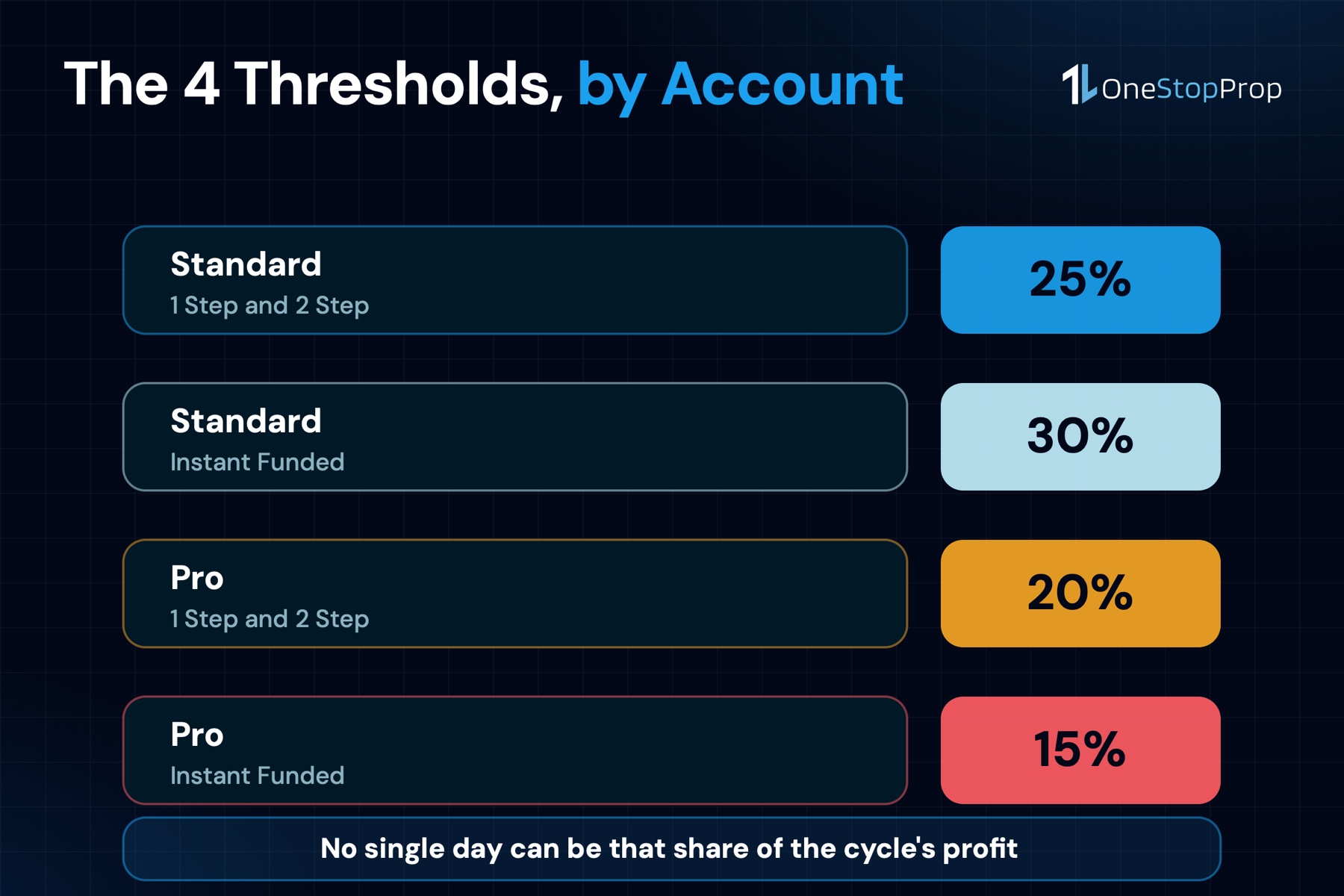
Once funded and approaching a payout request, the consistency rule activates. According to OneStopProp’s payout page, the thresholds are:
- Standard 1-Step and 2-Step: 25%
- Standard Instant Funded: 30%
- Pro 1-Step and 2-Step: 20%
- Pro Instant Funded: 15%
It does not fail your account. It delays the payout until your profit spreads out.
Standard Account: 25% Rule in Real Dollars
Take a $100K Standard 2 Step funded account. The account targets an 8% Phase 1 and 5% Phase 2, carries a 4% max daily loss, an 8% max total loss, and a 90% profit split, with payouts every 14 days.
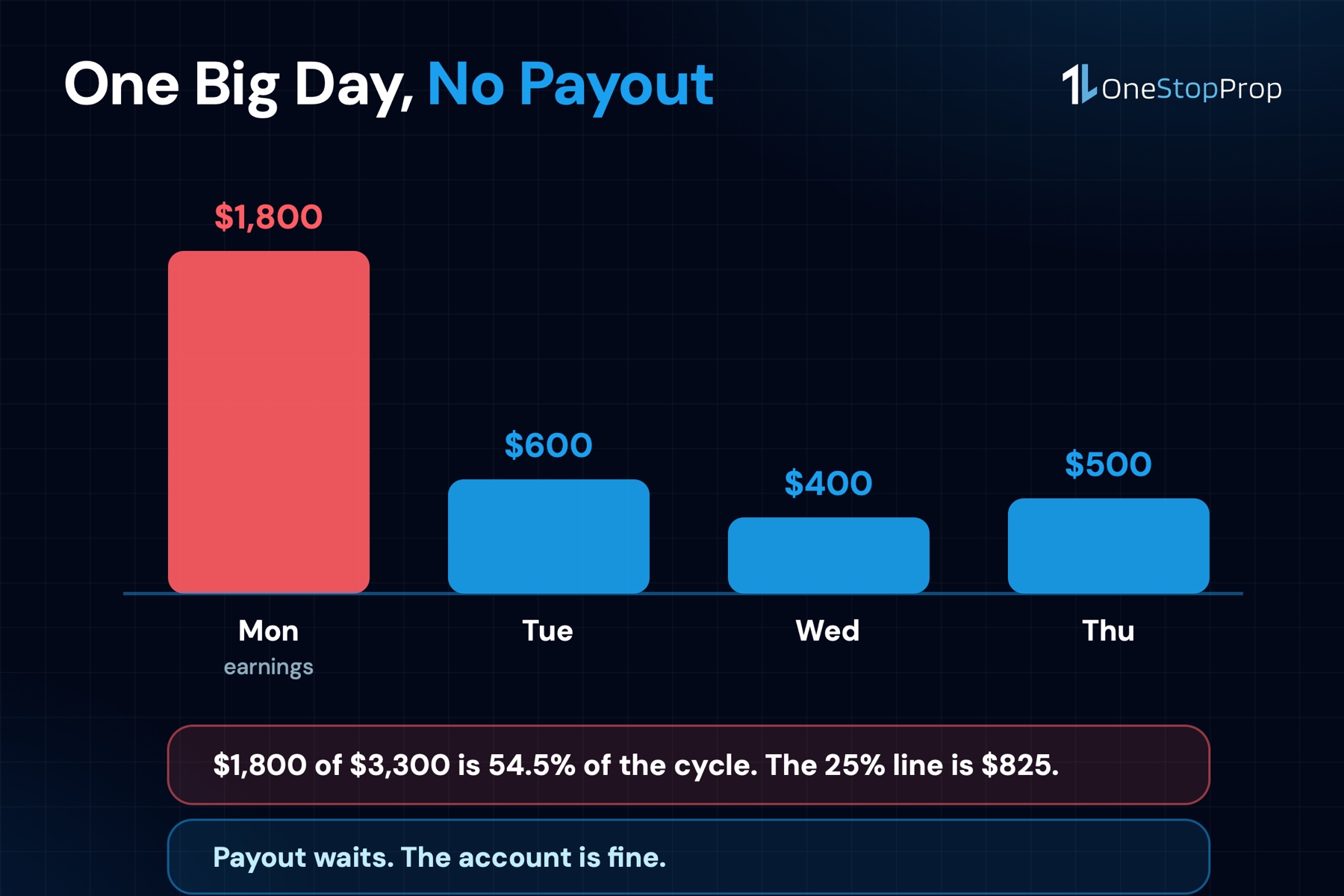
Scenario: During a payout cycle, you generate the following daily profits:
- Monday (Apple AAPL earnings): +$1,800
- Tuesday: +$600
- Wednesday: +$400
- Thursday: +$500
Total profit: $3,300. Best day: $1,800. Ratio: $1,800 / $3,300 = 54.5%. That is well above the 25% threshold, so the payout is blocked until the ratio comes down.
To meet the 25% consistency rule if you made $1,250 in a single trading day, your total profits must reach at least $5,001, because $1,250 is 25% of $5,000, and you need to be below 25%.
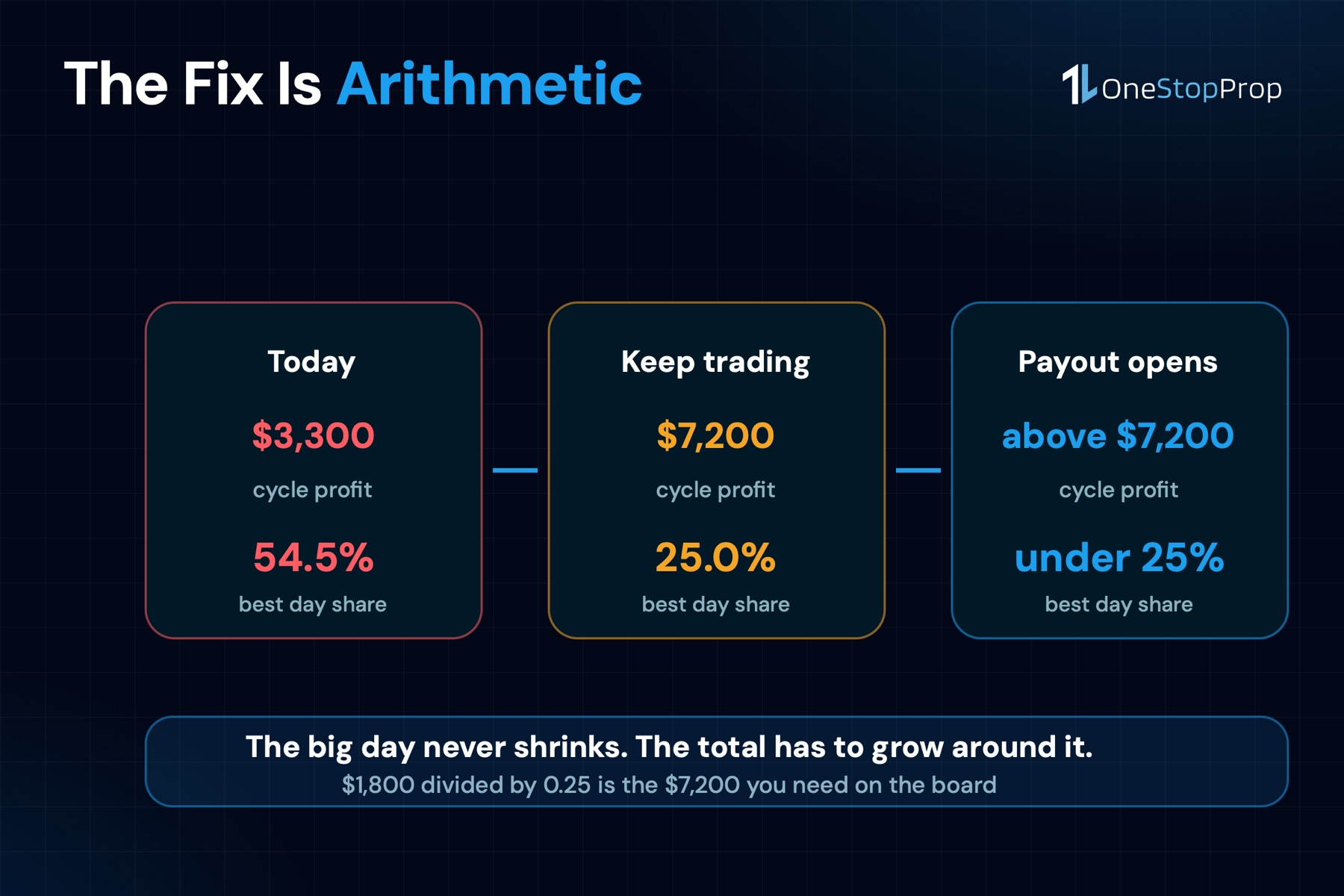
Translating that logic to the $1,800 day: $1,800 / 0.25 = $7,200 is the minimum total profit needed to bring the ratio to exactly 25%. You need to get above $7,200 in total cycle profit. With $3,300 already on the board, you need at least $3,901 more across additional sessions. If you average $500 per day, that is roughly 8 more sessions of steady trading before the payout unlocks.
Pro Tip: At the start of each payout cycle on a Standard account, set a mental daily profit cap at 20% of the profit you expect to make in the whole cycle. Keeping any single day below 20% of your running total gives you a comfortable buffer below the 25% threshold, so you are never scrambling to dilute a big session.
Pro Account: 20% Rule in Real Dollars
The OneStopProp Pro Account carries a tighter consistency threshold of 20% on 1 Step and 2 Step accounts, but it compensates with a 100% profit split on the first 5 payouts and a payout cycle of every 5 days after the first request.
The Pro account type pays 100% of profits on the first 5 payouts and 90% after that, while costing less than Standard at every account size.
Same $100K account, Pro version. You hit $900 on NVIDIA (NVDA) during a strong session after a Fed announcement. Your cycle total at that point is $2,000. Ratio: $900 / $2,000 = 45%. The 20% threshold is breached.
Say you trade 5 more sessions averaging $350 each. That adds $1,750, bringing the total to $3,750, and the ratio to $900 / $3,750 = 24%. Still above 20%, so that is not enough.
You need total profits of $900 / 0.20 = $4,500 to get the $900 day down to exactly 20% of the total. From $2,000, that means $2,500 more in additional sessions. At $350 per session, that is roughly 7 more trading days. Given the 5-day payout cycle on Pro, you may need to bridge into the next cycle, which reinforces the importance of front-loading your cycle with more sessions from the start rather than relying on a single strong open.
Pro Tip: On a Pro Account, your 5-day cycle is tight. If you have a strong day early in the cycle, do not slow down. Add 2 to 3 more normal sessions immediately. The denominator grows fastest in the days right after a big session, and you have a shorter window to get compliant than on Standard.
Common Mistakes That Trigger Consistency Violations
Chasing the Profit Target Too Aggressively Early On
A common mistake is starting conservatively, falling behind the profit target, and then increasing risk to catch up. This creates exactly the kind of P&L spike that triggers consistency violations. The result is a single large winning day that dominates the cycle. Flip the sequence: start with your normal risk, generate a few sessions of steady gains, then reduce size as you approach target, rather than ramping up when you feel behind.
Oversizing on High-Impact Catalysts
Stocks like Apple (AAPL), NVIDIA (NVDA), Microsoft (MSFT), Amazon, Alphabet/Google, Meta, and Tesla can move sharply on earnings or macro events. A position sized at your maximum allowable exposure on a strong catalyst day can produce a 1-session gain that locks your payout for an entire extra cycle.
Losing days are the hidden trap: they shrink your total, which raises your best day’s percentage without any new trading. This is the double hit many traders do not see coming. A string of small red sessions after a big winner does not help; it makes things worse by shrinking the denominator.
Not Tracking the Ratio After Each Session
Keep a running consistency score after every session, exactly as you would track an equity curve. This takes 30 seconds: divide your best session by total cycle profit. If you are already above 18% on a 20% threshold or above 22% on a 25% threshold, that is a warning signal. Cut position size for the next session to keep the next session’s contribution modest.
Pro Tip: Build a simple 2-column spreadsheet: daily P&L and running consistency ratio. Update it at the close of every trading day. This removes all surprise from payout time and lets you manage toward compliance with 3 to 5 days to spare.
Erratic Position Sizing to Manufacture Compliance
Sudden or erratic changes, such as trading 10 contracts one day and 2 the next solely to secure a payout, are not allowed. Adjustments that reflect market conditions, such as reducing contracts during periods of high volatility, are acceptable when aligned with a clear strategy. The rule monitors behavior, not just numbers. A dramatic size cut right before a payout request can trigger a manual review.
How to Build a Consistency-Friendly Trading Plan
Set a Per-Session Dollar Cap Before You Open the Platform
Set a mental cap at 20-30% of your total profit target per day, then stop trading when you hit it. That single discipline prevents most consistency violations before they happen.
For a OneStopProp Standard account targeting $3,000 in a cycle, a 20% cap means stopping any session at $600 in gains. That feels like leaving money on the table, until you factor in that exceeding it pushes you into a compliance problem that may cost you 8 more trading days.
The math to calculate your own daily cap:
Daily Cap = Estimated Cycle Profit Target x (Consistency Threshold – 5 points of buffer)
On Standard: $3,000 x 0.20 = $600 per session cap. On Pro: $3,000 x 0.15 = $450 per session cap. The buffer below the actual threshold keeps you out of close-call territory.
Spread Profits Across Multiple Sessions
Instead of one explosive winning day followed by flat performance, aim for steady gains across 4-10 sessions. This naturally dilutes your best-day percentage because no single session can dominate when profits accumulate gradually.
For stock traders at OneStopProp with access to the Magnificent 7 names, this means treating each earnings play, each Fed day, and each macro release as one input into a multi-session plan, not as a single event to maximize.
Use ATR-Based Position Sizing
The formula prop desks actually use is: position size = (account equity x risk %) / (stop distance in points x point value). Set your stop distance at 1.5x the 14-period ATR on your entry timeframe, tight enough to respect account rules, wide enough to survive normal noise.
This approach keeps daily P&L distribution flatter because position size shrinks automatically when volatility expands, exactly the sessions where consistency violations most commonly occur.
Pro Tip: On days when you are trading through a major catalyst on a Pro Account (news trading is permitted on Pro accounts), cut your standard position size by 30% before the session opens. If the move goes your way, you still book a meaningful gain. But that gain stays proportional to your cycle total rather than dominating it.
News Trading Considerations
OneStopProp Pro Accounts permit news trading, while Standard accounts do not. This is a meaningful structural difference. A strong FOMC reaction or Non-Farm Payrolls print can generate outsized intraday moves. On a Pro Account, those moves are accessible, but the 20% consistency threshold means sizing discipline on news days is even more important than on ordinary sessions.
Standard vs. Pro: Which Threshold Works for Your Strategy?
The choice between Standard and Pro at OneStopProp is made at checkout and covers both the account PATH (1 Step, 2 Step, or Instant) and the TYPE (Standard or Pro). These are separate decisions.
| Feature | Standard (2 Step) | Pro (2 Step) |
|---|---|---|
| Profit Targets | 8% then 5% | 10% then 5% |
| Max Daily Loss | 4% of initial balance | 4% of initial balance |
| Max Total Loss | 8% | 6% |
| Leverage | 1:50 | 1:20 |
| Profit Split | 90% | 100% first 5, then 90% |
| Payout Cycle | Every 14 days | Every 5 days after first |
| Consistency Rule (Funded) | 25% | 20% |
| News Trading | Not permitted | Permitted |
Pros (Standard):
- More lenient 25% consistency threshold
- Higher leverage (1:50) allows larger position sizing
- Lower profit target in Phase 1 (8% vs 10%)
Cons (Standard):
- Slower 14-day payout cycle
- No news trading
- 90% split from day one (no 100% opening phase)
Pros (Pro):
- 100% profit split on first 5 payouts
- 5-day payout cycle after first request
- News trading permitted
- Lower entry cost at every account size
Cons (Pro):
- Tighter 20% consistency threshold requires more session discipline
- Lower leverage (1:20) restricts maximum position sizing
- Stricter 6% max total drawdown
Within the catalogue, the Pro type is the cheaper entry at every size and pays more per payout, so it fits a trader whose strategy tolerates 1:20 leverage and a 5% to 6% total drawdown.
For traders whose strategy naturally distributes profits across multiple sessions, systematic approaches, multi-session swing trades on names like Tesla or Alphabet, the Pro Account’s tighter threshold costs little extra discipline while delivering the 100% split and 5-day payout cadence. For traders who rely on infrequent but large wins, Standard’s 25% threshold gives more room.
Frequently Asked Questions
Does the consistency rule apply during the OneStopProp challenge?
No. There is no consistency rule for challenges at OneStopProp. For traders who rely on patience and selective setups, this structure removes artificial pressure that forces sub-optimal trading. The rule activates only during the funded account payout cycle. Focus your challenge trading on hitting the profit target and respecting drawdown limits. Apply consistency discipline after you are funded.
What happens if I breach the threshold and request a payout anyway?
The payout request will not be approved until the ratio comes back into compliance. This rule does not result in account termination. You’ll simply need to continue trading and building profits until your largest trading day represents less than 25% of your total profit during that payout cycle. The account stays active. Keep trading normal sessions to grow the total cycle profit and dilute the best day’s share.
How is the payout cycle calculated at OneStopProp?
Traders can request a payout every 14 days on Standard accounts. The 14-day countdown begins from the day the previous payout was processed or denied. On Pro Accounts, the first payout request requires a minimum of 8 trading days. After the first payout, traders may request a payout every 5 days. The 5-day countdown begins on the date the previous payout request is processed.
Can I fix a consistency violation without taking more trades?
No. The only mechanical solution is to grow the total cycle profit so the best day’s share falls below the threshold. When a monster day happens anyway dilute it with normal days rather than undoing it. You cannot retroactively reduce profits on a winning session. Add steady, lower-volatility sessions until the ratio resolves itself.
Does position sizing affect the consistency review?
Yes, and this point trips up many traders. Position sizing is reviewed at payout. “Sudden or erratic” size changes made to secure a payout are not allowed, this is a discretionary test. Reducing contracts from 10 to 1 purely to generate smaller daily figures right before a payout request can be flagged during manual review. Keep your sizing aligned with your stated strategy throughout the cycle.
Does OneStopProp permit overnight and weekend holds?
Yes. On all account types and all paths, overnight and weekend holds are permitted. This matters for consistency planning because a trade opened on Thursday and closed Friday can split the gain across 2 sessions or concentrate it on Friday depending on when it closes, which affects the daily distribution. Plan your close timing with the cycle distribution in mind, especially on larger swing positions in names like Amazon or Microsoft.
Start Your Funded Account With Clear Rules
The consistency rule rewards traders who already do what good traders do: show up, apply a defined edge, and take profits distributed across sessions. It penalizes the opposite, concentrated bets, oversized catalyst plays, and last-minute position manipulation.
At OneStopProp, the challenge phase is free from the rule, giving you a clean run at the evaluation. The funded account payout phase applies a 25% threshold on Standard and a 20% threshold on Pro. Both are workable with straightforward session-capping and steady distribution.
If you are ready to start the challenge or compare the Standard and Pro options side by side, visit the OneStopProp checkout page and select the path and type that fits your strategy. The OneStopProp Help Center covers account-specific rules, drawdown parameters, and payout mechanics in detail. Before every scaling milestone, cross-reference your current account rules against the documentation there.
Sources
- Payout Rules, OneStopProp Help Center. The official consistency thresholds for every account type, and what happens if you breach them. https://help.onestopprop.com/faq/payout-rules/
- Payout Information and Guidelines, OneStopProp. Payout cycles, minimum trading days and request mechanics. https://help.onestopprop.com/faq/payout-rules/
- Why Traders Are Leaving Traditional Prop Firms in 2026, OneStopProp. Consistency thresholds stated for Standard and Pro. https://onestopprop.com/why-traders-are-moving-away-from-traditional-prop-firms-the-onestopprop-difference/
- How Funded Account Scaling Plans Work, OneStopProp. Challenge-phase rules and payout mechanics. https://onestopprop.com/funded-account-scaling-plan/
- Best Prop Firms for Stock Traders in 2026, OneStopProp. Pro Account payout cadence and structure. https://onestopprop.com/best-prop-firms-for-stock-traders-in-2026/