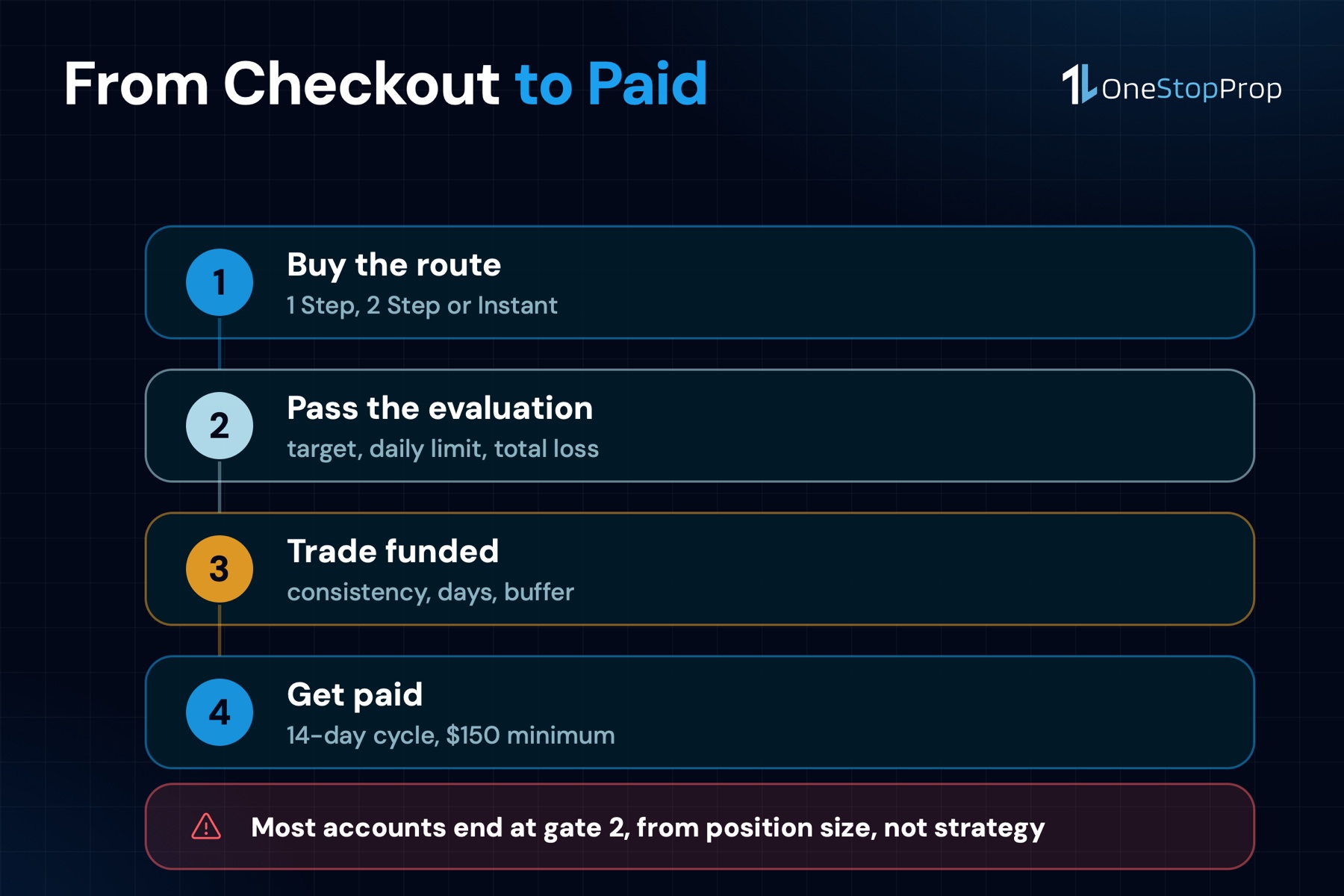
Funded account trading sounds like a shortcut and is usually sold like one. It is not. It is a sequence with 4 gates, and most traders who fail do not fail at the profit target. They fail at a rule they never read, somewhere between passing the evaluation and asking for money.
This walks the whole path at OneStopProp, from the checkout to the money landing: what each stage asks of you, what breaks an account, and what the first payout actually requires.
Key Takeaways
- You pick a route, a size, and the Add-Ons that fit how you trade. The route is 1 Step, 2 Step or Instant, and it sets the targets and the loss limits. The Add-Ons are where you buy your way out of a specific constraint.
- The daily loss limit is the rule that ends accounts, and reaching it is a breach, not a pause. It is 4% of the starting balance on 1 Step and 2 Step and 2% on Instant. There is no tomorrow on that account.
- Passing is not the finish line. After funding there is a consistency rule (25% on 1 Step and 2 Step, 20% on Instant), a minimum number of trading days per payout cycle, and a profit buffer before you can request anything.
- The base payout cycle is 14 days with a $150 minimum. The Faster Payouts Add-On removes the minimum trading day requirements and the waiting periods between payouts, provided all other account criteria are met.
- The fee comes back. OneStopProp refunds the evaluation fee after your third payout, which changes the arithmetic of what the attempt actually costs.
What a Funded Account Is, Exactly
A funded account is permission to trade a balance you did not deposit, inside rules the firm sets, in exchange for a share of what you make.
2 things follow from that, and both matter more than they sound.
The capital is not yours, so the firm decides what counts as acceptable risk, and those limits are tighter than anything you would impose on your own money. The loss is also not yours: the most you can lose is the fee you paid to attempt the evaluation. That trade, less freedom for more size, is the entire product.
At OneStopProp the trading happens on Match-Trader with TradingView charts, across 151 US stock CFDs plus forex, indices, commodities, metals and crypto. They are contracts for difference rather than shares you own outright, and the environment is simulated.
Stage 1: Choosing the Route
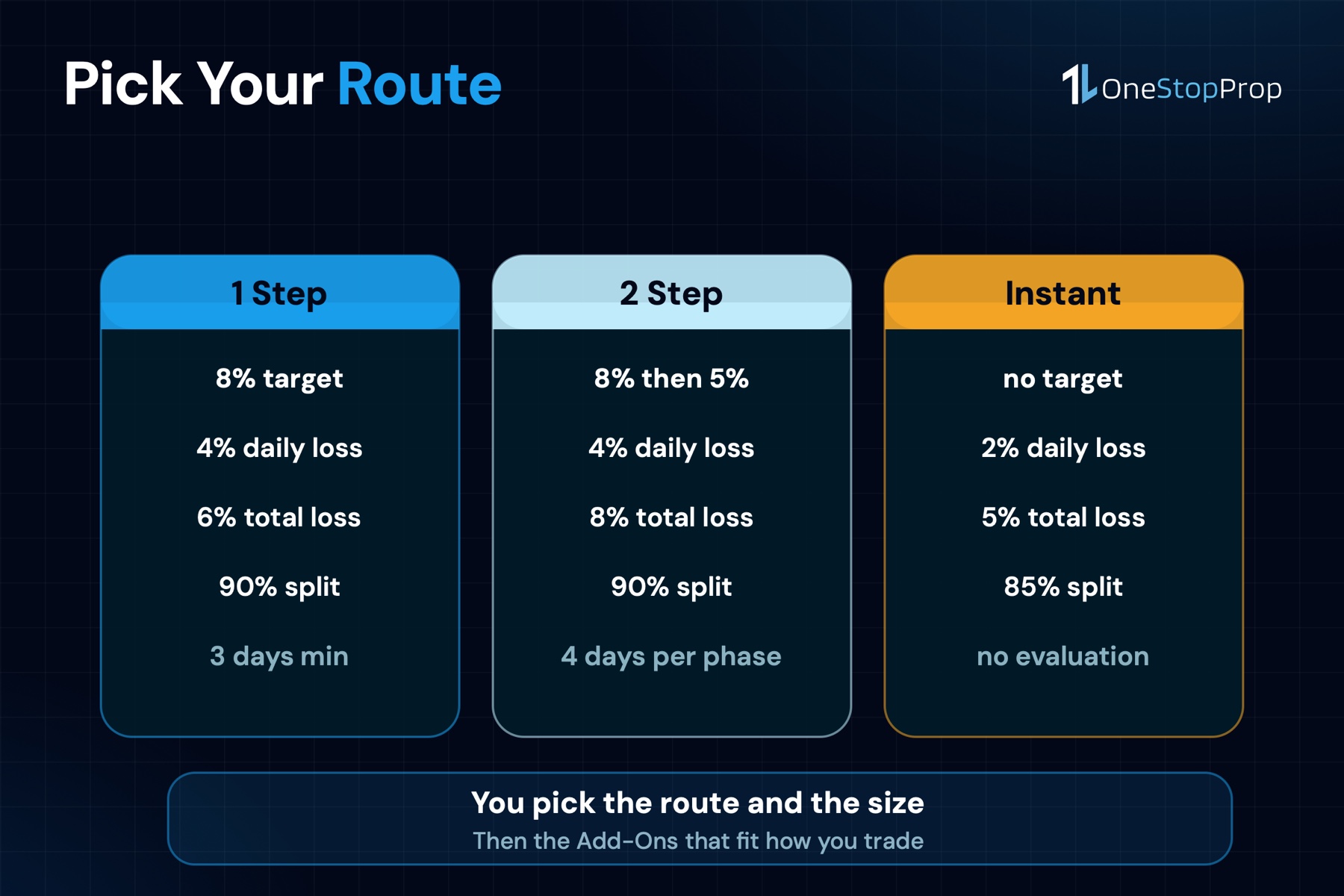
The checkout asks 2 things: which route and what size. It is worth slowing down for, because the routes are not 3 flavours of the same thing. The route sets your targets and your loss limits, and those are the numbers you will trade against every session.
| 1 Step | 2 Step | Instant | |
|---|---|---|---|
| Profit target | 8% | 8% then 5% | none |
| Max daily loss | 4% | 4% | 2% |
| Max total loss | 6% | 8% | 5% |
| Profit split | 90% | 90% | 85% |
| Minimum days to pass | 3 | 4 per phase | no evaluation |
1 Step asks for 8% in a single phase with a 6% total loss limit. The target comes fast and the cushion is thin.
2 Step splits the work: 8% in phase 1, then 5% in phase 2, with a wider 8% total loss limit. More time, more room, 2 chances to get it wrong.
Instant skips the evaluation entirely. You are funded from day one, which is why the limits are tightest: 2% daily, 5% total, and an 85% split instead of 90%.
Sizes run from $10K to $300K, except Instant, which runs from $25K to $200K. Scaling goes up to $1.2M in total allocation.
Pro Tip: the thin total loss limit is what catches 1 Step traders. An 8% target against a 6% loss limit means the market has to hand you a clean run. On 2 Step the same 8% sits against 8% of room, which is why it suits a strategy that needs a few bad days to get to a good month.
Stage 2: The Add-Ons
There are 7, and the percentage is what each adds to the price. Pick the ones that match the constraint your strategy actually runs into.
- 12% Max Total Loss + 6% Max Daily Loss, 35%. More room to lose before the account ends.
- Double Leverage, 15%.
- Account Double-Up, 50%. A second account of the same size, immediately. It is 2 accounts, not a bigger one.
- Faster Payouts, 35%. No minimum trading day requirements or waiting periods between payouts, provided all other account criteria are met.
- Zero Profit Buffer, 50%. No minimum buffer before requesting a payout, on any route. The account then runs a 15% consistency rule instead of its usual one.
- News Trading Allowed, 30%. Exempt from the 5-minute window either side of news on funded accounts.
- Lifetime Profit Split 95%, 15%. 95% of profits, permanently.
The useful way to read that list is as a set of constraints you can buy your way out of, each with a price. None of them makes the account easier to trade. They make it easier to get paid, or they widen the rope.
Stage 3: Passing the Evaluation
On 1 Step and 2 Step there is an evaluation, and it has 3 conditions that all have to be true at once.
Hit the profit target. 8% on 1 Step, 8% then 5% on 2 Step. There is no time limit, which removes the single worst pressure in funded trading: you are never forced to take a trade because a deadline is closing.
Never touch the daily loss limit. 4% of the starting balance on both routes. On a $100K account that is $4,000 in one session. Reaching it breaches the account, which is the sentence most traders read as “pauses the account” and later find out was literal.
Never touch the max total loss. 6% on 1 Step, 8% on 2 Step, measured from the starting balance rather than trailing your equity high. A balance-based floor means your cushion grows as you profit instead of chasing you upward.
There is also a minimum number of trading days: 3 on 1 Step, 4 per phase on 2 Step. It exists to stop a single lucky session from counting as a track record.
Pro Tip: work backwards from the daily limit, not forward from the target. On a $100K 2 Step account, risking 1% per trade means 4 consecutive losses reach the daily limit. Risking 0.5% means 8. The target takes care of itself if the limit never does.
Stage 4: Funded, and the Rules That Change
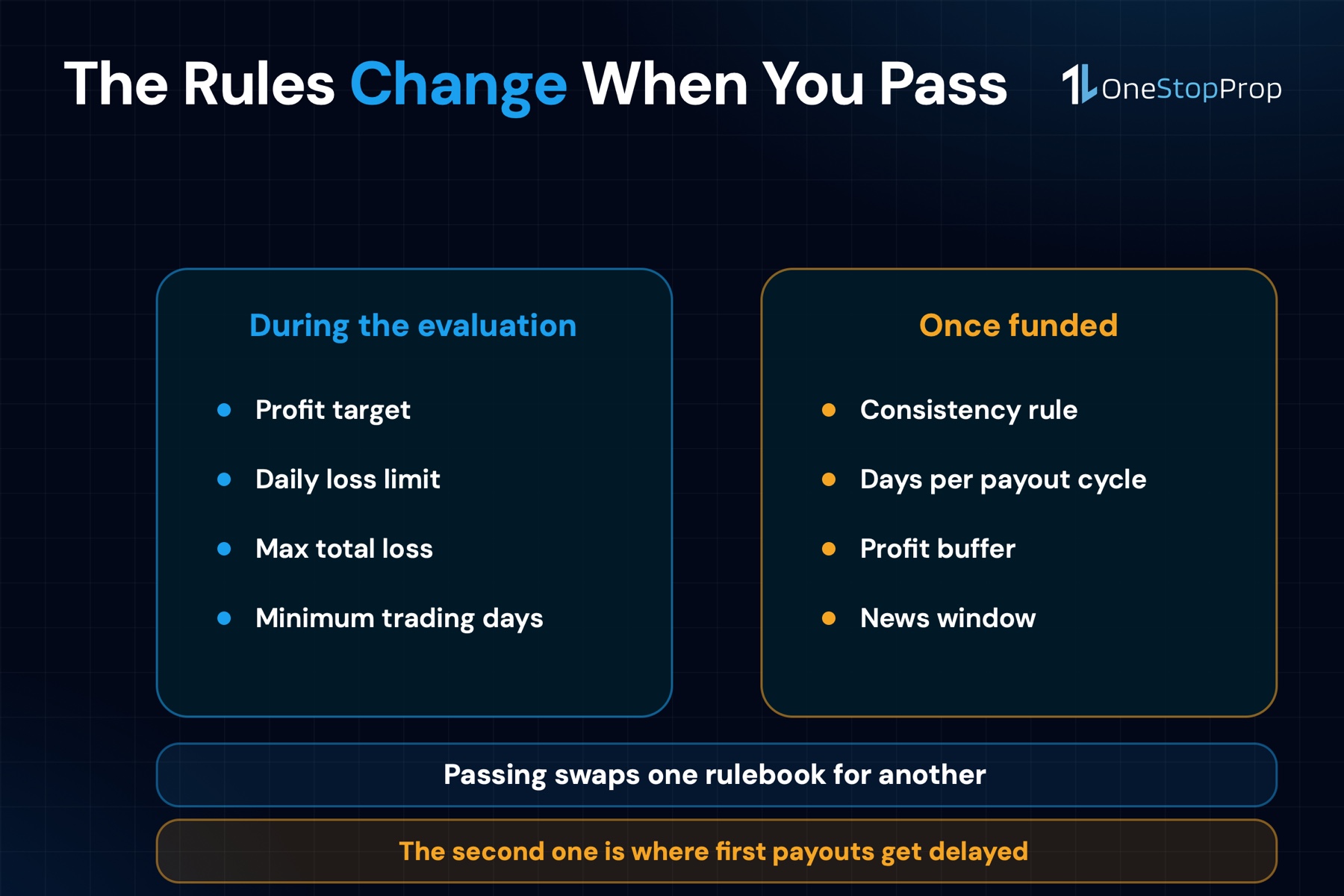
Passing moves you to a funded account, and a new set of rules starts applying. This is where most of the surprises live, because the evaluation rules are the ones everyone reads.
The consistency rule. No single trading day can account for 25% or more of your total profits in a payout cycle on 1 Step and 2 Step, or 20% or more on Instant. It does not fail the account. It holds the payout until the rest of your trading catches up to your best day.
Minimum trading days per cycle. 6 on 1 Step and 2 Step, 8 on Instant. Days you actually traded, not days that passed.
The profit buffer. 4% of the account size on 1 Step and 2 Step, 6% on Instant, before a payout can be requested. The Zero Profit Buffer Add-On removes it, at the cost of dropping the account to a 15% consistency rule.
The news window. Funded accounts cannot trade in the 5 minutes either side of scheduled news, unless the account carries the News Trading Allowed Add-On.
Stage 5: The First Payout
The base cycle is 14 days. Hit the day count, clear the buffer, stay inside the consistency rule, and you can request.
The split is 90% on 1 Step and 2 Step and 85% on Instant, or 95% on any route with the Lifetime Profit Split 95% Add-On. The minimum withdrawal is $150, and payouts go out by wire, crypto, Wise or PayPal.
On the first 5 payouts there are caps on how much can be withdrawn at once, scaling with account size from $1,000 on a $10K account to $6,000 on a $300K account. After the fifth, the caps come off.
And the fee comes back. OneStopProp refunds the evaluation fee after the third payout received, which means a trader who gets that far has been paid 3 times and has the cost of the attempt returned.
With the Faster Payouts Add-On the waiting disappears: no minimum trading day requirements and no waiting periods between payouts, provided all other account criteria are met.
Where Funded Accounts Actually Break
Reading the failure points in order is more useful than reading the rules in order, because they do not fail in the order they are written.
The daily loss limit, during the evaluation. Almost always from position sizing, not from a bad strategy. 2 trades sized for a personal account reach 4% faster than most traders expect.
The consistency rule, after funding. A trader passes, has one excellent day early in a cycle, and then cannot get paid until the rest of the cycle grows around it. Nothing is broken. The money is just later than planned.
The buffer, on a first payout. Clearing the profit target is not the same as clearing the buffer. They are separate numbers and the second one surprises people.
The news window. A funded trader who held through an earnings release on an account without the News Trading Allowed Add-On has broken a rule, regardless of whether the trade worked.
Frequently Asked Questions
How does funded account trading work?
You pay a fee to attempt an evaluation on a simulated balance. Hit the profit target without breaching the daily loss limit or the max total loss, and you move to a funded account where you keep most of the profits. At OneStopProp that is 90% on 1 Step and 2 Step and 85% on Instant, with payouts every 14 days once the cycle requirements are met.
How long does it take to get a funded account?
There is no time limit on the evaluation, so the honest answer is as long as your strategy needs. The floor is set by the minimum trading days: 3 on 1 Step, 4 per phase on 2 Step. Instant removes the evaluation entirely and funds you immediately, with tighter limits in exchange.
What happens if I hit the daily loss limit?
The account is breached. It does not pause until the next session and it does not reset overnight. That is why experienced funded traders set a personal stop well below the published number: 4% is the firm’s line, and the only one that protects you is the one you set under it.
Can I lose more than the fee I paid?
No. The capital is the firm’s, the environment is simulated, and your exposure is the cost of the evaluation. That is the structural reason funded accounts exist: it caps the downside of trading size you do not have.
When do I get my first payout?
After a full 14-day cycle in which you traded at least 6 days on 1 Step or 2 Step, or 8 days on Instant, cleared the profit buffer, and stayed inside the consistency rule. The minimum withdrawal is $150. With the Faster Payouts Add-On there are no minimum trading day requirements or waiting periods between payouts, provided all other account criteria are met.
Is the evaluation fee refundable?
Yes, after your third payout. That changes how to think about the cost: a trader who reaches the third payout has been paid 3 times and gets the fee back, so the real cost of the attempt is only paid by the attempts that do not get there.
The Bottom Line
Funded account trading is 4 gates, and only the first one looks like trading. Pick the route whose loss limit matches how your strategy actually behaves. Size from the daily limit rather than the balance. Expect the consistency rule to move your first payout later than you planned. And know that the fee returns if you get to the third one.
If you want to start, OneStopProp runs 1 Step, 2 Step and Instant routes from $10K to $300K, on stocks, forex, indices, commodities, metals and crypto in a single account, with no time limit on the evaluation.
Sources
- Payout Rules, OneStopProp Help Center. Consistency thresholds, minimum trading days, profit buffer and the Faster Payouts definition. https://help.onestopprop.com/faq/payout-rules/
- What is the Maximum Daily Loss?, OneStopProp. How the daily loss limit is calculated on each route. https://help.onestopprop.com/faq/what-is-the-maximum-daily-loss/
- What Instruments Can I Trade?, OneStopProp Help Center. The 151 US stock CFDs and the rest of the instrument list. https://help.onestopprop.com/faq/what-instruments-can-i-trade/
- OneStopProp Checkout, OneStopProp. Routes, sizes and the 7 Add-Ons with their surcharges. https://checkout.onestopprop.com/checkout/
- Prop Firm Consistency Rule: How It Works, OneStopProp. The rule that holds first payouts, worked in dollars. https://onestopprop.com/prop-firm-consistency-rule/
- Stop Loss vs Stop Limit, OneStopProp. Which order type actually exits when the daily limit is at stake. https://onestopprop.com/stop-loss-vs-stop-limit/