Market order vs limit order is the first decision in every trade and the one most traders make by habit. A market order fills now at whatever the price is. A limit order fills at your price or not at all. Both are correct, for different jobs, and on a funded account the wrong one costs you in a specific place: the daily loss limit.
This guide puts numbers on the trade-off. It measured every session of the last 12 months on the 155 U.S. stocks on OneStopProp’s instrument list, 36,036 of them: how far the open sat from the previous close, how often a buy limit placed below the open actually filled, and what the trader missed on the days it did not.
Then it sorts the jobs. Which order opens a position, which one closes it, which one belongs at a level, and which one the stop loss turns into when it fires.
Key Takeaways
- A market order buys certainty of fill and gives up certainty of price. Investor.gov’s definition is exact: you are almost always guaranteed execution, and the price may not be the one you expected.
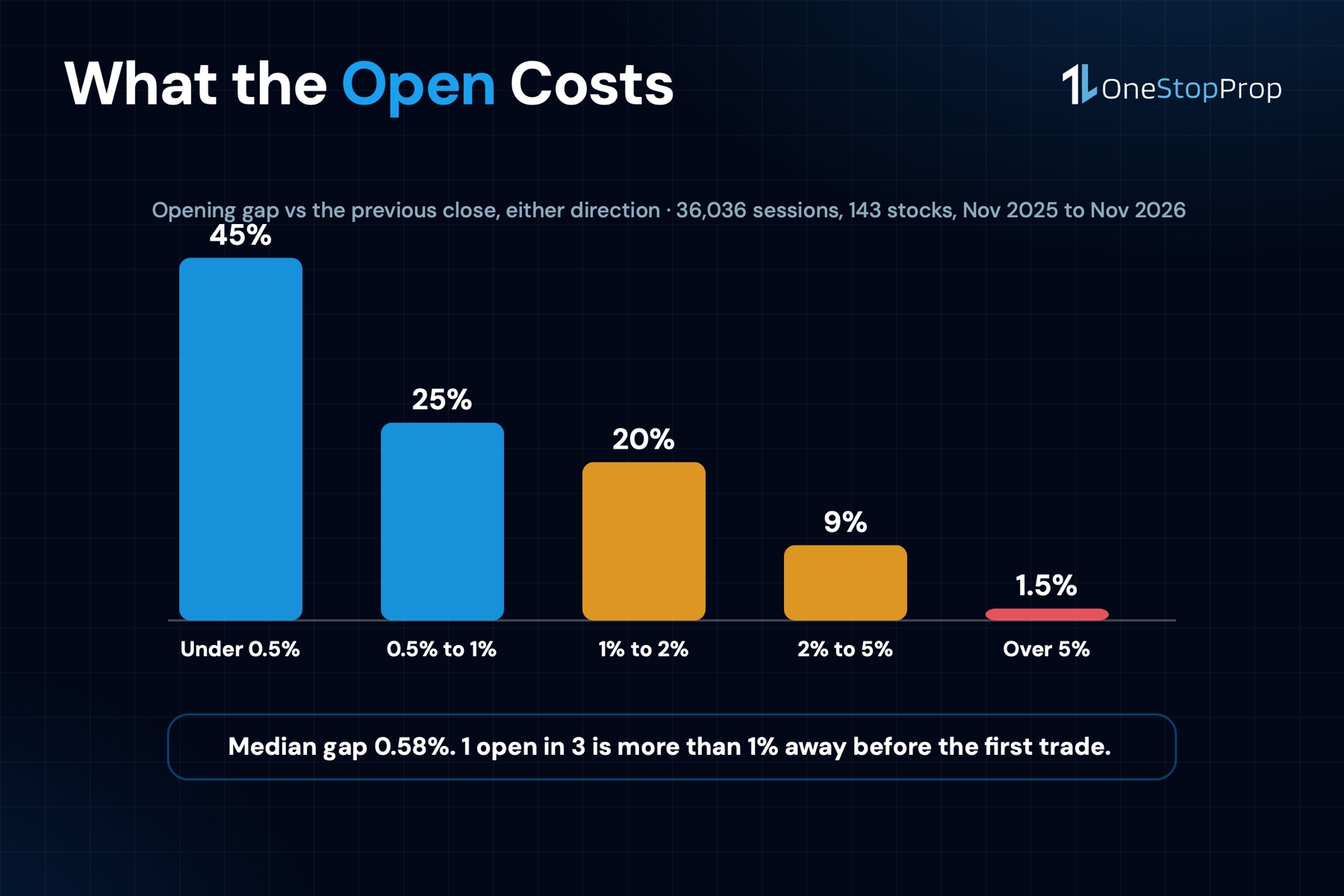
- The open is not the previous close. Across 36,036 sessions the median opening gap was 0.58%. 30% of sessions opened more than 1% from the prior close, 11% more than 2%, and 1.5% more than 5%.
- A limit below the open fills less often than it feels. A buy limit 0.5% under the open filled on 75% of sessions; 1% under, 54%; 2% under, 26%.
- The days a limit misses are the days the stock runs. When the 0.5% limit did not fill, the stock closed a median 1.18% above the open, and 56% of those sessions closed up more than 1%. The discount costs you the best days.
- The stop loss is a market order in disguise. When the stop price trades, the SEC’s definition says it becomes a market order. On a funded account the gap through a stop is the market order you did not plan for.
What a Market Order and a Limit Order Are
Investor.gov’s glossary defines a market order as an order to buy or sell a stock at the current market price. Its advantage: as long as there are willing buyers and sellers, you are almost always guaranteed the order will be executed. Its disadvantage: the price you pay may not be the price you expected.
The same source’s page on types of orders defines a limit order as an order to buy or sell at a specific price or better. A buy limit executes only at the limit price or lower; a sell limit only at the limit price or higher. The example it gives is a buy limit at $10 that executes only if the stock is $10 or less.
The SEC’s publication on trade execution adds the part that explains the whole market order vs limit order question: execution is not instantaneous. When you press enter, the order goes to your broker, who decides where to send it, and the price can move in between. A market order accepts that movement. A limit order refuses it.
On OneStopProp’s platform both are available. The Help Center’s page on placing orders lists market orders, limit orders, stop loss and take profit as the supported types, and the platform is Match-Trader with TradingView charts.
What the Open Does to a Market Order
The simplest market order a trader places is the one that fills at the open, after a decision made the night before. The question is how far the open is from the price the decision was made at. The scan measured the gap between each session’s open and the previous close on 143 stocks with 2 full years of data, 36,036 sessions from November 3, 2025 to November 3, 2026.
| Opening gap, either direction | Share of sessions |
|---|---|
| Under 1% | 70% |
| 1% to 2% | 20% |
| 2% to 5% | 9% |
| More than 5% | 1.5% |
The median gap was 0.58%. 1 session in 4 opened more than 1.17% from the previous close. That is the price of a market-on-open order on an ordinary day, before the stock has traded a share in the regular session.
Some names gap more than others. The largest median gaps on the list were OKLO at 1.91%, MSTR at 1.86%, INTC at 1.74%, COIN at 1.72%, AMD at 1.51% and HOOD at 1.48%. The smallest were KO at 0.31%, V at 0.33%, CVS at 0.34% and MSI at 0.34%. A market order at the open on OKLO is a bet on a 2% move you have not seen yet; on Coca-Cola it is a rounding error.
The day’s range tells the same story in a different unit. The median session on these stocks travelled 2.66% from low to high, and 1 session in 4 travelled more than 3.91%. A market order placed at a random moment inside that range is placed at a random point in a 2.66% band.
What a Limit Order Costs: the Fills It Misses
The other half of market order vs limit order is harder to see, because the cost of a limit order is a trade that never happened. The scan measured it directly. For every session, a buy limit was placed a fixed distance below the open. It filled if the session’s low reached it. If it did not fill, the scan recorded where the stock closed relative to the open, which is roughly what a market order at the open would have earned.
| Buy limit below the open | Filled | When it did not fill: close vs open, median | Missed sessions that closed up 1% or more |
|---|---|---|---|
| 0.25% | 87% | +1.41% | 64% |
| 0.5% | 75% | +1.18% | 56% |
| 1% | 54% | +0.83% | 45% |
| 2% | 26% | +0.41% | 34% |
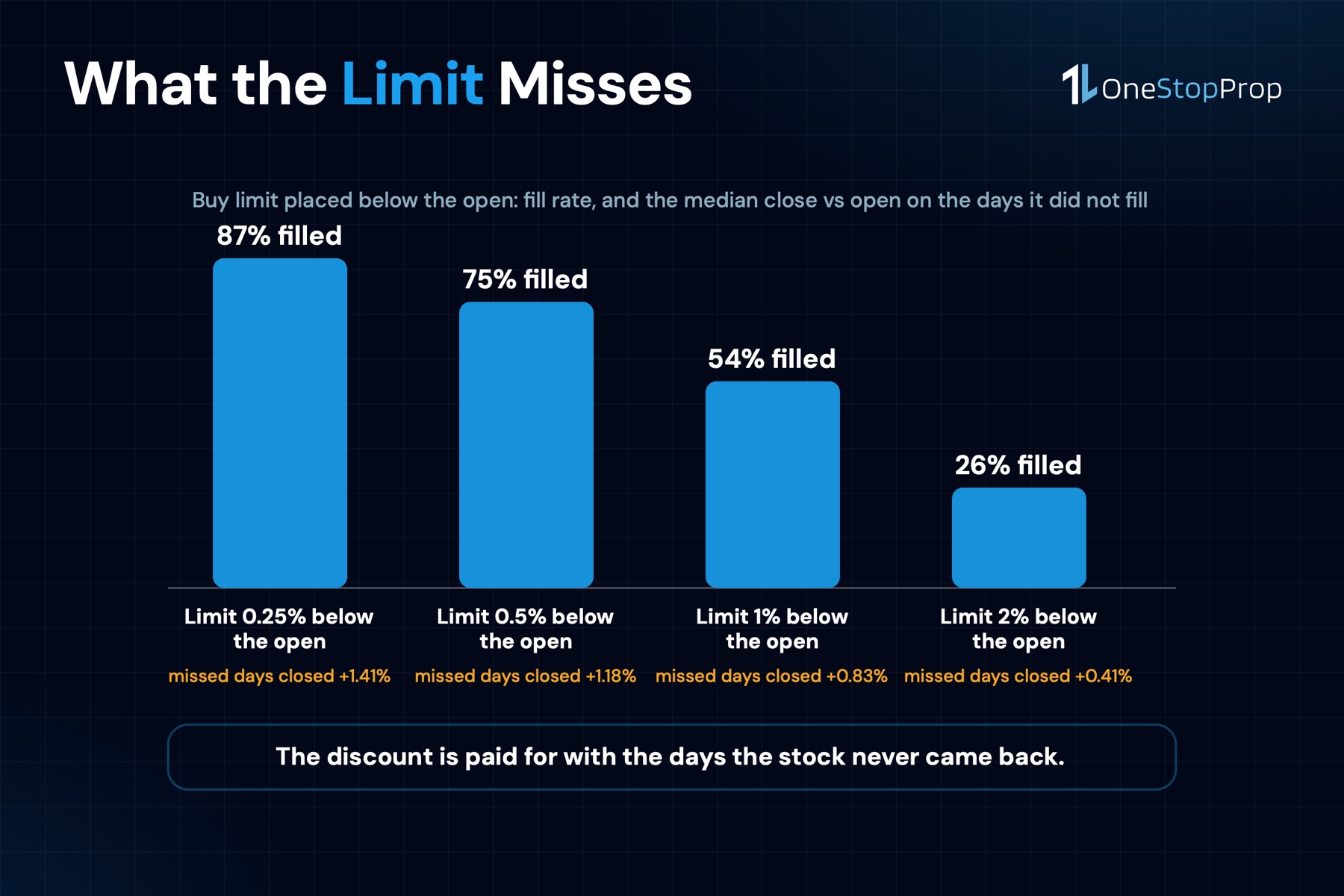
3 things to read there.
The discount is paid for with the best days. When the 0.5% limit missed, the stock closed a median 1.18% above the open, and more than half of those sessions closed up over 1%. A limit order filters out exactly the sessions where the price never came back, which are the sessions a breakout trader wanted.
The fill itself is not a bargain. On the sessions where the limit did fill, the close was within a few hundredths of a percent of the fill price, at every distance. The stock that comes down to your limit is, on the median day, a stock that is going down, and it finishes the day about where it found you.
Deeper is rarer, not better. A limit 2% under the open filled 1 session in 4. The misses at that distance closed a median 0.41% up, so the cost per miss is lower, but there are 3 times as many misses. There is no distance at which the limit order gets the stock cheaper on average than the market order did; what changes is which days you own.
Pro Tip: decide the order type by what the trade is for. A limit order is a statement that the price matters more than the trade. A market order is a statement that the trade matters more than the price. If you cannot say which one you mean, you are not ready to place either.
Market Order vs Limit Order on a Funded Account
The order types are the same on any account. 4 rules on a funded account decide which one you reach for.
The daily loss limit is measured from the higher of balance or equity at midnight. OneStopProp’s Help Center sets the maximum daily loss at 4% of the initial balance on 1 Step and 2 Step accounts and 2% on Instant, calculated at 12:00 AM EST. On a $100K 2 Step account that is $4,000. A market order at the open on a stock that gaps 2% against you has spent $2,000 of that on a $100,000 position before you have done anything, and $200 on a $10,000 position. The gap does not care about the order type; the position size does.
The stop loss becomes a market order when it fires. The SEC’s page on stop orders says it in 1 sentence: when the stop price is reached, a stop order becomes a market order. Every stop you place on a funded account is a market order waiting for a trigger, and on the 11% of sessions that open more than 2% away, it fires at the open, not at the stop. The stop loss vs stop limit guide works through the alternative, a stop limit that may not fill at all.
The news window closes the choice for you. On funded accounts, all trades must be closed 5 minutes before and may not be opened until 5 minutes after FOMC, NFP, CPI, PPI and earnings, unless the account carries the News Trading Allowed Add-On. A limit order resting through that window is an order that could fill inside it. The exit before the window is a market order by necessity.
Halts reopen with a market, not with your limit. A stock halted mid-session reopens at whatever price the auction finds, as the trading halts guide shows, and the Help Center recommends closing positions during halts and abnormal conditions. A limit order does not protect a position through a halt; it just declines to fill at the reopen.
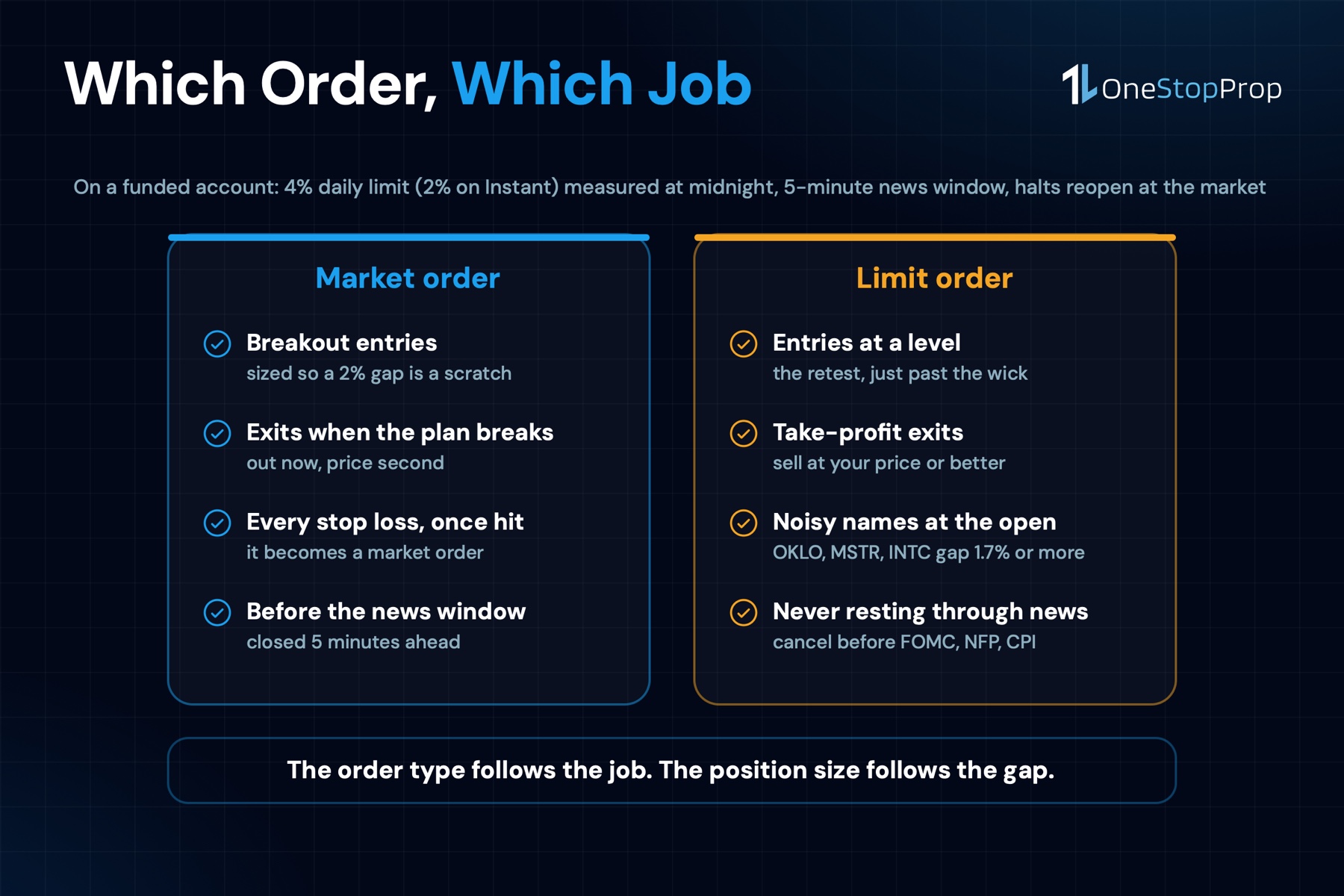
Which Order for Which Job
The scan and the rules sort the jobs cleanly.
Entries at a level: limit. If the plan is to buy a retest of support or sell a retest of resistance, the price is the plan. A limit at the level, or just above it, is the only order that executes the plan rather than an approximation of it. The support and resistance trading scan found that the wick overshoots the level on a quarter of holds by a median 0.42%, which is where the limit goes.
Entries on a breakout: market, sized for the gap. A 20-session breakout or an opening range breakout is a trade that exists because the price is moving away. A limit below the move is the 0.5% discount that misses 56% of the sessions that closed up more than 1%. Take the market order and let the stop distance set a position small enough that a 2% gap is a scratch.
Exits for risk: market. A stop loss is a market order by definition, and a discretionary exit when the plan is broken should be one too. The trailing stop loss guide measured 538 trades and found that gaps through a stop filled more than 1% below it on 11 of 408 trailing stops; the alternative, a stop limit, is a stop that may not fill while the account keeps losing.
Exits for profit: limit. A take profit is a limit order by construction: sell at this price or better. It works while you are asleep, which on a funded account matters, because open profit at midnight raises the next day’s floor under the daily loss rule.
Market-on-open: only with a reason. 30% of opens are more than 1% from the previous close. The best time to day trade stocks guide measured where the day’s range lives; the first minutes carry a large share of it. A market order at 9:30 AM ET is a trade placed at the widest spread and the largest gap of the day.
The Arithmetic of One Gap
Take a $100K 2 Step account, a $4,000 daily limit, and a trader who holds 3 positions of $15,000 each overnight, $45,000 of exposure, with stops 3% below each entry.
- A 2% gap against all 3 at the open, which happened on 11% of sessions for the median stock on this list, is $900 of equity gone before the first trade. The stops have not fired; the market orders inside them are waiting at 3%.
- A 5% gap on 1 of them, which happened on 1.5% of sessions, fires that stop at the open, 5% down instead of 3%: a $750 loss on a trade planned for $450, and $300 of the daily limit spent on the difference between a stop and a market order.
- The same 3 positions at $5,000 each turn those numbers into $300 and $250. The order type did not change. The share count did.
The risk reward ratio guide has the win rates a plan needs; none of them survive a position that gaps through a 4% limit on a Tuesday.
Common Mistakes With Market and Limit Orders
Using a limit order to be clever on a breakout
The 0.5% discount filled 75% of the time and missed the sessions that closed a median 1.18% higher. On a breakout the price running away is the signal. A limit below it is a refusal to take the signal.
Using a market order at a level
A support bounce is a price, and a market order placed when the price “looks close” is placed somewhere inside a 2.66% daily range. The limit at the level is the trade.
Trusting a stop limit to protect a funded account
A stop limit refuses to fill below its limit price, and the account keeps losing while it refuses. The daily loss limit does not refuse anything.
Placing market orders at the open by default
The median gap is 0.58% and the median range is 2.66%. A trader who enters at 9:30 AM ET every day pays the widest part of the day for the privilege of being early.
Leaving limit orders resting through the news window
An order that fills 2 minutes before the CPI on a funded account is a rule breach, not a fill. Cancel resting orders yourself before FOMC, NFP, CPI, PPI and earnings: a limit that fills inside the window opens a position the rule does not allow.
Frequently Asked Questions
What is the difference between a market order vs limit order?
A market order executes immediately at the current price and guarantees the fill but not the price. A limit order executes only at your price or better and guarantees the price but not the fill. Investor.gov’s definitions put it the same way: certainty of execution against certainty of price.
Which is better for a funded account, market order or limit order?
Neither is better; each has a job. Entries at a level and take-profit exits are limit orders. Breakout entries sized for the gap and risk exits are market orders, and a stop loss becomes a market order when it fires. The daily loss limit on a funded account is why the position size, not the order type, decides how much a gap costs.
How often does a limit order fill?
On 36,036 sessions across OneStopProp’s stocks, a buy limit 0.25% below the open filled 87% of the time, 0.5% below filled 75%, 1% below filled 54% and 2% below filled 26%. When the 0.5% limit did not fill, the stock closed a median 1.18% above the open.
Does a market order get a worse price?
It gets an unknown price. On this list the median opening gap was 0.58% and 30% of sessions opened more than 1% from the previous close, so a market order at the open is placed before that gap is known. Inside the session the median high-to-low range was 2.66%.
What happens to a stop loss when the stock gaps?
A stop loss is a stop order, which becomes a market order when the stop price is reached, per the SEC. On a gap through the stop it fills at the open, not at the stop price. In the trailing stop scan on the same stocks, 11 of 408 trailing stops filled more than 1% below the stop.
Can I use market and limit orders on OneStopProp?
Yes. The Help Center lists market orders, limit orders, stop loss and take profit as the supported order types on the platform. The 5-minute news window still applies on funded accounts without the News Trading Allowed Add-On, so cancel resting orders yourself before FOMC, NFP, CPI, PPI and earnings; a limit that fills inside the window opens a position the rule does not allow.
The Bottom Line
Market order vs limit order is a choice between knowing the fill and knowing the price, and on real stocks the cost of each is measurable. A market order at the open eats a median 0.58% gap and a 2% gap 1 day in 9. A limit 0.5% below the open fills 3 days in 4 and skips the days the stock closed a median 1.18% higher. Neither gets the stock cheaper on average. They get you different days.
On a funded account the decision lives next to a daily loss limit measured at midnight and a stop loss that turns into a market order the moment it is touched. So the order type follows the job, and the position size follows the gap. Limit at the level, market on the break, market out when the plan is broken, limit out when the target is hit, and nothing resting through the news window.
If you want to run those orders on an account where the loss limits are already written down, start a funded account at OneStopProp: 1 Step, 2 Step or Instant, from $10K to $300K, with U.S. stock CFDs on the same list this scan used, market and limit orders on Match-Trader with TradingView charts, and no time limit on the challenge.
Sources
- Market Order, Investor.gov. An order to buy or sell at the current market price: execution almost always guaranteed, price not. https://www.investor.gov/introduction-investing/investing-basics/glossary/market-order
- Types of Orders, Investor.gov. Market, limit and stop orders defined, with the $10 buy limit example. https://www.investor.gov/introduction-investing/investing-basics/how-stock-markets-work/types-orders
- Trade Execution: What Every Investor Should Know, U.S. Securities and Exchange Commission. Execution is not instantaneous, and where and how an order is executed affects the price paid. https://www.sec.gov/investor/pubs/tradexec.htm
- Stop Order, U.S. Securities and Exchange Commission. A stop order becomes a market order when the stop price is reached. https://www.sec.gov/answers/stopord.htm
- Historical Quotes, Nasdaq. Daily open, high, low and close for the 155 stocks on OneStopProp’s instrument list, 12 months to November 3, 2026, used for the 36,036-session gap and limit-fill measurements. https://www.nasdaq.com/market-activity/quotes/historical
- How do I place orders on the trading platform?, OneStopProp Help Center. Market orders, limit orders, stop loss and take profit. https://help.onestopprop.com/faq/how-do-i-place-orders/
- What is the Maximum Daily Loss?, OneStopProp Help Center. 4% of the initial balance on 1 Step and 2 Step, 2% on Instant, measured at 12:00 AM EST from the higher of balance or equity. https://help.onestopprop.com/faq/what-is-the-maximum-daily-loss/
- Is news trading allowed?, OneStopProp Help Center. The 5-minute window around FOMC, NFP, CPI, PPI and earnings on funded accounts, and the News Trading Allowed Add-On. https://help.onestopprop.com/faq/is-news-trading-allowed/
- What happens during halts or abnormal trading conditions?, OneStopProp Help Center. The recommendation to close positions during halts and abnormal conditions. https://help.onestopprop.com/faq/what-happens-during-halts-or-abnormal-trading-conditions/
- What trading platform do you use?, OneStopProp Help Center. Match-Trader for execution, TradingView for charting. https://help.onestopprop.com/faq/what-trading-platform-do-you-use/