Nvidia CEO Jensen Huang resigns, and NVDA opens 13% lower. That is the whole morning of Thursday, November 12, 2026, in 1 sentence. Nvidia’s board announced that its co-founder has left as president, CEO and director, effective immediately, with CFO Colette Kress stepping in as interim chief. The stock, which closed at $173.73 on Wednesday, traded at $160.05 at 9:49 AM ET, down 7.9% after a worse open, and 33% below its closing high of $239.24 on October 6.
For a trader with a funded account, this is not a headline to have an opinion about. It is a stock that moved more in 19 minutes than it usually moves in a week, 3 trading days before an earnings report that the company has confirmed will go ahead on November 17. NVDA is on OneStopProp’s list of 153 U.S. stocks, long or short, so the question is practical: how do you trade a shock like this without the daily loss limit deciding the outcome for you?
This guide puts numbers on it. It measures what NVDA did after each of its 8 biggest 1-day drops since November 2024, what Intel’s stock did the last time a chip CEO left without warning, and how a 7% gap translates into the daily limit on a $100K account. Then it turns that into a plan for the next 4 sessions.
Key Takeaways
- The resignation is effective immediately. Jensen Huang resigns as president, CEO and board member after 33 years; Colette Kress is interim CEO while keeping the CFO job, and Harvey C. Jones becomes the board’s first-ever chair, per Nvidia’s November 12 release.
- The move is company-specific, not a sector selloff. At 9:49 AM ET, NVDA was down 7.9% while AMD was up 2.7% and Broadcom up 4.0%. On the DeepSeek day in January 2025, Broadcom fell 17.4% alongside NVDA. Different kind of shock, different hedge.
- Shocks like this get bought the next day more often than not, and take weeks to heal. After NVDA’s 8 closes of 6% or worse since November 2024, the next session was up 5 times, and the stock took a median of 46 sessions to get back to the pre-drop close.
- November 17 is inside the news window. Nvidia will report after the close on Tuesday; on a funded account without the News Trading Allowed Add-On, that means no NVDA position through the release.
- Size for the gap, not the range. 300 shares of NVDA at $160 and a gap like Monday’s 7.3% is $3,500, which is 88% of the $4,000 daily limit on a $100K 1 Step or 2 Step account, before the first trade of the day.
What Happened: The Timeline Behind the Headline
Nvidia’s own release, published Thursday, November 12, 2026, is short. The board announced that Jensen Huang has resigned as President, Chief Executive Officer and a member of the Board, effective immediately. Colette Kress, executive vice president and CFO since September 2013, agreed to serve as interim CEO while keeping her current role until a permanent successor is named. The board is starting a search and will consider internal and external candidates. It also named Harvey C. Jones, a former Synopsys CEO, as its first-ever chair. You can read the full text on the NVIDIA Newsroom.
The release does not give a reason. The reporting around it does. CBS News reports that the decision came amid an investigation into Huang’s affair with a woman U.S. intelligence agencies suspect was spying for China, and that 2 sources told CBS on Wednesday night that the board had been preparing to oust him. CNBC lays out the sequence: Huang admitted to the affair on Sunday, November 8; the New York Times reported a second relationship on Wednesday, November 11; the resignation came Thursday morning.
2 details in the release matter more to a trader than the rest. First, the board says it expects operations, customer commitments and the product roadmap to continue without interruption. Second, the company confirms it will report third-quarter fiscal 2027 results on Tuesday, November 17, at approximately 1:20 PM PT, as previously scheduled, with the call at 2 PM PT. The earnings date did not move. The CEO did.
The Selloff in Numbers
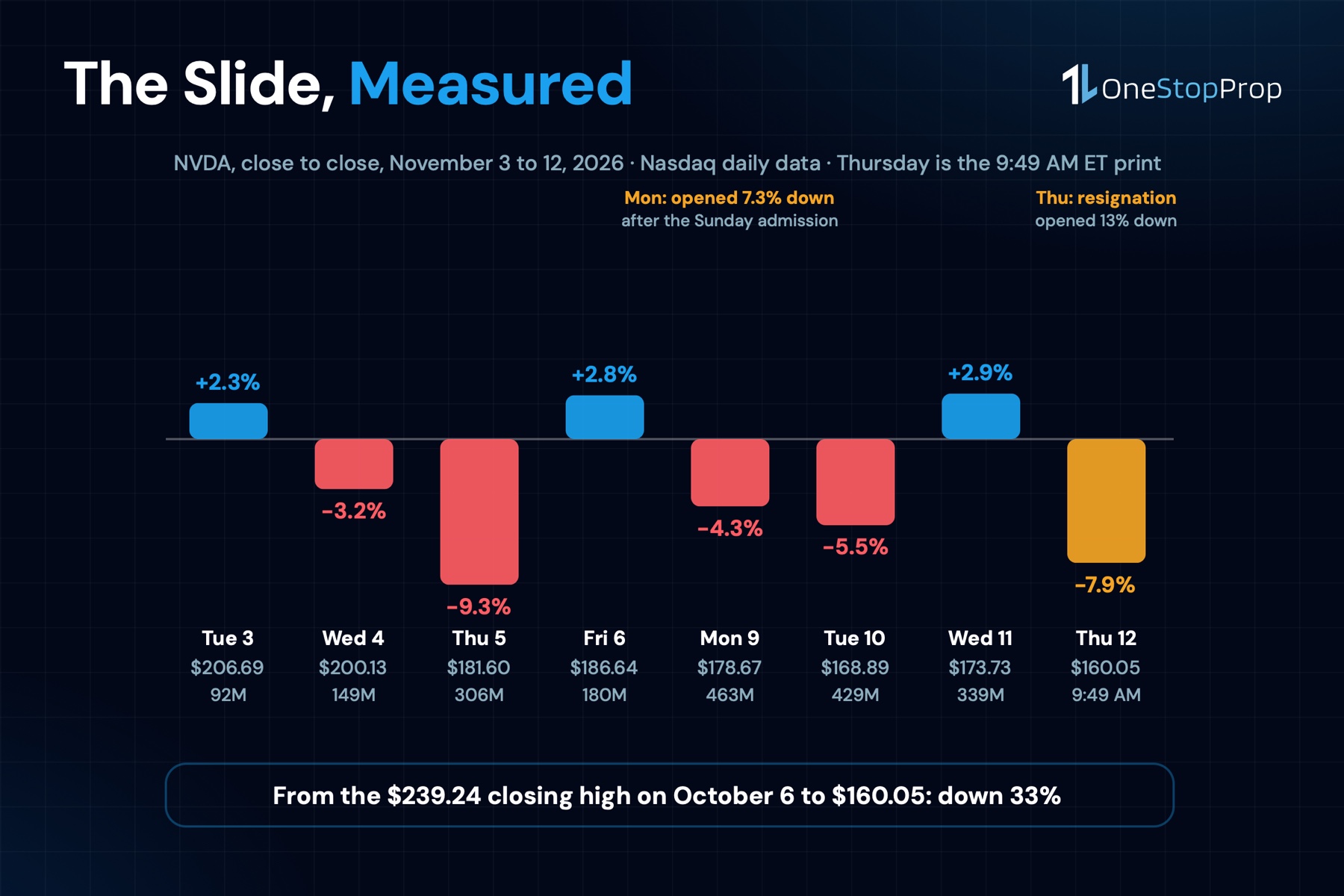
The drop did not start Thursday. Using daily data from Nasdaq, NVDA’s closing high of the year was $239.24 on October 6. It closed at $206.69 on November 3, then fell in 4 of the next 6 sessions:
| Session | Close | Change | Volume |
|---|---|---|---|
| Tuesday, November 3 | $206.69 | +2.3% | 92M |
| Wednesday, November 4 | $200.13 | -3.2% | 149M |
| Thursday, November 5 | $181.60 | -9.3% | 306M |
| Friday, November 6 | $186.64 | +2.8% | 180M |
| Monday, November 9 | $178.67 | -4.3% | 463M |
| Tuesday, November 10 | $168.89 | -5.5% | 429M |
| Wednesday, November 11 | $173.73 | +2.9% | 339M |
| Thursday, November 12, 9:49 AM ET | $160.05 | -7.9% | in progress |
A few things in that table are worth a trader’s attention.
Monday’s damage was in the gap. After the Sunday admission, NVDA opened at $173.07 on November 9, which is 7.3% below Friday’s close, then spent the session climbing back to close down 4.3%. Anyone holding through the weekend ate the whole 7.3% at 9:30 AM and got no stop fill on the way.
Volume ran 4 to 5 times normal. The median session in the 60 trading days through November 3 moved about 101 million shares. Monday did 463 million. Heavy volume on the way down is what makes the next-day bounces in the section below possible: it is also what makes the ranges wide enough to hurt.
Thursday’s open was worse than the print above. CNBC’s live coverage described the stock plunging over 13% at the open, with the company’s market value falling below $4 trillion. By 9:49 AM ET it had recovered to a 7.9% loss. A 5-point swing in the first 19 minutes is the kind of tape where a market order fills somewhere you did not intend.
The chip sector did not follow. At the same 9:49 AM print, AMD was up 2.7% and Broadcom up 4.0%, while TSMC was down 1.9% and Micron down 3.3%. Compare that with January 27, 2025, when NVDA fell 17.0% and Broadcom fell 17.4%, TSMC 13.3% and AMD 6.4% in the same session. That was a shock to the whole AI supply chain. Thursday’s is a shock to one company’s leadership, and the market is pricing it that way: capital rotating within the sector, not leaving it.
CNBC also reported that the stock had already lost more than 20% over the past month and was on its sixth straight weekly decline, the longest since 2012, before Thursday’s open. Bernstein cut its price target from $400 to $200 on the news. None of that tells you where NVDA closes Friday. It tells you the regime: wide ranges, heavy volume, and headlines that land outside market hours.
What NVDA Did After Its 8 Biggest Drops Since 2024
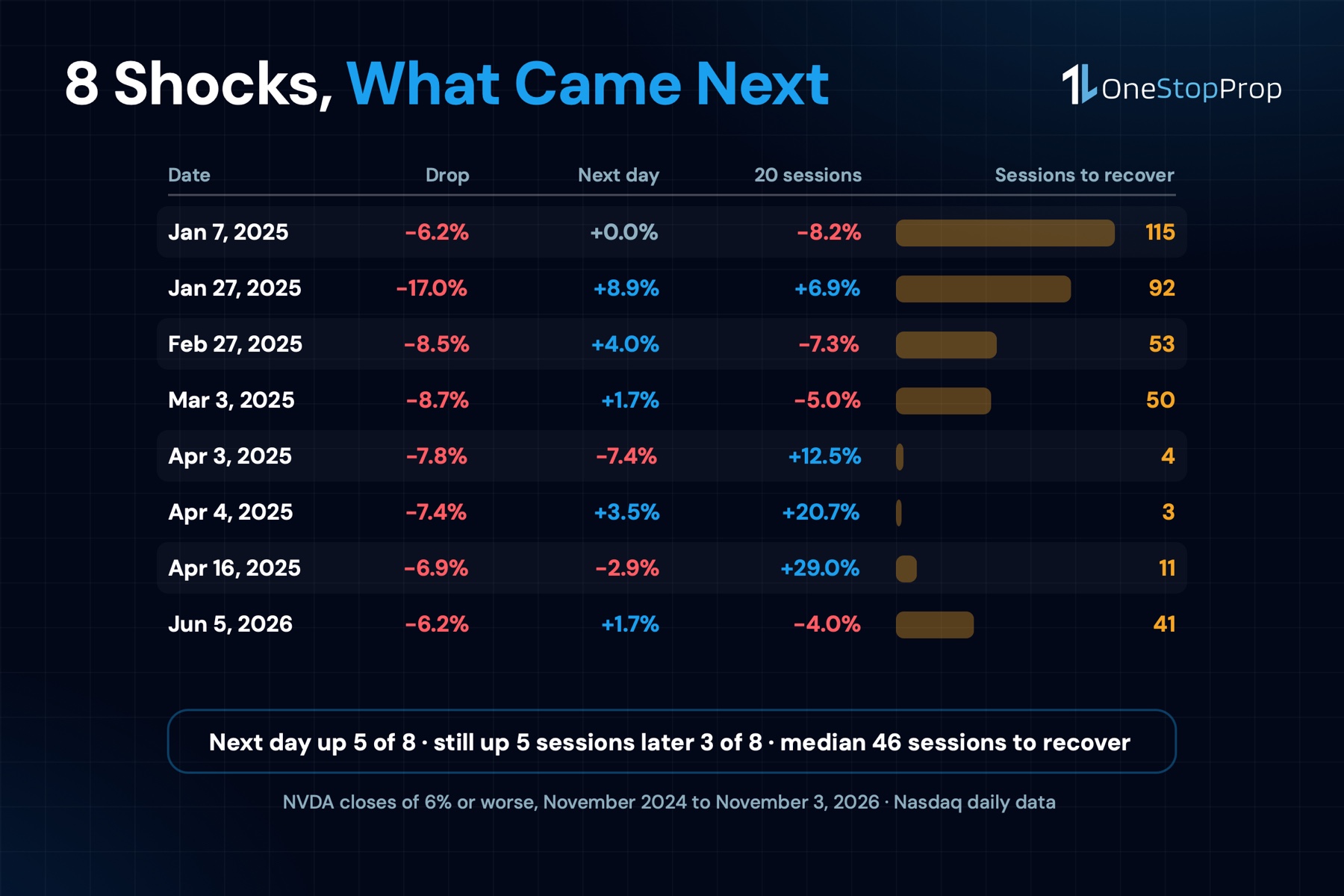
Here is the measurement that should sit under every decision this week. Taking NVDA’s daily closes from Nasdaq between November 1, 2024 and November 3, 2026, there are 8 sessions where the stock closed down 6% or more. For each one, the table shows what happened the next session, 5 sessions later, 20 sessions later, and how many sessions it took to close back above the pre-drop level.
| Date | Drop | Next session | 5 sessions | 20 sessions | Sessions to recover |
|---|---|---|---|---|---|
| January 7, 2025 | -6.2% | 0.0% | -2.8% | -8.2% | 115 |
| January 27, 2025 | -17.0% | +8.9% | -1.5% | +6.9% | 92 |
| February 27, 2025 | -8.5% | +4.0% | -8.0% | -7.3% | 53 |
| March 3, 2025 | -8.7% | +1.7% | -6.2% | -5.0% | 50 |
| April 3, 2025 | -7.8% | -7.4% | +5.7% | +12.5% | 4 |
| April 4, 2025 | -7.4% | +3.5% | +17.6% | +20.7% | 3 |
| April 16, 2025 | -6.9% | -2.9% | +1.9% | +29.0% | 11 |
| June 5, 2026 | -6.2% | +1.7% | 0.0% | -4.0% | 41 |
3 patterns, and 1 warning.
The next session leaned up. 5 of 8 were positive, and the biggest bounce followed the biggest drop: +8.9% the day after the DeepSeek selloff. Thursday’s intraday recovery from 13% down to 8% down fits that shape.
5 sessions later, the bounce had usually faded. Only 3 of 8 were higher a week on. The first-day buyers who held were underwater in 5 of the 8 cases.
Recovery took a median of 46 sessions. The 2 fast ones, 3 and 4 sessions, were the April 2025 tariff drops, which reversed on a policy announcement. The ones driven by company or sector news took 41 to 115 sessions. That is 2 to 5 months of a stock below its old level.
The warning is the ranges. The DeepSeek session had a 10.0% high-to-low range on 819 million shares, and the next day’s range was 11.0%. February 27 ran a 12.5% range. In the 60 sessions through November 3, the average range was 2.3%. The days after a shock are 4 to 5 times wider than normal, in both directions, and the daily loss limit on a funded account is measured against the whole day, not against your entry.
The Last Time a Chip CEO Left Suddenly: Intel, December 2024
There is a recent precedent for a chipmaker losing its CEO overnight. On Monday, December 2, 2024, Intel announced that Pat Gelsinger had retired as CEO and left the board, effective December 1, with 2 interim co-CEOs and a search committee, as its press release states.
INTC’s session that day, from Nasdaq’s daily data, is a lesson in how a CEO headline trades. The stock opened at $24.84, which is 3.3% above the prior close of $24.05, ran as high as $25.48, fell as low as $23.44, and closed at $23.93, down 0.5%. That is an 8.7% high-to-low range on 150 million shares, against 37 million the session before. Then it fell 6.1%, 2.3% and 5.3% over the next 3 sessions, closing at $20.80 on December 5, 13.5% below where it stood before the announcement.
Intel in 2024 and Nvidia in 2026 are different companies in different positions, and the reasons for the exits are not comparable. The mechanics are. The first session had a wide range and no net move; the real move came over the following days. A trader who sized Monday for the headline and was flat by the close missed the risk. A trader who held the “relief” open through the week carried the whole 13.5%.
Where the Opportunity Is This Week
Our point, and the reason this article exists, is that a shock like this is the kind of week a stock trader waits for. The numbers above say why, and they also say where the opportunity sits and where it does not.
The range is the opportunity. NVDA’s average high-to-low range in the 60 sessions through November 3 was 2.3%. The sessions after its biggest drops ran 10% to 12.5%, and Thursday moved 5 points in its first 19 minutes. A setup that normally offers 1R in a day offers 3R to 5R in a week like this, with the same stop logic and a smaller position. More movement per share is the whole reason to trade a stock this week instead of an index.
It cuts both ways, and shorting is allowed. The 8-drop record says the first bounce is real (up 5 of 8 the next day, +8.9% after DeepSeek) and that it fades (only 3 of 8 still higher 5 sessions later). That is a long setup on day 1 and a short setup on days 2 to 5, both with dates attached. On a funded account you can take either side, because shorting is permitted on every instrument.
The rotation is tradable inside the same account. At 9:49 AM ET, AMD was up 2.7% and Broadcom up 4.0% while NVDA was down 7.9%. Money leaving one AI name for the next is a relative-strength trade, and it only works if both names are on your list. OneStopProp’s list of 153 U.S. stocks has NVDA, AMD, AVGO, TSM and MU on it, long or short, next to forex, indices, commodities, metals and crypto. A futures-only account cannot take this trade at all.
The second catalyst is 3 sessions away. Nvidia’s November 17 report is confirmed, which means the stock has 2 headlines in 1 week. Without the News Trading Allowed Add-On, the position is flat before Tuesday’s close and the opportunity is the 3 sessions before it. With the Add-On, the release itself is tradable too. Either way, the sizing table below is what keeps the opportunity from becoming the day the account breaches.
Pro Tip: opportunity on a funded account is measured in R, not in dollars. A 10% range with a 2% stop is 5R of room; the same 10% range with a position sized for a 2.3% day is a breach. Size down, let the range pay.
What Changes on a Funded Account During a Shock Like This
Nothing in OneStopProp’s rulebook mentions CEOs. The rules that apply are the same ones that apply every week, and 4 of them meet this week head-on. Every figure below comes from the OneStopProp Help Center and applies to the funded stage.
The news window includes next Tuesday’s earnings. The Help Center’s answer to Is news trading allowed? lists all individual stock earnings reports, including post-market releases, among the restricted events: on funded accounts, all trades must be closed 5 minutes before the release and may not be opened until 5 minutes after.
Nvidia’s release is at approximately 1:20 PM PT, which is 4:20 PM ET, after the cash close, and U.S. stock CFDs trade when the exchanges do. In practice, a funded account without the News Trading Allowed Add-On is flat in NVDA before Tuesday’s 4:00 PM ET close and reopens no earlier than Wednesday’s open. With the Add-On, the restriction does not apply. Trading earnings releases covers how to plan around that window.
Overnight holds are allowed, and that is where the risk sits. The Help Center confirms that positions can be held overnight and over weekends. The daily loss limit is 4% of the initial balance on 1 Step and 2 Step and 2% on Instant, measured at 12:00 AM ET from the higher of balance or equity, per What is the Maximum Daily Loss?. A gap at the open counts against that day’s limit in full, before you have done anything.
Shorting is allowed on every instrument. The Help Center’s Is shorting allowed? says yes, across all instruments. For a stock in a 6-week decline with headline risk after hours, that matters: the setups this week are on both sides, and how to short a stock on a funded account walks through the mechanics.
Halts can freeze the exit. A stock moving 5 points in 19 minutes can trip the exchange’s volatility pause. Trading halts explains what happens to a stop inside one: nothing fills until the reopen, and the reopen price is the one you get.
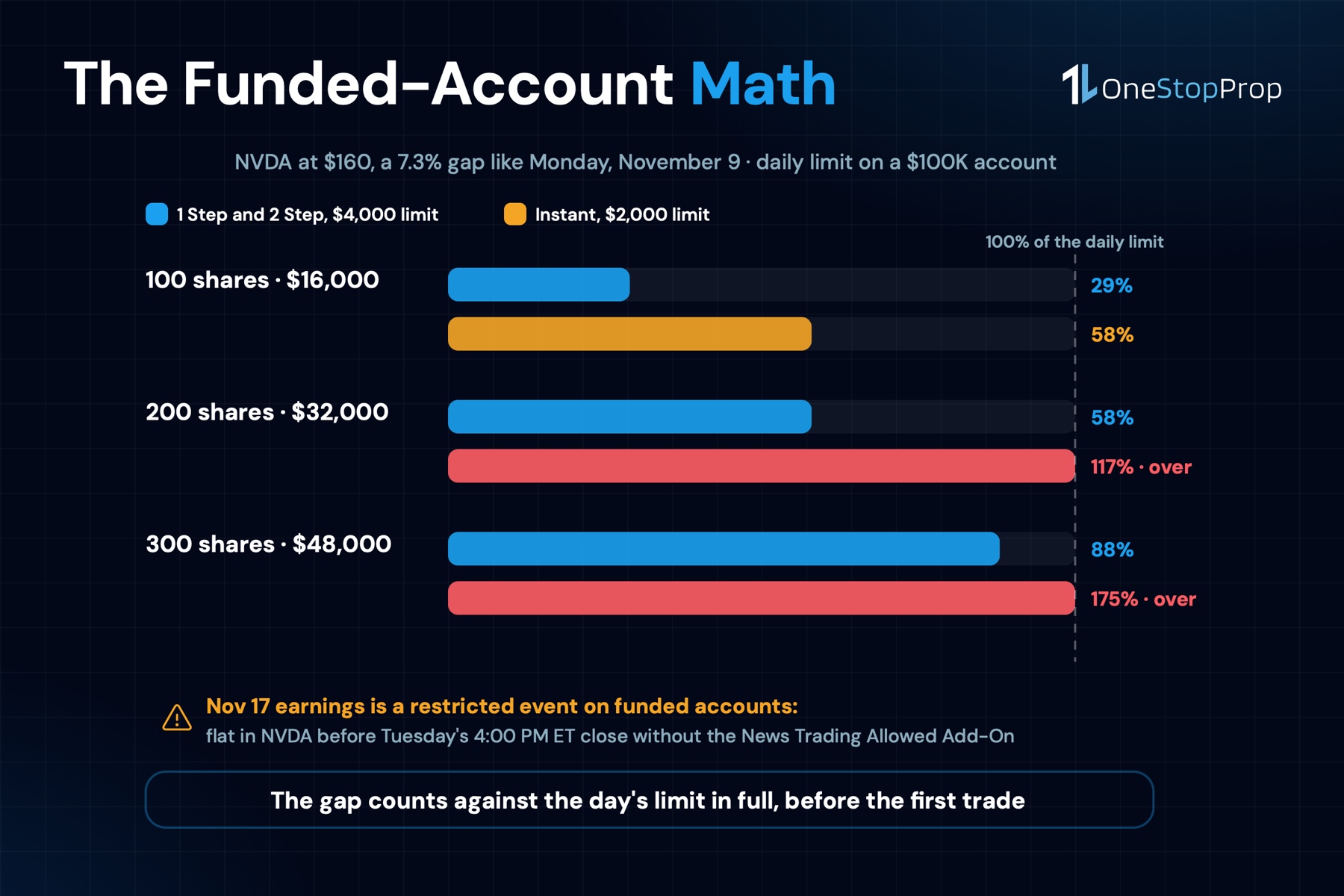
Now the arithmetic, on a $100K 2 Step account with a $4,000 daily limit, using Monday’s 7.3% gap as the yardstick and NVDA at $160.
| Position | Notional | 7.3% gap | Share of $4,000 limit (1 Step, 2 Step) | Share of $2,000 limit (Instant) |
|---|---|---|---|---|
| 100 shares | $16,000 | $1,168 | 29% | 58% |
| 200 shares | $32,000 | $2,336 | 58% | 117% |
| 300 shares | $48,000 | $3,504 | 88% | 175% |
A 17% move, the size of January 27, 2025, on the 100-share line is $2,720, which is 68% of the 1 Step and 2 Step limit and more than the whole Instant limit. The point is not that 100 shares is the right size. It is that the number has to be written down before the open, because at 9:31 AM it is already decided.
Pro Tip: for every NVDA position you plan to hold past the close this week, write down the dollar loss at a 7% gap and at a 17% gap. If the 7% number is above half your daily limit, you are not trading NVDA; you are betting on a headline you cannot stop out of.
A 4-Step Plan for NVDA Over the Next 4 Sessions
The data above turns into 4 decisions, in order.
- Trade the session, not the gap. The next-session record after a shock leans up, 5 of 8, but the open is where the slippage lives. Let the opening range print, then trade a level with a stop that can fill. The opening range breakout on a day like Thursday is a wider box than usual: size to the box, not to your habit.
- Cut overnight size to the gap you can afford. Use the table. If a 7% gap would use more than half the daily limit, the position is too big to sleep on. The recovery data says this stock has taken a median of 46 sessions to heal after a shock; there is no prize for carrying full size through the first night.
- Be flat in NVDA before Tuesday’s close unless you hold the Add-On. The November 17 release is a restricted event on a funded account. Put the alarm on the calendar now, because the week will be loud and the rule is quiet. The NVDA guide for prop firm traders covers how the earnings rule works on this specific stock.
- Keep the sector trade separate from the NVDA trade. Thursday’s print has AMD and Broadcom up while NVDA is down. If your thesis is “AI spending continues,” the stocks that are not losing a CEO are pricing that already. If your thesis is “NVDA is oversold,” that is a single-name trade with single-name gap risk, and it gets single-name sizing. Most volatile stocks lists what the rest of the AI complex is doing on a normal day, for comparison.
Common Mistakes This Week
Buying the first bounce and holding it for a week
The next session after NVDA’s 8 big drops was up 5 times. 5 sessions later, only 3 of 8 were still higher. The bounce is a day trade until the data says otherwise.
Treating the open as a price
The stock opened more than 13% down and was 7.9% down 19 minutes later. A market order at 9:30 AM on a day like this fills at the worst print of the morning. Market order vs limit order covers when each one belongs.
Forgetting the earnings rule because the CEO news is louder
November 17 is confirmed. On a funded account without the News Trading Allowed Add-On, an NVDA position through the close that day is a rule breach, not a bad trade.
Hedging NVDA with other chip stocks
On the DeepSeek day, the whole chain fell together, and a long AMD against short NVDA would have lost on both. On Thursday, AMD and Broadcom rose while NVDA fell. The correlation changes with the kind of shock, and a hedge built on last year’s correlation is a second position, not a hedge.
Sizing to the average day
NVDA’s average high-to-low range in the 60 sessions through November 3 was 2.3%. The sessions after its biggest drops ran 10% to 12.5%. A position sized for 2.3% is 4 to 5 times too large for the week after a shock.
Frequently Asked Questions
Why did Jensen Huang resign from Nvidia?
Nvidia’s November 12, 2026 release says only that Jensen Huang resigned as president, CEO and board member, effective immediately, and does not state a reason. CBS News reports the decision came amid an investigation into his affair with a woman U.S. intelligence agencies suspect was spying for China; CNBC reports he admitted to the affair on Sunday, November 8, and that a second relationship was reported on November 11.
Who is the new CEO of Nvidia?
Colette Kress, Nvidia’s executive vice president and CFO since 2013, is interim CEO while keeping her CFO role. The board is searching for a permanent CEO and will consider internal and external candidates. Harvey C. Jones, a former Synopsys CEO, was named the board’s first-ever chair.
How far has NVDA fallen?
From its closing high of $239.24 on October 6, 2026, to $160.05 at 9:49 AM ET on November 12, NVDA is down 33%. It fell 15.9% in the 6 sessions from November 3 to November 11, and opened more than 13% lower on November 12 before recovering part of the drop.
Can I trade NVDA on a funded account?
Yes. NVDA is on OneStopProp’s list of 153 U.S. stocks, available as CFDs, long or short, in the same funded account as forex, indices, commodities, metals and crypto. Overnight and weekend holds are allowed. The daily loss limit is 4% on 1 Step and 2 Step and 2% on Instant.
Is Nvidia’s earnings report still on November 17?
Yes. The company’s release confirms third-quarter fiscal 2027 results on Tuesday, November 17, at approximately 1:20 PM PT, with the call at 2 PM PT. On a funded account without the News Trading Allowed Add-On, that release is a restricted event: no NVDA trades 5 minutes before through 5 minutes after, which with an after-close release means flat before the 4:00 PM ET close.
What does NVDA usually do after a drop this size?
Measured on its 8 closes of 6% or worse since November 2024, the next session was up 5 of 8 times, with a median gain of 1.7%, but only 3 of 8 were higher 5 sessions later, and the stock took a median of 46 sessions to close back above the pre-drop level. The sessions right after a shock ran high-to-low ranges of 10% or more.
The Bottom Line
Nvidia CEO Jensen Huang resigns, NVDA gaps 13%, and the same stock that spent 2 years as the market’s steadiest bid is now the one with the widest range on the board. The record after its 8 biggest drops says the first bounce is real and short, the healing takes months, and the days in between are 4 to 5 times wider than a normal session. The Intel precedent says the first day is noise and the move comes after.
On a funded account, the decision is the same in every case: size for the gap you can survive, trade the session you can stop out of, and be flat before the November 17 release unless the Add-On says otherwise. The opportunity in a week like this is real, and it belongs to the trader whose daily limit is still intact on Wednesday morning.
If you want to trade NVDA, long or short, with the daily and total loss limits written down before the next headline lands, start a funded account at OneStopProp: 1 Step, 2 Step or Instant, from $10K to $300K, with 153 U.S. stocks, forex, indices, commodities, metals and crypto in the same account, no time limit and overnight holds allowed.
Sources
- NVIDIA Announces CEO Transition, NVIDIA Newsroom. The November 12, 2026 release: Jensen Huang’s resignation effective immediately, Colette Kress as interim CEO, Harvey C. Jones as first-ever chair, the CEO search, and the November 17 earnings date reconfirmed. https://nvidianews.nvidia.com/news/nvidia-announces-ceo-transition
- Nvidia CEO Jensen Huang resigns in wake of affair with woman suspected of spying for China, CBS News. The investigation behind the resignation and the board’s preparations to remove Huang, updated November 12, 2026, 9:30 AM EST. https://www.cbsnews.com/news/nvidia-ceo-jensen-huang-resigns/
- Nvidia stock falls nearly 10% as CEO Jensen Huang announces resignation, CNBC. The timeline from the November 8 admission to the resignation, the stock’s 20% decline over the prior month, and Bernstein’s price target cut from $400 to $200. https://www.cnbc.com/2026/11/12/nvidia-nvda-jensen-huang-second-affair.html
- Nvidia live updates: CEO Jensen Huang resigns, Colette Kress named interim chief, CNBC. The 13% plunge at the open, the market value below $4 trillion, the $239.24 closing high on October 6 and the sixth straight weekly decline. https://www.cnbc.com/2026/11/12/nvidia-jensen-huang-ceo-live-updates.html
- NVIDIA Corporation (NVDA) Historical Data, Nasdaq. Daily opens, highs, lows, closes and volume used for the November 2026 table, the 8-drop measurement and the 9:49 AM ET quotes on November 12, 2026. https://www.nasdaq.com/market-activity/stocks/nvda/historical
- Intel Announces Retirement of CEO Pat Gelsinger, Intel. The December 2, 2024 announcement used as the precedent for a sudden chip CEO exit, with INTC’s session data from Nasdaq. https://www.intel.com/content/www/us/en/newsroom/news/intel-ceo-news-dec-2024.html
- Is news trading allowed?, OneStopProp Help Center. The 5-minute window before and after restricted events on funded accounts, including all individual stock earnings reports, and the News Trading Allowed Add-On. https://help.onestopprop.com/faq/is-news-trading-allowed/
- What is the Maximum Daily Loss?, OneStopProp Help Center. The 4% daily limit on 1 Step and 2 Step, 2% on Instant, measured at 12:00 AM ET from the higher of balance or equity. https://help.onestopprop.com/faq/what-is-the-maximum-daily-loss/
- Can I hold trades overnight and over weekends?, OneStopProp Help Center. Overnight and weekend holds are allowed. https://help.onestopprop.com/faq/can-i-hold-trades-overnight-and-over-weekends/
- Is shorting allowed?, OneStopProp Help Center. Shorting is permitted on all instruments. https://help.onestopprop.com/faq/is-shorting-allowed/