When is the next Fed meeting? Tuesday, December 8 and Wednesday, December 9, 2026. The Federal Open Market Committee releases its statement on the second day, Wednesday, December 9, at 2:00 PM ET, and the Chair’s press conference starts at 2:30 PM ET. It is the last of the 8 meetings of 2026 and 1 of the 4 meetings a year that come with a Summary of Economic Projections, the document the market calls the dot plot.
That answers the search. The rest of this guide is for the trader who has a position, or wants one, on December 9. It lists the dates and times from the Federal Reserve’s own calendar, including the revised 2027 schedule the Fed published on November 12, and it records what the Committee did with the rate at each of the 7 meetings so far this year, in the Fed’s own words.
Then it measures how much the S&P 500 and the Nasdaq-100 actually moved on each of those 7 days against the 20 sessions before, with Nasdaq’s daily data. And it explains what that date means under the rule that matters on a funded account: the 5-minute news window around FOMC announcements and Fed Chair speeches.
Key Takeaways
- The next Fed meeting is December 8 to 9, 2026. The statement comes out Wednesday, December 9 at 2:00 PM ET and the Chair’s press conference at 2:30 PM ET, per the Federal Reserve’s calendar. This meeting includes a Summary of Economic Projections.
- 2026 so far: 6 holds and 1 hike. The Committee kept the federal funds target range at 3.50% to 3.75% at the January, March, April, June and July meetings, raised it by 0.25 points to 3.75% to 4% on September 16, and held it there on October 28.
- Fed day was bigger than an average day on SPY, but not every time. On the 7 statement days of 2026, SPY’s high-to-low range averaged 1.16% of the close against 0.89% for the 20 sessions before each one. 4 of 7 Fed days were wider than their own 20-day average; the September 16 hike day ran 2.8 times its average.
- On a funded account, you must be flat from 1:55 PM to 2:05 PM ET, and again around the press conference. The Help Center’s rule for funded accounts is that all trades must be closed 5 minutes before the release and trading resumes 5 minutes after. The Help Center writes the rule for funded accounts and does not mention the challenge; the News Trading Allowed Add-On removes it on a funded account.
- The 2027 calendar has 8 meetings, 7 of them with a decision. January 26 to 27, March 16 to 17, April 27 to 28, June 8 to 9, July 27 to 28, September 14 to 15, October 26 to 27 (a strategy meeting with no policy announcement) and November 16 to 17.

When Is the Next Fed Meeting, and What Is on the Agenda
The Federal Reserve publishes the FOMC schedule on its Meeting calendars and information page. The 2026 list runs January 27 to 28, March 17 to 18, April 28 to 29, June 16 to 17, July 28 to 29, September 15 to 16, October 27 to 28 and December 8 to 9. The FOMC holds 8 regularly scheduled meetings a year, and the December one is the eighth.
4 of those meetings carry an asterisk on the Fed’s page: March, June, September and December. The footnote reads “Meeting associated with a Summary of Economic Projections.” That is the quarterly release where each participant writes down where they see the rate, growth, unemployment and inflation over the next few years. December 9 is 1 of those 4, so the 2:00 PM release will include the projection materials as well as the statement.
The timing is standing policy, not a guess. When the Fed announced the 2025 and 2026 schedule, it wrote: “The Committee releases a policy statement at 2 p.m. Eastern Time on the second day of each regularly scheduled meeting, and the Chair holds a news conference at 2:30 p.m. Eastern Time the same day.” The Fed’s own page for the October 27 to 28 meeting stamps the statement “Released October 28, 2026 at 2:00 p.m.”
So the afternoon of Wednesday, December 9 has 2 scheduled events: the statement and projections at 2:00 PM ET, and the press conference at 2:30 PM ET. The FOMC page lists Kevin Warsh as Chairman, so the press conference is his. Both events are on the restricted list of a funded account, which the second half of this guide covers.
What the Fed Did at Each 2026 Meeting
Every FOMC statement is a press release on federalreserve.gov. This table takes 1 sentence from each of the 7 statements of 2026: the decision on the target range for the federal funds rate.
| Meeting | Statement date | Decision, in the statement’s words | Target range after |
|---|---|---|---|
| January 27 to 28 | January 28 | “decided to maintain the target range” | 3.50% to 3.75% |
| March 17 to 18 | March 18 | “decided to maintain the target range” | 3.50% to 3.75% |
| April 28 to 29 | April 29 | “decided to maintain the target range” | 3.50% to 3.75% |
| June 16 to 17 | June 17 | “decided to maintain the target range” | 3.50% to 3.75% |
| July 28 to 29 | July 29 | “decided to maintain the target range” | 3.50% to 3.75% |
| September 15 to 16 | September 16 | “decided to raise the target range for the federal funds rate by 1/4 percentage point” | 3.75% to 4% |
| October 27 to 28 | October 28 | “decided to maintain the target range” | 3.75% to 4% |
The September 16 statement is the only change of the year: a 0.25 point increase to 3.75% to 4%. The October 28 statement kept it there. That is where the rate stands going into December 9.
This guide does not forecast the December decision. The Fed publishes what it decided at 2:00 PM on the day, and nothing before that is a fact. What a trader can prepare for is the size of the move, and that can be measured.
How Much the Market Moves on Fed Day, Measured
To measure Fed day without guessing, this guide pulled the daily open, high, low and close of SPY and QQQ, the ETFs that track the S&P 500 and the Nasdaq-100, from Nasdaq’s historical data for every session from December 2025 through November 23, 2026. For each of the 7 statement days of 2026 it computed the day’s range, high minus low as a percentage of the close, and compared it with the average range of the 20 sessions before that day.
The data is daily, so the range is the whole session, not the hour after 2:00 PM. The number answers the question a daily loss limit asks: how far did the market travel from top to bottom that day. SPY and QQQ are the measuring stick here, not a recommendation: on the platform the equivalents are the index CFDs, which track the same indexes, and the stocks on OneStopProp’s list, which move more than the indexes do.
| Statement day | SPY range | SPY, prior 20-day average | Times the average | SPY close vs. prior close |
|---|---|---|---|---|
| January 28 | 0.56% | 0.71% | 0.8 | -0.01% |
| March 18 | 1.29% | 1.19% | 1.1 | -1.40% |
| April 29 | 0.54% | 0.95% | 0.6 | -0.02% |
| June 17 | 1.75% | 1.09% | 1.6 | -1.25% |
| July 29 | 1.86% | 0.88% | 2.1 | -1.54% |
| September 16 | 1.60% | 0.57% | 2.8 | -0.44% |
| October 28 | 0.53% | 0.81% | 0.7 | +0.34% |
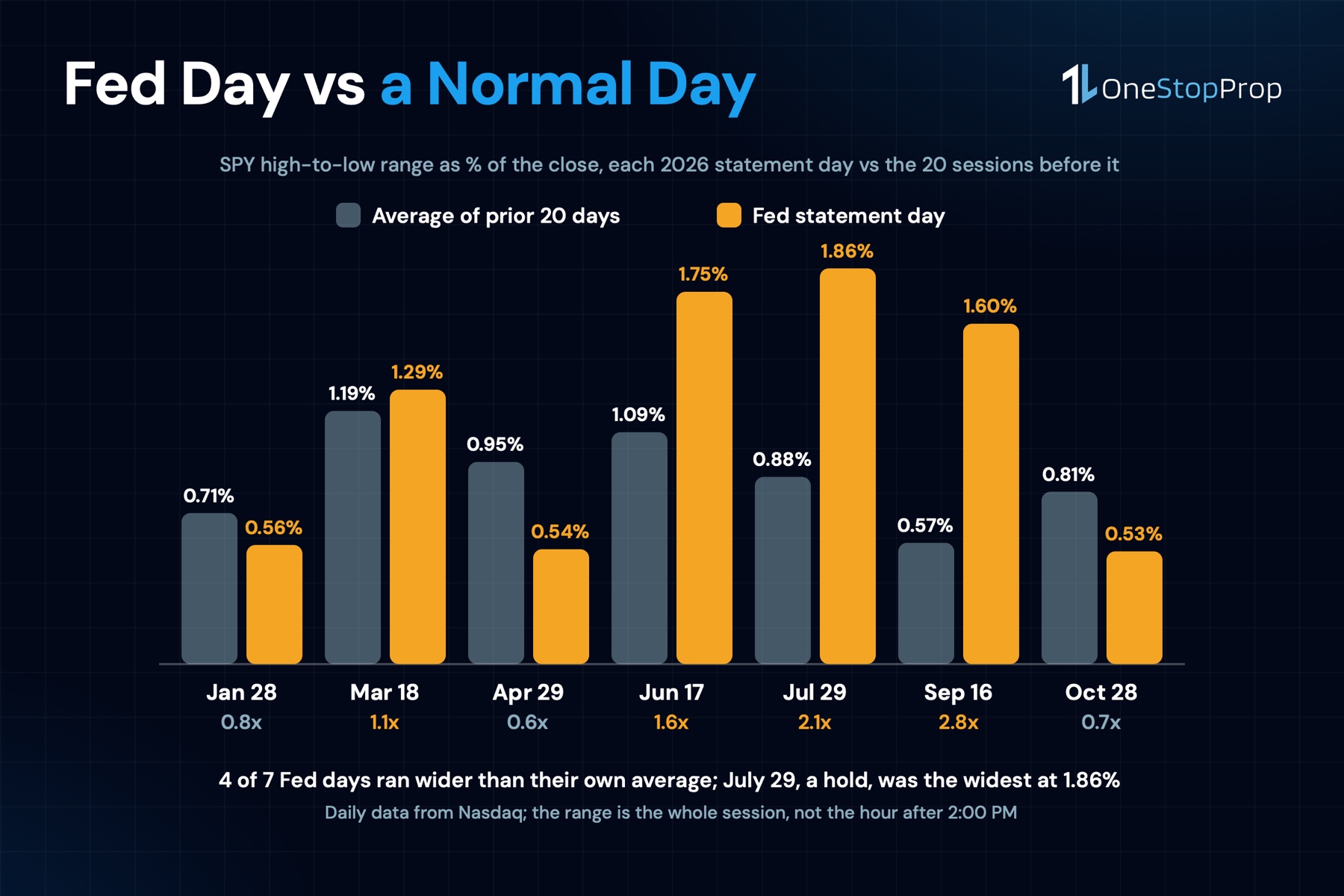
4 readings from the table.
The average Fed day was wider, by about a third. Across the 7 days SPY’s range averaged 1.16% against 0.89% for the sessions before them. The median Fed day was only 1.1 times its average, so the extra came from a few big days, not from all of them.
3 of the 7 were quieter than normal. January 28, April 29 and October 28 all ran under 0.6%, below their own 20-day averages. A Fed day is not automatically a big day.
The biggest ranges were not all on the day the rate changed. September 16, the hike, ran 1.60%, 2.8 times its average. But July 29, a hold, had the widest range of the year on SPY at 1.86%, and June 17, another hold, ran 1.75%. The decision being “maintain” did not make the day small.
The close hid the range. SPY closed lower on 6 of the 7 days, 3 of them by more than 1%, but 2 of the 6 were within 0.02% of flat. On January 28 the index traveled 0.56% top to bottom and finished unchanged. A funded account is measured on equity during the day, not at the close, so the range is the number that matters.
QQQ’s numbers were bigger, but its Fed-day premium was smaller. Its Fed-day range averaged 1.48% against 1.36% for the prior 20 sessions, only 3 of 7 days were above their own average, and the median Fed day was 0.98 times its average, so the typical QQQ Fed day was no wider than normal. The widest was July 29 at 2.86%, 1.8 times its average.
For context, across all 225 sessions of 2026 through November 23, QQQ’s range was 1% or more on 162 days and 2% or more on 42, while SPY’s range reached 1% on 85 days and 2% on 11.
Pro Tip: the day after the statement was not a quiet day either. SPY’s median range on the 7 sessions after a 2026 statement was 1.06%, against a median of 0.87% across all 225 sessions of 2026, and the index moved more than 0.75% close to close on 4 of those 7 days. The trading restriction ends at 2:05 PM, but the market can keep moving for the rest of the day and the next one.
Individual stocks move more than the index. The guide to day trading rules on a funded account measured 36,036 sessions on the stocks of OneStopProp’s list and found a high-to-low range of 4% or more on 24% of them. A 1.9% day on SPY is a bigger day on the names you actually trade.
What This Means on a Funded Account
The rule is on the Help Center page Is news trading allowed?, and the wording matters, so here it is in full. For funded accounts: “all trades must be closed 5 minutes before the news release and traders must wait until 5 minutes after the news release to open or resume trading.” The restricted events are “FOMC (Federal Open Market Committee announcements) and Fed Chair Speeches,” NFP, CPI, PPI and all individual stock earnings reports.
The same page describes the exemption: “Traders with the News Trading Allowed Add-On are exempt from these restrictions and may open, maintain, or close positions during all restricted news events.” The word “maintain” is the one to notice. Without the Add-On, a position held through the window is not allowed, because all trades must be closed before it opens.
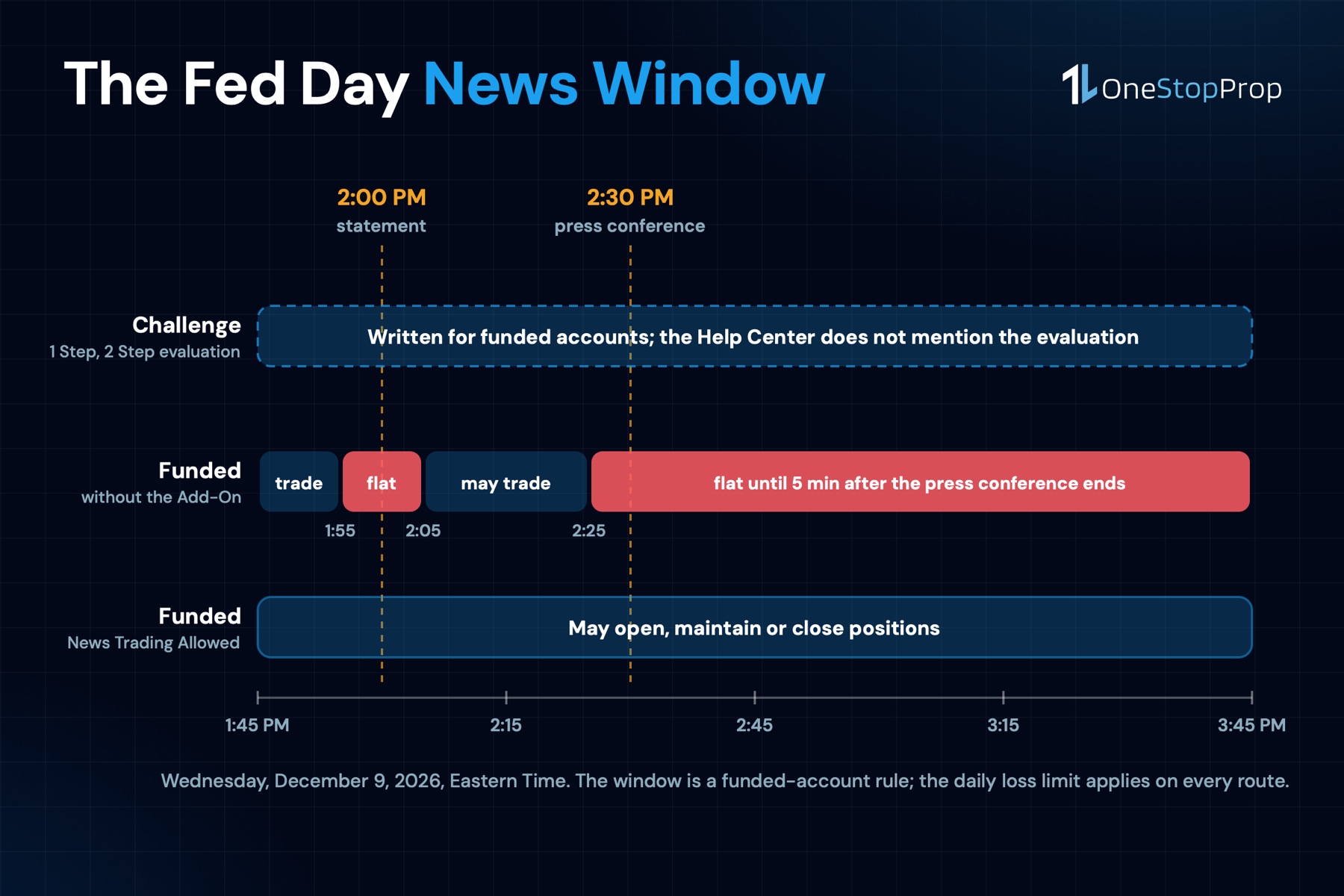
The clock on December 9
2:00 PM ET, the statement. On a funded account without the Add-On, every position is closed by 1:55 PM ET and nothing opens until 2:05 PM ET. That is every instrument on the account, not only the ones tied to the Fed: the rule says all trades.
2:30 PM ET, the press conference. The Help Center lists Fed Chair speeches as a separate restricted event, and a press conference is a Fed Chair speech that runs until the last question. The 5-minute clock starts at 2:25 PM. The end of a press conference is not a timestamp the way a release is, so the reading that cannot breach the rule is: flat from 2:25 PM until 5 minutes after the Chair stops speaking. If your plan needs a tighter reading than that, ask support before December 9, not after.
The challenge is not in the rule’s text. The Help Center writes the window for funded accounts and does not mention the evaluation. Our reading is that a 1 Step or 2 Step challenge is outside it; if your plan depends on holding through 2:00 PM in a challenge, ask support through the Help Center first and keep the answer.
What applies in full either way is the daily loss limit, 4% on both routes, and the max total loss, 6% on 1 Step and 8% on 2 Step, and the range measured above is the reason to size for them.
Instant is funded from the first day. An Instant account has no evaluation, so the window applies from the first trade. The 2% daily limit on Instant also makes it the tightest route on a wide day.
The overnight hold and the Fed
OneStopProp allows overnight and weekend holds on every route, per the Help Center’s overnight and weekend holding page. So a position opened Tuesday, December 8 can be held into Wednesday. What changes on a funded account without the Add-On is the deadline: that position must be closed by 1:55 PM ET on Wednesday. Holding it “through the Fed” is the thing the rule prohibits.
With the News Trading Allowed Add-On, the position can stay open through 2:00 PM, through the press conference, and overnight again if you want. The Add-On is selected at checkout, where it adds 30% to the account price, and it changes the rule, not the loss limits. If you already hold a funded account and want it, ask support whether it can be added to that account; the Help Center does not say.
Resting orders count too, in our reading of the rule: a limit order that fills at 1:58 PM is a trade opened inside the window. Cancel pending orders in Match-Trader before 1:55 PM; the guide to market orders vs limit orders on a funded account spells out why a resting order is the one you forget.
The daily limit against a 1% to 2% move, by route
The maximum daily loss is 4% of the initial balance on 1 Step and 2 Step accounts and 2% on Instant. It is set at the 12:00 AM EST day change from the higher of balance or equity, and during the day equity cannot drop below that floor. The floor is tested by the low of the day, not by the close.
On a $100K account the daily limit is $4,000 on 1 Step and 2 Step, and $2,000 on Instant. Here is what a move against a position of a given size does to that limit, before any stop and assuming nothing was lost earlier in the day. A day’s range is the whole session’s travel, not the loss on 1 position, so the table is the worst case for a position held through all of it.
1 more thing about the stop: in the minutes after 2:00 PM a stop is a market order that can fill away from its price, as the same guide to market and limit orders shows, so the stop limits the loss only if it fills at its price.
| Position size | 1% move against you | Share of the $4,000 limit (1 Step, 2 Step) | Share of the $2,000 limit (Instant) | 2% move against you | Share of $4,000 | Share of $2,000 |
|---|---|---|---|---|---|---|
| $25,000 | $250 | 6.3% | 12.5% | $500 | 12.5% | 25% |
| $50,000 | $500 | 12.5% | 25% | $1,000 | 25% | 50% |
| $100,000 | $1,000 | 25% | 50% | $2,000 | 50% | 100% |
The last cell is the one to remember. A $100,000 position on a $100K Instant account that moves 2% against you, which is less than QQQ’s 2.86% range on July 29, lands on the daily limit, and the rule gives no room past it; that $2,000 is also 40% of Instant’s 5% max total loss. The same position on a 1 Step or 2 Step account uses half of the day’s room, and a quarter of the 8% total loss on 2 Step, a third of the 6% on 1 Step.
The position that keeps a 2% adverse swing at half the daily limit is $100,000 on 1 Step and 2 Step and $50,000 on Instant.
With 1:50 leverage, a $100,000 position on a $100K account is well within what the account allows. The constraint on Fed day is not margin; it is the daily floor, and the floor is measured on the worst point of the day. The risk of ruin guide works through how many of those days fit before the max total loss.
Pro Tip: write December 9 into the plan now, with 3 times on it: 1:55 PM (flat, orders canceled), 2:05 PM (may trade), 2:25 PM (flat again). The simplest plan is to stay flat from 1:55 until 5 minutes after the press conference ends. If you do trade the 20 minutes in between, size the position so that a move the size of the widest 2026 Fed day, 1.86% on SPY and 2.86% on QQQ, stays under half your daily limit: for a 2.86% move that is about $70,000 on a $100K 1 Step or 2 Step account and about $35,000 on a $100K Instant. The times come from the firm’s rule; the position size is your decision.
When Is the Next Fed Meeting After December? The 2027 Calendar
On November 12, 2026 the Federal Reserve published a revised tentative schedule for 2027. It revises the schedule the Fed had published earlier and sets the last meeting of the year in November. The Fed’s calendar page notes that “each meeting date is tentative until confirmed at the meeting immediately preceding it.”
| 2027 meeting | Days | Decision announced? |
|---|---|---|
| January 26 to 27 | Tuesday to Wednesday | Yes, January 27 |
| March 16 to 17 | Tuesday to Wednesday | Yes, March 17 |
| April 27 to 28 | Tuesday to Wednesday | Yes, April 28 |
| June 8 to 9 | Tuesday to Wednesday | Yes, June 9 |
| July 27 to 28 | Tuesday to Wednesday | Yes, July 28 |
| September 14 to 15 | Tuesday to Wednesday | Yes, September 15 |
| October 26 to 27 | Tuesday to Wednesday | No: dedicated to monetary policy strategy |
| November 16 to 17 | Tuesday to Wednesday | Yes, November 17 |
The October 26 to 27 meeting is the odd one. The Fed’s release says it “will be dedicated to the discussion of broad monetary policy strategy issues” and that the Committee will announce its policy decision “as usual on the second day of each meeting, except the October 26-27 meeting.” The Fed has not said whether that meeting will have a statement or a press conference. On a funded account, treat any Fed Chair remarks that day as a Fed Chair speech, which is restricted either way.
After the November 16 to 17 meeting, the next one on the Fed’s list is January 25 to 26, 2028. The Fed’s calendar page does not yet mark which 2027 meetings will carry a Summary of Economic Projections, so this guide does not either.
How to Prepare for December 9 on a Funded Account
1. Put 3 times in the calendar. 1:55 PM, 2:05 PM and 2:25 PM ET on Wednesday, December 9. Add the end of the press conference plus 5 minutes once it is over.
2. Decide the overnight question on December 8. If the account is funded and does not carry the News Trading Allowed Add-On, anything held Tuesday night has a 1:55 PM deadline Wednesday. If that deadline turns the trade into a bad one, it is a Tuesday decision, not a Wednesday one.
3. Size the between-window trade for the range, not the close. The widest 2026 Fed day on SPY ran 1.86%, on QQQ 2.86%, and the stocks on OneStopProp’s list run wider. Use the daily limit by route: $4,000 on a $100K 1 Step or 2 Step, $2,000 on a $100K Instant.
4. Cancel resting orders in Match-Trader before 1:55 PM. A fill inside the window is an open trade inside the window.
5. Check the rest of the week. The Fed is not the only restricted event. Earnings for any stock you hold are on the list, including post-market releases; the NVIDIA earnings guide walks through the same clock around a single stock. CPI and PPI dates are on the Bureau of Labor Statistics schedule.
6. Log the day. How wide the stocks you trade ran between 2:00 and 4:00 PM is the best input for the January 26 to 27, 2027 meeting, and it is a number you can only collect once.
Common Mistakes Around a Fed Meeting
Treating a “hold” as a quiet day
July 29 was a hold and the widest Fed day of 2026 on SPY. Position size should depend on the range the day can produce, which is independent of whether the rate changes.
Forgetting that the press conference is a Fed Chair speech
The 2:00 PM window is the one everybody knows. The Help Center lists Fed Chair speeches separately, and the 2:30 PM press conference is one. On a funded account without the Add-On there are 2 windows, not 1.
Leaving orders resting through 2:00 PM
A pending order does not know what time it is. If it fills at 1:58, you opened a trade inside the window.
Assuming the window will not matter to you yet
The Help Center writes it for funded accounts. But Instant accounts are funded from purchase, and the funded phase of 1 Step and 2 Step is where the window applies in full. Plan for it before the first funded trade, not after.
Sizing by the close
SPY finished January 28 down 0.01% after traveling 0.56% top to bottom. On a funded account the floor is tested at the low of the day. Size for the range.
Reading election or holiday guides as Fed guides
Elections are not on the restricted list, and neither is Thanksgiving week, which has no FOMC meeting. The midterm elections and Black Friday trading hours guides cover those weeks; the Fed is its own event with its own clock.
Frequently Asked Questions
When is the next Fed meeting?
December 8 to 9, 2026. The statement is released Wednesday, December 9 at 2:00 PM ET and the Chair’s press conference starts at 2:30 PM ET, per the Federal Reserve’s meeting calendar. It is the last FOMC meeting of 2026.
Does the December 2026 Fed meeting include the dot plot?
Yes. The Fed’s calendar marks December 8 to 9 as a meeting associated with a Summary of Economic Projections, the quarterly release that includes the participants’ rate projections. The other 3 in 2026 were March, June and September.
What did the Fed do at its last meeting?
On October 28, 2026 the FOMC “decided to maintain the target range for the federal funds rate at 3-3/4 to 4 percent.” The only change in 2026 was on September 16, a 0.25 point increase that took the range from 3.50% to 3.75% up to 3.75% to 4%.
When is the next Fed meeting after December 2026?
January 26 to 27, 2027. The revised 2027 schedule has meetings in January, March, April, June, July, September, October and November, with the October 26 to 27 meeting dedicated to strategy and no policy decision announced that day.
Can I hold a position through the Fed announcement on a funded account?
Not without the News Trading Allowed Add-On. On funded accounts, all trades must be closed 5 minutes before the release and trading resumes 5 minutes after, for FOMC announcements and Fed Chair speeches. With the Add-On, the account may open, maintain or close positions during restricted events. The Help Center writes the rule for funded accounts and does not mention the 1 Step or 2 Step challenge; if you plan to hold through the release in an evaluation, confirm with support first.
How much does the market move on Fed day?
On the 7 statement days of 2026, SPY’s high-to-low range averaged 1.16% of the close against 0.89% for the 20 sessions before each one; the widest was 1.86% on July 29. QQQ averaged 1.48%, with a 2.86% day on July 29. 3 of the 7 Fed days were quieter than their own averages.
The Bottom Line
When is the next Fed meeting? December 8 to 9, 2026, with the statement and the Summary of Economic Projections at 2:00 PM ET on Wednesday the 9th and the Chair’s press conference at 2:30 PM ET. The rate stands at 3.75% to 4% after 6 holds and 1 hike this year, and the Fed has already published the 8 meetings of 2027, the last of them November 16 to 17.
On a funded account without the News Trading Allowed Add-On, the day has 2 windows: flat from 1:55 to 2:05 PM, and flat again from 2:25 PM until 5 minutes after the press conference ends. The 7 Fed days of 2026 averaged a third more range than a normal day on SPY, with the widest at 1.86%, and the daily limit is tested at the low of the day, not the close. If you trade between the 2 windows, choose a position size that can absorb a move of that size without reaching the daily loss limit of your route.
If you want to trade the December 9 meeting on a funded account, the Instant route is funded from the first day, and the 1 Step and 2 Step challenges have no time limit, so you can start now and reach the funded phase at your own pace. Pick your OneStopProp account: 1 Step, 2 Step or Instant, from $10K to $300K (Instant from $25K to $200K), with overnight and weekend holds allowed and TradingView-powered charts inside Match-Trader.
Sources
- Meeting calendars and information, Federal Reserve Board. The 2026 FOMC meetings, December 8 to 9 marked as associated with a Summary of Economic Projections, the 2027 list, and the note that each date is tentative until confirmed at the preceding meeting. https://www.federalreserve.gov/monetarypolicy/fomccalendars.htm
- Federal Reserve announces revised tentative schedule of Federal Open Market Committee meetings in 2027, Federal Reserve Board. November 12, 2026: the 8 meetings of 2027, the October 26 to 27 strategy meeting with no policy announcement, and January 25 to 26, 2028. https://www.federalreserve.gov/newsevents/pressreleases/monetary20261112a.htm
- Federal Open Market Committee announces its tentative meeting schedule for 2025 and 2026, Federal Reserve Board. The policy statement at 2 p.m. Eastern Time on the second day of each meeting and the Chair’s news conference at 2:30 p.m. Eastern Time the same day. https://www.federalreserve.gov/newsevents/pressreleases/monetary20240809a.htm
- October 27-28, 2026 FOMC Meeting, Federal Reserve Board. The statement and implementation note “Released October 28, 2026 at 2:00 p.m.” https://www.federalreserve.gov/monetarypolicy/fomcpresconf20261028.htm
- Federal Reserve issues FOMC statement, September 16, 2026, Federal Reserve Board. The decision to raise the target range by 1/4 percentage point to 3-3/4 to 4 percent. https://www.federalreserve.gov/newsevents/pressreleases/monetary20260916a.htm
- Federal Reserve issues FOMC statement, October 28, 2026, Federal Reserve Board. The decision to maintain the target range at 3-3/4 to 4 percent. https://www.federalreserve.gov/newsevents/pressreleases/monetary20261028a.htm
- Federal Reserve issues FOMC statement, January 28, 2026, Federal Reserve Board. The decision to maintain the target range at 3-1/2 to 3-3/4 percent, repeated in the March, April, June and July statements. https://www.federalreserve.gov/newsevents/pressreleases/monetary20260128a.htm
- Federal Open Market Committee, Federal Reserve Board. The FOMC holds 8 regularly scheduled meetings per year; the 2026 Committee members, with Kevin Warsh as Chairman. https://www.federalreserve.gov/monetarypolicy/fomc.htm
- SPDR S&P 500 ETF Trust (SPY) Historical Data, Nasdaq. Daily open, high, low, close and volume used to measure the range of each 2026 statement day against the 20 sessions before it. https://www.nasdaq.com/market-activity/etf/spy/historical
- Invesco QQQ Trust (QQQ) Historical Data, Nasdaq. The same daily data for the Nasdaq-100 ETF. https://www.nasdaq.com/market-activity/etf/qqq/historical
- Is news trading allowed?, OneStopProp Help Center. On funded accounts, all trades closed 5 minutes before the release and trading resumed 5 minutes after, for FOMC announcements and Fed Chair speeches, NFP, CPI, PPI and individual stock earnings; the News Trading Allowed Add-On exemption. https://help.onestopprop.com/faq/is-news-trading-allowed/
- What is the Maximum Daily Loss?, OneStopProp Help Center. 4% of the initial balance on 1 Step and 2 Step, 2% on Instant, set at the 12:00 AM EST day change from the higher of balance or equity. https://help.onestopprop.com/faq/what-is-the-maximum-daily-loss/
- Can I hold trades overnight and over weekends?, OneStopProp Help Center. Overnight and weekend holds are allowed. https://help.onestopprop.com/faq/can-i-hold-trades-overnight-and-over-weekends/