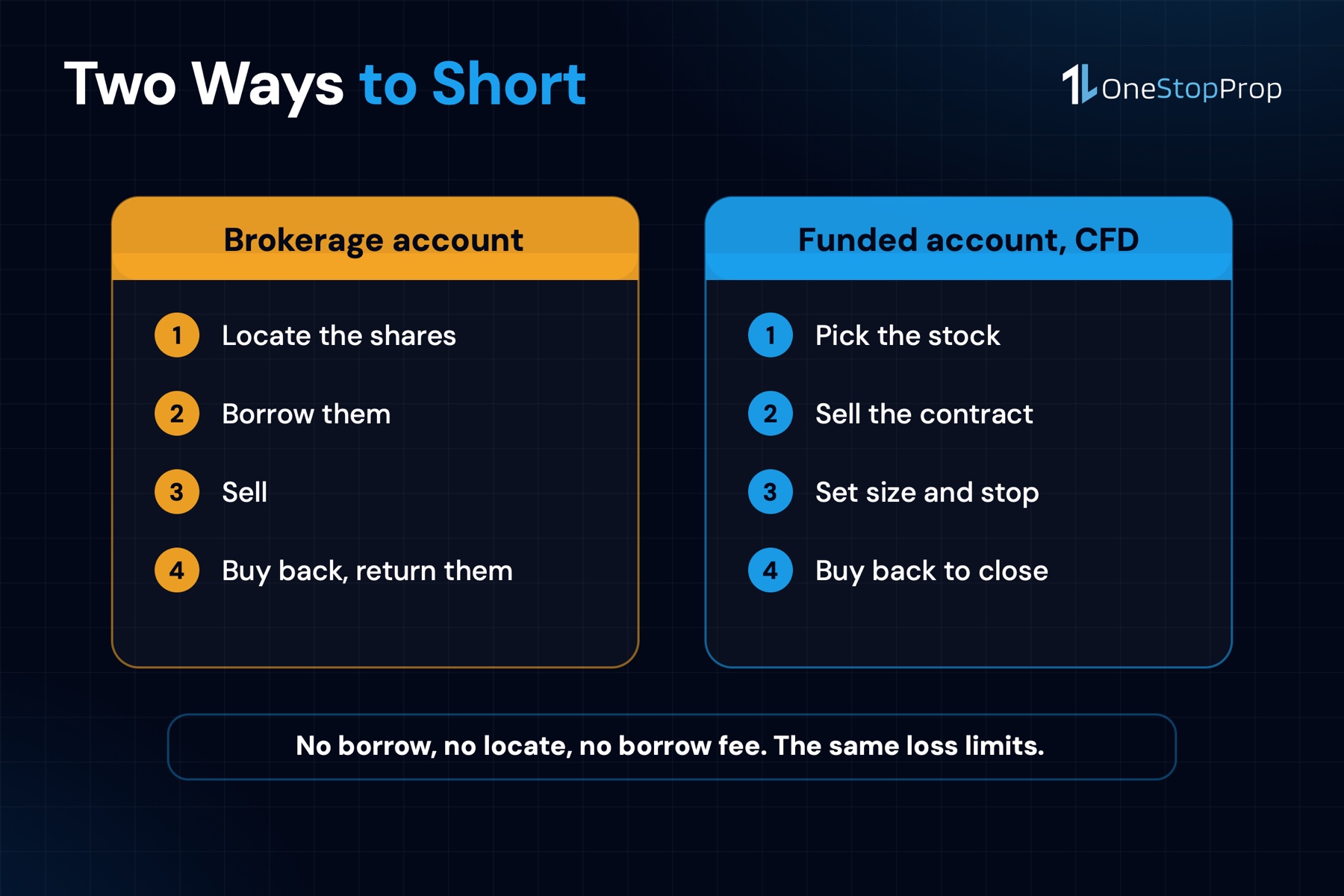
How to short a stock depends on where you are doing it. In a brokerage account, a short sale means borrowing shares you do not own, selling them, and buying them back later, with a locate, a borrow fee and a margin requirement attached. On a funded account that trades U.S. stock CFDs, a short is a sell order on the contract, and none of those 3 attachments exist.
What does not change is the risk. A short loses money when the stock rises, a stock can rise without a ceiling, and on a funded account every dollar of that rise counts against a daily loss limit that was set before you opened the trade.
This guide covers both versions of how to short a stock, what is different about doing it on a funded account, and how to size a short so that the one gap that goes against you costs a trade and not the account.
Key Takeaways
- A short sale profits when the stock falls. You sell first and buy back later. The SEC’s own definition is the sale of a stock you do not own, with the borrowed shares delivered to the buyer.
- In a brokerage account, 3 things come attached: a locate under Regulation SHO, a borrow fee that varies by stock, and margin interest. Hard-to-borrow names can be expensive or unavailable.
- On a funded account trading stock CFDs, you sell the contract. No borrow, no locate, no borrow fee. OneStopProp’s Help Center states that shorting is allowed on all instruments, including stocks.
- The loss on a short has no natural ceiling. A long can lose what you paid; a short can lose more than the position was worth. On a funded account the daily loss limit is the ceiling, so the position size has to be built from it.
- Gaps are where shorts die. A short held through a report or a halt can reopen far above the stop. The size you chose is the only protection that still works at the reopen.
What a Short Sale Actually Is
A long trade is the one everyone learns first: buy, wait, sell higher. A short reverses the order. You sell first, at the price you think is too high, and you buy back later, at a lower price if you were right.
The U.S. Securities and Exchange Commission defines it in its Key Points About Regulation SHO as the sale of a stock you do not own, or that you will borrow for delivery. In its example, an investor borrows shares of a company trading at $60, sells them, watches the stock fall to $40, buys the shares back and returns them, keeping the $20 difference per share minus costs.
The same page makes the point that matters for a funded trader. A long position’s risk is limited to what you invested. A short leaves you open to losses with no theoretical limit, because the stock can keep rising.
That asymmetry is the whole reason how to short a stock is a different question from how to buy one. The mechanics are easy. The risk shape is not.
How to Short a Stock in a Brokerage Account
In a standard margin account the sequence has steps that do not exist on the long side, and each one can stop the trade before it starts.
- The locate. Under Rule 203 of Regulation SHO, a broker has to have reasonable grounds to believe the shares can be borrowed before it executes your short. Popular, liquid stocks locate instantly. Thinly traded or heavily shorted names may not be available at all.
- The borrow. The shares come from the broker’s inventory, from other clients’ margin accounts or from another lender. You pay a borrow fee, which is small on most large caps and can be very large on names that are hard to borrow.
- Margin. A short runs on borrowed money, so margin rules apply, interest accrues, and a rising price can trigger a margin call that forces you to buy back at the worst moment.
- Dividends and recalls. If the borrowed stock pays a dividend while you are short, you owe it to the lender. And a lender can recall the shares, which forces the broker to close your position whether you want to or not.
- The price test. Rule 201 of Regulation SHO restricts the price at which a short can be executed once a stock has fallen 10% in a day, for the rest of that day and the next.
None of this is a reason not to short in a brokerage account. It is the list of frictions that a trader learns to budget for, and it is the list that disappears on a funded account.
How to Short a Stock on a Funded Account
At OneStopProp, the stocks you trade are U.S. stock CFDs on Match-Trader, with TradingView charts inside the platform. The Help Center’s rule is 1 sentence long: shorting is allowed on all instruments, including Forex, Crypto and Stocks.
Here is what that means in practice.
- A short is a sell order. You pick the stock, choose Sell instead of Buy, set the size and the stop, fixed or a trailing stop loss that follows the price down, and the position is open. There is no locate step, because there are no shares to borrow: a CFD tracks the price of the stock without delivering it.
- No borrow fee, no recall. The frictions in steps 1, 2 and 4 above do not apply. A hard-to-borrow stock in a brokerage account is just another instrument on the list here.
- The same limits as a long. The daily loss limit is 4% of the initial balance on 1 Step and 2 Step and 2% on Instant, the total loss limit is 6%, 8% and 5% by route, and a short counts against them exactly like a long. The limit is measured at 12:00 AM ET from the higher of balance or equity.
- Overnight and weekends are allowed. The Help Center confirms you can hold trades overnight and over weekends, which includes shorts. Whether you should hold a short through a night is a sizing question, covered below.
- The news window applies. Once funded, no trades 5 minutes before and after FOMC, NFP, CPI, PPI and earnings, unless the News Trading Allowed Add-On is on the account. A short into an earnings report is the most common way to meet this rule by accident.
- No hedging. The list of strategies that are not allowed starts with hedging, so a short cannot be used to offset a long in the same instrument. A short is a directional position, not insurance.
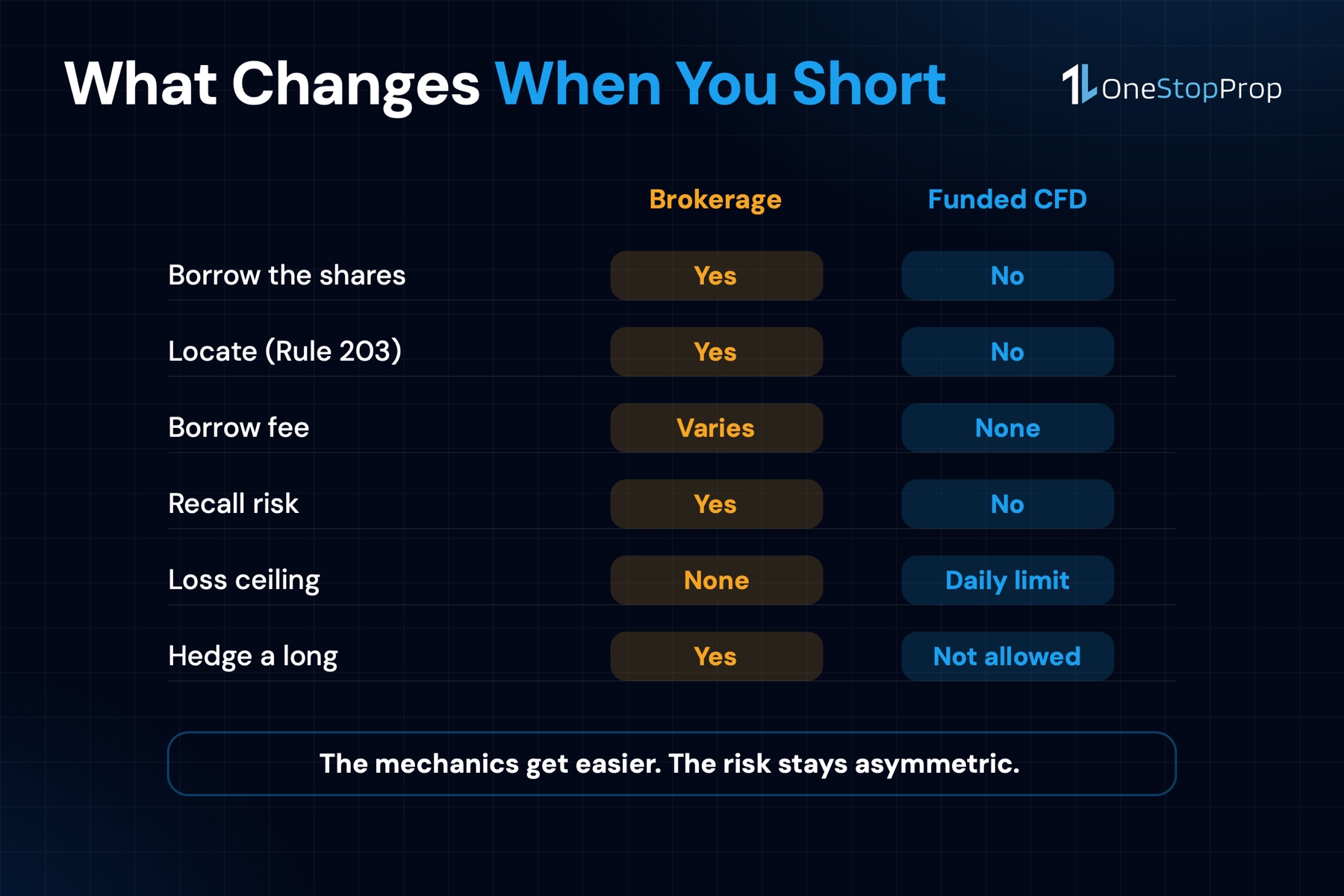
The short version of how to short a stock on a funded account: the mechanics get easier, the rules get stricter, and the risk stays exactly as asymmetric as it was.
Sizing a Short Inside the Daily Loss Limit
The formula is the same one used for a long. Risk per trade in dollars, divided by the distance from entry to stop, gives the number of shares. What changes on a short is where the distance can come from.
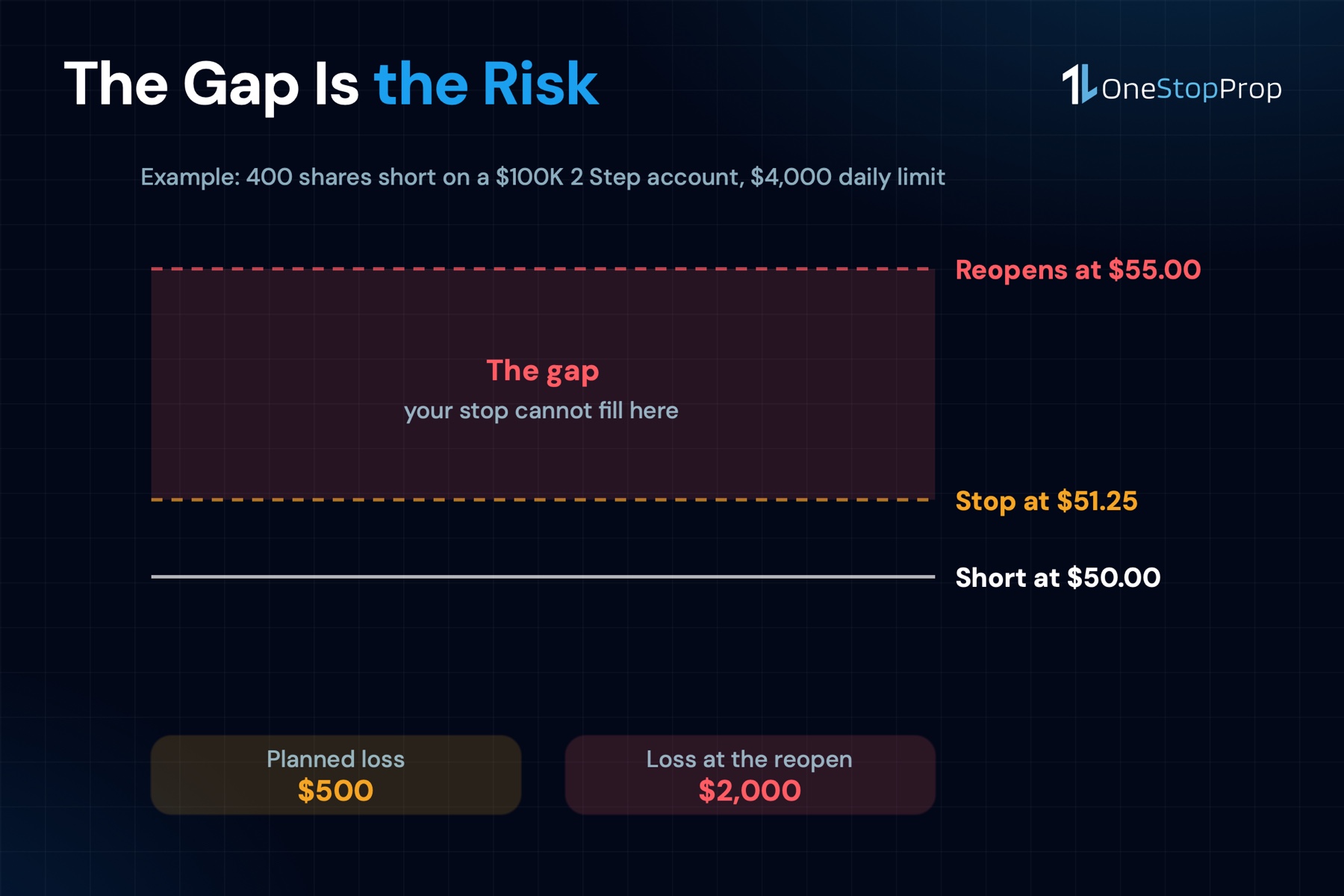
Take a $100K 2 Step account with a $4,000 daily limit and a plan that risks 0.5%, or $500, per trade. A short at $50.00 with a stop at $51.25 has a distance of $1.25, so 400 shares. If the stop fills where it was placed, the loss is $500, one eighth of the daily limit.
Now the stock reports after the close, or gets halted at 10:40 AM, and reopens at $55.00. The stop converts to a market order at the next available price, which is $55.00, not $51.25. The loss is $5.00 times 400 shares, which is $2,000: half the daily limit, on a trade that was planned at $500.
That is the arithmetic that makes a short different. A long that gaps against you has a floor at zero. A short that gaps against you has no equivalent, which is why the size has to be set from the gap you can survive rather than the stop you intend to use. 3 rules follow from it.
- Size the short so that a 10% gap against you fits inside your personal daily stop. On the example above, a 10% gap on 400 shares is $2,000, which is exactly a $2,000 personal stop. 300 shares would leave room.
- Do not hold a short through the stock’s own earnings report without the News Trading Allowed Add-On, and consider not doing it even with it. The report is the gap you cannot size for.
- Know what a halt does. Under a trading halt nothing fills, your stop included, and the reopen can be anywhere. A short in a stock with pending news is a halt waiting to happen.
Pro Tip: write the stop on a short as a price and as a dollar amount, side by side. The price is what you place; the dollar amount is what has to fit inside the daily limit, and on a short the 2 can separate fast.
The 3 Short Setups That Fit a Funded Account
A short needs a trigger, an invalidation and a target, like any setup. These 3 are common because the stop is clear and the move usually resolves inside the session, which keeps the short away from the overnight gap.
The failed breakout
A stock pushes above an obvious level, the kind support and resistance trading is built around, cannot hold it, and closes back below. The short goes in on the close back inside, the stop goes above the failed high, and the target is the low of the move that led into the level. The trade is over in minutes or it is wrong. A completed head and shoulders pattern gives a slower version of the same entry, on the close below the neckline.
The VWAP rejection
A stock that opened strong trades back to VWAP, bounces weakly and rolls over below it. The short triggers on the first close below VWAP after the rejection, the stop above the rejection high, and the target is the morning low. The VWAP trading strategy guide covers the long side of the same logic.
The opening range breakdown
The mirror image of the opening range breakout. A break below the first 15 minute low on volume, stop above the range low, target 2 times the stop distance. Same rules, opposite direction.
What the 3 share: the stop is above a price that the market already rejected once, so the distance is defined by the chart rather than by hope, and the position can be sized from it.
What a Short Costs on Each Account Type
| Brokerage margin account | Funded account, stock CFDs | |
|---|---|---|
| How you open it | Borrow shares, then sell | Sell order on the contract |
| Locate | Required under Rule 203 | None |
| Borrow fee | Varies, high on hard-to-borrow names | None |
| Dividends while short | You owe them to the lender | Not applicable to the borrow; check the instrument’s terms |
| Recall risk | Lender can recall the shares | None |
| Loss ceiling | None, margin call forces the buy-back | The daily and total loss limits |
| Overnight holds | Allowed, with interest | Allowed |
| Hedging a long with a short | Allowed | Not allowed |
The last 2 rows are the ones that change behaviour. A brokerage trader can hedge and can decide a loss is “temporary” for weeks. A funded trader has a daily number that does not care how temporary the loss is.
Common Mistakes When Shorting Stocks
Shorting strength without a trigger
A stock that is up 40% looks like an obvious short and is the most expensive one. Strength can continue for days. A short needs a rejection to sell into, not a feeling that it has gone too far.
Adding to a short that is squeezing
Averaging into a losing short is the fastest route to the daily limit, and on a funded account martingale is on the list of strategies that are not allowed. 1 position, 1 stop, 1 decision.
Holding a short into a report
The gap on a report can be 10% to 20% on a single name. The news window rule exists for a reason, and the Add-On that lifts it does not change the arithmetic of a 400 share short that reopens $5 higher.
Treating “no borrow fee” as “no cost”
The borrow fee is gone on a CFD. The spread, the gap risk and the daily limit are not. The cost of a short is still the distance to the stop multiplied by the shares, plus whatever the gap adds.
Sizing from the balance instead of the stop
“1,000 shares” is not a size; it is a number. 1,000 shares with a $0.50 stop is $500 of risk, and with a $3.00 stop it is $3,000, which is 75% of a $4,000 daily limit on 1 trade.
Frequently Asked Questions
Can you short stocks at a prop firm?
At OneStopProp, yes. The Help Center states that shorting is allowed on all instruments, including Forex, Crypto and Stocks. Stocks are traded as U.S. stock CFDs, so a short is a sell order with no borrow or locate.
How is shorting a CFD different from shorting shares?
With shares you borrow them, sell them, pay a borrow fee and margin interest, owe any dividends to the lender, and can be recalled. With a CFD you sell a contract that tracks the price. The direction and the risk are the same; the borrowing steps are not there.
Do you pay a borrow fee to short a stock on a funded account?
No. There is no borrow, so there is no borrow fee or locate. The costs that remain are the spread and the risk of the price moving against the position.
Can I hold a short overnight at OneStopProp?
Yes. Positions can be held overnight and over weekends on all routes. The question is whether the gap you are exposed to fits inside your daily limit, which is a sizing decision, not a rule.
Is short selling riskier than going long?
The loss on a long is capped at the position’s value. The loss on a short has no cap, because the price can keep rising. On a funded account the daily loss limit is the practical cap, which is why a short is sized for the gap rather than for the stop.
What happens to a short during a trading halt?
Nothing fills, including the stop. When the stock reopens, a stop that has been passed converts to an order at the next available price, which can be far above where it was set. The size chosen before the halt decides what that costs.
The Bottom Line
How to short a stock has 2 answers. In a brokerage account, you borrow, sell and buy back, with a locate, a fee and margin attached. On a funded account trading stock CFDs, you sell the contract and the attachments are gone.
The risk is the part that does not simplify. A short has no ceiling, gaps go against it with no floor, and on a funded account the daily loss limit is the only wall. Size every short from the gap you can survive, keep it out of the news window, and the short side becomes what it should be: half of the market instead of a special occasion.
If you want to short stocks without a locate and inside limits that are written down before you start, open a OneStopProp account: 1 Step, 2 Step or Instant, from $10K to $300K, with U.S. stock CFDs, forex, indices, commodities, metals and crypto in the same account and overnight holds allowed.
Sources
- Key Points About Regulation SHO, U.S. Securities and Exchange Commission. The definition of a short sale, the borrowing mechanics, the unlimited-loss warning, the locate requirement of Rule 203 and the price test of Rule 201. https://www.sec.gov/investor/pubs/regsho.htm
- Short Sales, Investor.gov. The SEC’s investor-education entry on short sales. https://www.investor.gov/introduction-investing/investing-basics/glossary/short-sales
- Short sale, Nasdaq Glossary. Nasdaq’s definition of a short sale. https://www.nasdaq.com/glossary/s/short-sale
- Is shorting allowed?, OneStopProp Help Center. The firm’s rule: shorting is allowed on all instruments, including stocks. https://help.onestopprop.com/faq/is-shorting-allowed/
- What trading strategies are not allowed?, OneStopProp Help Center. Hedging, martingale and the rest of the list. https://help.onestopprop.com/faq/what-trading-strategies-are-not-allowed/
- What is the Maximum Daily Loss?, OneStopProp Help Center. The 4% daily limit, the 12:00 AM ET calculation and the 2% Instant limit. https://help.onestopprop.com/faq/what-is-the-maximum-daily-loss/
- Trading Halts: What Happens to Your Open Stock Position, OneStopProp. Why nothing fills during a halt and where the reopen lands. https://onestopprop.com/trading-halts/