A trading halt is the one market event your stop cannot do anything about. While a stock is halted there are no prints, no fills and no exits, and the order you placed to protect the position sits there doing nothing until trading comes back.
On a funded account that matters more than it does in a personal brokerage, because the loss that lands at the reopen is measured against a daily limit that does not move. Here is how halts work, what they do to an open position, and the 1 decision you still control.
Key Takeaways
- A halt stops everything, including your exit. Stops, limits and market orders all wait. The protection you set before the halt only works again once the stock reopens.
- There are 3 kinds, and they come from different places. A regulatory halt on pending news, a single-stock volatility pause, and a market-wide circuit breaker that halts every NMS security at once.
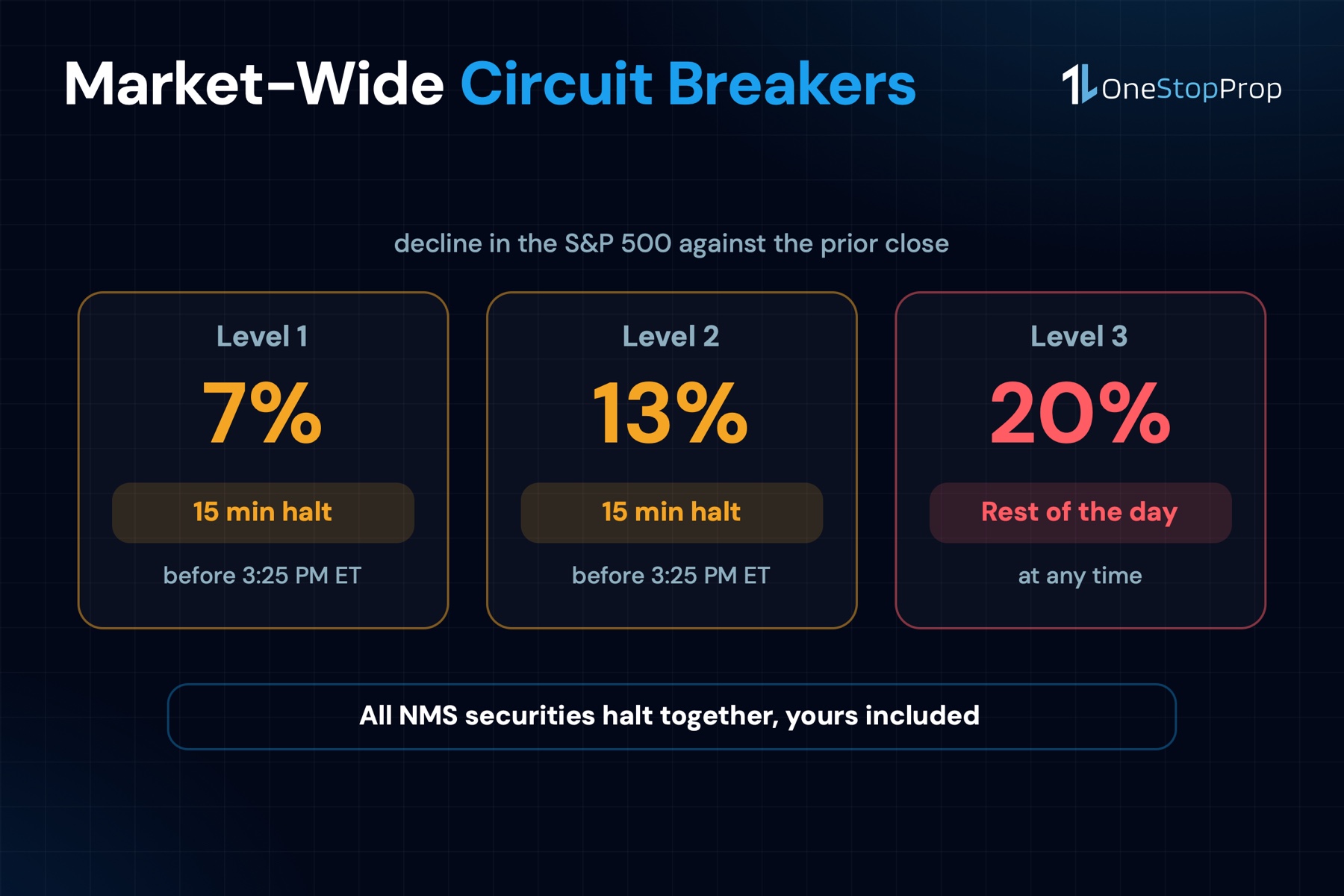
- Market-wide circuit breakers run on 3 thresholds. A 7%, 13% or 20% decline in the S&P 500 against the prior day’s close, with the first 2 halting trading for 15 minutes if they hit before 3:25 PM ET.
- The reopen is where the damage lands. Price can return far from where it was halted, and that distance is the loss your account takes, not the distance you planned.
- Position size is the part you control. Nothing about a halt is predictable; what the loss costs you is set by the size you chose before it happened.
What a Trading Halt Actually Is
A trading halt is a temporary stop on trading in a security, or in the whole market, ordered by an exchange or by the primary listing venue.
During it, the order book stops matching. Orders can usually be entered and cancelled, but nothing fills, because there is no trading to fill against. That includes your stop.
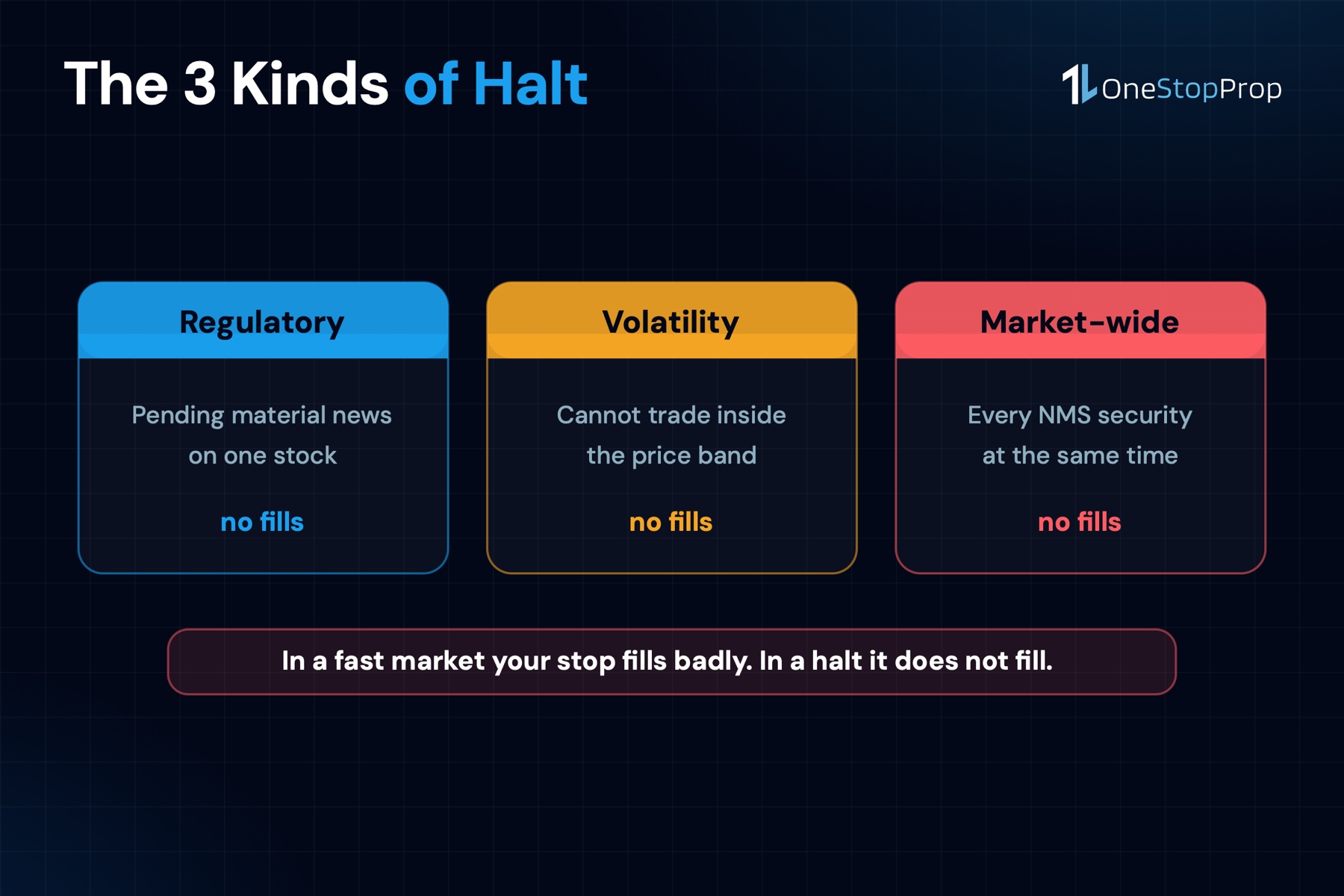
This is the detail that separates a halt from a fast market. In a fast market your stop fills badly. In a halt it does not fill at all.
The 3 Kinds of Halt
Regulatory, on pending news. The listing venue halts a stock before a material announcement so the information reaches everyone before trading resumes. These are the halts around earnings, mergers and regulatory decisions.
Single-stock volatility. Under the Limit Up-Limit Down mechanism, a stock that cannot trade within its price band for 15 seconds goes into a pause. This is the common one, and it is the one that catches an intraday position mid-move.
Market-wide circuit breakers. When the S&P 500 falls far enough, every NMS security halts at the same time. Nothing you hold is exempt, because the halt is not about your stock.
How Market-Wide Circuit Breakers Work
These are the clearest to plan for because the thresholds are published and fixed.
The levels are calculated daily from the prior day’s close of the S&P 500. If the index declines by 7%, 13% or 20% during regular hours, a market-wide halt is declared and every NMS security stops.
| Level | Decline in the S&P 500 | What happens |
|---|---|---|
| Level 1 | 7% | 15 minute halt if before 3:25 PM ET |
| Level 2 | 13% | 15 minute halt if before 3:25 PM ET |
| Level 3 | 20% | Trading stops for the rest of the day |
At or after 3:25 PM ET, a Level 1 or Level 2 breach does not halt trading. A Level 3 breach halts it at any time, for the remainder of the session.
Pro Tip: A Level 3 halt ends the session with your position still open. If your plan assumes you close everything intraday, that assumption has an exception, and the exception is the day you least want one.
What Happens to Your Open Position
Nothing, and that is the problem.
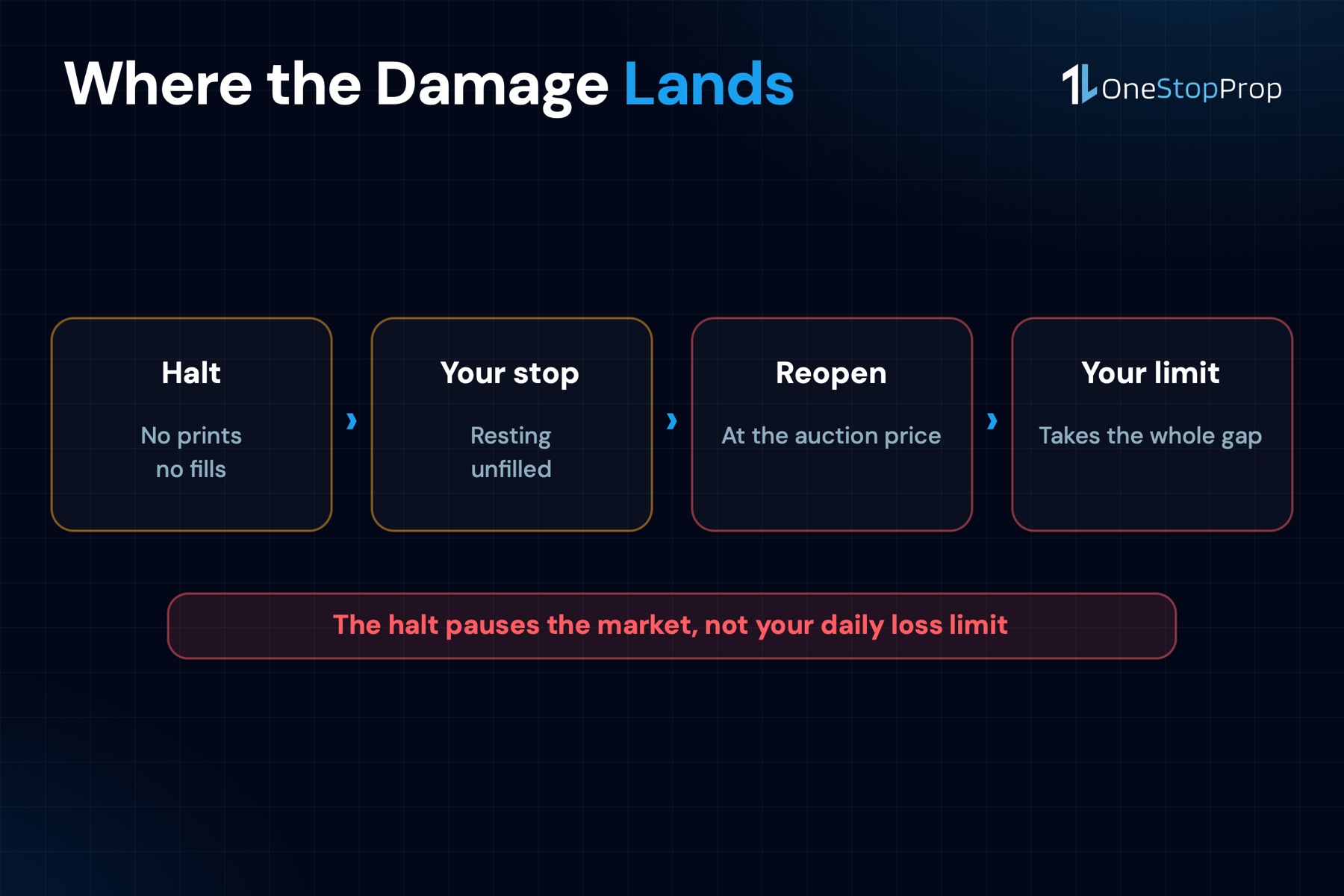
The position stays exactly as it was. Your stop stays where you put it, unfilled. Your unrealized loss is frozen at a price that no longer reflects anything, because the market is forming a new opinion that cannot print yet.
When trading resumes, the stock reopens at whatever price the auction produces. If that price is through your stop, your stop becomes an order to sell at the next available price, which is the reopening price or worse.
That gap is the real risk of a halt, and it is the same mechanism that makes a stop-limit order dangerous: an order that guarantees a price can simply not fill, while an order that guarantees execution fills wherever the market is.
Why This Hits a Funded Account Harder
A personal account absorbs a bad reopen and carries on. A funded account measures it.
The loss that prints at the reopen counts against the daily loss limit of your route: 4% on 1 Step and 2 Step, 2% on Instant. Reaching that limit ends the account, so a single halted position that reopens badly can do what a whole losing week normally takes.
The total loss limit is the second line: 6% on 1 Step, 8% on 2 Step and 5% on Instant. A halt does not care which of those you were close to.
There is a second rule that is easy to miss, and it is OneStopProp’s own. The firm recommends closing positions during halts and abnormal conditions, and trading through them on a funded account can put the account in front of the risk team. Trades placed in those windows may be flagged, which can mean disqualification from a payout. So the cost of trading a halt is not only the reopen, it is the payout you were working toward.
The Decision You Actually Control
You cannot predict a halt, you cannot exit during one, and you cannot choose where it reopens. What you choose is how many shares are exposed when it happens.
That turns into a question worth asking before every entry: if this position reopened 10% against me, what would it cost, and is that number smaller than what is left of my daily limit today?
If the answer is no, the position is too big, regardless of how good the setup looks. The risk reward ratio of the trade is calculated from a stop that assumes the stop fills. A halt is the case where it does not.
Pro Tip: Size catalysts differently. A stock with a scheduled announcement carries a known halt risk, so the position that survives it is smaller than your normal size, not the same size with a tighter stop.
Common Mistakes Around Halts
Treating a halt as a pause in your risk
The daily loss limit keeps running on the clock, not on your fills. A position frozen in a halt is still an open exposure against it.
Adding to a halted position
Orders queued during a halt execute at the reopen, at the reopening price. Averaging into a halt is sizing up into a price you have not seen.
Assuming the stop protected you
A stop is a resting instruction, not a guarantee of where you exit. In a halt it protects nothing until the book reopens.
Ignoring the calendar
Most regulatory halts are tied to something scheduled. Knowing what is due on the names you trade is the cheapest halt protection there is.
Frequently Asked Questions
What is a trading halt?
A temporary stop on trading in a security or in the whole market, ordered by an exchange or the primary listing venue. No trades print while it lasts, so no order fills.
How long does a trading halt last?
It depends on the type. A market-wide Level 1 or Level 2 halt lasts 15 minutes when it happens before 3:25 PM ET, while a Level 3 halt ends trading for the day. Regulatory and single-stock pauses vary with the situation that caused them.
Can I sell during a trading halt?
No. You can usually enter and cancel orders, but nothing fills because there is no trading. Your order joins the queue for the reopen.
Does a halt cancel my stop loss?
No. The stop stays active and unfilled. When the stock reopens, a stop that has been passed converts to an order at the next available price, which can be well below where you set it.
What triggers a single-stock halt?
Under Limit Up-Limit Down, a stock that cannot trade inside its price band for 15 seconds goes into a pause. Regulatory halts are triggered by pending material news instead.
How does a halt affect a prop firm account?
The loss that prints at the reopen counts against the daily loss limit of the route, 4% on 1 Step and 2 Step and 2% on Instant, and against the total loss limit. The halt itself changes nothing about those numbers.
The Bottom Line
A trading halt removes your ability to act and leaves your exposure in place. That is the whole risk, and no order type solves it.
What does work is the thing you decide before the entry. A position sized so that a bad reopen costs a fraction of the daily limit survives the halt as an annoyance. A position sized for the stop you planned, assuming the stop fills, is the one that ends an account on a day nobody saw coming.
If you want those limits set before the next halt finds you, start a funded account at OneStopProp: 1 Step, 2 Step or Instant, from $10K to $300K, with no time limit on the evaluation.
Sources
- What happens during halts or abnormal trading conditions?, OneStopProp Help Center. The firm’s own rule on trading through a halt. https://help.onestopprop.com/faq/what-happens-during-halts-or-abnormal-trading-conditions/
- Market-Wide Circuit Breakers FAQ, Nasdaq. The 7%, 13% and 20% thresholds, the 15 minute halts and the 3:25 PM ET cutoff. https://www.nasdaqtrader.com/content/MarketRegulation/MWCB_FAQ.pdf
- Limit Up-Limit Down FAQ, Nasdaq. The price bands and the 15 second condition that triggers a single-stock pause. https://www.nasdaqtrader.com/content/MarketRegulation/LULD_FAQ.pdf
- Trade Halts, Nasdaq. The live list of halted securities and the reason code for each. https://www.nasdaqtrader.com/trader.aspx?id=TradeHalts
- Funded Account Trading: How It Works, OneStopProp. The daily and total loss limits by route. https://onestopprop.com/funded-account-trading/
- Stop Loss vs Stop Limit, OneStopProp. Which order type exits when the market gaps. https://onestopprop.com/stop-loss-vs-stop-limit/
- Risk Reward Ratio for Stock Traders, OneStopProp. How stop distance and size decide what a losing trade costs. https://onestopprop.com/risk-reward-ratio-stock-traders/