The PDT Rule Explained: What Changed in 2026 and What Replaced It
For more than 2 decades, a single regulatory line stood between most aspiring stock traders and the ability to trade freely: the Pattern Day Trader (PDT) rule. If your brokerage account held less than $25,000, you were restricted to 3 day trades every rolling 5 business days. Cross that limit and your account could be frozen for 90 days. The rule, introduced in 2001 after the dot-com crash, was designed to protect retail investors. By 2026, regulators agreed it had become a blunt instrument that kept skilled, small-account traders locked out of the market.
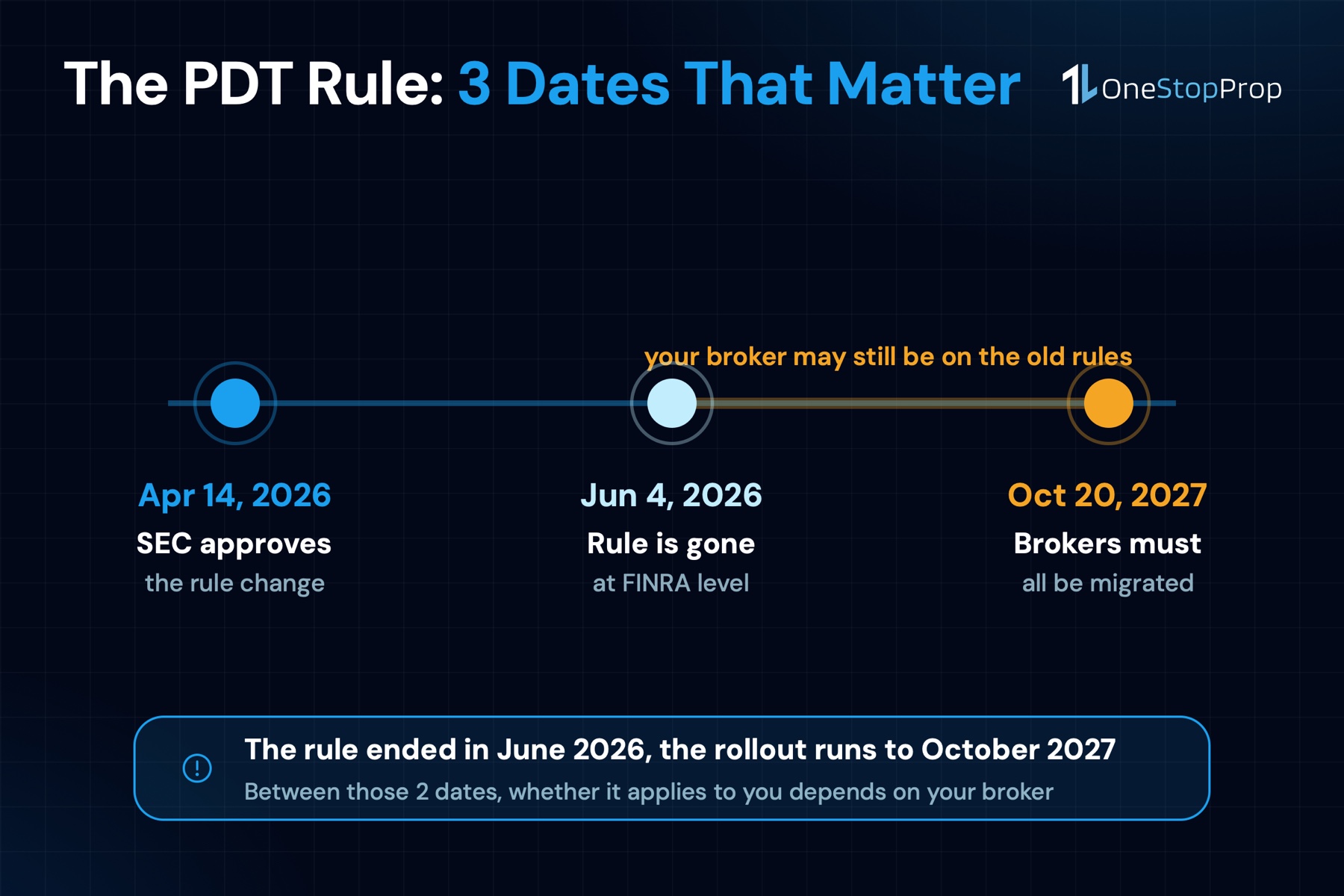
The associated $25,000 minimum equity requirement, in place since 2001, was approved to be eliminated by the SEC on April 14, 2026. On April 20, FINRA announced that the effective date for the rule change would be June 4, 2026. This article explains what the PDT rule was, what replaced it on June 4, 2026, why your own broker may still be enforcing the old version, and what all of that changes for a trader working with a small account.
Key Takeaways
-
The PDT rule is officially eliminated: On April 14, 2026, the SEC formally approved FINRA's amendments to Rule 4210 (filing SR-FINRA-2025-017), eliminating the day-trade count, the pattern day trader designation, and the $25,000 minimum equity requirement in their entirety. If you want to understand the current status, that is the definitive answer.
-
Your broker may still enforce the old rules through late 2027: Brokerage firms may phase in the change through October 20, 2027, meaning a margin account may remain subject to legacy day-trade counting and the $25,000 threshold until its broker converts it. Check your broker directly before assuming the rule no longer applies to your account.
-
A risk-based intraday margin system replaced the fixed floor: The new framework is dynamic – your buying power is tied to your real-time equity and the margin your broker extends, not an arbitrary weekly counter. Greater access comes with tighter real-time risk monitoring.
-
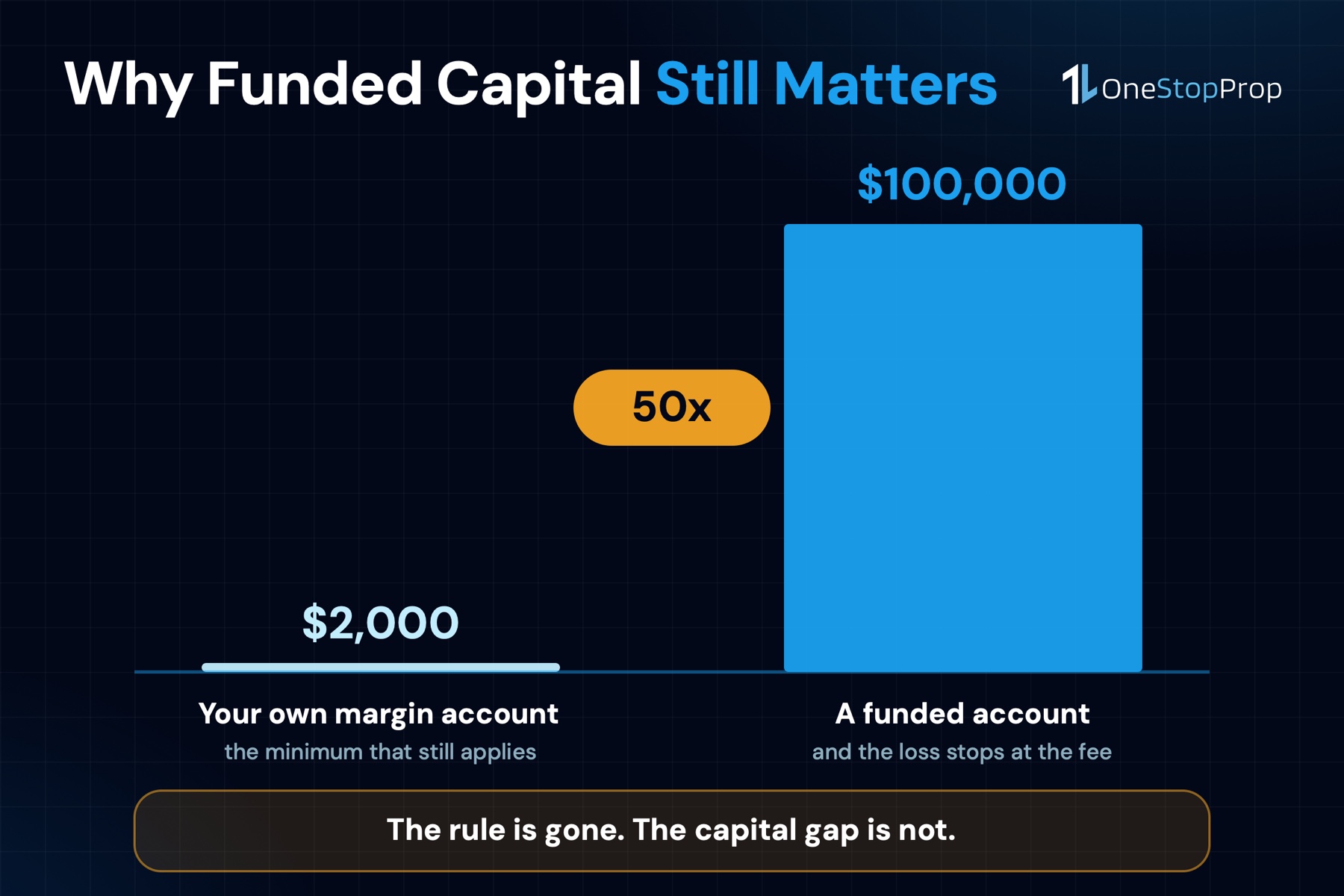
The reason to use a funded account changed: for years the pitch was that a prop firm let you skip the $25,000 floor. That floor is gone, so that pitch is gone with it. What is left is the part that always mattered more: you trade a size you do not own, and the most you can lose is the evaluation fee instead of your own savings. A margin account still needs $2,000 to open. A $100K funded account is 50 times that number, and none of it is yours to lose.
-
Discipline is the non-negotiable: Whether trading under the new intraday margin system or through a funded account, position sizing, risk management, and a tested strategy determine outcomes, not the account size alone.
Quick-Start Prioritization Framework
| Route | Best For | Effort Level | Time to Trade Actively |
|---|---|---|---|
| Prop firm funded account (challenge path) | Traders with a tested strategy who want large capital without personal risk | Medium | Weeks (after passing evaluation) |
| Retail margin account (new intraday rules) | Self-funded traders with $2,000+ and broker already updated | Low | Immediately, once broker implements |
| Cash account | Cautious traders happy with T+1 settlement limits | Low | Immediately, no PDT ever applied |
| Instant-funded prop account | Experienced traders who want to skip a multi-phase challenge | Low-Medium | Days |
Start here if you are:
- Small account, under $5,000: A prop firm funded account gives you access to meaningful size without tying up personal capital, and without waiting for your broker to implement the new intraday rules.
- Self-funded with $2,000-$25,000: Check whether your broker has already implemented the new framework. If yes, you can day trade freely now. If no, you face the old rules until that broker's rollout is complete.
- Experienced trader wanting scale: A Pro-type funded account can accelerate your payout cycle and deliver higher splits on early payouts, which makes it worth prioritizing over a Standard account if your strategy fits the tighter drawdown parameters.
What Was the PDT Rule, and Why Did It Exist?
The Original 2001 Framework
The day trading rule for pattern day traders, implemented by FINRA in 2001, required margin account holders who executed 4 or more day trades within 5 business days to maintain a minimum equity balance of $25,000. Accounts falling below that threshold were restricted from further day trading until the balance was restored.
The rule was introduced in the wake of the dot-com crash, when regulators were concerned about retail traders using excessive margin to make frequent speculative bets. It was the most significant change to day-trading rules since they were written.
Why the Rule Became Outdated
The original logic was to ensure that a trader had enough capital to absorb the losses that frequent day trading could generate. By 2024, most brokerages had built real-time margin monitoring systems that could assess a trader's actual exposure moment to moment, not at the end of the day. The SEC's order language was unusually direct. Regulators agreed the old PDT regime had become disconnected from how risk is actually monitored at modern brokerages, where positions are repriced second-by-second rather than once a day.
In September 2025, FINRA's Board of Governors voted to replace the entire day trading margin framework. On December 29, 2025, FINRA filed the proposed rule change with the SEC as SR-FINRA-2025-017. The public comment period received over 100 responses, with the overwhelming majority in favor of eliminating or significantly reducing the threshold.
Pro Tip: Even before June 2026, there were legal ways to day trade without $25,000, including cash accounts, trading futures, and using prop firm funded accounts. Understanding these options is still important because not every broker has updated its systems yet.
The 2026 PDT Rule Change: What Exactly Happened
The Regulatory Timeline
The rule change moved through the regulatory pipeline faster than most expected. Here is the confirmed sequence of events, sourced from official filings:
- December 29, 2025: FINRA officially filed the proposed rule change with the SEC as SR-FINRA-2025-017.
- January 14, 2026: The SEC published it in the Federal Register and accepted public comments through February 4, 2026, receiving over 100 responses, with all but 1 supporting the change.
- April 14, 2026: The SEC approved FINRA's amendments to Rule 4210, formally eliminating the $25,000 minimum equity requirement and the pattern day trader designation entirely.
- April 20, 2026: FINRA published Regulatory Notice 26-10 setting the effective date of June 4, 2026.
- June 4, 2026: Rule officially takes effect.
- October 20, 2027: Brokers that need more time to implement the rule change may phase in their implementation over 18 months, until October 20, 2027.
What Was Eliminated
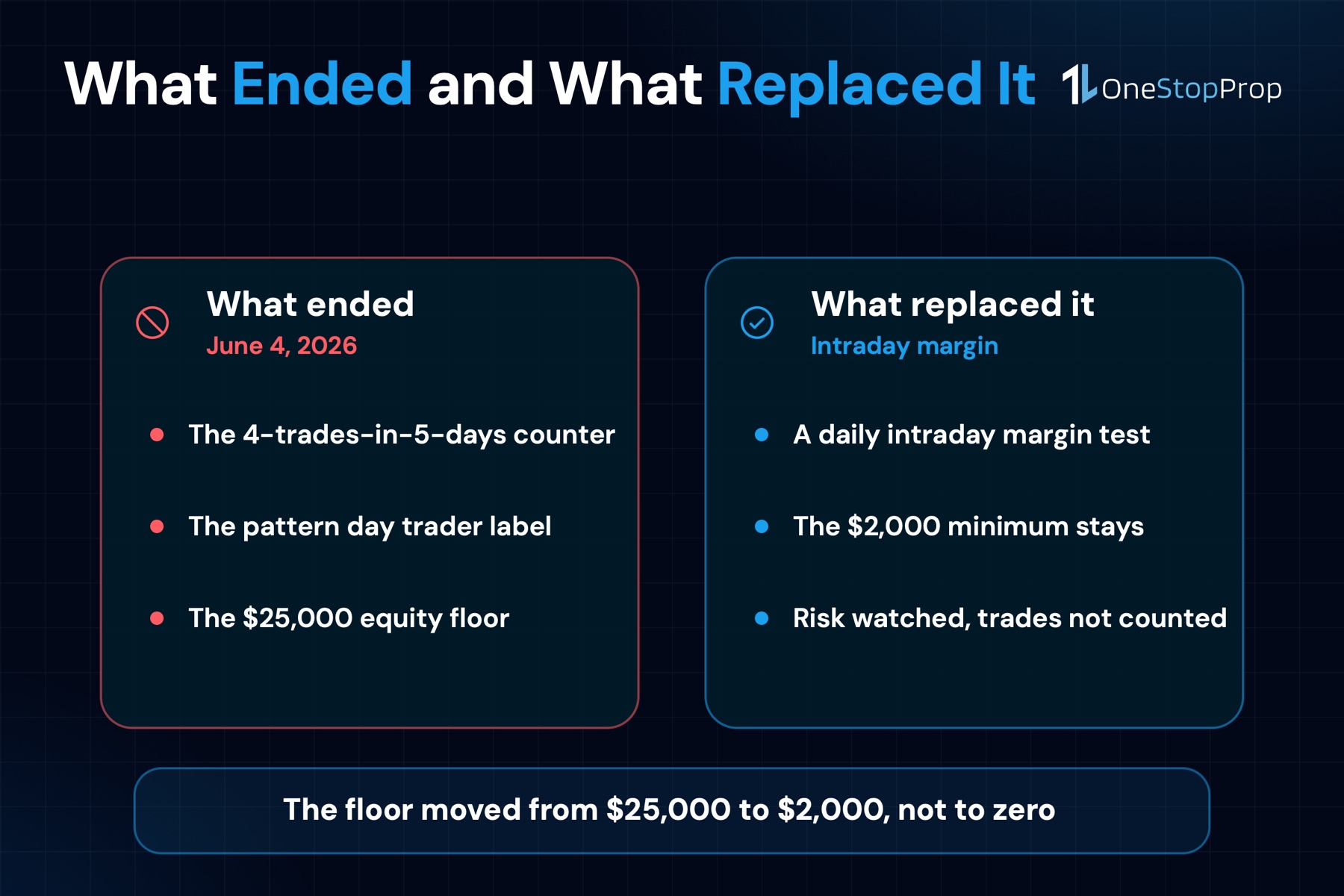
On June 4, 2026, a change to FINRA Rule 4210 removed the $25,000 pattern day trader minimum and the "pattern day trader" label itself, replacing both with a system that measures an account's risk during the trading day rather than counting its trades.
Specifically, 3 things ended at once:
- The $25,000 equity floor
- The 4-trades-in-5-business-days counter that triggered PDT status
- The "pattern day trader" designation and all restrictions attached to it
What Replaced It
The new system is called intraday margin. It does not restrict how many times you trade. It monitors your account equity in real time (or at end of day, depending on your broker), and if your positions consume more margin capacity than your account can support, you will have an intraday margin deficit. Handle that deficit poorly, repeatedly, and you face a 90-day trading restriction, the same consequence as the old PDT freeze, arrived at through a completely different path.
In practical terms: you can trade intraday with as little as the $2,000 minimum that margin accounts have always required, though your broker can set a higher house requirement on top of it.
Pro Tip: The new system removes the trade-count trigger but adds a real-time margin test. A trader who overlevers a small account can still face a 90-day freeze under the new rules, the path to restriction just changed from "too many trades" to "too much intraday exposure." Size positions to match your equity, not your ambition.
The Broker Rollout: Why the Rule May Still Apply to Your Account
A Staggered Implementation
This is the part most coverage glosses over, and it matters enormously if you are planning to start trading actively right now. FINRA changed the rule, but brokers control the rollout. FINRA permits firms that need additional time to phase in implementation through October 20, 2027. During that period, a firm may continue applying legacy PDT controls until it converts the relevant accounts and systems.
In other words, the rule is eliminated at the regulatory level, but your account may still be operating under the old system depending on which broker you use. Here is where some major platforms stood as of September 2026:
- Robinhood: Moved to the intraday margin framework on June 4 and wiped existing PDT flags.
- Charles Schwab: Stopped counting day trades on June 8 and introduced Intraday Margin Buying Power on July 13.
- E*TRADE: Implemented these changes on June 9, 2026, shortly after the new rules took effect.
- Fidelity: The existing PDT rules have been replaced with an intraday margin framework that offers greater trading flexibility while ensuring accounts maintain equity levels that appropriately reflect their intraday exposure. The new rules went into effect on June 4, 2026.
- Interactive Brokers: Warns that an account may remain subject to existing PDT rules during FINRA's transition period.
The action step here is simple: contact your broker or check their announcements page before making any trades that could previously have triggered the PDT flag. Until your broker rolls out the new framework, the old $25,000 threshold may still apply to your account.
Your Options Now That the $25,000 Floor Is Gone
Even with the rule officially eliminated, not every trader will benefit immediately. Here are the 3 main routes available right now.
Option 1: Retail Margin Account Under the New Rules
If your broker has implemented the new framework, you can open a margin account with as little as $2,000 and trade as frequently as your intraday margin allows. This is the most straightforward approach for traders who are self-funded and whose broker is already live on the new system. The trade-off is that your buying power is proportional to your equity, so small accounts still have limited firepower.
Option 2: Cash Account (No PDT, But Settlement Limits Apply)
A cash account can be used for day trading with less than $25,000 because it does not rely on borrowed funds and is outside the old PDT structure. The trade-off is settlement speed: sale proceeds cannot be reused until the trade settles, which slows active stock trading even when day trades themselves are not numerically capped. For high-frequency intraday trading, cash accounts create friction that limits how many positions you can cycle through in a day.
Option 3: Prop Firm Funded Account
A prop firm funded account solves the capital problem directly. The trader must reach a profit target (typically 8-10% of account size) while respecting daily loss limits (typically 4-5% of account size) and maximum drawdown limits (typically 8-12% of account size). Some firms require a 2-step evaluation, where Phase 1 has a higher profit target and Phase 2 has a lower target. Upon passing, the trader receives a funded account with real capital. Profits are split between the trader and the firm.
The funded account route is distinct from retail trading in one important way: you are trading on the firm's capital under the firm's risk rules. The PDT minimum never applied to how prop firms structured their own proprietary capital, which is why the funded account path existed as a workaround long before the regulatory change, and why it remains valuable even after it.
Pro Tip: The prop firm model rewards discipline, not just profit-seeking. Meeting a profit target while staying within daily loss and drawdown limits requires the kind of structured risk management that separates consistent traders from gamblers. Treat the challenge rules as a framework for better trading habits, not just a hurdle to clear.
Prop Firm Funded Accounts: What the Structure Looks Like
How the Evaluation Works
The most common format is a 2-phase challenge. Phase 1 requires hitting a profit target of around 8% while staying within defined risk limits. Phase 2 requires a smaller profit target under the same rules. Pass both and you move into a funded account.
Daily loss limits cap how much your account can lose in a single trading day, usually around 4 to 5%. Breach this and the challenge ends immediately, regardless of your overall profit. Maximum drawdown caps total losses from your peak balance over the entire challenge period, typically 8 to 10%. This is a cumulative limit, not a daily one.
OneStopProp: A Funded Account Built for Stock Traders
OneStopProp is a prop firm built for stock traders first, with forex and crypto as additional options in the same funded account. Traders reach the platform through TradingView charting and Match-Trader execution. The funded account covers stocks including the full Magnificent 7, Apple (AAPL), NVIDIA (NVDA), Microsoft (MSFT), Amazon (AMZN), Alphabet/Google (GOOGL), Meta (META), and Tesla (TSLA), alongside forex and crypto, all tradable from a single account with TradingView-powered charts.
At OneStopProp's checkout, you choose a PATH (1 Step, 2 Step, or Instant) and separately a TYPE (Standard or Pro). These are distinct decisions. Confusing them leads to picking the wrong account for your strategy.
The $100K Standard 2 Step account runs 8% then 5% profit targets across its 2 phases, with a 4% max daily loss and 8% max total loss limit. The profit split is 90%, leverage is 1:50, and payouts are available every 14 days. A consistency rule applies on the payout cycle (25% on Standard), and a minimum of 4 trading days is required per phase, there is no time limit on how long the challenge can run overall.
The $100K Pro 2 Step account targets 10% then 5%, carries the same 4% max daily loss but a tighter 6% max total loss, and delivers 100% profit split on the first 5 payouts, then 90/10 after that. Leverage is 1:20, payouts are available every 5 days after a first payout that requires a minimum of 8 trading days, and the consistency rule is 20%. News trading is permitted on Pro accounts, making the Pro path better suited to traders whose strategies include earnings or macro event setups.
OneStopProp's program structure offers accounts from $10K to $300K with scaling options reaching up to $1.2M, positioning it among the better-capitalized retail programs in 2026. Overnight and weekend holds are permitted across the account lineup, and shorting is allowed on all instruments.
Pro Tip: If your stock trading strategy involves holding through earnings announcements or macro data releases, the Pro account's news trading permission is a meaningful structural advantage. The Standard account restricts news trading, which could invalidate a trade even if the position is profitable. Match your account type to how you actually trade.
Common Mistakes Traders Make When Navigating the PDT Rule
Assuming the Rule Is Gone Everywhere
The most dangerous mistake right now is assuming that because FINRA eliminated the PDT rule, the old restrictions no longer apply to your account. The rule is gone, but "the rule is gone" does not mean "every broker is ready." Brokers have an 18-month implementation window until October 20, 2027 to phase in the new framework. Make a fourth day trade at a broker that has not yet updated, and the old consequences still apply.
Confusing the PDT Rule With a Cash Account Restriction
The PDT rule only applied to margin accounts, but settlement rules still apply to cash accounts and limit same-day reuse of funds. Traders sometimes switch to cash accounts to avoid the PDT, then discover the settlement cycle restricts their ability to compound positions rapidly throughout the day. Both problems require different solutions.
Treating a Prop Firm Challenge Like a Demo Account
A funded account evaluation is a live performance test with real consequences. Blowing through the daily loss limit, even once, typically ends the challenge immediately. The challenge rules, daily loss limits, total drawdown caps, and minimum trading days, exist to simulate the discipline required on a funded account. Traders who treat the challenge phase casually often find they pass the profit target but breach a risk rule on the final day.
Ignoring Payout Rules on Funded Accounts
Consistency rules on funded accounts are often misunderstood. At OneStopProp, the consistency rule applies on the payout cycle only, not on the challenge itself. This means your largest single-day profit during a payout period cannot account for more than 25% of total profits (Standard) or 20% (Pro). The practical implication: avoid lumping all your gains into 1 outsized day, and spread your trading across the cycle to stay within the consistency band.
Frequently Asked Questions
Is the PDT rule still in effect in 2026?
Effective June 4, 2026, the $25,000 pattern day trader minimum and the pattern day trader designation were eliminated through an amendment to FINRA Rule 4210, approved by the SEC on April 14, 2026. However, because brokers have until October 20, 2027 to implement the new framework, the old rules may still apply at some platforms. Check with your specific broker to confirm their implementation status.
What replaced the $25,000 PDT requirement?
An intraday margin standard replaced it. Brokers must now monitor margin accounts for intraday margin deficits, either in real time (blocking trades that would create a deficit) or through end-of-day calculations that can trigger a margin call. The oversight moved from counting your trades to watching your margin, which is a more honest measure of risk. The effective minimum to open a margin account is now $2,000, down from $25,000.
Is there still a reason to use a prop firm now that the PDT rule is gone?
Yes, but it is not the reason it used to be. The old argument was regulatory: the PDT rule applied to retail margin account holders, not to traders operating inside a proprietary trading structure, so a funded account was a way around the $25,000 floor. That floor no longer exists, so that argument retired with it.
The reason that survives is arithmetic. Opening a margin account still takes $2,000 of your own money, and your buying power is a multiple of whatever you put in. A funded account hands you $10K to $300K to trade and caps your downside at the evaluation fee. You trade under the firm's risk rules instead of your own, which is the trade you are actually making: more size, less freedom, and a loss that stops at what you paid to get in.
Do I need to pass an evaluation to get a funded account?
Most prop firms, including OneStopProp, require traders to pass a 1 or 2 phase evaluation before receiving full funding. The evaluation demonstrates that you can hit a profit target while staying within risk parameters. OneStopProp also offers an Instant path for account sizes between $25K and $200K, which skips the multi-phase challenge structure, though the same daily loss and drawdown rules apply from day one of the funded account.
Can I trade the Magnificent 7 stocks through a prop firm funded account?
Yes. OneStopProp's funded account covers 151 US stock CFDs including Apple (AAPL), NVIDIA (NVDA), Microsoft (MSFT) and Tesla (TSLA), alongside forex pairs, indices, commodities, metals and crypto, all in one funded account. They are contracts for difference on those stocks rather than shares you own outright, and all trading happens in a simulated environment. Trading recognizable, liquid names like Amazon (AMZN), Alphabet/Google (GOOGL), and Meta (META) means your strategy benefits from tight spreads and deep liquidity.
What happens if I breach the daily loss limit during a challenge?
Breaching the daily loss limit ends the challenge immediately. At OneStopProp that limit is a fixed percentage of the initial balance, reset at 12:00 AM ET on the higher of balance or equity: 4% on Standard 1 Step, Standard 2 Step and Pro 2 Step, 3% on Pro 1 Step, and 2% on both Instant accounts.
There is no grace period or partial forgiveness. This is the most common reason traders fail evaluations, and it is almost always a position-sizing error rather than a bad trade. Daily loss limits cap how much your account can lose in a single trading day. Breach this and the challenge ends immediately, regardless of your overall profit. Size each trade so that a full loss on that position cannot move your daily drawdown past the limit, and use an order type that actually exits when it is hit.
The Bottom Line
The PDT rule is eliminated at the regulatory level as of June 4, 2026, confirmed by the SEC's approval of FINRA filing SR-FINRA-2025-017 and formalized in Regulatory Notice 26-10. The elimination of the Pattern Day Trader rule is the most significant regulatory change for retail traders in a generation. By replacing the arbitrary $25,000 threshold and trade-counting system with a risk-based intraday margin framework, FINRA has modernized the rules to reflect how markets and technology actually work in 2026.
The practical reality is more nuanced. Not every broker will switch to the new system immediately. Brokerage firms are allowed to phase in the changes gradually, and the full transition period extends all the way until October 20, 2027. That gap, between the rule being legally eliminated and your broker implementing the change, is where prop firm funded accounts continue to provide a decisive advantage. A funded account gives you access to $10K to $300K in trading capital under structured, transparent risk rules, with no requirement to maintain a personal balance of any specific size.
If you are ready to trade stocks like Apple (AAPL), NVIDIA (NVDA), Microsoft (MSFT), and the rest of the Magnificent 7 under a funded account structure with TradingView-powered charts and no time limit on your evaluation, explore the OneStopProp account options and choose the PATH and TYPE that matches how you trade.
Sources
-
FINRA Regulatory Notice 26-10, FINRA. Primary source: elimination of the PDT designation, the day-trade count and the $25,000 minimum. https://www.finra.org/rules-guidance/notices/26-10
-
Frequent Intraday Trading, FINRA. What replaced the rule, and the $2,000 margin minimum that stayed. https://www.finra.org/investors/insights/frequent-intraday-trading
-
Schwab Updates Day Trading and Margin Rules, Charles Schwab. Broker rollout: day-trade counting stopped June 8, Intraday Margin Buying Power July 13. https://www.schwab.com/learn/story/schwab-changes-rules-around-day-trading
-
PDT Rule Change: What's New, E*TRADE from Morgan Stanley. Broker implementation of the new intraday margin rules. https://us.etrade.com/knowledge/library/margin/pattern-day-trading-rule-change
-
Intraday Trading, Fidelity. Broker confirmation of the framework and its June 4 start. https://www.fidelity.com/learning-center/trading-investing/intraday-trading
-
Robinhood, Webull and Interactive Brokers as the PDT Rule Dies, Benzinga. Broker-by-broker status on the day the rule took effect. https://www.benzinga.com/trading-ideas/movers/26/06/53007723/robinhood-webull-interactive-brokers-set-to-gain-as-pdt-rule-dies-today
-
Response to the FINRA PDT Proposal, Cboe Global Markets. Industry comment letter supporting the intraday margin replacement. https://cdn.cboe.com/resources/government_relations/Cboe-Response-to-FINRA-PDT-Proposal-February-2026-.pdf
-
Pattern Day Trading, Tastytrade. History of the rule and the elimination timeline. https://tastytrade.com/learn/markets/industry/pattern-day-trading/
-
FINRA PDT Rule Removal 2026, QuantInsti. The intraday margin standard explained. https://www.quantinsti.com/articles/finra-pdt-rule-removal-2026/
-
What is the Maximum Daily Loss?, OneStopProp. Official daily loss calculation for each account path. https://help.onestopprop.com/faq/what-is-the-maximum-daily-loss/
-
What Instruments Can I Trade?, OneStopProp Help Center. The instrument list, including US stock CFDs. https://help.onestopprop.com/faq/what-instruments-can-i-trade/
-
OneStopProp Homepage, OneStopProp. Account lineup, platform and funded trading structure. https://onestopprop.com/