Every list of the most volatile stocks to day trade names the same companies. Tesla, NVIDIA, the rest of the Magnificent 7. They are the stocks everyone watches, so they are the stocks everyone writes about.
We measured instead. Every one of the 83 US stocks available to trade at OneStopProp, 66 trading sessions, average daily range as a percentage of the closing price. The result is not the list you have read before, and the gap is not small: the stock at the top of the ranking moves 3.6 times as much on an average day as Apple does.
That matters more on a funded account than anywhere else, because your daily loss limit is a fixed percentage and the stock’s range is not.
Key Takeaways
- The most volatile stock on the list is Moderna (MRNA), at 7.47% average daily range. Over 66 sessions it moved more than twice as much per day as Tesla (TSLA), the widest-ranging name in the Magnificent 7.
- None of the Magnificent 7 reach the top 10. Tesla leads that group at 3.29%, which would place it outside the 20 widest names on the list. Apple (AAPL) sits at 2.09%, roughly a third of the top of the ranking.
- A 7% daily range against a 4% daily loss limit is an arithmetic problem, not an opportunity. On a $100K Standard 2 Step account the daily loss limit is $4,000. A position sized the way you would size Apple can reach that number on Moderna before lunch.
- Range is a sizing input, not a stock picker. The wider the average range, the smaller the position has to be for the same dollar risk. Traders who skip that step are the ones who breach.
- These numbers move. The ranking below was measured on October 7, 2026 over the prior 66 sessions. Recalculate before you build a strategy on any single name.
How This Was Measured
The method is deliberately simple, so you can repeat it.
For each stock, we took the daily high, low and close for the last 66 trading sessions, calculated (high – low) / close for every session, and averaged the result. That gives average daily range as a percentage, which is comparable across stocks regardless of share price. A $30 stock and a $700 stock can sit in the same table.
The universe is the 83 US stock CFDs listed in the OneStopProp Help Center, not a general screen of the market. That is the point: these are the names you can actually take a position in on a funded account there, so the ranking answers a question you can act on.
2 caveats worth stating. The figures are as of October 7, 2026, and volatility regimes change. And average range is not the same as risk: a stock can have a wide average range and still trend cleanly, or a narrow one and gap viciously on news.
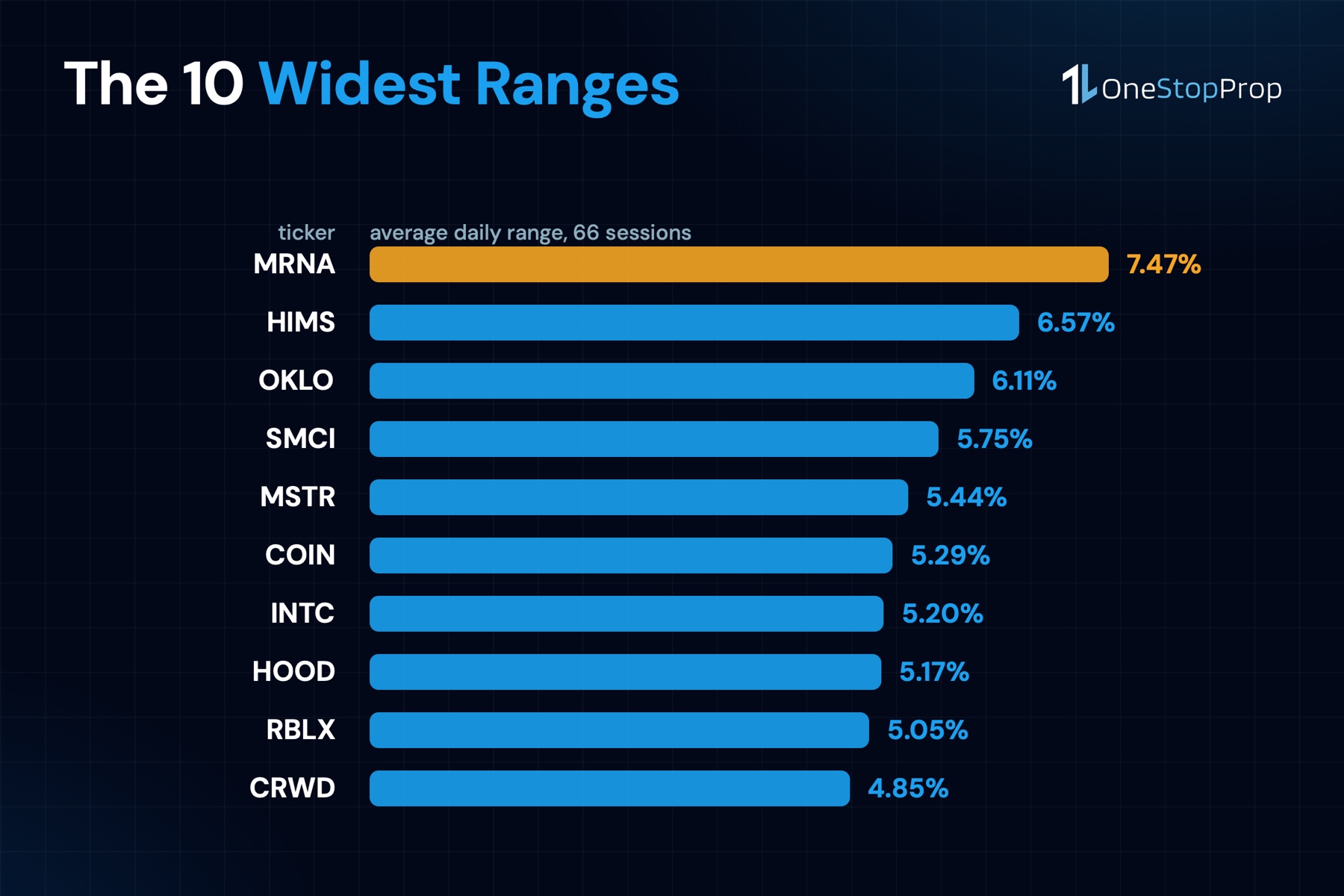
The 10 Most Volatile Stocks to Day Trade
| # | Stock | Ticker | Average daily range |
|---|---|---|---|
| 1 | Moderna | MRNA | 7.47% |
| 2 | Hims & Hers Health | HIMS | 6.57% |
| 3 | Oklo | OKLO | 6.11% |
| 4 | Super Micro Computer | SMCI | 5.75% |
| 5 | MicroStrategy | MSTR | 5.44% |
| 6 | Coinbase | COIN | 5.29% |
| 7 | Intel | INTC | 5.20% |
| 8 | Robinhood | HOOD | 5.17% |
| 9 | Roblox | RBLX | 5.05% |
| 10 | CrowdStrike | CRWD | 4.85% |
Behind them: AppLovin (APP) at 4.63%, Snap (SNAP) at 4.71%, Rivian (RIVN) at 4.58%, Palo Alto Networks (PANW) at 4.54% and AMD at 4.42%.
What the top of this table has in common is not sector. It is that each of these companies has a single question hanging over it that the market re-prices constantly: a drug pipeline, a reactor approval, a bitcoin balance sheet, a foundry turnaround. Those are the setups that produce range.
Why the Magnificent 7 Are Not on the List
This is the part most volatility articles get backwards.
| Stock | Ticker | Average daily range |
|---|---|---|
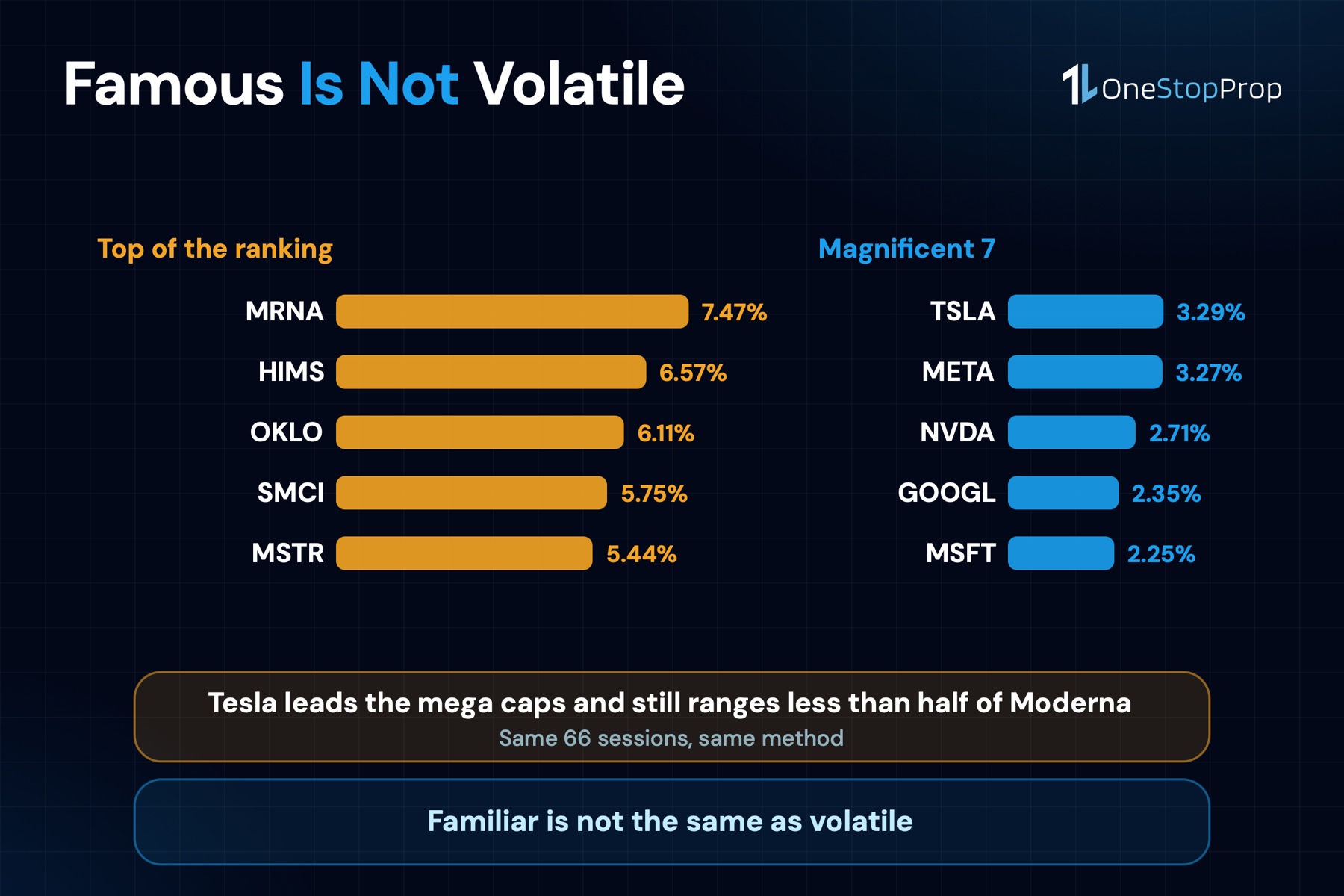
| Tesla | TSLA | 3.29% |
| Meta Platforms | META | 3.27% |
| NVIDIA | NVDA | 2.71% |
| Alphabet | GOOGL | 2.35% |
| Microsoft | MSFT | 2.25% |
| Amazon | AMZN | 2.16% |
| Apple | AAPL | 2.09% |
Tesla is genuinely the most active of the group, and on an earnings day it can move far more than 3.29%. But measured across 66 ordinary sessions, the widest-ranging mega cap still ranges less than half as much as Moderna.
The reason is size. A company worth over a trillion dollars needs an enormous amount of new information to move 5% in a day. Moderna does not. The same news flow that nudges Apple reprices a $70 billion biotech.
This does not make the Magnificent 7 bad stocks to trade. Tight spreads, deep liquidity and clean technical levels are real advantages, and a 2% average range is still a tradeable range. It makes them the wrong answer to the specific question “which stocks move the most”.
What a 7% Range Does to a Daily Loss Limit
Here is the cross that matters on a funded account, and the reason this ranking is not a shopping list.
At OneStopProp the max daily loss is a fixed percentage of the initial balance, and it depends on the path you buy: 4% on Standard 1 Step, Standard 2 Step and Pro 2 Step, 3% on Pro 1 Step, and 2% on both Instant accounts. On a $100,000 Standard 2 Step account, that is $4,000 in a single session. Reach it and the account is breached, not paused.
Now put a 7.47% average range against that number.
Take a $20,000 position in Moderna. A 7.47% range means the distance between the day’s high and low is about $1,494 on that position. You do not lose the full range, but a stop placed anywhere inside normal daily movement can be hit twice in a session and still be a correct stop. 2 of those is $3,000 against a $4,000 ceiling, from a stock doing nothing unusual.
The same $20,000 in Apple, at 2.09%, puts the day’s full range at about $418. You would need the position to be more than 3 times larger to face the same dollar exposure.
That is the whole lesson. The wider the range, the smaller the position, if the dollar risk is supposed to stay the same.
Sizing a Position by Average Daily Range
The adjustment is mechanical once you have the number.
Decide the dollar risk first. On a $100,000 account with a 4% daily limit, a common choice is to risk 0.5% to 1% of the account per trade, so $500 to $1,000, and never more than a quarter of the daily limit on one position.
Then divide. Position size = dollar risk / (stop distance as a percentage x share price), where the stop distance is anchored to the stock’s own range rather than a round number. A stop set at roughly half the average daily range survives ordinary noise without sitting so far out that it stops being a stop.
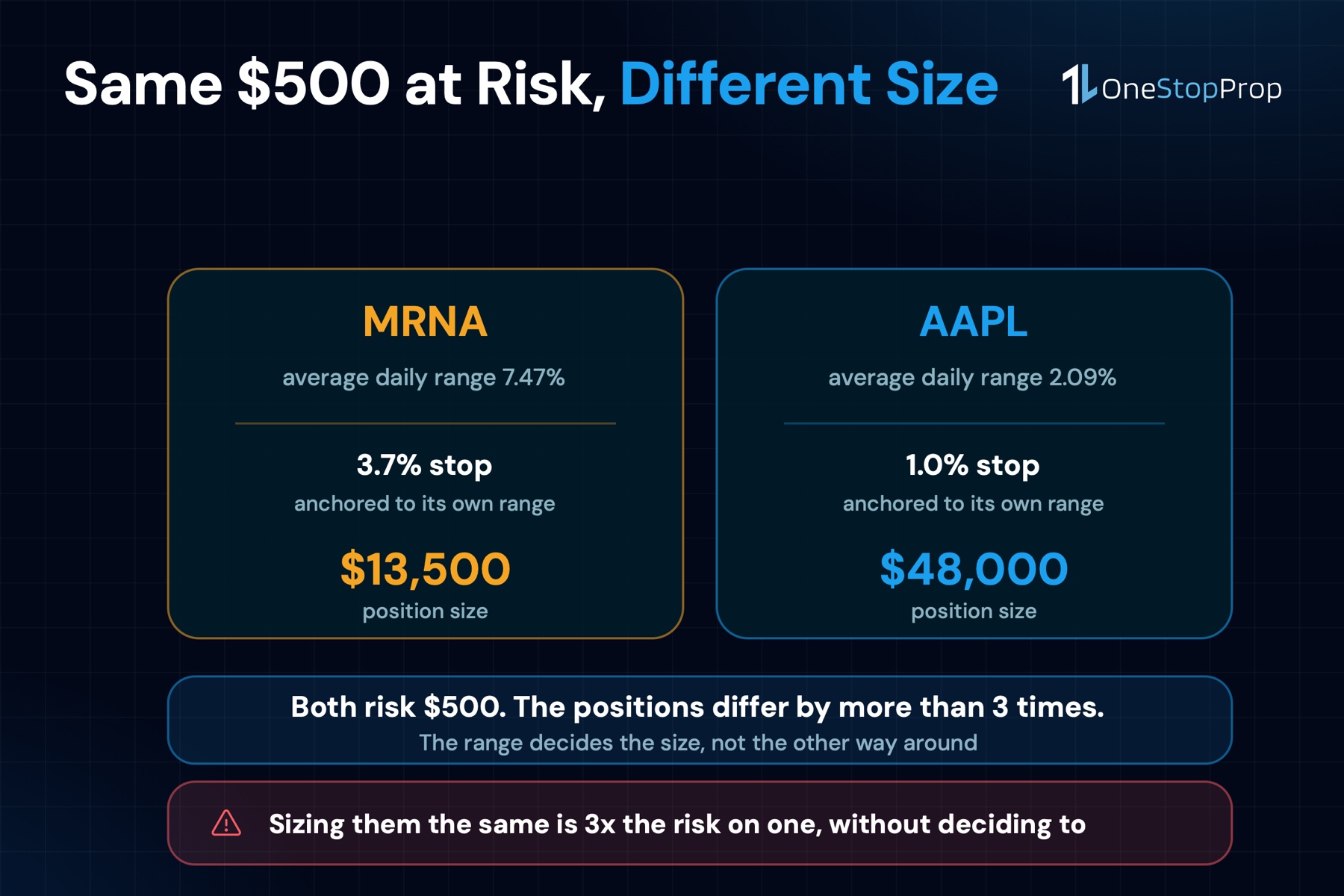
On Moderna, half of 7.47% is about 3.7%. To risk $500, the position is about $13,500. On Apple, half of 2.09% is about 1%, and the same $500 of risk supports a position near $48,000. Same risk, positions that differ by more than 3 times, purely because the stocks move differently.
Traders who size both the same way are not taking the same risk. They are taking 3 times the risk on one of them without deciding to.
What the Top of the Ranking Has in Common
Scanning the 10 most volatile stocks on the list, the pattern is not sector. Biotech, nuclear power, server hardware, crypto treasuries, semiconductors and a brokerage sit in the same table. What they share is structural.
Each one has a binary question attached. Moderna’s value depends on a pipeline that either reads out well or does not. Oklo’s depends on reactor approvals. MicroStrategy’s depends on a bitcoin price it holds on the balance sheet. These are companies where a single piece of news can legitimately change what the business is worth by 10%, so the market reprices them continuously rather than drifting.
Most are mid caps, not mega caps. The same dollar of buying or selling moves a $40 billion company far more than a $3 trillion one. That is most of the gap between the top of this ranking and the Magnificent 7, and it is also why the ranking is relatively stable even as individual names rotate through it.
Several are heavily shorted or heavily crowded. When positioning is one-sided, ordinary news produces disorderly moves as traders are forced out. That shows up in the daily range long before it shows up in a headline.
For a day trader, the practical read is that these are the names where intraday structure actually develops. A stock that travels 5% between its high and low gives a strategy room to work. A stock that travels 2% gives the same strategy a much thinner margin after spread and slippage.
The Other End of the List
The low-range names are worth knowing for the opposite reason.
Over the same 66 sessions, Roku (ROKU) averaged 1.21%, Coca-Cola (KO) 1.54% and Costco (COST) 1.63%. Those are not broken stocks. They are stocks where an intraday strategy has very little room to cover its own costs.
This is where the daily loss limit cuts the other way. On a narrow-range name, hitting a meaningful profit target requires either a much larger position or far more trades, and both of those push against the rules rather than with them. A larger position means a single adverse move consumes more of the daily limit. More trades means more spread paid, and on a funded account the consistency rule also starts to matter, because grinding out many small sessions is exactly the profile it rewards.
The useful question is not which end of the list is better. It is whether your strategy needs range to work. A breakout strategy starves on a 1.5% stock. A mean-reversion strategy on a 7% stock can be right about direction and still be stopped out twice before the move arrives.
Common Mistakes With Volatile Stocks on a Funded Account
Treating the Range as the Edge
A wide range means opportunity and damage in equal measure. It does not predict direction. Moderna at 7.47% will move against a wrong entry just as fast as it moves for a right one, and the daily loss limit does not care which.
Using the Same Stop on Every Stock
A fixed 1% stop is too wide on Apple and far too tight on Oklo. On a stock with a 6% average range, a 1% stop will be hit by noise on most sessions, which turns a sound strategy into a string of small losses that still add up to a breach.
Holding a Wide-Range Name Through Earnings
Average daily range measures ordinary sessions. Earnings is not an ordinary session, and the gap between the close and the next open can skip past a stop entirely. On the names at the top of this ranking, that gap can be a multiple of the average range.
Adding to a Loser Because the Range Justifies It
The reasoning sounds plausible on a volatile stock: it moves 6% a day, so it can come back. It can. It can also keep going. Each add is a separate trade against the same daily limit, and the limit arrives faster than the recovery.
Frequently Asked Questions
What is the most volatile stock to day trade right now?
Measured across 66 sessions to October 7, 2026, Moderna (MRNA) had the widest average daily range of the 83 US stocks available at OneStopProp, at 7.47%. Hims & Hers Health (HIMS) at 6.57% and Oklo (OKLO) at 6.11% follow. These rankings shift with volatility regimes, so the figure is worth recalculating rather than treating as permanent.
Is Tesla the most volatile stock?
No, though it is the most volatile of the mega caps. Tesla’s average daily range over the same 66 sessions was 3.29%, which leads the Magnificent 7 but sits well outside the top 10 of the full list. On a single earnings day Tesla can move much more, but the question of which stock moves most on an ordinary day has a different answer.
How do I calculate average daily range myself?
Take the daily high, low and close for each session over your chosen window, compute (high – low) / close for each day, and average them. Expressing it as a percentage of the close is what makes stocks of different prices comparable. A 66-session window covers roughly 3 months, long enough to smooth single events without going stale.
Does volatility help or hurt on a funded account?
Both, and the deciding factor is position size. A wider range gives a strategy more room to work in, and it consumes the daily loss limit faster at the same position size. The rule that keeps traders funded is to shrink the position as the range widens so that the dollar risk stays constant.
Can I trade these stocks at OneStopProp?
Yes. All 10 names in the ranking are among the 83 US stock CFDs listed in the OneStopProp Help Center, tradeable alongside forex, indices, commodities, metals and crypto from a single funded account. They are contracts for difference rather than shares you own outright, and all trading happens in a simulated environment.
What range should I expect around earnings?
More than the average, often by a multiple. Average daily range is calculated over ordinary sessions and does not describe gap risk. For the names at the top of this list, the practical approach is to reduce size before a scheduled report or to be flat into it, because a gap can clear a stop without ever trading at it.
The Bottom Line
The honest ranking of the most volatile stocks to day trade does not look like the lists that circulate, because those lists rank familiarity rather than movement. Moderna, Hims & Hers, Oklo and Super Micro moved more per session over the last 3 months than any of the companies that dominate the headlines.
What to do with that is the opposite of what it seems. A wider range is not a reason to take a bigger position. It is the input that tells you to take a smaller one, so that the same trade idea costs the same dollars whether you express it in Apple or in Moderna.
If you want to trade these names with the risk rules defined in advance, OneStopProp’s Standard 2 Step account runs a 4% daily loss limit measured off the initial balance, an 8% maximum total loss and a 90% profit split, across a stock list that includes every ticker in this ranking.
Sources
- What Instruments Can I Trade?, OneStopProp Help Center. The 83 US stock CFDs that make up the universe measured here. https://help.onestopprop.com/faq/what-instruments-can-i-trade/
- What is the Maximum Daily Loss?, OneStopProp. How the daily loss limit is calculated on each account path. https://help.onestopprop.com/faq/what-is-the-maximum-daily-loss/
- Historical price data, Yahoo Finance. Daily high, low and close for each ticker over the 66 sessions to October 7, 2026, the basis for every range figure in this article. https://finance.yahoo.com/
- Prop Firm Drawdown Rules for Stock Traders, OneStopProp. How daily and total drawdown interact on a funded account. https://onestopprop.com/prop-firm-drawdown-rules-stock-traders/
- Stop Loss vs Stop Limit, OneStopProp. Which order type actually exits when a volatile name moves against you. https://onestopprop.com/stop-loss-vs-stop-limit/