A trading plan template is the set of decisions you write down before the first order of the day: what you trade, when, how much you risk, and at what point you stop. On a personal account those are preferences. On a funded account they sit inside limits the firm already wrote for you, and a plan that ignores those limits is a plan for a different account.
This is a trading plan template built for that situation. It has 7 blocks, each one with a number to fill in, and a worked example on a $100K 2 Step account so you can see what a finished plan looks like.
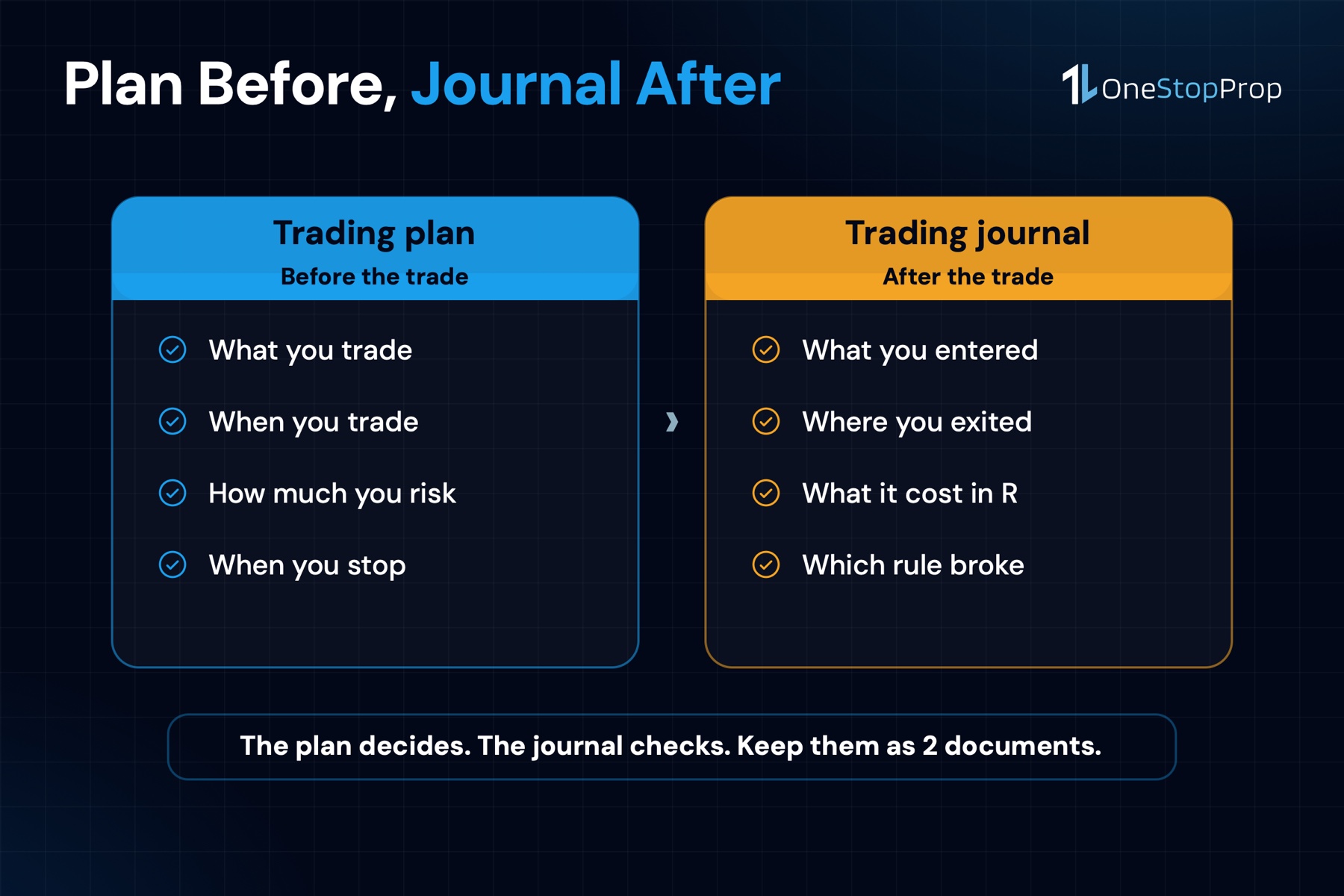
It is not a journal. The trading journal template records what happened after each trade. The plan is what you decide before it, and the journal only becomes useful once there is a plan to measure it against.
Key Takeaways
- The plan goes before the trade; the journal comes after. A trading plan template sets the rules, a journal checks whether you followed them. Keep them as 2 separate documents.
- Start from the firm’s numbers, then write yours inside them. On a $100K account the daily loss limit is $4,000 on 1 Step and 2 Step and $2,000 on Instant. Your own daily stop has to sit below that, not on it.
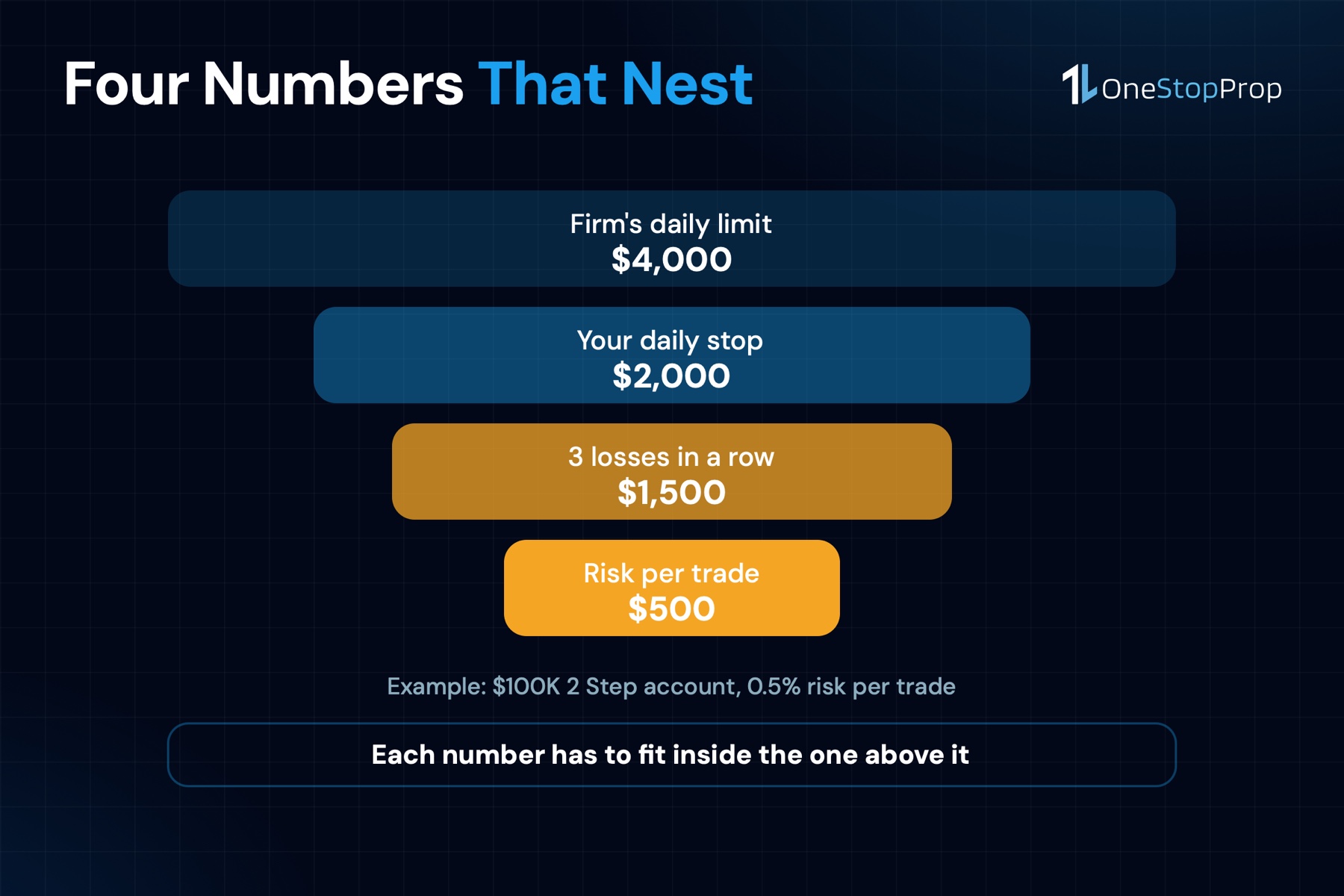
- 4 numbers have to agree. Risk per trade, maximum losses in a row, your daily stop and the firm’s daily limit nest inside each other. If any pair is out of order, the plan fails on a normal losing day.
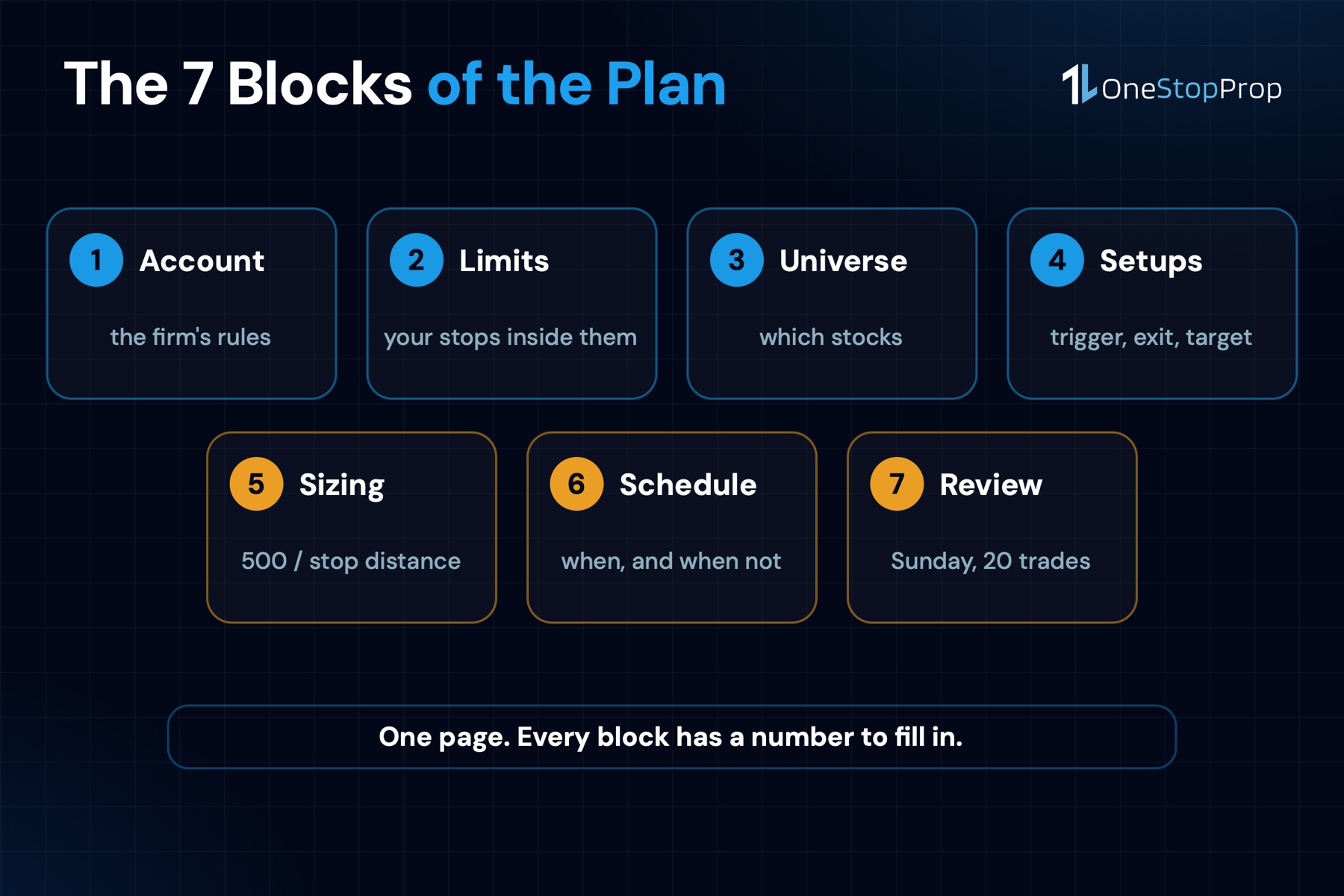
- A plan with 7 blocks is enough. Account, limits, universe, setups, sizing, schedule, review. Anything longer does not get read on a Tuesday morning.
- Change the plan on a schedule, never mid-session. Rules edited after a loss are not rules.
Why a Funded Account Needs Its Own Trading Plan Template
Most trading plan templates online are written for a brokerage account where the only hard limit is the balance. They cover goals, strategy and psychology, and they leave the numbers to you.
A funded account has numbers that are not yours to choose. The daily loss limit, the total loss limit, the profit target, the minimum trading days, the consistency rule and the news window are all set by the route you bought. A plan that does not quote them is missing the part that ends accounts.
The second difference is the clock. A personal account survives a bad week by waiting. A funded account measures the daily loss limit at 12:00 AM ET from the higher of balance or equity, which means every session starts a new count and the count is not negotiable. The plan has to say what you do when the count gets close.
The U.S. Securities and Exchange Commission’s warning on day trading puts the general risk plainly: day traders typically suffer severe losses in their first months, and should only risk money they can afford to lose. On a funded account the money at risk is the evaluation fee and the account itself, which is exactly why the plan matters more, not less.
The 7 Blocks of the Trading Plan Template
Each block is a short set of lines with a blank to fill. The example values are for a $100K 2 Step account at OneStopProp; the route-specific numbers change for 1 Step and Instant, and the table further down shows where.
Block 1: The account layer
Copy the firm’s rules for your route, in dollars, at the top of the page. This block is the one most templates skip, and it is the one that decides everything below it.
- Route and size: 2 Step, $100,000
- Profit target: 8% in phase 1 ($8,000), 5% in phase 2 ($5,000)
- Maximum daily loss: 4% of the initial balance ($4,000), measured at 12:00 AM ET from the higher of balance or equity
- Maximum total loss: 8% ($8,000)
- Minimum trading days: 4 per phase in the challenge, 6 per payout cycle once funded
- Consistency rule, once funded: no single day may be 25% or more of the cycle’s profit
- News window, once funded: no trades 5 minutes before and after FOMC, NFP, CPI, PPI and earnings, unless the News Trading Allowed Add-On is on the account
- Not allowed: hedging, martingale, grid, latency arbitrage, HFT, tick scalping; EAs are allowed during the challenge and not on the funded account
- Allowed: overnight and weekend holds, no time limit on the evaluation
Write it out even if you know it. The point is that the rest of the plan references these lines, and a plan that references a number from memory is the one that gets the Instant limit wrong.
Block 2: Your limits inside the firm’s limits
The firm’s daily limit is the line where the account ends. Your daily stop is the line where you stop trading, and it has to be well inside the first one, because the gap between them is what absorbs a bad fill, a gap at the open or a halt.
- Personal daily stop: 50% of the firm’s daily limit ($2,000)
- Maximum losing trades in a row before stopping for the day: 3
- Maximum trades per day: 4
- Weekly stop: $4,000, which is half of the total loss limit, after which the week is over
The 50% figure is a starting point, not a rule of nature. What matters is that it leaves room: a stop that sits at 90% of the firm’s limit means a single slippage of 0.5% of the account turns a stopped day into a closed account.
Block 3: The universe
Which stocks you are allowed to trade, written as filters rather than tickers, so the list updates itself.
- Only names on the firm’s instrument list
- Average daily range above 2%, so the stop fits inside normal movement
- Price above $20, so the spread is a small fraction of the stop
- Watchlist capped at 10 names, rebuilt once a week
The most volatile stocks ranking shows why the range filter matters: a 7% daily range stock and a 1% one need completely different stop distances, and a plan that treats them the same will be sized wrong in one of them.
Block 4: The setups
2 or 3 setups, each with 3 lines: the trigger, the invalidation and the target. If you cannot write the 3 lines, it is not a setup yet.
- Setup A, opening range breakout: entry on a break above the 15 minute high with volume above the opening average; invalidation back inside the range; target 2 times the stop distance. The full rules are in the opening range breakout strategy.
- Setup B, VWAP reclaim: entry on the first close back above VWAP after a morning flush; invalidation below the flush low; target the prior day’s high.
- Setup C: none. The third slot stays empty until A and B have 20 logged trades each.
A plan with 6 setups is a plan with no setups, because the journal cannot tell you which one works when the sample is split 6 ways.
Block 5: Risk per trade and position size
The number that connects the plan to the account. Risk per trade is a fixed dollar amount, and the position size is whatever that amount buys at the stop distance you chose.
- Risk per trade: 0.5% of the initial balance ($500)
- Shares = risk per trade divided by the distance from entry to stop
- Example: entry $180.00, stop $178.80, distance $1.20, so 416 shares
- Maximum open risk across all positions: 1% ($1,000)
The formula is the whole block. A trader who sizes by “about 400 shares” takes $480 of risk on a $1.20 stop and $1,600 on a $4.00 stop, and the second one is 40% of a daily limit on a single trade.
Pro Tip: write the share formula on the plan with the numbers already in it, not as algebra. “500 divided by the stop distance” gets used; “R / (E minus S)” gets skipped.
Block 6: The schedule
When you trade, when you do not, and what happens on days with a scheduled release.
- Session: 9:30 to 11:30 AM ET, which is where most of the day’s range is. The best time to day trade stocks measured the opening half hour at about 4 times the range of the quietest afternoon slot.
- No new trades after 3:30 PM ET unless the position will be held overnight by design
- Days with FOMC, CPI, PPI or NFP: flat 5 minutes before and after the release, or no trading in that hour
- Earnings: no position in a stock through its own report unless the News Trading Allowed Add-On is on the account
- Market holidays and early closes: no trading
The news lines are not a style choice on a funded account. Trading inside the 5 minute window without the Add-On is a rule breach, and the plan is where you decide in advance that it will not happen by accident.
Block 7: Review and change rules
How the plan gets updated, so that it is updated by evidence instead of by the last trade.
- Review: every Sunday, against the journal, reading the 3 weekly numbers
- The plan changes only after 20 logged trades on the setup in question
- No edits to any number during a session
- A rule broken twice in a week is the first item of the next review
This is where the journal and the plan meet. The journal produces the 20 trades; the plan is what those trades are allowed to change.
The 4 Numbers That Have to Agree
A trading plan template is only coherent if 4 of its numbers nest inside each other, from smallest to largest. Here they are for the $100K 2 Step example.
| Number | Where it lives | $100K 2 Step | Has to be smaller than |
|---|---|---|---|
| Risk per trade | Block 5 | $500 | the daily stop divided by the max losses in a row |
| Max losses in a row, times risk | Block 2 and 5 | 3 x $500 = $1,500 | the personal daily stop |
| Personal daily stop | Block 2 | $2,000 | the firm’s daily limit |
| Firm’s daily limit | Block 1 | $4,000 | nothing; it is the account |
Read the table from the top. 3 losses in a row cost $1,500, which is inside the $2,000 personal stop, which is inside the $4,000 firm limit with $2,000 to spare. A normal losing day ends with the account intact and half the limit untouched.
Now change one number. Raise risk per trade to 1.5% ($1,500) and leave everything else. 3 losses are $4,500, which passes the personal stop on the second loss and the firm’s limit on the third. The plan did not change its rules; it just stopped being internally consistent, and the account pays for it.
The same check runs on the way up. On a 2 Step route the phase 1 target is $8,000. At $500 of risk per trade, a 1:2 reward to risk ratio and a 60% win rate, the expected result per trade is about $400, which is roughly 20 trades to the target. The risk reward ratio article has the full table by win rate, and the point here is that the plan’s risk number has to produce a realistic number of trades, not a heroic one.
Adapting the Template to Your Route
The structure of the trading plan template does not change between routes. The numbers in Block 1 do, and 2 of them change everything below.
| Rule | 1 Step | 2 Step | Instant |
|---|---|---|---|
| Profit target | 8% | 8% then 5% | none |
| Maximum daily loss | 4% | 4% | 2% |
| Maximum total loss | 6% | 8% | 5% |
| Minimum days, challenge | 3 | 4 per phase | none |
| Minimum days, payout cycle | 6 | 6 | 8 |
| Consistency rule, funded | 25% | 25% | 20% |
On Instant the daily limit is 2%, so every number in Block 2 and Block 5 halves. A $100K Instant account with a 0.5% risk per trade has room for only 2 losses before a 50% personal stop, not 3. A trader who copies the 2 Step plan onto an Instant account has a plan that breaks on the second trade of a bad day.
On 1 Step the total loss limit is 6% instead of 8%, so the weekly stop in Block 2 should come down to $3,000 to keep the same proportion.
The consistency rule is the one number traders forget to plan for. Once funded, no day may be 25% or more of the cycle’s profit on 1 Step and 2 Step, or 20% on Instant. If the cycle is at $4,000 and a single session makes $2,000, that day is 50% of the cycle and the payout waits until total profit grows enough to bring it under the threshold. The prop firm consistency rule article works the arithmetic; for the plan, the implication is a daily profit stop as well as a daily loss stop once a payout is in sight.
What the Finished Plan Looks Like
A page, not a document. This is the $100K 2 Step example compressed to the lines a trader actually reads before the open.
| Block | Line |
|---|---|
| Account | $100K 2 Step. Daily limit $4,000. Total $8,000. Target $8,000 then $5,000. |
| Limits | Daily stop $2,000. 3 losses in a row and done. 4 trades max. Week stops at $4,000. |
| Universe | On the firm’s list, range above 2%, price above $20, 10 names max. |
| Setups | A: 15 min ORB, 2R target. B: VWAP reclaim, prior high target. |
| Sizing | $500 per trade. Shares = 500 / stop distance. Open risk $1,000 max. |
| Schedule | 9:30 to 11:30. Flat around FOMC, CPI, PPI, NFP. No earnings holds. |
| Review | Sunday. 20 trades before any change. No edits mid-session. |
That is the whole trading plan template, filled in. Everything in it can be checked against the journal at the end of the week, which is the test of whether a line belongs: if the journal cannot tell you whether you followed it, it is not a rule, it is a wish.
Common Mistakes With a Trading Plan
Writing the plan after the first loss
A plan written on day 3, after a $3,000 session, is a reaction. It will be too tight for a month and then get abandoned. Write it before the account is funded, on the demo or on the challenge, and let the first 20 trades test it.
Copying another trader’s numbers
Risk per trade, session hours and setups belong to a strategy, not to a template. A 0.5% risk suits a setup that loses 3 or 4 times in a row on a normal week. A setup that loses 7 in a row needs a smaller number, and only a journal can tell you which one you have.
No line for when not to trade
Most plans say when to enter. Few say when the day is over, when the week is over, or that a scheduled release means no position. The missing lines are the ones that would have prevented the losses that end accounts.
Treating the firm’s limit as the stop
A personal daily stop at 95% of the daily limit is not a stop; it is the limit with a different name. The gap between the 2 is what absorbs slippage, a gap at the open or a halt, and the stop loss vs stop limit article shows how much of that gap a single bad fill can eat.
Changing the plan during the session
Every rule in the plan was written by a calm version of you. The version that edits it at 10:15 AM after 2 losses is not that person. The review day exists so the edit can happen, later, with 20 trades of evidence instead of 2.
Frequently Asked Questions
What should a trading plan template include?
7 blocks: the account’s rules in dollars, your own limits inside them, which stocks you trade, 2 or 3 setups with trigger and invalidation, risk per trade and the sizing formula, the session schedule including news days, and the rules for reviewing and changing the plan.
Is a trading plan the same as a trading journal?
No. The plan is written before the trade and sets the rules. The journal is written after and records what happened. The journal is only useful when there is a plan to compare it against, and the plan only improves when the journal has enough trades to judge it.
How much should I risk per trade on a funded account?
The number has to nest inside the daily limit. A common starting point is 0.5% of the initial balance, which on a $100K 1 Step or 2 Step account is $500 and leaves room for 3 losses in a row inside a $2,000 personal stop. On Instant, where the daily limit is 2%, the same proportion halves.
How often should I update my trading plan template?
On a schedule, with evidence. A weekly review against the journal, and no change to a setup’s rules until it has 20 logged trades. Nothing changes during a session.
Can I use the same trading plan on 1 Step and Instant?
The structure, yes. The numbers, no. Instant has a 2% daily loss limit against 4% on 1 Step and 2 Step, a 5% total loss, 8 minimum days per payout cycle and a 20% consistency threshold, so Blocks 1, 2 and 5 are rewritten for it.
Do I need a trading plan to pass a prop firm challenge?
The challenge does not require one. What it requires is not breaching the daily or total loss limit on the way to the target, and the plan is the document that makes those 2 numbers something you decided in advance instead of something you discover at 10:45 AM.
The Bottom Line
A trading plan template for a funded account is short, specific and written inside the firm’s limits. 7 blocks, each with a number, and 4 of those numbers nested so that an ordinary losing day stops you before the account does.
The plan is not the strategy. It is the frame the strategy runs in, and the frame is what decides whether a bad week costs a week or an account.
If you want to fill the template with numbers that are already written down, pick your OneStopProp account: 1 Step, 2 Step or Instant, from $10K to $300K, with every limit in Block 1 published before you pay and no time limit on the evaluation.
Sources
- Day Trading: Your Dollars at Risk, U.S. Securities and Exchange Commission. The regulator’s own summary of day trading risk and the rule of only risking money you can afford to lose. https://www.sec.gov/investor/pubs/daytips.htm
- Day Trading, Investor.gov. The SEC’s investor-education definition of day trading and its risk. https://www.investor.gov/additional-resources/general-resources/glossary/day-trading
- Stop Order, Investor.gov. How a stop order converts to a market order, which is why the gap between a personal stop and the firm’s limit matters. https://www.investor.gov/introduction-investing/investing-basics/glossary/stop-order
- What is the Maximum Daily Loss?, OneStopProp Help Center. The 4% rule, the 12:00 AM ET calculation and the 2% Instant limit. https://help.onestopprop.com/faq/what-is-the-maximum-daily-loss/
- Payout Rules, OneStopProp Help Center. Minimum trading days, the profit buffer and the consistency thresholds by route. https://help.onestopprop.com/faq/payout-rules/
- Trading Journal Template for Prop Firm Traders, OneStopProp. The journal this plan is reviewed against. https://onestopprop.com/trading-journal-template/