The prop firm industry has grown from a niche corner of retail trading into a mainstream path to funded capital. In January 2020, the term “prop firm” generated approximately 880 monthly global searches. By the second quarter of 2025, that figure had reached 49,500, a 56-fold increase in just 5 years. That kind of growth tells you traders everywhere are looking for an alternative to risking their own savings from day one.
The problem is that most traders pay for a challenge before they fully understand what they are walking into. They scan a marketing page, see a big account size and a high profit split, and click checkout. Then the rules surprise them on day 3. This guide does the opposite: it walks you through every stage of the prop firm evaluation process step by step, in plain language, so you can decide whether a program fits your trading style before you spend a dollar.
Key Takeaways
- Evaluations test risk discipline, not just returns: Prop firm evaluations test risk management as much as profitability. Conservative sizing of 0.5 to 1% per trade and strict rule compliance matter more than aggressive returns. Calibrate your position size before you start, not after your first breach.
- Drawdown type is the most critical variable to check: 5 rules decide almost every evaluation: profit target (typically 5-10%), maximum drawdown (5-10%), daily loss limit (3-5%), minimum trading days (commonly 0-4, range up to 40), and banned strategy clauses. Drawdown type matters more than drawdown size, static, balance-trailing, and end-of-day trailing drawdown behave completely differently on the same trade sequence. Confirm which type your firm uses before placing trade one.
- Fee ranges are predictable, shop them deliberately: Challenge fees usually run from $50 to several hundred dollars, which means the evaluation is both a trading test and a pricing decision about whether the rules justify the fee. Compare total cost against profit split, payout frequency, and drawdown type together.
- Read payout rules before challenge rules: The challenge rules tell you how to pass. The payout terms tell you whether passing is actually worth anything. Payout eligibility usually depends on four checks: enough profit, no rule breach, a clean identity review, and an allowed request date. Verify all 4 before you commit.
- Profit splits range from 70% to 90%+ industry-wide: Profit splits in 2026 range from 70/30 to 90/10, with 80/20 in the trader’s favor being the industry norm for standard programs. A higher split with restrictive payout conditions can net you less than a lower split with clean withdrawal terms.
Quick-Start Prioritization Framework
Before spending time on a specific firm’s rules, use this table to match the right evaluation type to your current situation.
| Strategy | Best For | Effort Level | Time to Results |
|---|---|---|---|
| 1-Step Challenge | Experienced traders with a tested, repeatable edge | Low, Medium | Days to weeks |
| 2-Step Challenge | Traders who want lower fees and are comfortable with a 2-phase test | Medium | Weeks to 1-2 months |
| Instant Funded | Traders who want to skip evaluation entirely (smaller starting balance) | Low | Immediate access |
| Demo testing first | New to prop firms or still refining a strategy | Low | Ongoing |
| Multi-account stacking | Funded traders seeking to diversify income across assets | High | Months |
Start here if you’re:
- New to prop firms: Choose a 2-step challenge at a lower account size. Lower fee, lower pressure, and the 2-phase process gives you more time to find a rhythm.
- An experienced trader with a proven system: A 1-step challenge removes the second phase variance. A one-phase prop firm challenge cuts that variance risk in half. You have 1 target, 1 drawdown limit, 1 finish line.
- Trading multiple markets: Look for a multi-asset firm. A multi-asset trader covering stocks, forex, and crypto in one account will find OneStopProp the best structural match, almost no other firm lets you trade all 3 asset classes under a single funded account.
Step 1, Choose Your Account and Understand What You Are Buying
What a prop firm evaluation actually is
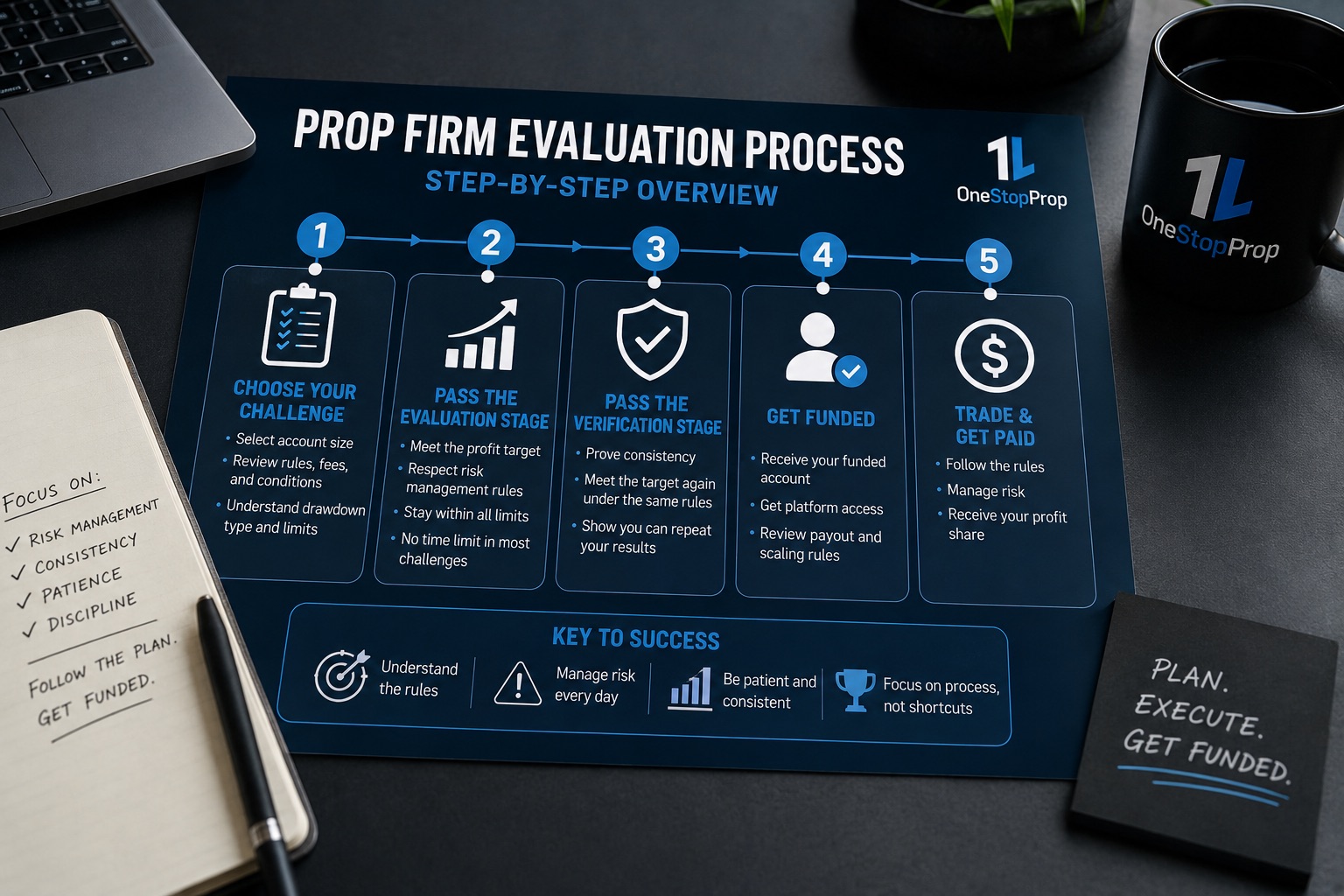
A prop firm evaluation is a structured, rules-based test run on a simulated account. A prop firm challenge is a rules-based evaluation where you trade a funded account to hit a profit target while staying within daily loss and drawdown limits. The firm grants you a simulated account at a chosen size, sets specific performance thresholds, and monitors whether you can trade within them. Hit the targets without breaching the limits, and you qualify for a funded account where the firm backs real capital.
This process forms the gateway to accessing institutional resources. These firms provide advanced tools, ample leverage, and generous profit splits. Traders keep most of the resulting gains, typically 70% to 90%, after successfully passing the initial test. The evaluation fee is, in effect, the price of that audition.
Choosing the right account size
The challenge tier you purchase directly sets your starting allocation. Prop firm accounts range from $3,500 to $300,000, with popular sizes including $10,000, $25,000, $50,000, $75,000, $100,000, and $150,000. The most popular sizes are $50,000 and $100,000. Choose a size that matches the risk you actually trade, not the largest number you can afford to pay for. A $300,000 account with 1% position sizing requires you to manage 3x the dollar volatility of a $100,000 account. Start where your strategy has been tested.
Pro Tip: Before buying any challenge, read the payout rules document, not the marketing page. Look specifically for: consistency rules per payout cycle, single-day profit caps, and minimum trading day requirements. These 3 items are where most hidden restrictions live.
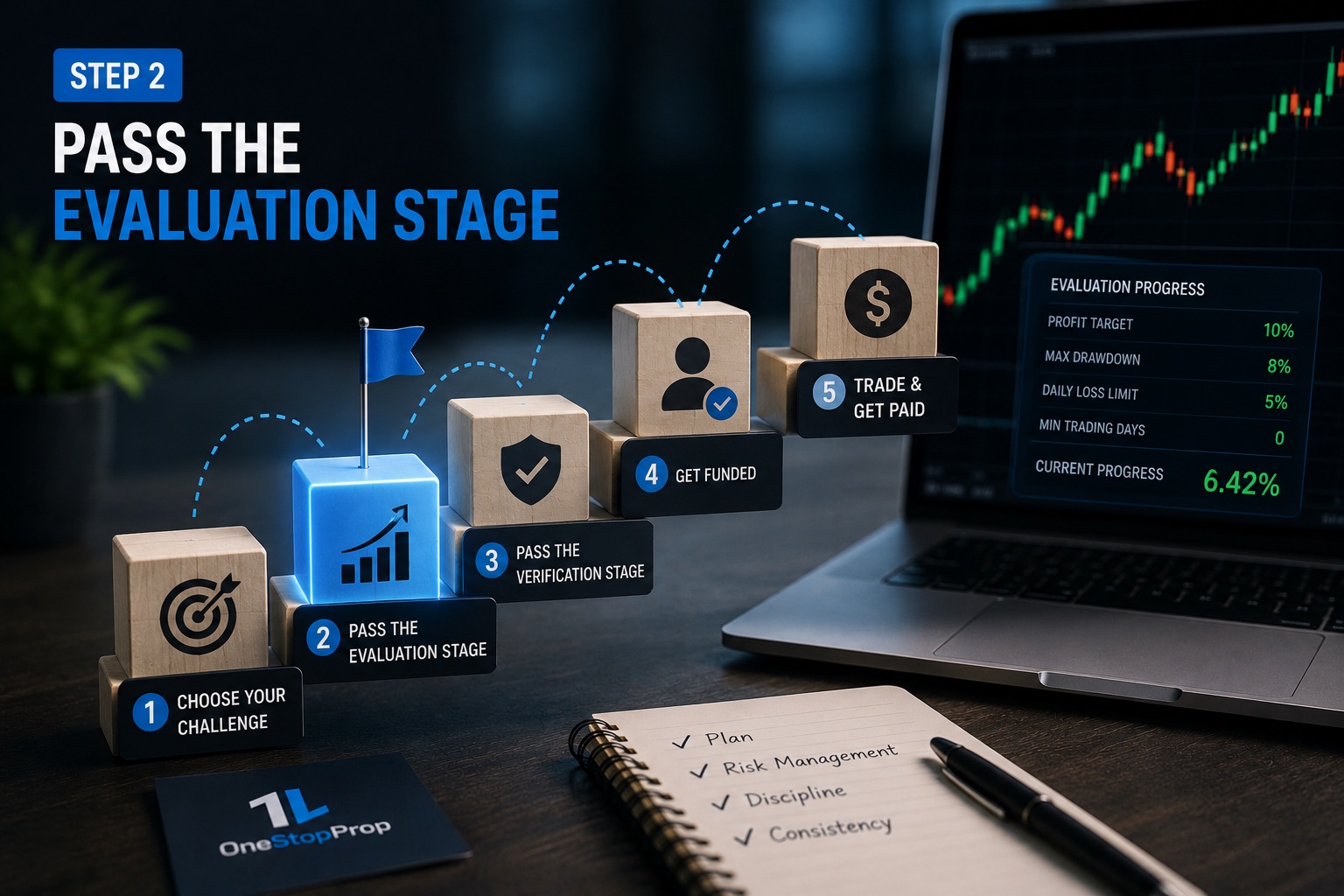
Step 2, Learn the 5 Rules That Decide Every Evaluation
Profit target
One-step evaluations require traders to hit a single profit target while respecting all risk rules in one phase. Profit targets often sit around 8-10%. For 2-step programs, Phase 1 usually requires 8-10% while Phase 2 requires around 4-5%. The profit target is not the hard part for most traders. The hard part is getting there without breaking any of the following rules along the way.
Maximum drawdown (static vs trailing)
Trailing drawdown is a prop firm trading rule where the maximum drawdown threshold moves upward as your account balance reaches new highs, but never moves back down when your account loses money. Unlike a static drawdown that is fixed at a set dollar amount below your starting balance, a trailing drawdown tracks the highest point your account has ever reached. This means every new account high permanently tightens the gap between your current balance and the violation threshold.
Static drawdown is fixed at the starting balance and does not increase with profits. It offers a stable risk limit, making it easier to plan trades. It is ideal for swing and position traders. In practice, drawdown rules are the number 1 reason traders fail prop firm challenges, not bad trades, but not understanding which drawdown type they are dealing with.
Daily loss limit
Daily loss limits typically sit at 4-5%, and maximum drawdown caps run 8-12%. These force you to think like a professional. Most traders obsess over the overall drawdown (typically 8-10%) while completely underestimating the daily drawdown limit (usually 4-5%). Breach the daily limit once and your evaluation ends, regardless of where your overall equity stands. Therefore, always calculate your maximum dollar loss for the day before the session opens and stop trading the moment you approach it.
Minimum trading days
Minimum trading day requirements prevent traders from taking concentrated risk over one or two sessions and passing on luck rather than consistency. A trader who reaches the profit target before the minimum day count must continue trading, introducing additional risk of giving back profits while waiting to satisfy the requirement. Know the number before you start. If your firm requires 4 minimum trading days, do not try to finish the challenge in 2.
Consistency rules (and when they don’t apply)
Many prop firm challenges include a consistency rule that caps how much of the total profit target or withdrawal can come from a single trading day, usually between 30% and 50%. This is where many experienced traders get caught off guard. A trader on a $100,000 challenge with a $10,000 profit target and a 30% consistency cap cannot reach the target on the back of one $3,000 day followed by smaller gains.
Step 3, Trade the Challenge Correctly
Position sizing is the foundation
A prop firm challenge is a simulated-capital evaluation where you must hit a profit target (typically 8-10%) without breaching a daily loss limit (usually 5%) or maximum drawdown (usually 10%). To pass, risk 0.25-0.5% per trade, trade only your A+ setups, and treat the rules as hard boundaries.
In my experience, the most common error traders make is starting at the same position size they use in their personal account without adjusting for the evaluation’s drawdown mechanics. Traders risk 2-5% per trade when professional risk management says 0.5-1%. A trader risking 3% per trade who hits a 4-trade losing streak, common in any strategy, sits at 12% drawdown. That breaches most prop firm absolute drawdown limits. Reduce your size at the start and build up only once you have a profit buffer.
Understanding the 3 phases of a challenge
The difference between passing and failing often comes down to position sizing, daily loss discipline, and understanding the 3 phases of a successful challenge: the setup phase (build a buffer), the survival phase (protect it), and the execution phase (hit your target).
The setup phase is typically the first 20-30% of your expected trading days. Use reduced sizing, focus on your highest-quality setups, and build an equity buffer before you think about the profit target at all. The survival phase means protecting that buffer. The execution phase is where, with a cushion already in place, you can trade normally toward the profit target without needing a single outsized day.
What to avoid during an evaluation
Every prop firm has different evaluation rules and requirements, and trading a prop firm account before fully understanding them is one of the most common mistakes. Many traders jump into trading their newly-purchased challenge account, only to realize too late that they’ve violated some kind of rule they brushed off and didn’t read about.
Every prop firm has different opening or closing trades around high-impact news, usually in a 10-minute window. Ignoring this could result in having your profits from the news trade deducted, or at worst, a breach of your prop firm account. Check whether your firm has a news trading restriction before every major data release (NFP, CPI, FOMC).
Pro Tip: If you lose 2 trades in a row during your evaluation, stop for at least 30 minutes. Revenge trading is the single most destructive behavior in funded accounts. You lose on a clean setup that just did not work, and instead of accepting the loss, you jump back in with bigger size to recover. That second trade is almost always worse.
Step 4, Pass the Verification Stage and Go Funded
What happens after you hit the profit target
Once you have met the profit target and satisfied all minimum trading day requirements, most firms move you through an identity verification (KYC) process before activating your funded account. Prop firm payouts usually take days to weeks, not hours, because approval and transfer are two separate stages. The approval stage checks rule compliance, account status, and know-your-customer documents, while the transfer stage depends on the payment rail itself.
At OneStopProp, the challenge phase is the initial test where you demonstrate your ability to trade profitably while following risk management rules. This phase is designed to evaluate your consistency, discipline, and overall trading skill. By successfully completing the challenge phase, you prove to the firm that you are ready to manage a funded account responsibly.
Funded account rules differ from evaluation rules
I’ve found that many traders assume the funded account operates under identical rules to the challenge. In most cases, funded accounts carry their own drawdown parameters, payout schedules, and minimum trading day counts. Read those terms separately. One of the biggest mistakes traders make after getting funded is immediately becoming aggressive. A trader who was disciplined during the challenge phase suddenly doubles risk in pursuit of rapid payouts. That often ends the same way: account breach. Treat each funded stage as a new evaluation.
Step 5, Request Your First Payout
How the payout process works
A prop firm payout is the process by which a proprietary trading firm distributes a trader’s share of profits earned on a funded account. After a trader passes the evaluation phase and begins trading with firm capital, profits are split according to a predefined profit split ratio. The payout is typically processed on a fixed schedule, such as bi-weekly or monthly.
Per OneStopProp’s payout guidelines, traders can request a payout every 14 days. With the Faster Payouts Add-On, there are no minimum trading day requirements or waiting periods between payouts, provided all other account criteria are met. The minimum payout request for all accounts is $150.
What makes OneStopProp’s payout terms stand out
For traders who want an industry-leading opening split, OneStopProp offers a meaningful structural advantage. Profit targets on a 2 Step account are 8% (Phase 1) and 5% (Phase 2) versus 10%+ at many firms. The base profit split is 90/10 in the trader’s favor, and the Lifetime Profit Split 95% Add-On raises it to 95% for life. At OneStopProp there is no consistency rule during the challenge and no time limit to finish it, unlike the typical 30 to 90 day windows elsewhere. The consistency rule applies once you are funded, to each payout cycle: no single day can make up 25% or more of your profit for the period on a 1 Step or 2 Step account, or 20% on Instant.
Affordable reset options are available if you don’t pass the first time, unlike many firms that require full repayment.
Pro Tip: Once funded, track your payout eligibility every 14 days the same way you tracked your profit target during the challenge. Understanding the rules that decide payouts before you fund an account is the most effective way to avoid surprises.

Common Mistakes to Avoid at Every Stage
At the selection stage
Not all firms are equal. Compare firms on drawdown type (static vs. trailing), profit split, payout frequency, and instrument support before buying an evaluation. A firm with a higher profit split but trailing intraday drawdown is structurally harder to succeed with than one offering 80% with static drawdown and no consistency rule during the challenge.
During the challenge
Most failed evaluations come from breaching a measurement mechanic, equity vs. balance, trailing vs. static drawdown, server-time resets, rather than from a genuinely bad trade. Read every rule that relates to how loss is measured, not just what the limit is.
After getting funded
Never skip the evaluation debrief. Whether you pass or fail, your evaluation data is valuable. Review every trade, tag by strategy and outcome, and calculate your actual risk per trade versus your planned risk. That analysis tells you exactly what to replicate, and what to eliminate, on your funded account.
Frequently Asked Questions
What is a prop firm evaluation?
A prop firm evaluation, also called a challenge, is a rules-based trading test on a simulated account. You must hit a profit target, typically between 5% and 10% of the account balance, without breaching daily loss or maximum drawdown limits. The evaluation process is a risk test, not a profit contest. A prop firm challenge is a structured risk test. The firm is trying to answer one question: can this trader protect their capital while generating controlled returns under specific operating constraints?
How much does a prop firm evaluation cost?
Retail prop trading operators target retail traders, offering standardized challenge formats (typically 2-4 week evaluation phases) in exchange for $100-$500 fees per attempt. The actual fee varies by account size. At OneStopProp, the $100K 2 Step evaluation lists at $542 before promo codes, with no activation fee once you pass and no monthly subscription costs.
What is the difference between static and trailing drawdown?
While both models are designed to manage risk and protect prop firm capital, they operate in very different ways. A static drawdown provides a fixed loss limit that never changes, while a trailing drawdown moves upward as account profits increase. Static drawdown is generally more forgiving, because a profitable week does not reduce your remaining safety margin. Trailing drawdown is the rule that ends more funded accounts than any other, and most of the traders it catches did not fully understand how it worked before they violated it.
How do prop firm payouts work?
A prop firm payout is not simply “your profit minus a percentage.” It is a sequence of gates, and your profit gets squeezed through each one before any money moves. The typical gates are: the profit split percentage, a minimum trading day count, a consistency or single-day cap check, and KYC verification. Across major firms in August 2026 the split runs 80-100%, and the realistic gap between clicking request and money settling is 1 to 5 business days.
Can I trade stocks, forex, and crypto in one prop account?
Most prop firms specialize in one asset class. OneStopProp funds forex, stocks and crypto, with access to up to $300,000 in trading capital. The challenge structure offers both 1-step and 2-step evaluation paths, and there is no mandatory time limit forcing you to trade on days that do not suit your strategy. If you trade multiple markets, verify that the firm supports all of them under a single funded account before buying.
Ready to Apply What You’ve Learned?
The evaluation process rewards preparation. Every section of this guide, understanding the rules, sizing correctly, managing the 3 phases of a challenge, and reading the payout terms before you click checkout, translates directly into a higher probability of reaching a funded account and keeping it.
If you are ready to take the next step, OneStopProp’s challenge accounts offer a clear, well-documented evaluation process with no time restrictions, no hidden fees, and a 90% profit split (95% for life with the Lifetime Profit Split 95% Add-On). That is a concrete starting point for traders who want to trade all 3 major asset classes under one funded account.
Sources
- Prop Firm Trading: Complete Guide to Getting Funded (2026), TradeZella. Evaluation risk rules and challenge structure. https://www.tradezella.com/blog/prop-firm-trading
- Prop Firm Challenge Rules Explained, PropAccount. Consistency rules, trailing drawdown, and minimum day mechanics. https://propaccount.com/resources/blog/prop-firm-challenge-rules-explained/
- How to Pass a Prop Firm Challenge: Risk Management Framework (2026), TradeZella. 3-phase challenge structure and sizing guidance. https://www.tradezella.com/blog/pass-prop-firm-challenge
- Trailing Drawdown Explained: How It Actually Works (2026), TradeZella. Mechanics of all 3 trailing drawdown types. https://www.tradezella.com/blog/trailing-drawdown
- Static vs Trailing Drawdown: Key Differences, Damn Prop Firms. Drawdown model comparison for traders. https://damnpropfirms.com/trading-guides/static-vs-trailing-drawdown-key-differences/
- Why Traders Fail Prop Firm Evaluations, DayTraders. The 7 most common mistakes. https://daytraders.com/why-traders-fail-prop-firm-evaluations
- The 5 Most Common Mistakes Prop Firm Traders Make, PipBack. Risk sizing and rule-reading guidance. https://reviews.bestpropfirms.com/guides/evaluations/
- Prop Trading Industry Size 2026: $850M Market Analysis, Track360. Market size and growth data. https://track360.io/blog/prop-trading-industry-report-2026-market-analysis
- Prop Trading Firms in 2026: How They Work, Who They Suit & Why They’re Growing Fast, InvestingLive. Industry search volume and market size statistics. https://investinglive.com/Education/prop-trading-firms-in-2026-how-they-work-who-they-suit-why-theyre-growing-fast-20260604/
- Payout Information and Guidelines, OneStopProp. Payout schedule, minimums, and funded account terms. https://help.onestopprop.com/faq/payout-rules/
- Funded Account Scaling Plan: Max Out Your Capital in 2026, OneStopProp. Challenge targets, profit split, and scaling path. https://onestopprop.com/funded-account-scaling-plan/
- Why Traders Are Moving Away from Traditional Prop Firms: The OneStopProp Difference, OneStopProp. Rule comparison between OneStopProp and competitors. https://onestopprop.com/why-traders-are-moving-away-from-traditional-prop-firms-the-onestopprop-difference/
- How Much Capital Can You Actually Get From a Prop Firm in 2026, OneStopProp. Account size ranges and evaluation mechanics. https://onestopprop.com/how-much-capital-can-you-get-from-a-prop-firm/