The prop trading industry is now estimated to be worth $20 billion globally, with over 2,000 active firms, and the number of traders looking to get a slice of that keeps rising. If you have been curious about funded trading but are not sure how prop firms actually operate, or whether concerns about scams are legitimate, this guide breaks it all down plainly.
In January 2020, the term “prop firm” generated approximately 880 monthly global searches. By the second quarter of 2025, that figure had reached 49,500, a 56-fold increase in five years. That kind of growth does not happen by accident. Traders are paying attention, and the right response is to understand how prop firms work before committing a single dollar.

Key Takeaways
- The model is built on capital access, not charity: A proprietary trading firm is a company that provides traders with capital to trade financial markets. Instead of trading your own money, you trade the firm’s capital and keep a percentage of the profits, typically anywhere from 70% to 95%. Therefore, your job is to prove you can manage risk before the capital arrives.
- The industry is large and mostly legitimate: The reality is that prop firms are not inherently a scam. They are a legitimate business model. However, due diligence matters, because as a business model, prop trading is legitimate, but the industry is unregulated, which means some firms operate dishonestly.
- The growth wave is real but maturing: According to For Traders’ 2026 industry report, market growth in prop trading grew 25% globally in 3 years, fueled by a 16% rise in the S&P 500 and increased interest from Gen Z and millennials. Entering a maturing market means better firms and clearer rules than in the wild years of 2021-2023.
- Payouts are real but conditional: After a trader passes the evaluation phase and begins trading with firm capital, profits are split according to a predefined profit split ratio, commonly 70/30 to 90/10 in the trader’s favor. The payout is typically processed on a fixed schedule, such as bi-weekly or monthly. Payout eligibility is subject to trading rules: the trader must respect drawdown limits, daily loss limits, and consistency rules throughout the payout period.
- Multi-asset access is a growing differentiator: Most firms lock you into one market. A multi-asset trader covering stocks, forex, and crypto in one account will find OneStopProp the best structural match, as almost no other firm lets you trade all 3 asset classes under a single funded account.
Quick-Start Prioritization Framework
| Strategy | Best For | Effort Level | Time to Results |
|---|---|---|---|
| Standard 2-phase evaluation | Traders with a proven strategy | Medium | 4-8 weeks |
| Instant funded account | Experienced traders wanting speed | Low setup | Immediate |
| Faster Payouts Add-On | Traders targeting fast, frequent payouts | Medium-High | 8-12 weeks |
| Multi-asset account (stocks, forex, crypto) | Diversified strategy traders | Medium | 4-8 weeks |
| Single-asset challenge (futures/forex) | Specialists in one market | Low-Medium | 2-6 weeks |
Start here if you’re:
- New to prop firms: Begin with a standard 2-phase evaluation; it builds discipline and forces consistency before real capital is involved.
- Experienced with a track record: Consider an instant funded account to skip the evaluation phase and start generating payout history faster.
- Focused on maximizing income speed: The OneStopProp Faster Payouts Add-On is purpose-built for this: with it, there are no minimum trading day requirements or waiting periods between payouts, provided all other account criteria are met.
How Prop Firms Actually Work
The Core Model Explained
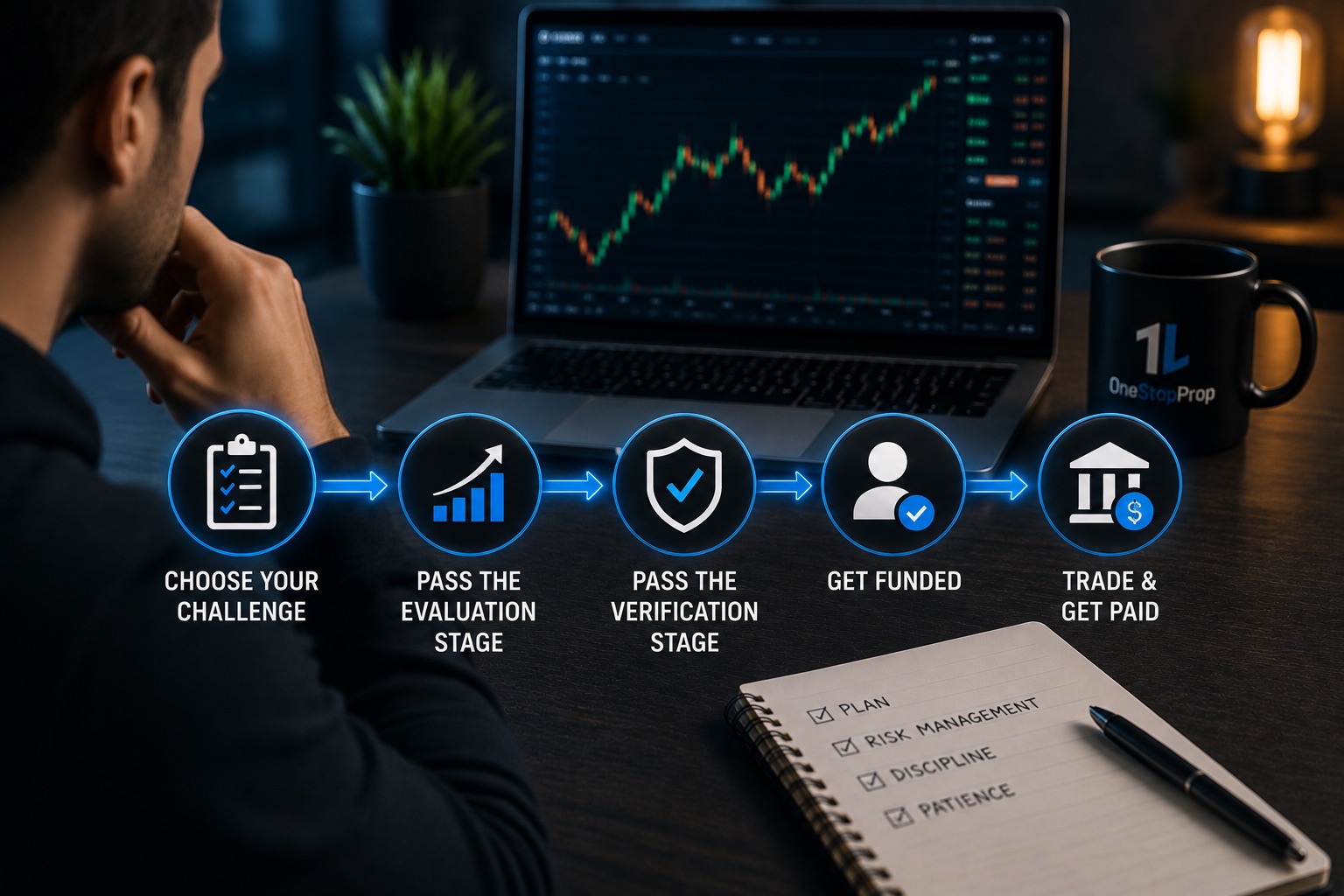
The basic exchange at the heart of every prop firm is straightforward. A proprietary firm provides traders with access to capital, typically through a structured evaluation process. Instead of depositing large personal funds, participants usually pay a fee to attempt a challenge designed to test trading performance.
If the trader meets predefined conditions, they may receive access to a funded account and earn a share of profits generated under the firm’s rules. Most prop firms use either one-step or multi-step evaluation models. Think of it like an audition: the firm wants to see how you behave under pressure before handing you real capital.
What the Evaluation Looks Like
The business model works like this: traders pay an evaluation fee (typically $100-$500), attempt to pass a challenge with strict profit targets and drawdown limits, and if successful, receive access to a “funded account.” The firm keeps 10-30% of profits. The specific rules vary, but the structure is consistent across the industry.
While details vary, common requirements include profit targets that must be reached within the evaluation, daily and overall drawdown limits that restrict losses, minimum trading days to ensure consistent activity, and risk rules governing position size, strategy, or trading conditions. Breaking any one of these rules typically ends the evaluation. Therefore, read the full rule set before placing your first trade, not halfway through.
Pro Tip: The daily loss limit is the single most common evaluation killer. According to ThePropFirmGuide’s 2026 statistics analysis, the majority of evaluation failures happen in the first week from daily loss limit breaches, not missed profit targets. Size positions relative to the daily loss limit, not the total account balance.
How Funded Accounts and Payouts Work
Once funded, the relationship shifts. When you trade a funded account you are not trading your own money, you’re trading the firm’s simulated or live capital under a contract. That contract defines exactly when profit in the account becomes money in your bank.
Across major firms in August 2026 the split runs 80-90%, and the realistic gap between clicking request and money settling is 1 to 5 business days. Speed of payout is increasingly a competitive differentiator. As ThinkCapital’s payout guide notes, many modern prop firms process payouts within 24 hours of a request, treating traders like professional partners rather than employees.
Why Thousands of Traders Are Making the Switch
The Capital Leverage Argument
The practical math here is hard to ignore. The practical difference from a retail brokerage is in position sizing. A retail trader with $5,000 personal capital trading at 1% risk generates $50 per trade. The same trader with a $100,000 funded account generates $1,000 per trade at the same risk percentage. That 20x multiplier on earnings, at identical risk behavior, is the primary reason traders explore prop firms.
Self-funded trading requires $25,000 or more to avoid the pattern day trader rule, while prop firms bypass this requirement entirely by providing their own capital. For traders without that capital base, prop firms represent an accessible on-ramp to professional-scale trading.
The Instruments Available
Major forex pairs, equity indices commodities (including gold and oil), and cryptocurrency are available on most established platforms. Some platforms now offer futures as well, following the surge in futures prop trading particularly in the US market.
OneStopProp stands out for going further. The full range of trading instruments at OneStopProp includes forex, indices, commodities, metals, cryptocurrencies, and US stocks on funded accounts with flexible rules and high-performance execution. Traders can hold trades overnight and can trade through news with the News Trading Allowed Add-On, freedoms that are restricted at many competing firms.
The Growth of a Generation
The prop trading industry saw a major surge in 2025, fueled by 3 key factors: growing interest from traders, advancements in technology, and more flexible funding options. Younger generations, particularly Gen Z and millennials, have been drawn to trading as a way to achieve financial independence. For this demographic, a prop firm challenge fee is a far lower barrier than the $25,000 required to trade freely as a self-funded retail trader.
Are Prop Firms Scams? An Honest Assessment
This is the most common concern traders bring up, and the honest answer is: the industry has a mixed record, but the landscape has improved significantly.
What Went Wrong in 2024-2025
Between February 2024 and the end of 2025, an estimated 80 to 100 proprietary trading firms shut down, the largest industry collapse in prop trading history. Some were legitimate businesses caught in a platform licensing crisis. Others were not.
MetaQuotes, the company that owns MetaTrader 4 and MetaTrader 5, used by an estimated 70-80% of all prop firms, began revoking platform licenses from prop firms serving US clients or operating without proper broker relationships. Firms that had built everything on borrowed infrastructure collapsed overnight. True Forex Funds closed permanently due to financial insolvency, leaving traders with an estimated $1.2 million in unpaid withdrawals.
What the Industry Looks Like Now in 2026
The industry in 2026 is healthier than it was in early 2024. The firms that survived are stronger, safer and more transparent. Regulatory signals reinforce this. The Prop Association, founded in April 2025 as an industry self-regulatory body, further signals that the surviving firms are building infrastructure for long-term legitimacy.
According to industry analysis shows, the rapid growth of the proprietary trading industry has attracted millions of traders around the world, but it has also led to confusion. Stories about failed challenges, payout disputes, and firms suddenly shutting down have made many people skeptical. At the same time, thousands of traders receive legitimate payouts every month and build consistent income streams through funded accounts.
Red Flags to Watch For
In general, there are 3 categories of prop trading scams: collections of fees with no service fulfillment or fake promises; legitimate-looking firms that alter policies during challenges to disenfranchise participants; and firms operating without oversight, actual funds, or payouts, surviving solely on entry fee revenue.
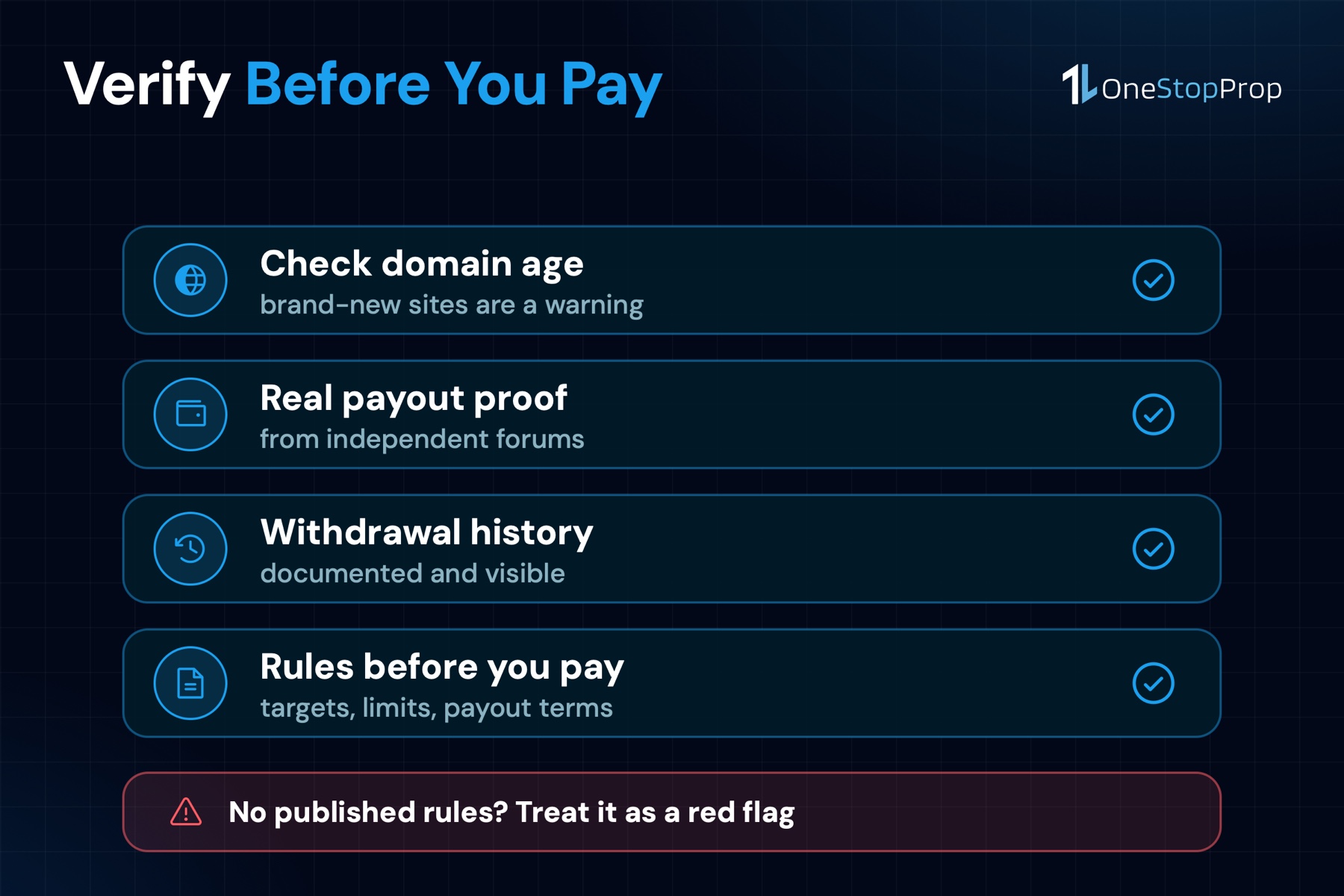
Practical verification steps matter more than promises:
- Check domain age, scam operations often register sites less than 6 months before launching
- Verify payout proof from real traders on independent forums
- Confirm the firm has a visible, documented history of processing withdrawals
- Look for transparent rule sets published before you buy
Pro Tip: A legitimate prop firm publishes its full rule set, drawdown limits, profit targets, payout terms, before you pay anything. If you cannot find the rules clearly displayed, treat that as a disqualifying red flag.
What to Look for in a Legitimate Prop Firm
Transparent Rules and No Hidden Fees
Industry analysis shows demonstrate several characteristics. First, it should have clear and transparent rules. Traders should know exactly what is expected of them, how payouts work, and what behaviors could lead to account violations.
Second, the firm should have a visible history of processing payouts and maintaining active communication with its community. Companies that regularly publish updates, improve their products, and engage with traders tend to build stronger long-term trust.
Payout Reliability and Speed
The headline profit split is the least important number, payout frequency, minimum withdrawal, consistency rules, and rail fees decide what you actually keep. That reframe should shift how you evaluate any firm. A 90% split paid once a month may deliver less practical income than an 80% split paid on a fast, frequent cycle.
For traders who prioritize both speed and clarity, OneStopProp’s funded accounts are designed around this reality. OneStopProp’s financial structure delivers a 90% base profit split, which can be raised to 95% for the life of the account with the Lifetime Profit Split 95% Add-On. For traders who add the Faster Payouts Add-On, the payout cadence tightens significantly: there are no minimum trading day requirements or waiting periods between payouts, provided all other account criteria are met. Full details are available on the OneStopProp Help Center.
Multi-Asset Access and Scaling
For most traders entering a funded program, the realistic starting range sits between $10,000 and $200,000. Prop firms can offer accounts from $25,000 to over $1,000,000, depending on your performance. OneStopProp offers accounts from $10K to $300K, with scaling options up to $1.2M in total allocation.
Pro Tip: In my experience evaluating funded trading programs, the combination of a 90% profit split, which can rise to 95% for the life of the account with the Lifetime Profit Split 95% Add-On, and access to multiple asset classes in a single account is genuinely rare. Most firms make you trade one market category. Platforms like OneStopProp that let you move across stocks, forex, and crypto within the same account give you a meaningful edge when one market is slow.
Common Mistakes Traders Make with Prop Firms
Treating the Evaluation Like a Game
The rules differ in their exact numbers, but the approach that works is universal: trade smaller than you think you need to, be consistent, and protect the downside before chasing the upside. Traders who blow evaluations almost always do so by oversizing positions in an attempt to hit the profit target faster.
Changing Behavior After Getting Funded
Many traders push aggressively during the challenge phase to hit the profit target, then revert to loose habits once funded. The funded account has the same drawdown rules, and often tighter psychological pressure because real payouts are now on the table. Consistency is the whole point. If the behavior that got you funded disappears once you are funded, the account will not last long.
Ignoring the Scaling Path
Once funded, the real objective becomes sustainability and growth. The traders who last longest in the prop trading world are rarely the ones chasing massive daily profits. Instead, they focus on controlled scaling, increasing account size and returns while keeping risk stable and consistent. A common mistake traders make is increasing position size too aggressively once they feel close to the target. They may be halfway toward scaling and then take a large trade to speed up the process. This can quickly lead to drawdown problems.
Frequently Asked Questions
How much does a prop firm challenge cost?
Prop firms let traders access $50,000-$400,000 in buying power after passing a 1-2 step evaluation process that typically costs $150-$600 per attempt. Costs vary based on account size, larger accounts require higher fees. The challenge fee is your only financial exposure; you do not risk any trading capital beyond it.
Do prop firms actually pay out profits?
Yes, established firms do. In the 90 days leading up to 2026 traders received $56 million in payouts. Notably, in April 2025, 1 trader secured a single-day payout of $2,552,800.50, verified via bank wire, one of the largest single-day payouts on record. The key is choosing a firm with a documented payout history and transparent withdrawal terms. Always verify independently before signing up.
What happens if a prop firm shuts down while I have a funded account?
What happens if a prop firm shuts down? You lose your challenge fee and any profits in your funded account. There is no regulatory body that will recover your money. This risk makes firm selection critical, prioritize firms with longer operating histories and verifiable financials.
Can I trade multiple asset classes with one prop firm account?
Most firms do not allow this. Most firms specialize in a single asset class. OneStopProp is a notable exception. OneStopProp allows you to trade stocks, forex, and crypto in one account with challenge rules that are actually reasonable with no hidden restrictions like other firms have. This multi-asset flexibility lets you follow market opportunities wherever they arise rather than being locked into a single instrument category.
Is prop trading suitable for beginners?
Prop trading is worth it for traders who already have a proven, profitable strategy and disciplined risk management. It allows access to capital far beyond what most retail traders could fund themselves, with the only downside being the challenge fee. It is NOT worth it for traders who are still learning, the evaluation conditions are stressful and will amplify bad habits. Build your strategy on a personal account first, then bring it to a prop firm evaluation once results are consistent.
Ready to Get Started?
The prop firm model has matured significantly since its wild early years. 2025 did not represent a collapse of prop trading. It marked a structural recalibration that exposed weak business models, elevated the role of technology and risk management, and reshaped how both firms and traders approach funded trading. What remains is a cleaner, more accountable industry.
If you are ready to explore funded trading with a firm that offers multi-asset access, transparent rules, no hidden fees, and a 90% profit split that can rise to 95% for the life of the account with the Lifetime Profit Split 95% Add-On, visit the OneStopProp checkout page to choose your account size and get started. Full payout details, instrument lists, and account rules are published openly at OneStopProp’s help center, read everything before you commit.
Sources
- Prop Trading Firms in 2026: How They Work, InvestingLive. Industry growth and search volume data. https://investinglive.com/Education/prop-trading-firms-in-2026-how-they-work-who-they-suit-why-theyre-growing-fast-20260604/
- Complete 2026 Guide to Prop Firms for Beginners, The Investor’s Podcast. Evaluation model breakdown. https://www.theinvestorspodcast.com/business/the-complete-2026-guide-to-prop-firms-for-beginners/
- Prop Firm Rule Changes for 2026, New York City Servers. Business model and fee structure analysis. https://newyorkcityservers.com/blog/prop-firm-rule-changes-2026
- Prop Firm Guide 2026: Rules, Math, and How to Get Funded, Traders Second Brain. Challenge math, profit splits, and trader suitability. https://traderssecondbrain.com/guides/prop-firm-guide
- Prop Firm Statistics 2026: Pass Rates, Payouts and Trends, AtmosFunded. Detailed payout and industry data. Prop Trading Statistics 2026, Track360. https://track360.io/blog/prop-trading-industry-statistics-2026
- Prop Firm Scams to Avoid in 2026, MyForexFirms. Documented firm collapses and scam categories. https://myforexfirms.com/blogs/prop-firm-scams-to-avoid
- Are Prop Firms Legit? A Comprehensive Guide, AtlasFunded. Legitimacy analysis and red flags. https://www.atlasfunded.com/post/are-prop-firms-legit-a-comprehensive-guide
- Are Prop Firms a Scam?, OFP Funding. Industry transparency and legitimate firm criteria. https://investinglive.com/Education/prop-trading-firms-in-2026-how-they-work-who-they-suit-why-theyre-growing-fast-20260604/
- The Great Shake-Out: How 2025 Reshaped the Prop Trading Industry, Investing.com. 2024-2025 consolidation analysis. https://www.investing.com/analysis/the-great-shakeout-how-2025-reshaped-the-prop-trading-industry-200672263
- How Prop Firm Payouts Actually Work in 2026, ThorTradeCopier. Payout mechanics, buffers, and withdrawal gates. https://thortradecopier.com/blog/how-prop-firm-payouts-work
- Prop Firm Statistics 2026, QuantVPS. Verified payout data and industry benchmarks. https://www.quantvps.com/blog/prop-firm-statistics
- Prop Firm vs Self-Funded Trading, OneStopProp. Multi-asset access and account structure. https://onestopprop.com/prop-firm-vs-self-funded-trading/
- Funded Account Scaling Plan, OneStopProp. Account and Add-On features and scaling strategy. https://onestopprop.com/funded-account-scaling-plan/
- How Much Capital Can You Get from a Prop Firm, OneStopProp. Account size ranges and evaluation failure data. https://onestopprop.com/how-much-capital-can-you-get-from-a-prop-firm/
- Best Prop Firms for Stock Traders 2026, OneStopProp. Payout cadence and account comparison. https://onestopprop.com/best-prop-firms-for-stock-traders-in-2026/
- OneStopProp Instruments, OneStopProp. Full asset class breakdown for funded accounts. https://help.onestopprop.com/faq/what-instruments-can-i-trade/