NVIDIA (NVDA) just reported fiscal Q2 2026 revenue of $96.22 billion, a 106% year-over-year increase, and the stock’s intraday swings regularly exceed 2% on ordinary sessions. For prop firm traders, that combination of institutional relevance and raw price movement makes NVDA one of the most compelling instruments on the board. The challenge is that trading a stock this volatile inside a funded account demands a different kind of discipline than trading it in a personal brokerage. In a personal account, a string of losses may just mean a rough week. In a prop firm environment, strict daily drawdown and maximum drawdown rules change everything. This guide breaks down what you need to know to trade nvda at a prop firm before you put a single share of NVDA on a prop account.
Key Takeaways
- NVDA’s volatility is a double-edged catalyst: NVIDIA (NVDA) carries annualized volatility of 36.54%, which creates strong intraday setups but also demands tighter-than-average position sizing inside a funded account.
- Earnings events require special handling: If your NVDA strategy involves earnings plays, that counts as a news trading event under standard prop firm rules. By default, OneStopProp funded accounts require closing positions before major earnings releases and news events; the News Trading Allowed Add-On lifts that restriction.
- The prop firm industry is maturing fast: Search interest in the prop firm sector grew 607% between 2020 and 2024, and the industry is now estimated to be worth $20 billion globally, with over 2,000 active firms. That means more choice, but also more noise to cut through.
- Rules kill more challenges than bad trades: Most traders who fail a challenge do not fail because of poor trading. They fail because a rule they did not fully understand ended their account before they reached the profit target. Know the rulebook before you size into NVDA.
- Prop firms are a legitimate path to scale: Prop firms are a legitimate workaround to the US Pattern Day Trader rule since you trade simulated capital, not a personal brokerage account.
Quick-Start Prioritization Framework
| Trader Profile | Recommended Approach | Effort Level | Time to First Payout |
|---|---|---|---|
| NVDA swing trader | 2-step challenge, overnight holds allowed | Medium | Weeks |
| NVDA intraday scalper | 1-step challenge, static drawdown firm | Medium | Days to weeks |
| Earnings catalyst trader | News Trading Allowed Add-On (no news restriction) | High | Weeks to months |
| New to prop firms | Start small, 1-step challenge, lower account size | Low | Weeks |
| Multi-asset trader (NVDA + Forex + Crypto) | Firm supporting all 3 in 1 account | Medium | Weeks |
Start here if you are:
- A swing trader: Choose a firm that explicitly allows overnight positions and does not penalize weekend holds. NVDA can gap significantly on macro news, so weekend exposure rules matter.
- An intraday trader: Prioritize static drawdown structures over trailing drawdown. Position size against the drawdown, not the trade. 0.5 to 1% risk per trade with stops at 1 to 1.5x ATR is the institutional default.
- An earnings catalyst trader: Add the News Trading Allowed Add-On, which lifts news restrictions. Trading around NVDA earnings without it is a quick way to lose your funded status.
Why NVDA Is One of the Most Traded Stocks in a Prop Firm Account
The AI Revenue Machine Behind the Price Action
NVIDIA is not just a popular ticker; it is a fundamental pillar of the global AI infrastructure buildout. NVIDIA shattered expectations with its fiscal Q2 2026 earnings, reporting $96.22 billion in revenue, a remarkable 106% year-over-year increase, and delivered adjusted earnings per share of $2.22, comfortably beating Wall Street’s consensus estimate of $2.10. That kind of earnings trajectory generates constant institutional repositioning, which is exactly what creates the intraday setups prop traders want to exploit.
NVIDIA’s market cap remains at $5.34 trillion, significantly outperforming the S&P 500, cementing its position as a Magnificent 7 name alongside Apple (AAPL), Microsoft (MSFT), Amazon (AMZN), Alphabet/Google (GOOGL), Meta (META), and Tesla (TSLA). For prop firm traders with access to these 7 names, NVDA typically offers the highest average daily volatility of the group, and that translates directly to more trading opportunity per session.
Volume, Liquidity, and Why They Matter for Funded Accounts
Retail investor interest soared with NVDA being the most traded stock on Robinhood and Fidelity for 11 straight months. For prop traders, high retail and institutional volume is not just trivia; it means tighter spreads, faster order execution, and more reliable technical levels. When you are trading inside a funded account where every basis point of slippage counts toward your drawdown, liquidity is a feature, not a luxury.
Pro Tip: Check whether your prop firm measures drawdown on floating equity or closed balance only. On a volatile news day, a position briefly moving against you could hit your drawdown limit even if it recovers, this is where traders get shocked. On a stock like NVDA, that distinction is critical.
Understanding Prop Firm Rules When Trading NVDA
Drawdown Mechanics and NVDA’s Average Daily Range
Drawdown is the single biggest reason traders fail prop firm challenges. The most common pattern: the trader either picks the wrong drawdown structure for their strategy, or sizes positions the way they would on a personal account where the daily reset does not matter.
NVDA’s daily range regularly spans $4 to $8 per share depending on macro conditions. Early 2025 brought sharp swings with shares falling to $93.42 on April 8 amid a broader technology-sector sell-off before recovering through the summer. Those kinds of moves are the exact scenarios that breach a prop account’s daily limit if position sizing is not calibrated to the stock’s actual ATR.
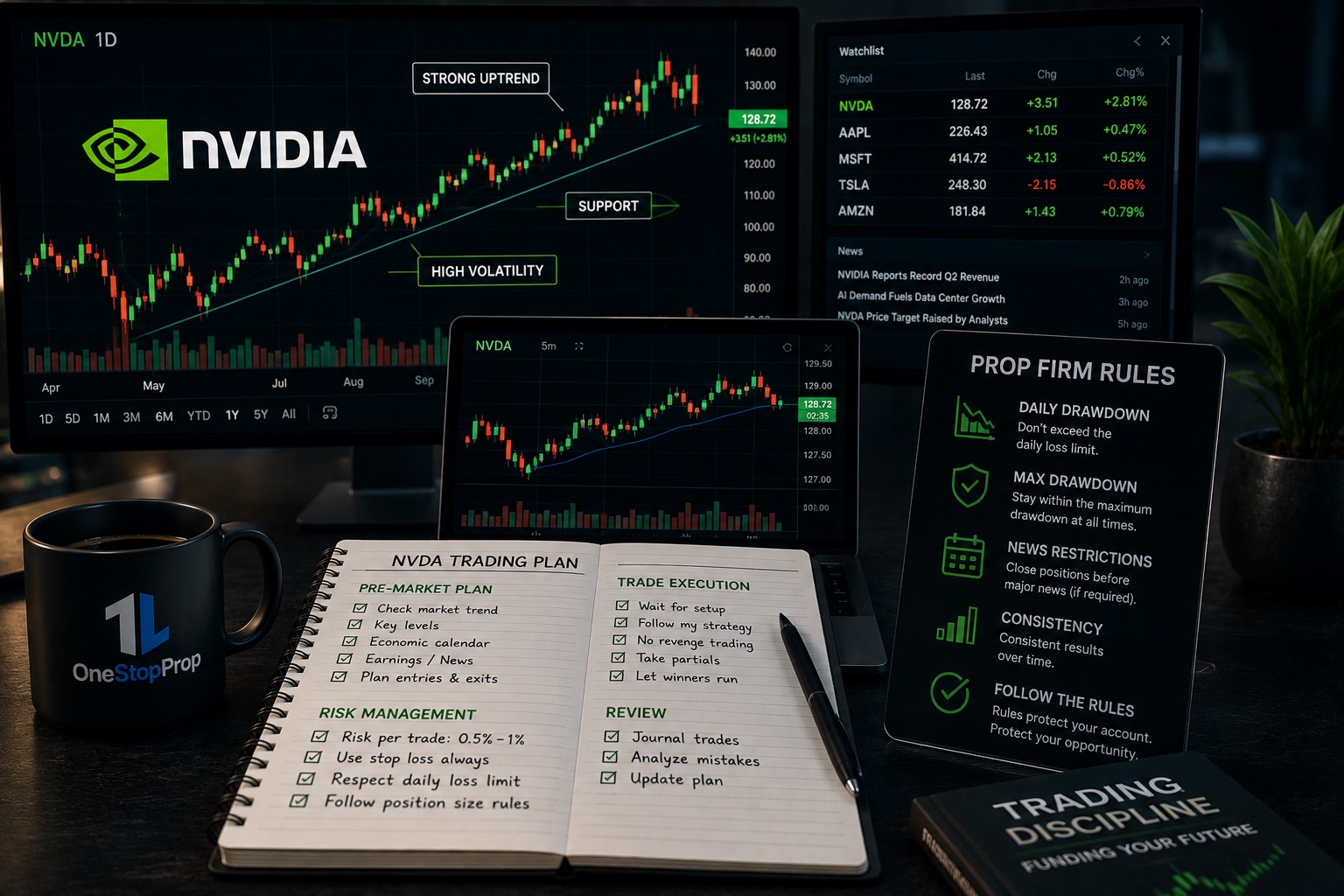
The Average True Range, or ATR, is commonly used to measure market volatility. If you base your stop loss on ATR, your position size automatically adjusts to market conditions. When volatility increases, ATR expands, meaning your stop loss becomes wider, and your position size should become smaller to maintain the same dollar risk. Apply this framework to NVDA before every session.
The Earnings Rule, and Why It Matters More for NVDA
NVIDIA has pulled back the day after reporting in all 4 of the last quarters, despite meeting or beating on EPS, revenue, and guidance. Over the last 4 quarters, NVDA has averaged -2.8% the day after earnings and -5.3% over 2 days. That post-earnings drift is a real trading opportunity, but it is also a serious risk event under most prop firm rule sets.
News, HFT, copy trading, and consistency rules are where “passed but not paid” disputes happen; read how each is measured before you buy, not after. If you want to trade through NVDA earnings, capturing the initial spike or the post-earnings drift; you need the News Trading Allowed Add-On, which explicitly permits news event trading.
Pro Tip: By default, OneStopProp accounts require closing positions before major earnings releases. The News Trading Allowed Add-On lifts that restriction. If you want to trade through the catalyst instead of around it, that distinction matters. Check the OneStopProp Add-On details before you build a strategy around NVDA earnings.
Consistency Rules and Single-Day Windfalls
The consistency rule caps how much of your total profit can come from a single trading day, usually 20-40% of the overall target. If 1 trade or 1 day accounts for more than the allowed share, the firm can withhold or reduce your performance reward even if you technically hit the profit target. It exists to reward steady, repeatable process over 1 lucky swing trade during a volatile session.
On NVDA, this is especially relevant. A big macro catalyst, an AI regulation headline, a surprise earnings beat, a chip export ruling, can move the stock 5-8% in a single session. If that session produces most of your challenge profit, a consistency rule can disqualify the result entirely. Check your firm’s rules before sizing up on high-conviction NVDA days.
Strategies That Work for NVDA in a Prop Firm Context
Opening Range Breakout (ORB) on NVDA
NVDA’s high volume and volatility make it suitable for various day trading strategies, including the Opening Range Breakout. The first 30 minutes after the market opens often sets the tone for NVDA’s intraday price action. In a prop firm context, the ORB suits funded accounts well because it has a clearly defined entry trigger, a logical stop placement, and a natural profit target based on the opening range size.
Execution note: size your position so that a stop at the other side of the opening range does not exceed 0.5-1% of your remaining drawdown buffer. NVDA’s ORB can occasionally whipsaw on high-impact macro days, so keep the initial position conservative.
VWAP-Based Mean Reversion
For NVDA, the best times to trade are usually within the first and last hours of the market session. Liquidity is higher and the stock is more likely to exhibit strong trends. Between those windows, VWAP-based mean reversion tends to work well on NVDA because institutional algorithms anchor to VWAP throughout the session, creating predictable bounce and rejection points.
As of early 2026, the most common cause of blown prop firm accounts is bad position sizing, not bad strategy. This is especially true on VWAP mean-reversion setups where the temptation is to average into a position as it moves further away from VWAP. Resist that temptation. Each add is a separate trade for drawdown purposes.
Pro Tip: Stop trading for the day after 2 consecutive losses. 2 losses and you are done. This caps your daily drawdown at roughly twice your per-trade risk. On a $100K account, that keeps your worst NVDA session survivable.
Momentum Continuation Setups
NVDA frequently runs in multi-day momentum sequences after major catalysts, a data center revenue beat, a positive analyst upgrade cluster, or a macro tailwind for AI capex spending. Industry analysts project that AI-optimized server spending will increase by 49% in 2026, with NVIDIA chips representing the dominant share of that growth. That fundamental backdrop means momentum setups on NVDA are not just technical; they are backed by a genuine demand narrative.
For prop traders, momentum continuation requires overnight hold permissions. Confirm that your firm allows overnight positions before building a multi-day NVDA momentum strategy. OneStopProp supports forex stocks, indices, commodities, and cryptocurrencies, all tradable from a single account, a rarity in the prop firm world, and overnight holds are permitted, making it a practical fit for traders who want to run NVDA momentum setups across multiple sessions.
Common Mistakes When Trading NVDA at a Prop Firm
Oversizing During Earnings Week
NVIDIA has seen average absolute moves on the day of reporting quarterly earnings of 9.3%. On a $100K funded account, holding even a modest NVDA position into an earnings print with no risk management can result in a loss that blows through both your daily limit and a significant chunk of your total drawdown in a single session. The solution is simple: either close before the event by default, or size down dramatically if your account has the News Trading Allowed Add-On.
Ignoring the Drawdown Type
Always check which drawdown measurement method your firm uses before trading news events. A 100-pip spike against your position can terminate your account with equity-based calculation even if the trade recovers 2 minutes later. NVDA’s intraday range on volatile macro days makes this especially dangerous. A position that briefly dips into drawdown territory and then recovers can still end your challenge if your firm measures floating equity in real time.
Over-Trading Because of Excitement
High volatility stocks like NVDA can be exciting, but frequent trading increases transaction costs and can lead to impulsive decisions. Stick to your trading plan and avoid trades outside your strategies. In a prop firm evaluation, over-trading is a budget problem, every extra trade that loses chips away at your drawdown floor. Set a maximum trade count per session and honor it.
Choosing the Right Prop Firm to Trade NVDA
Most “top prop firm” lists are 90% forex, only a handful actually let you trade individual US stocks. When evaluating firms for NVDA trading specifically, prioritize these 4 factors:
- Stock-specific access, confirm NVDA is explicitly offered, not just index exposure
- Overnight and weekend hold permissions for swing-based strategies
- Drawdown type, static is more forgiving for volatile equity traders than trailing
- News trading policy, critical for anyone building an earnings-based strategy
OneStopProp funds forex, stocks and crypto, with access to up to $300,000 in trading capital. The challenge structure offers both 1-step and 2-step evaluation paths, and there is no mandatory time limit forcing you to trade on days that do not suit your setup.
The financial structure is designed to maximize trader success: a default 90/10 profit split, with the option to raise it to 95/5 for the life of the account through the Lifetime Profit Split 95% Add-On, still industry-leading compared to traditional firms. For stock traders who want access to all 7 Magnificent 7 names, including NVIDIA (NVDA), Apple (AAPL), Microsoft (MSFT), Amazon (AMZN), Alphabet (GOOGL), Meta (META), and Tesla (TSLA), alongside Forex and Crypto in a single funded account, that combination is structurally rare.
OneStopProp offers accounts from $10K to $300K, with scaling options up to $1.2M in total allocation. If trading NVDA momentum setups and wanting access to the full Magnificent 7 universe within 1 funded account sounds like the right structure for your strategy, the OneStopProp funded account is worth exploring.
Frequently Asked Questions
Can I trade NVDA at a prop firm without hitting the Pattern Day Trader rule?
Yes. Prop firms are a legitimate workaround to the US Pattern Day Trader rule since you trade simulated capital, not a personal brokerage account. The PDT rule applies to personal margin accounts at regulated brokers. Funded prop firm accounts operate under the firm’s own ruleset, not broker margin account regulations.
What happens if NVDA gaps down overnight and breaches my drawdown?
This depends on whether your firm permits overnight holds and how it measures drawdown. Overnight gaps can skip stop-loss orders and breach drawdown limits. If you are holding NVDA overnight, size conservatively, a 3-5% gap on NVDA is historically plausible on macro catalysts. Confirm your firm’s overnight hold policy and gap risk before leaving any position open.
Should I trade NVDA with the News Trading Allowed Add-On?
If your NVDA strategy involves earnings plays, that counts as a news trading event under standard prop firm rules. By default, OneStopProp funded accounts require closing positions before major earnings releases. The News Trading Allowed Add-On lifts that restriction. If you want to trade through the catalyst instead of around it, that distinction matters. For purely intraday setups outside earnings windows, you do not need it.
How should I size NVDA positions given prop firm drawdown rules?
Risk per trade should be kept between 0.5% and 1% of account size to allow multiple losing trades without reaching your drawdown limit. For NVDA specifically, calculate your stop distance in dollars per share, then divide your maximum risk amount by that figure to get your share count. Do this calculation before every entry, never eyeball it on a high-volatility stock.
Does trading NVDA at a prop firm give me exposure to the actual stock?
Stock trading at a prop firm works differently than most traders expect. The retail prop challenge industry does not give you direct ownership of equities. What firms do offer is exposure to stock price movements through the firm’s instrument structure, depending on the firm and platform. The practical result, profit and loss tied directly to NVDA’s price, is the same for trading purposes, even if the underlying mechanism differs from owning shares outright.
Final Thoughts
NVDA is the benchmark stock of the AI era. Its daily ranges, earnings volatility, and sector leadership make it one of the best instruments available to prop firm traders who want real price action on a name with genuine institutional relevance. The edge is not in picking direction; it is in understanding the prop firm ruleset well enough to exploit that volatility without letting a single bad session end the challenge. Get the rules right first. Then trade the stock.
Ready to trade NVDA and the full Magnificent 7 inside a funded account with overnight holds, a short minimum trading day requirement, and a 90/10 profit split you can raise to 95/5 with the Lifetime Profit Split 95% Add-On? Visit the OneStopProp homepage to explore the challenge structure, or go directly to the OneStopProp checkout to get started.
Sources
- NVDA Q2 FY2026 Earnings Analysis, Intellectia AI. NVIDIA revenue of $96.22B, up 106% YoY. https://intellectia.ai/blog/nvidia-q2-earnings-august-29-2026
- NVIDIA Volatility Data, GuruFocus. Annualized volatility 36.54% as of June 2026. https://www.gurufocus.com/term/volatility/NVDA
- NVIDIA Stock Price History 2025-2026, Capital.com. Price action and 2025 volatility events. https://capital.com/en-int/analysis/nvidia-nvda-stock-forecast
- NVDA Earnings Reaction Data, TradingView Trade Ideas. Post-earnings drift statistics. https://www.tradingview.com/symbols/NASDAQ-NVDA/ideas/
- Day Trading Strategies 2026, PropTradingVibes. Strategy breakdown including position sizing rules. https://proptradingvibes.com/blog/day-trading-strategies
- Prop Firm Drawdown Rules Decoded, KenMacro. Institutional framework for drawdown management. https://kenmacro.com/prop-firm-drawdown-rules-explained-2026/
- How to Day Trade NVDA, TraderInsight. Intraday strategies and NVDA-specific timing. https://traderinsight.com/how-to-day-trade-nvidia-nvda/
- NVIDIA Earnings Implied Move, TradingView Q325 Preview. Average quarterly move of 9.3%. https://pl.tradingview.com/chart/NVDA.US_24/2c7dqa9l-Nvidia-Q325-Earnings-Preview-What-traders-need-to-know
- NVIDIA Hits $5 Trillion Market Cap, Intellectia AI. AI chip demand and market cap analysis. https://intellectia.ai/blog/nvidia-5-trillion-market-cap-ai-chip-demand-2026
- Best AI Stocks for Prop Firm Trading, OneStopProp. NVDA account rules and news trading Add-On details. https://onestopprop.com/best-ai-stocks-for-prop-firm-trading/
- Best Prop Firms for Stock Traders 2026, OneStopProp. Industry size, stock access, and account structure. https://onestopprop.com/best-prop-firms-for-stock-traders-in-2026/
- OneStopProp Capital Allocation Guide, OneStopProp. Scaling structure up to $1.2M. https://onestopprop.com/how-much-capital-can-you-get-from-a-prop-firm/
- NVDA Stock Statistics, CoinLaw. Retail trading volume and beta data. https://www.benzinga.com/trading-ideas/long-ideas/26/05/52606517/nvidia-stock-tops-robinhoods-most-traded-list-for-first-four-months-of-2026-heres-the-top-10