Earnings season is one of the most powerful recurring catalysts in the stock market. Hundreds of companies report quarterly results in a compressed window, prices swing hard, and traders with a clear plan can capture moves that simply do not exist on a quiet Tuesday afternoon. For prop firm traders, though, the opportunity comes with a layer of complexity: the firm’s risk rules do not pause for earnings volatility, and a single misstep can end an evaluation before the result even hits the tape.
This guide walks you through exactly how to prepare for, enter, manage and start trading earnings releases, prop firm trades inside a funded account, from reading the release to protecting your drawdown.
Key Takeaways
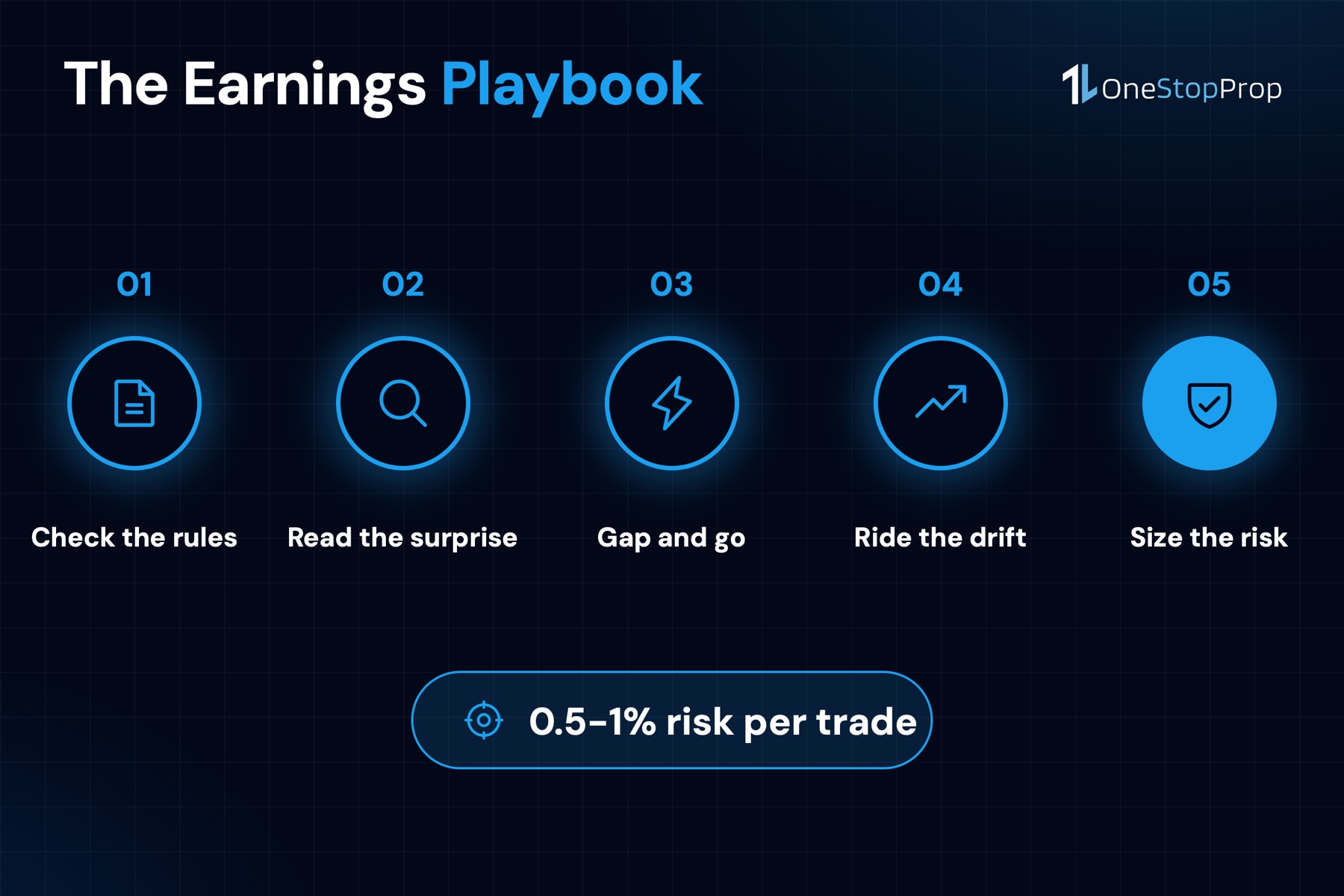
- Know your firm’s news policy before the announcement: Most proprietary trading firms place restrictions on news trading due to extreme market volatility, slippage, and widened spreads, often enforcing blackout periods around high-impact announcements during which trading is prohibited or limited. Earnings are treated as high-impact events, so confirm the exact window in your account agreement.
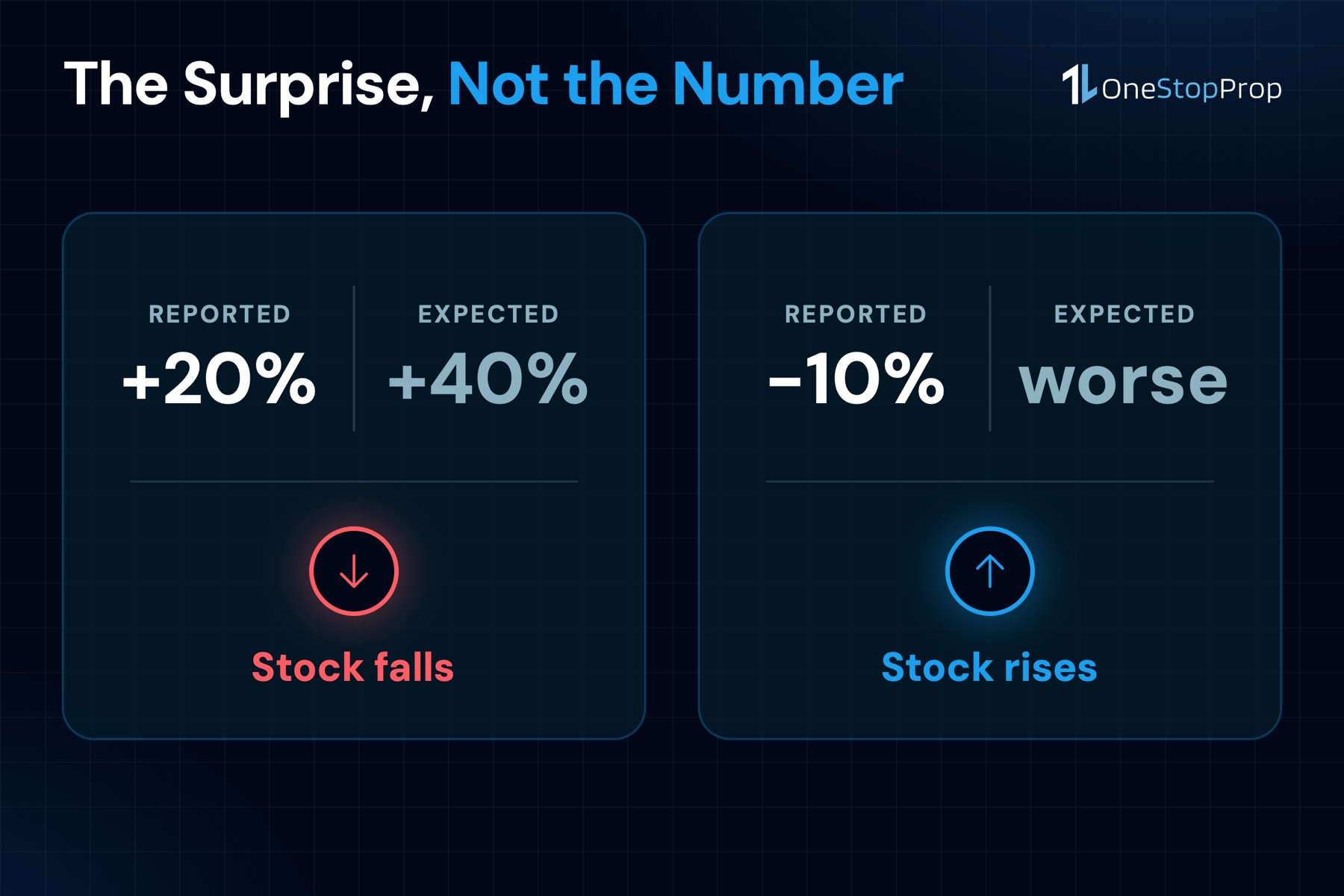
- Price reacts to the surprise, not the headline number: The market does not just react to whether a company beat expectations; it reacts to whether results and the business outlook changed the story investors already priced in, which is why a stock can sometimes fall after “good” results or rally after a miss. Therefore, study the estimate, not just the EPS.
- Post-earnings drift can extend the trade beyond the open: Post-Earnings Announcement Drift (PEAD) is a market anomaly in which a stock’s price continues to move in the same direction as an earnings surprise well after the initial announcement, with the delayed price adjustment often unfolding over weeks or even months. Size for both the gap-open and the continuation.
- Risk 0.5-1% per earnings trade: Risking 3% per trade means just 5 consecutive losses produce a -14.2% drawdown, challenge over, whereas at 1%, the same losing streak results in only -4.9%, which is survivable. Earnings volatility amplifies this math.
- Premarket volume confirms or kills the gap: Entering gap trades within the first 30 minutes when gaps exceed 3% from the previous close, while monitoring pre-market volume of 500,000+ shares, helps validate gap strength. Volume without a catalyst is noise.
Quick-Start Prioritization Framework
| Strategy | Best For | Effort Level | Time to Results |
|---|---|---|---|
| Gap-and-Go (post-open) | Day traders, intraday focus | Medium | Same session |
| Post-Earnings Momentum (PEAD) | Swing traders, multi-day holds | Medium | 2-10 days |
| Pre-Earnings Momentum | Experienced traders only | High | 5-10 days pre-print |
| Flat into the number (standard account) | Traders on restricted firms | Low | N/A, risk avoidance |
| Trade-through the catalyst (Pro account) | Funded traders with Pro access | High | Real-time at release |
Start here if you’re:
- New to prop firm trading: Close positions ahead of the earnings window and use the post-open gap as your entry. You stay compliant and still catch the move.
- Swing trader with a multi-day hold allowance: Study PEAD setups and enter after the first confirmed session, not the open candle.
- On a OneStopProp Pro Account: Standard accounts at OneStopProp require closing positions before major earnings releases and news events, while Pro accounts do not have that restriction, so if you want to trade through the catalyst instead of around it, that distinction matters.
Step 1: Read the Firm’s Earnings Policy Before Touching a Setup
Why the Rule Exists
Major economic announcements can create trading conditions that differ significantly from normal market conditions, prices can move rapidly, spreads can widen, available liquidity can decrease, and orders may be filled away from the price visible immediately before execution. Prop firms absorb that execution risk on simulated capital, so they manage it with blackout rules.
Most funded accounts now have blackout periods around high-impact news events, with common restrictions including 2-5 minute windows before and after announcements where opening or closing trades is prohibited. Earnings releases from Magnificent 7 stocks such as Apple (AAPL), NVIDIA (NVDA), Microsoft (MSFT), Amazon (AMZN), Alphabet (GOOGL), Meta (META), and Tesla (TSLA) routinely qualify as high-impact events under these policies.
What to Check in Your Account Agreement
Major economic announcements can news trading during the evaluation but introduce additional rules when the trader reaches a funded or reward-eligible account, while other firms apply the same news policy throughout the program, so check the rules again whenever you move to a new account stage.
Pro Tip: Set a calendar alert 20 minutes before every scheduled earnings release for stocks you hold. That gives you enough time to close or reduce positions to comply with your firm’s blackout window without rushing a decision under pressure.
Step 2: Understand What Actually Moves the Stock
The Surprise Factor, Not the Number
Stock prices tend to rise when earnings results exceed market expectations while disappointing results tend to lower share prices, because prices move based on expectations, a 20% increase in quarterly income may not be seen as positive if market expectation is 40%, while a 10% decrease in earnings may cause a stock to rise if the expectation was a much larger decline.
This means your pre-earnings research should focus on the analyst consensus estimate and the “whisper number” (the unofficial, more aggressive target that institutional money actually trades against), not just the raw EPS figure.
Key Metrics That Drive Post-Announcement Moves
While revenue growth and EPS remain important indicators of financial performance, professional traders also evaluate profit margins, free cash flow, and, perhaps most importantly, the market’s reaction to the report, with momentum traders finding the highest-probability opportunities when earnings, guidance, and technical price action align.
The stock market has continued to rally in 2026 on the back of another strong earnings season, with S&P 500 earnings on track for a seventh consecutive quarter of double-digit earnings growth, with roughly 97% of S&P 500 companies reporting, 86% have topped estimates according to FactSet. A high beat rate like this matters because it establishes which sectors have momentum and which are already priced for perfection.
Step 3: Execute the Gap-and-Go Entry
How the Setup Works
The Gap and Go strategy is a day trading method where a trader enters a position in the direction of a stock’s opening gap, aiming to capture the momentum that caused the gap within the first 30 to 90 minutes of the session.
The strategy works best on gaps caused by genuine catalysts rather than low-volume overnight drift, the core logic being that if a catalyst is strong enough to move a stock 3% before the market opens and volume confirms that real money is behind the move, the odds favor continuation in the first 30 to 60 minutes.
According to TradeFundrr’s earnings trading guide, TradeFundrr’s earnings trading guide result in 15% larger price moves than after-hours releases, and trading volume peaks in the first hour after market open on earnings days, accounting for 28% of the day’s total volume. Therefore, focus your attention on the open and the first 30 minutes rather than midday entries.
Entry Rules for Gap Trades
A typical gap-and-go setup works like this: a stock gaps up strongly at the open on heavy volume and positive news, and rather than fading it, the trader watches the first few minutes and, if price holds above the opening level and shows continued buying, enters long to ride the momentum higher, with a common refinement being to wait for price to break the high of the first candle or a brief opening consolidation, confirming that buyers remain in control before entering.
Avoid chasing gaps that have already moved more than 15-20% by the open without a consolidation, particularly on stocks where implied volatility was extreme going into the print. The quality of the news matters – a 5% gap on a minor analyst upgrade has very different prospects than a 5% gap on a 40% earnings beat.
Pro Tip: Use a 5-minute chart and wait for the first candle to close above the opening price before entering long on a gap-up. This single filter cuts false-start entries significantly and keeps your stop tight, critical inside a prop firm drawdown structure.
Step 4: Trade Post-Earnings Drift for Multi-Day Holds
What PEAD Is and Why It Works
Post-Earnings Announcement Drift is a market anomaly in which a stock’s price continues to move in the same direction as an earnings surprise well after the initial announcement.
Every earnings season, a predictable pattern plays out: certain stocks beat estimates by a wide margin and keep drifting higher for days or weeks afterward. This is one of the most well-documented anomalies in financial markets, the earnings momentum strategy, formally called PEAD, captures that sustained move by combining a strong earnings surprise with relative strength analysis to find the highest-conviction setups.
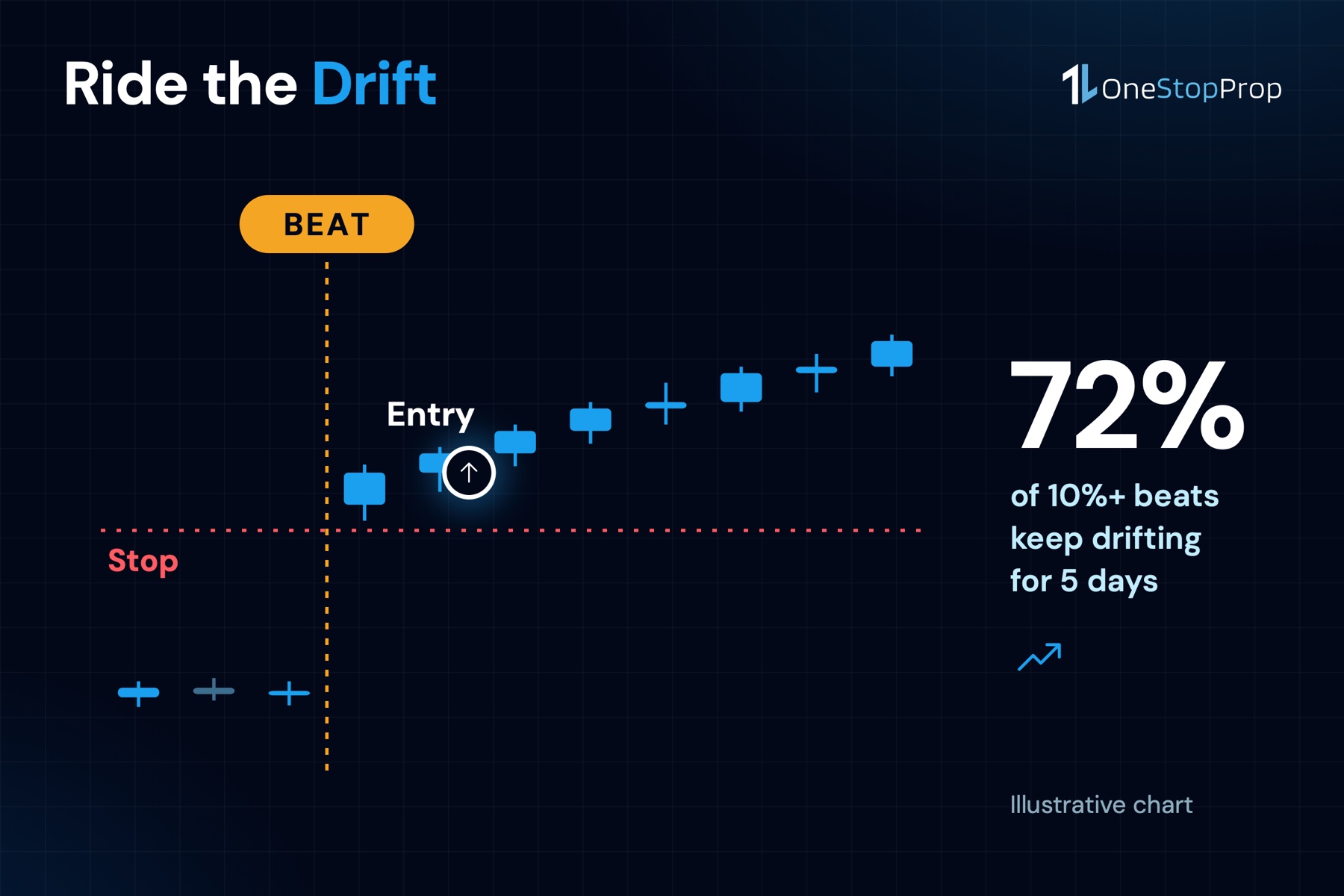
According to Alpha Architect research cited by StockAlarm, Alpha Architect research cited by StockAlarm expectations by 10% or more demonstrate approximately 72% probability of positive 5-day price momentum following the announcement, a statistically meaningful edge worth systematically capturing. Therefore, if the beat is less than 5%, skip the continuation trade and wait for the next setup.
How to Enter a PEAD Trade Without Chasing
Buying before earnings can capture the announcement reaction but exposes the trader to event risk if results disappoint, whereas buying after a confirmed positive surprise may miss some initial upside but aligns the trade with the observed drift, reducing the risk of being on the wrong side of a surprise.
The practical entry on a PEAD trade inside a prop firm account is to let the gap settle, wait for the first session to close above the gap-up opening price, and enter the following morning with a stop placed just below the prior session’s low. This approach is especially clean on stocks like NVIDIA (NVDA) or Microsoft (MSFT), where institutional accumulation following an earnings beat can extend for multiple weeks.
Step 5: Apply Prop-Firm-Specific Risk Management
Position Sizing Around Earnings
Position sizing is the bridge between a trading idea and the prop firm’s loss rules, a good entry with an oversized position can fail an account, while a properly sized trade can be wrong without causing serious damage.
During earnings trades, standard volatility assumptions break down. A stock that normally moves 1-2% per day can gap 10-15% on a print. Because of this, Apex Trader Funding’s risk management guide notes that Apex Trader Funding’s risk management guide primarily on the available drawdown allowance and the number of normal losses the account should be able to absorb, since using only a percentage of the total account balance can create more exposure than the trader intends.
For earnings trades specifically, consider cutting your normal position size by 25-50%. TradeFundrr’s earnings trading guide indicators to identify stocks outperforming their sector and monitoring analyst estimate revisions in the 2 weeks before earnings, while setting position sizes at 25-50% smaller than normal, forms a solid pre-earnings discipline.
Know Your Drawdown Floor Before You Enter
The typical prop firm rule stack is a 3-5% daily loss limit, an 8-12% maximum drawdown, 1-5% position-size caps and a 30-50% consistency rule on the best trading day. Every one of these thresholds is under extra pressure during an earnings gap because slippage, spreads, and fast price action all work against you simultaneously.
OneStopProp’s challenge structure sets straightforward parameters: a maximum daily drawdown of 4%, a maximum total drawdown of 8%, and profit targets of 8% for phase 1 and 5% for phase 2. Map these numbers to your position size before every earnings trade, not after you are already in the position.
Pro Tip: Before an earnings trade, write your stop level, share count, and maximum dollar loss on paper before placing the order. Seeing the actual dollar loss against your drawdown floor makes over-sizing obvious in a way that percentages on a screen rarely do.
Common Mistakes to Avoid
Holding Through the Number Without Checking Your Account Type
Some firms allow news trading in evaluation accounts but restrict it in funded accounts, and violating news trading rules can lead to account termination or profit forfeiture. In my experience, traders who are caught off-guard by this shift lose funded accounts they worked weeks to earn, simply because they assumed the rules that applied in evaluation still applied once funded.
Chasing the Headline Move Without Volume Confirmation
Chasing exhaustion gaps is a common trap, the biggest, most exciting gaps are often the most dangerous. A stock that has already run 400% in the prior year and then gaps 30% on an earnings beat is showing exhaustion, not continuation. Wait for volume-confirmed setups with clear technical levels.
Ignoring Guidance in Favor of Backward-Looking EPS
Results compared to consensus estimates, along with forward guidance and management commentary, often matter more than headline earnings per share. I’ve found that traders who only look at the EPS beat are frequently confused when a stock gaps down on a positive print, the forward guidance missed, and the market always prices forward.
Over-Concentrating on 1 Earnings Name
Most traders who fail a challenge do not fail because of poor trading; they fail because a rule they did not fully understand ended their account before they reached the profit target. Putting 80% of your available risk into a single earnings trade is the fastest way to end both the trade and the account in the same session.
Frequently Asked Questions
Can I hold positions through an earnings release at a prop firm?
It depends entirely on your account type and the firm’s specific rules. Most proprietary trading firms place restrictions on news trading due to the risks involved, such as extreme market volatility, slippage, and widened spreads during major economic events. At OneStopProp, standard accounts require positions to be closed before earnings releases, while the Pro Account removes that restriction entirely, making it the better fit if earnings plays are a core part of your strategy.
What counts as an earnings-related blackout event?
A restricted news window is a defined period before and after a particular economic release during which certain trading actions are prohibited or treated differently, for example, a firm might restrict execution for several minutes before and after a high-impact announcement, with the exact duration varying by program and never to be assumed. Always check the firm’s economic calendar and confirm whether individual stock earnings reports fall under the same policy as macro events like NFP or FOMC.
How much should I reduce position size for an earnings trade?
A common guideline is 0.5-2% risk per trade, but on prop accounts the real constraint is the drawdown limit, not the account size. For earnings trades, I’ve found that reducing size to 0.5% risk or lower keeps the trade survivable even if a gap reverses sharply in the first 15 minutes. Size for the worst realistic outcome, not the best expected outcome.
What is Post-Earnings Announcement Drift and how long does it last?
When a company announces earnings the stock price does not always adjust immediately, instead it often drifts in the direction of the earnings surprise for up to 60 days, a phenomenon called PEAD that has been studied since 1968 and can provide traders with opportunities for above-average returns. Stick to the 3-10 day window for most prop firm setups, since extended holds on funded accounts require a clear overnight and weekend hold allowance.
Which stocks are best for earnings trades at a prop firm?
Focus on liquid names with tight spreads and confirmed retail and institutional interest. The Magnificent 7, Apple (AAPL), NVIDIA (NVDA), Microsoft (MSFT), Amazon (AMZN), Alphabet (GOOGL), Meta (META), and Tesla (TSLA), are the most commonly traded earnings names inside stock-funded prop accounts, because their high liquidity means tighter spreads and more predictable gap behavior. OneStopProp allows you to trade stocks, forex and crypto in one account with challenge rules that are reasonable and without hidden restrictions like other firms have, making it straightforward to access these names inside a single funded account without switching platforms.
If you are looking for a prop firm built for stock traders who want to run earnings strategies without arbitrary rule complexity, OneStopProp’s Pro Account removes the earnings blackout restriction entirely and lets you trade through the catalyst. Traders receive 100% of earnings for the first 5 payouts, then 90% ongoing, with a straightforward 2-phase challenge and no consistency rule to navigate around. Start your evaluation at OneStopProp and build your earnings playbook with a firm designed to let you trade, not work around rules.
Sources
- Earnings Season Guide: How To Read an Earnings Report, Chase. Covers how earnings results, forward guidance, and analyst estimates drive stock price reactions. https://www.chase.com/personal/investments/learning-and-insights/article/earnings-season-guide-how-to-read-an-earnings-report
- News Trading Rules: Why They Exist & How to Avoid Violations, MyFXBook. Explains prop firm blackout period mechanics and spread behavior around announcements. https://www.oanda.com/us-en/trade-tap-blog/asset-classes/forex/forex-volatility–understanding-analyzing-trading-currency-fluctuations/
- Prop Firm Rule Changes for 2026, New York City Servers. Covers blackout windows, firm-level enforcement, and the 2-5 minute restriction standard. https://newyorkcityservers.com/blog/prop-firm-rules-2026
- Can You Trade News Events in Prop Firm Accounts?, For Traders. Covers account-specific rules, blackout periods, and penalties for violations. https://fortraders.com/blog/can-you-trade-news-events-in-prop-firm-accounts
- Trading Around Earnings: 5 Proven Strategies That Work, TradeFundrr. Provides data on premarket vs. after-hours announcement size and volume patterns. https://tradefundrr.com/trading-around-earnings-announcements/
- Gap Trading Strategy: Complete Guide (2026), Quantum Algo. Details gap-and-go entry mechanics and confirmation signals. https://www.quantum-algo.com/blog/guides/gap-trading-strategy-complete-guide/
- Tracking Post-Earnings Announcement Drift (PEAD), Financial Modeling Prep. Covers the PEAD anomaly, holding period, and sector targeting strategies. https://site.financialmodelingprep.com/education/other/tracking-postearnings-announcement-drift-with-fmps-market-data
- Earnings Momentum Strategy: How to Profit from Post-Earnings Drift, StockAlarm. Cites Alpha Architect data on 72% probability of 5-day momentum after a 10%+ beat. https://pro.stockalarm.io/blog/earnings-momentum-strategy
- Position Sizing for Prop Firms, Traders Second Brain. Covers the 1% vs 3% risk rule math and consecutive loss survival rates. https://traderssecondbrain.com/guides/position-sizing-for-prop-firms
- Effective Risk Management for Prop Firm Funded Accounts, Apex Trader Funding. Covers drawdown-referenced position sizing methodology. https://apextraderfunding.com/resources/prop-trading/effective-risk-management-strategies-for-prop-firm-funded-accounts/
- Prop Firm Rules Explained 2026, Velotrade. Summarizes daily loss limit, trailing drawdown, news restrictions, and consistency rules. https://velotrade.com/blog/prop-firm-rules-explained
- Which Earnings Metrics Actually Move Stocks?, Paper Trading Journal. Reports 88% EPS beat rate and 84% revenue beat rate in Q1 2026. https://papertradingjournal.com/2026/07/14/which-earnings-metrics-actually-move-stocks/
- Best AI Stocks for Prop Firm Trading, OneStopProp. Explains the Standard vs. Pro account distinction on earnings news trading. https://onestopprop.com/best-ai-stocks-for-prop-firm-trading/
- Why Traders Are Moving Away from Traditional Prop Firms, OneStopProp. Covers challenge parameters, drawdown rules, and payout structure. https://onestopprop.com/why-traders-are-moving-away-from-traditional-prop-firms-the-onestopprop-difference/