Most traders hear “drawdown limit” and immediately think of punishment. Hit the number, lose the account, end of story. That framing is understandable, but it misses the bigger picture almost entirely of how prop firm drawdown limits protect traders.
Prop firm drawdown rules are designed to help you survive long enough to demonstrate skill and consistency. The rules that feel like a cage are, in practice, the structure that separates traders who build long careers from those who blow capital in a single emotional session. This guide breaks down exactly what drawdown limits are, how they work mechanically, and critically, why a well-designed drawdown framework genuinely serves your interests as a trader.
Key Takeaways
- Hitting the firm’s daily loss limit breaches the account. Be clear on this before anything else: at OneStopProp, reaching the max daily loss is a breach. The account is done, not paused until tomorrow. The limit caps what one bad session can cost, but it protects the account by ending it, not by sending you home for the day. Treat the published number as a line you never reach, not a safety net that catches you.
- Drawdown rules are the most powerful anti-revenge-trading tool available. Revenge trading is not a rare disease affecting a few emotional traders. A behavioral analysis of over 500,000 trading accounts by hoc-trade found that 37% of all traders show measurable revenge-trading behavior. A personal daily stop, set well inside the firm’s, enforces the cool-down that willpower alone cannot, and it does it while you still have an account.
- Static drawdown widens your buffer as you profit. For most traders, a static balance-based drawdown is the best type. The floor is predictable, your buffer grows rather than shrinks as you profit, and floating losses on open trades cannot trap you mid-session. Therefore, prioritize firms using this model when choosing a challenge.
- Knowing the type matters more than knowing the percentage. Trailing drawdowns, especially intraday equity-based ones, are far less forgiving and demand tighter discipline. If you are comparing firms, the drawdown model often matters more than the headline profit target.
- Your personal limit should sit well inside the firm’s limit. Set a personal daily loss limit at 60-70% of the firm’s limit. If your firm allows 5%, stop trading for the day at 3%. The extra 2% is your emergency buffer, not your trading budget.
Prioritization Framework for How Prop Firm Drawdown Limits Protect Traders
| Drawdown Type | Best For | Effort Level | Protection Benefit |
|---|---|---|---|
| Static / Balance-Based Daily | All trader styles, especially swing traders | Low | Predictable floor; buffer grows with profits |
| Trailing (End-of-Day) | Position traders, moderate discipline | Medium | Locks in gains at close; forgiving intraday |
| Trailing (Intraday) | Disciplined scalpers, experienced traders | High | Tightest protection; demands real-time tracking |
| Personal Inner Limit (50-70% of firm’s cap) | Every funded trader | Low | Eliminates emotional breach risk entirely |
Start here if you are:
- New to funded trading: Focus on static drawdown firms and apply a personal stop at 50% of the firm’s daily cap, this gives you maximum room to learn without blowing out on a single session.
- Experienced with a proven strategy: Check whether your historical max drawdown fits inside the firm’s limit, then set your personal stop at 60-70% of the firm’s published cap to absorb normal market noise without risk of a technical breach.
- Scaling across multiple accounts: Apply the same risk percentage per trade across all accounts. A firm like OneStopProp uses balance-based daily drawdown and offers no time limits, which means you can pace your scaling without deadline-driven risk creep.
What Drawdown Limits Actually Are (And Why the Framing Matters)
The Basic Mechanics
A drawdown measures the decline in a trading account’s value from a prior peak. It is a key metric used by prop firms to assess risk and strategy performance. In a funded trading context, this measurement stops being informational and becomes structural. In prop trading, drawdown stops being a performance statistic and becomes a hard rule: breach the daily or overall drawdown limit and the evaluation ends immediately, regardless of how the trade would have finished.
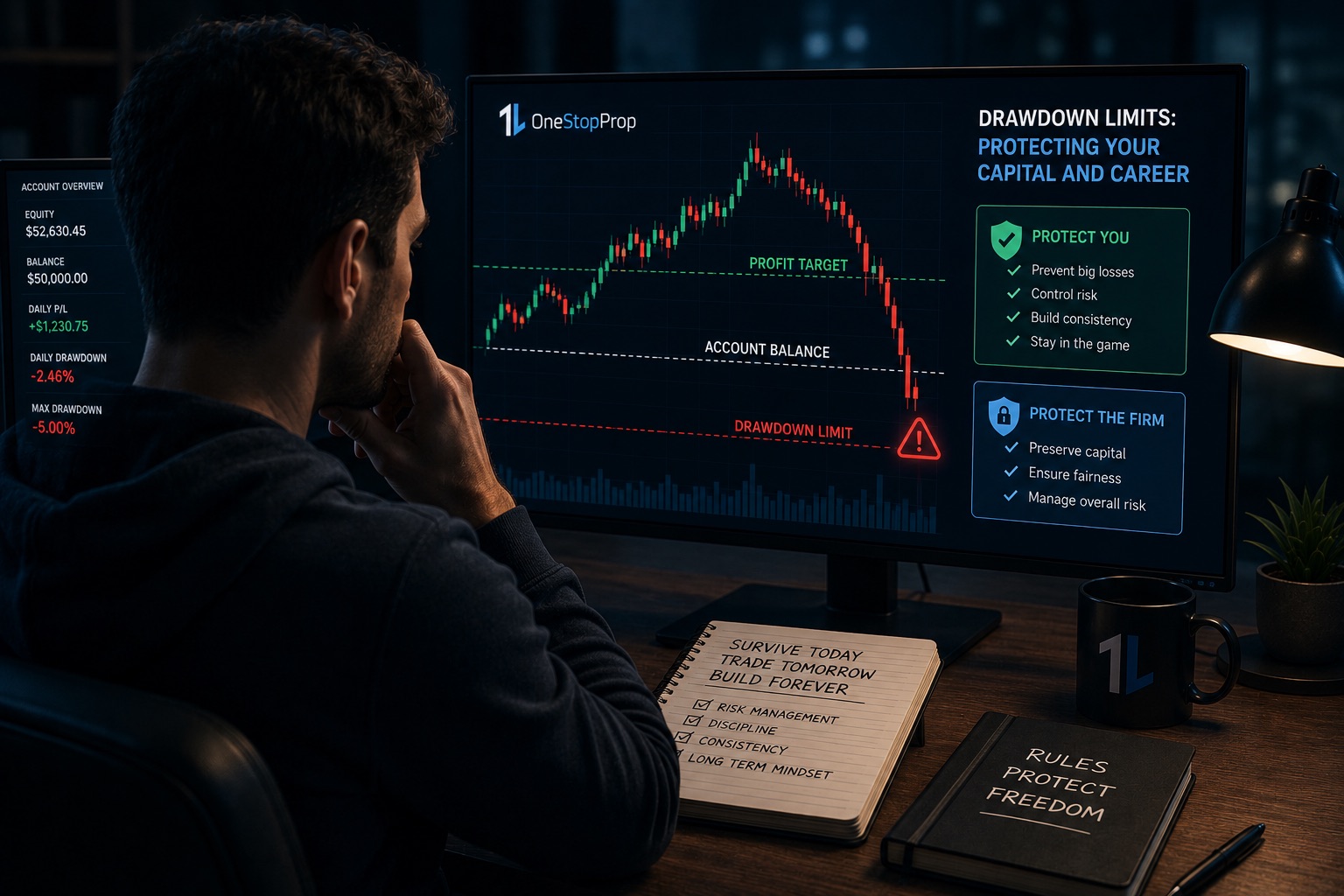
Most prop firms apply 2 main types: daily drawdown, the maximum loss allowed within a single trading day, and overall drawdown, the maximum total loss allowed over the life of the account. Beyond these, firms may use fixed drawdown, trailing drawdown, or an equity-based calculation instead of a balance-based one.
Why This Structure Exists for You, Not Just the Firm
Drawdown limits exist to protect the firm’s capital. Because the firm is backing you, it needs guardrails to cap how much any single trader can lose, and to filter for traders who can manage risk. A trader who cannot survive one bad day is unlikely to generate consistent profits, so the limit doubles as a test of discipline.
That dual function, protecting capital and testing discipline, is exactly what makes these rules valuable for your development. Prop firms implement daily drawdown limits to protect both their capital and traders from severe losses. These limits instill discipline, help traders avoid overleveraging, and encourage consistent, responsible trading needed for long-term success. Without a hard boundary, emotional decision-making fills the vacuum.
Pro Tip: Risk management is more than capital protection; it is emotional protection. When you know your maximum loss is capped at 1% to 2% per trade, anxiety decreases. You can execute strategies without fear of catastrophic drawdowns destroying accounts.
Static vs. Trailing Drawdown: The Distinction That Changes Everything
Static (Fixed) Drawdown
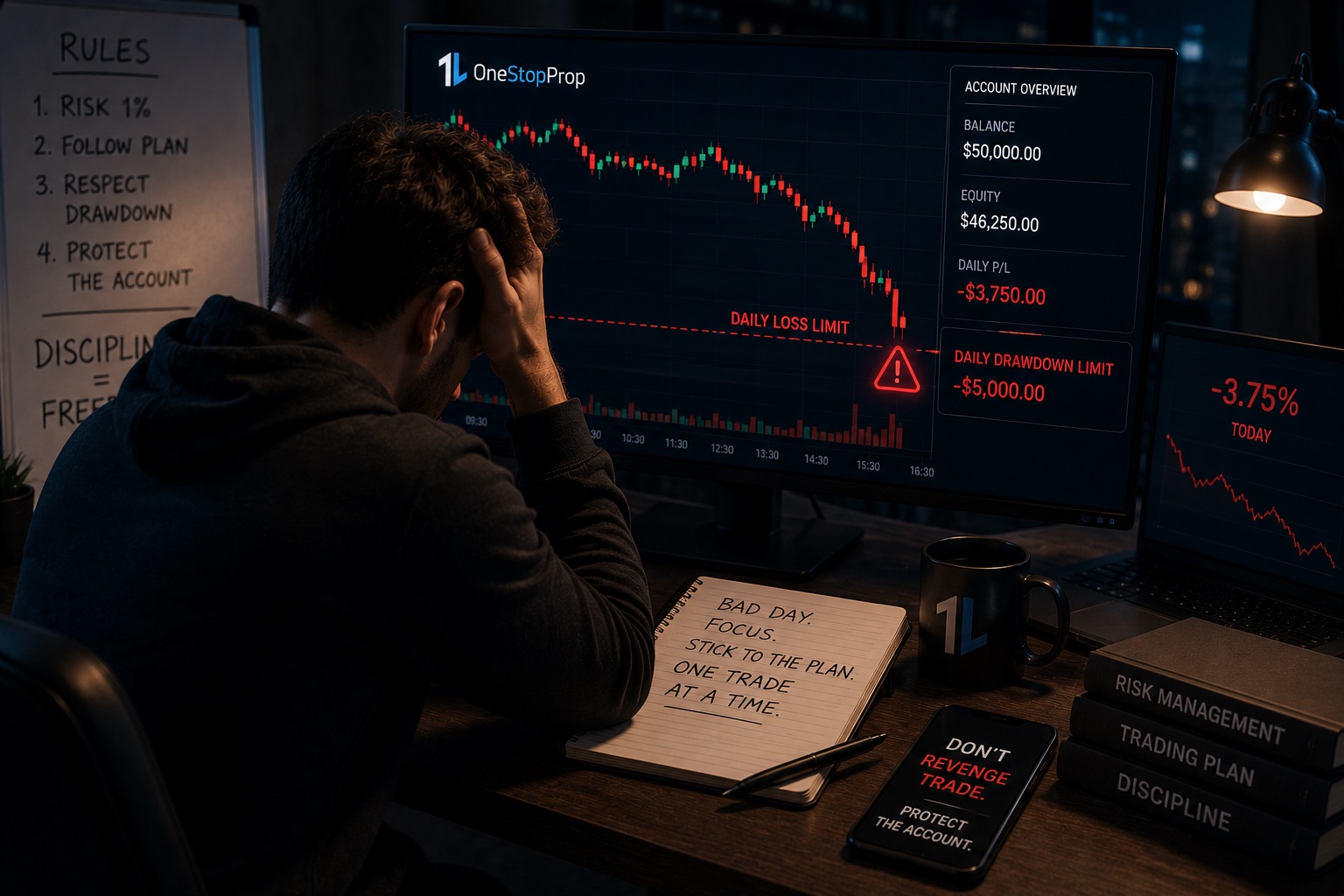
Static drawdown fixes your loss floor at the starting balance, for example, $90,000 on a $100,000 account, so early profits permanently widen your cushion. This is the most straightforward model because the math never changes. Take your starting balance, apply the overall drawdown percentage, and that number is fixed for the life of the account. No recalculation, no trailing, no adjustment as your balance grows or shrinks intraday. This is why static drawdown is often the easiest rule to explain to someone brand new to funded trading, there’s no moving target to track mentally while you’re also watching price.
Trailing Drawdown
Trailing drawdown moves the floor up with every new equity or balance high-water mark, which means a green week can still leave you one bad trade from a breach. The protection it offers comes from locking in gains progressively. The trailing-drawdown approach means the firm won’t shut you out the moment you dip a little below a fixed limit, but it will close the account if you erode too much of the gains you’ve already earned. That’s smart risk management; it aligns your incentives with the firm’s. It encourages disciplined scaling: the more you profit, the larger the buffer before a stop-out.
Choosing the Right Fit
Static drawdown is generally more forgiving for traders who build up profits early. Trailing drawdown demands consistent discipline from the first session. Neither model is superior in isolation. The right choice depends on your trading style and how you manage open equity.
How Daily Limits Block the Most Destructive Trading Behavior
The Revenge Trading Problem
Revenge trading is one of the most destructive behavioral patterns in financial markets, and it has erased more accounts than any single market crash. The mechanics are predictable: a loss triggers an emotional response, and that response overrides the trading plan. A drawdown is a sequence of clustered losses that challenges the integrity of the capital base and the trader’s self-belief, often triggering intense emotional reactions like denial, regret, and revenge trading behavior.
According to behavioral finance research by Kahneman and Tversky (Prospect Theory), losses generate an emotional impact 2 to 2.5 times greater than equivalent gains. This explains why a 20% drawdown feels far worse than a 20% gain feels good. That asymmetry is what drives impulsive re-entries, oversized positions, and strategy abandonment, all at the exact moment when discipline matters most.
What the Daily Limit Actually Does to That Pattern
Traders who have reviewed their own breach history consistently find the same thing. Most violations occur on days with 2 or more losses in a row, not from one large loss at the open. That means the rule rarely fails traders on a genuinely bad-luck day.
That is why your own stop matters more than the firm’s. A personal limit is a circuit breaker: it steps in when your judgment is most compromised and you still have an account in the morning. The firm’s limit is not a circuit breaker, it is the end of the line. Accounts do not typically die after the first loss; they die after what the trader does next, and the firm’s number is where that ends.
Pro Tip: Stick to risking no more than 1% of your account balance per trade. Additionally, set a personal daily stop-loss at half the firm’s limit. For example, if the firm allows a $500 daily loss, stop trading once you hit $250. This way, the limit is a last resort, not your actual operating boundary.
The Practical Benefits Traders Overlook
Drawdown Rules Train Position Sizing
One of the most underrated benefits of firm-enforced drawdown limits is what they do to your position sizing habits over time. Professional traders recommend risking between 0.25% and 1% of your account balance per trade during prop firm challenges. This conservative approach creates sufficient buffer for multiple consecutive losses without triggering drawdown limits. Even after 5 losses at 1% risk, you’ve only lost 5% of your account, which remains completely recoverable.
Keeping risk per trade between 0.5% and 1% of account size allows multiple losing trades without reaching firm limits. That is not timid; it is mathematically optimal for staying in the game. Funded traders must think like risk managers first and traders second.
Drawdown Rules Create Scalable Habits
From a trader’s perspective, the scaling structure is actually a feature. It forces you to build a track record at each capital tier before moving to a higher-stakes environment. The discipline you build respecting a 5% daily limit on a $50,000 account is the same discipline that protects a $200,000 account later.
The critical protection in funded trading: if a funded trader breaches the drawdown limit, the firm closes the account and absorbs the trading losses up to the drawdown threshold. Without a drawdown limit, that floor does not exist, and you carry the full weight of every mistake yourself.
Drawdown Rules Protect Against Your Own Psychology
Here is the distinction that costs traders their accounts. A limit you set for yourself stops your trading for the day: you close the platform, you regroup, you come back tomorrow. The firm’s limit does not work that way. Reaching it breaches the account, and there is no tomorrow on that account. So your personal stop has to sit well below the firm’s number, because it is the only one of the 2 that leaves you another session.
Pro Tip: The difference between struggling traders and professionals is not the absence of the revenge trading impulse, but the presence of systems that prevent acting on it. Most traders report meaningful improvement within 3 to 6 months of consistently applying structural safeguards like daily loss limits, mandatory cool-down periods, and emotional journaling.
How to Work With Drawdown Limits, Not Against Them
Know Your Numbers Before the Session Starts
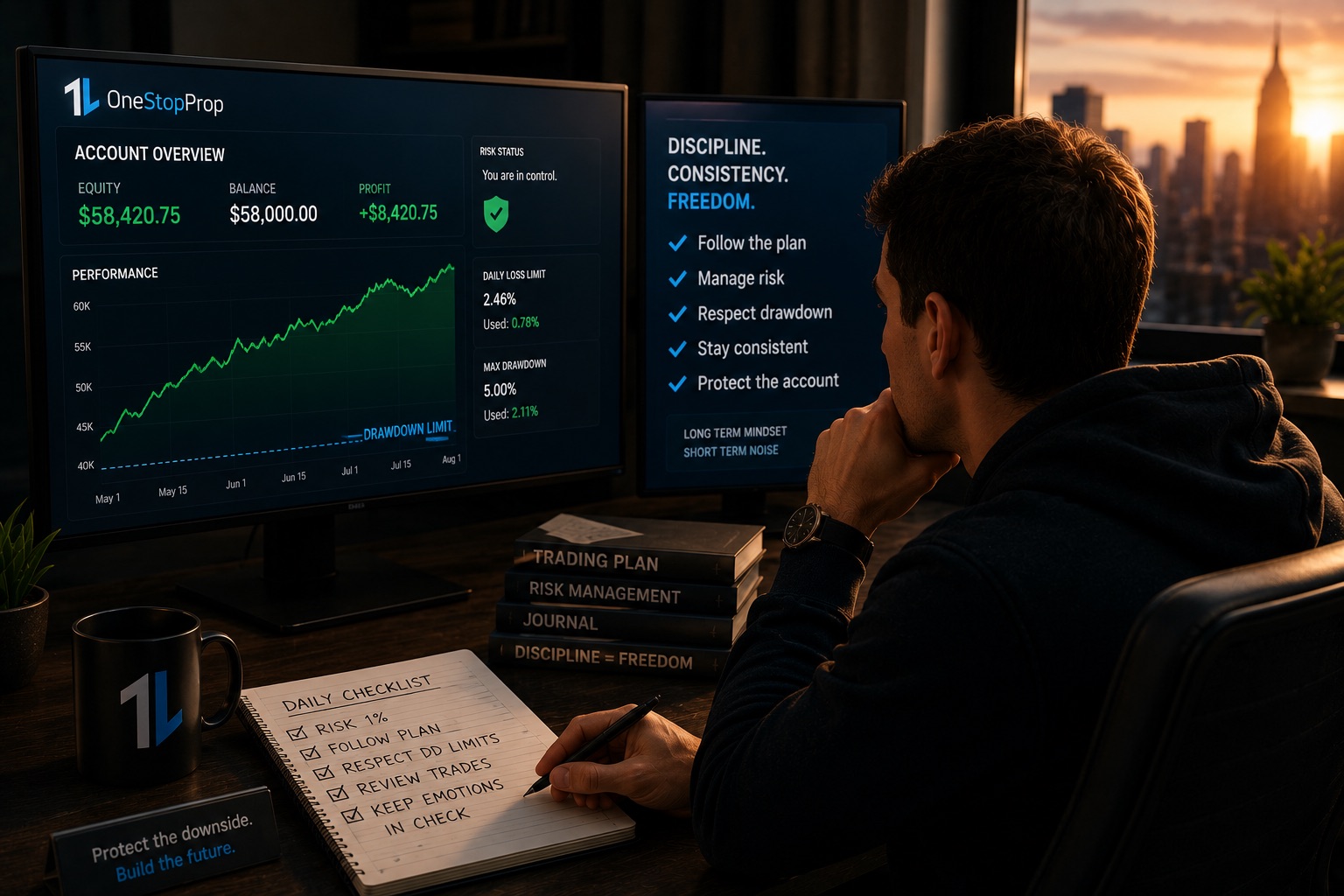
Treat the firm’s daily drawdown as an absolute ceiling, not a budget. On a $100,000 account with a 5% daily limit, the floor lies $5,000 below starting equity. A personal daily stop at $2,500 (50% of the firm’s cap) creates a hard stop inside that boundary. With a $2,500 personal stop and a 5-trade session cap, each trade risks $500 (0.5%).
Understand Which Type of Drawdown You’re Under
There’s a meaningful difference between a firm that moves your drawdown level at end of day versus one that moves it in real time as your unrealized profit peaks. Same dollar amount. Completely different experience. And in some cases, completely different outcome on the exact same trading day. According to VeloTrade, there’s a meaningful difference, most traders who breach their evaluation lose it because they didn’t fully understand how the trailing drawdown was calculated, not what it was, but how it was calculated.
Build a Personal Risk Layer
Professional prop traders adopt disciplined approaches to manage drawdowns effectively: set personal loss limits using half of the allowed daily drawdown as a self-imposed stop to avoid hitting hard limits, and risk only 0.25% to 1% of capital per trade to minimize the impact of losing streaks. Use automatic stop-losses to cap individual trade losses.
If you hit your personal limit for the day, close your platform and review. The market will be open tomorrow. The ability to remain disciplined when the market moves against you, to stay patient when opportunities are limited, and to follow predefined rules when emotions begin to interfere is what makes trading a sustainable career. Managing yourself means maintaining stability in an unstable environment. It requires accepting uncertainty, respecting risk, and executing decisions based on structure rather than impulse.
Choosing a Firm Where the Drawdown Structure Works in Your Favor
Not all drawdown models are equal, and the structure of a firm’s rules either amplifies or reduces the protective benefit for you as a trader. Most prop firms share these common elements: a daily loss limit that prevents significant losses in a single day, a maximum drawdown to ensure overall losses stay within a set percentage, a profit target that defines how much profit you need to make to pass, and trading style restrictions at some firms that prohibit scalping or news trading.
What separates good structures from frustrating ones is transparency and alignment with how traders actually behave under pressure. OneStopProp uses a balance-based daily drawdown model, with balance-based daily drawdown, no time limits, and no deceptive rules. That means early profits increase your cushion rather than tighten it, and there’s no artificial deadline forcing you to take sub-optimal trades under pressure.
OneStopProp also offers funded resets: if you encounter a drawdown on your funded account, reset options are available to keep you in the game. Their two-phase challenge system uses a straightforward evaluation process with reasonable profit targets that demonstrate skill without encouraging excessive risk.
For traders who want to scale faster while keeping the same protective drawdown structure, OneStopProp’s Add-Ons are designed for that purpose, options for those seeking higher capital and expanded features. OneStopProp’s financial structure delivers a 90/10 profit split, which can rise to 95% for life with the Lifetime Profit Split 95% Add-On. If you have a proven, repeatable edge, these Add-Ons directly accelerate the compounding effect. You can review the full structure at the OneStopProp checkout page.
Frequently Asked Questions
What is the difference between daily drawdown and maximum drawdown?
The daily drawdown defines the maximum loss allowed in a single trading session. The maximum drawdown defines the total loss allowed from starting balance or equity peak over the account’s life. These are 2 independent limits. Confusing them, or treating them as one blended threshold, leads to early account termination. Always check which one applies at each moment in your session.
Does a floating (unrealized) loss count toward my drawdown?
It depends on the firm’s model. The max drawdown includes unrealised losses at most firms. If you have open positions that are $4,000 in negative floating P&L, that counts against your drawdown even though you have not closed the trades yet. This catches traders off guard because they think “I have not lost that money yet”, the firm disagrees. Always verify whether your firm uses equity-based or balance-based measurement.
Can I recover if I get close to my drawdown limit?
Establish a personal maximum loss rule that is tighter than the firm’s daily drawdown. If a $100,000 account firm allows a 5% daily loss limit, force yourself to stop trading if you hit 2.5% or 3%. Protecting your account is more important than attempting to aggressively recover losses. Getting close to the firm’s limit is a signal to stop for the day, never a reason to push harder.
Does withdrawing profits affect my drawdown limit?
One mechanic that surprises traders: withdrawals don’t reset a trailing drawdown level. If your level has locked at $50,000 and your balance is $52,000, withdrawing $1,000 drops your balance to $51,000 while the level stays at $50,000, so your buffer shrinks from $2,000 to $1,000 through a payout rather than a losing trade. On a static drawdown, this dynamic does not apply. Always check your firm’s specific payout policy, OneStopProp’s payout details are publicly available for review before you commit.
Why do drawdown limits feel punitive if they are protective?
The experience of hitting a limit is frustrating precisely because emotions are running high at that moment. If you want to stay funded over the long term, treat risk rules not as a constraint but as a framework for professional behaviour. The traders who pass challenges and retain accounts are not necessarily the most talented. They are the most disciplined. The limit removes a decision that stress would otherwise make badly for you.
Take the Next Step
Drawdown limits stop being intimidating the moment you understand exactly what they’re protecting you from. If you’re ready to apply this understanding with a firm that builds its drawdown rules around trader success, explore OneStopProp’s funded account options, with balance-based daily drawdown, no time limits, funded resets, and Add-Ons like the Lifetime Profit Split 95% that lifts the base 90% split to 95% for life.
Sources
- Prospect Theory, Loss Aversion and the Kahneman-Tversky research, Yuka Chou. Why a loss weighs 2 to 2.5 times more than an equivalent gain. https://yukaichou.com/behavioral-analysis/prospect-theory-loss-aversion-kahneman-tversky/
- Revenge Trading: 37% Do It, But It Costs Less Than You Think, hoc-trade. Behavioral analysis of more than 500,000 trading accounts. https://hoc-trade.com/blogs/behavioral-risks/revenge-trading-emotional-recovery
- 5 Revenge Trading Triggers That Blow Accounts Overnight, MQL5 Traders’ Blogs. Neurological and behavioral triggers behind impulsive re-entries. https://www.mql5.com/en/blogs/post/768620
- What is the Maximum Daily Loss?, OneStopProp. How the daily loss limit is calculated, and that breaching it ends the account. https://help.onestopprop.com/faq/what-is-the-maximum-daily-loss/
- OneStopProp, Funded Trading for Stocks, Forex and Crypto, OneStopProp. Balance-based drawdown, account lineup and platform. https://onestopprop.com
- Why Traders Are Moving Away from Traditional Prop Firms, OneStopProp. Funded resets, profit splits and the challenge structure. https://onestopprop.com/why-traders-are-moving-away-from-traditional-prop-firms-the-onestopprop-difference/
- Funded Account Scaling Plan, OneStopProp. Account structure, scaling mechanics and drawdown parameters. https://onestopprop.com/funded-account-scaling-plan/