Getting funded sounds like the hard part. In reality, staying funded is where most traders struggle. Over 80% of traders who fail their first prop firm challenge, don’t fail because of bad strategies or lack of market knowledge, but from simple (and avoidable) mistakes: discipline failures, rule violations, and poor risk management decisions that could have been prevented with the right preparation.
The good news is that every mistake on this list is identifiable, correctable, and predictable. Whether you are going through your first evaluation or protecting an existing funded account, understanding these pitfalls puts you ahead of the majority of participants before you place a single trade.

Key Takeaways
- Drawdown breaches end more accounts than losing trades do. According to OneFunded’s evaluation data, 78.7% of all challenge failures come from breaching the daily drawdown, so managing intraday risk is your single most important skill.
- Rule ignorance is a silent killer. As Velotrade’s 2026 research shows, most prop firm failures come from rule breaches and behavior patterns, not bad strategies. Read the full terms before you trade a single lot.
- Emotional trading accelerates every other mistake. Liquidityfinder’s risk management analysis reports that 80% of account violations happen when traders ignore their own rules because emotions take over.
- Journaling is the difference between improvement and repetition. According to TradeZella’s prop firm guide, the difference between traders who pass on their 2nd attempt and those who fail 5 times in a row is almost always data.
- Choosing a firm with transparent, simple rules reduces your structural risk. Research cited by The Prop Wire suggests that firms with clearer, simpler rule structures produce better payout rates because traders can actually comply with fewer, more legible constraints.
Prioritization Framework: Common Prop Firm Mistakes to Avoid
| Mistake | Most Dangerous For | Urgency to Fix | Impact on Account |
|---|---|---|---|
| Ignoring daily drawdown rules | All traders | Critical | Immediate account closure |
| Revenge trading | Intraday traders | Critical | Rapid equity destruction |
| Oversizing positions | New funded traders | High | Silent account erosion |
| Skipping the rulebook | First-time challengers | High | Instant disqualification |
| No trading plan or journal | All traders | High | Inconsistency and repeat failures |
| Overtrading for targets | Challenge-phase traders | Medium-High | Rule breach + exhaustion |
| Holding through news events | Forex and index traders | Medium | Unexpected breach |
| Ignoring profit withdrawal timing | Funded account holders | Medium | Lost gains on breach |
Start here based on your situation:
- First-time challenger: Fix mistake #4 (read the full rulebook) and #3 (position sizing) before anything else. These 2 alone account for the majority of early eliminations.
- Already funded but struggling to get paid: Focus on mistake #8 (payout timing) and mistake #2 (revenge trading). These are the top reasons funded traders lose accounts they already earned.
- Consistently profitable but failing challenges: Address mistake #1 (daily drawdown awareness) and #6 (overtrading). Your strategy may be sound but structurally incompatible with challenge rules.
Mistake 1: Treating the Daily Drawdown Limit as a Target, Not a Hard Stop
Why the Daily Limit Destroys More Accounts Than Any Other Rule
Nearly 4 out of every 5 failed challenges come down to 1 rule, the daily drawdown. In OneFunded’s data, 78.7% of all challenge failures come from breaching the daily drawdown. Every prop firm sets a maximum loss you can take within a single trading day, and crossing that line ends the evaluation. Therefore, your only job before opening each session is to know exactly how much room you have left before you hit the daily floor, and to stop trading well before you reach it.
A daily loss limit breach means your losses for the day exceed the maximum allowed, typically 4-5% of account balance. The account is suspended for the day or closed permanently depending on whether this is an evaluation or a funded account. One number, 4 or 5 percent, determines whether weeks of work survive or disappear.
How to Actually Apply the Daily Limit
Track your remaining daily loss capacity before every single trade entry, not after. As MT4Copier’s 2026 journaling guide explains, knowing remaining daily loss capacity before trade entry is the single most critical factor for account survival. A trader who checks this number before every entry will almost never blow a funded account on a rule violation. Set a personal daily stop at 50-60% of the firm’s published limit. If you hit your personal limit, close the platform and walk away.
Pro Tip: At OneStopProp, the parameters are published per path: a 2 Step runs a 4% maximum daily drawdown and an 8% maximum total drawdown, while a 1 Step runs 4% daily and 6% total, and Instant runs 2% daily and 5% total. There are no hidden triggers buried in fine print, but you do have to read the ones for your own account. Knowing your exact numbers in advance, rather than discovering them mid-loss, is one of the clearest structural advantages you can give yourself before your first trade.
Mistake 2: Revenge Trading After a Loss
The Psychology That Kills Funded Accounts
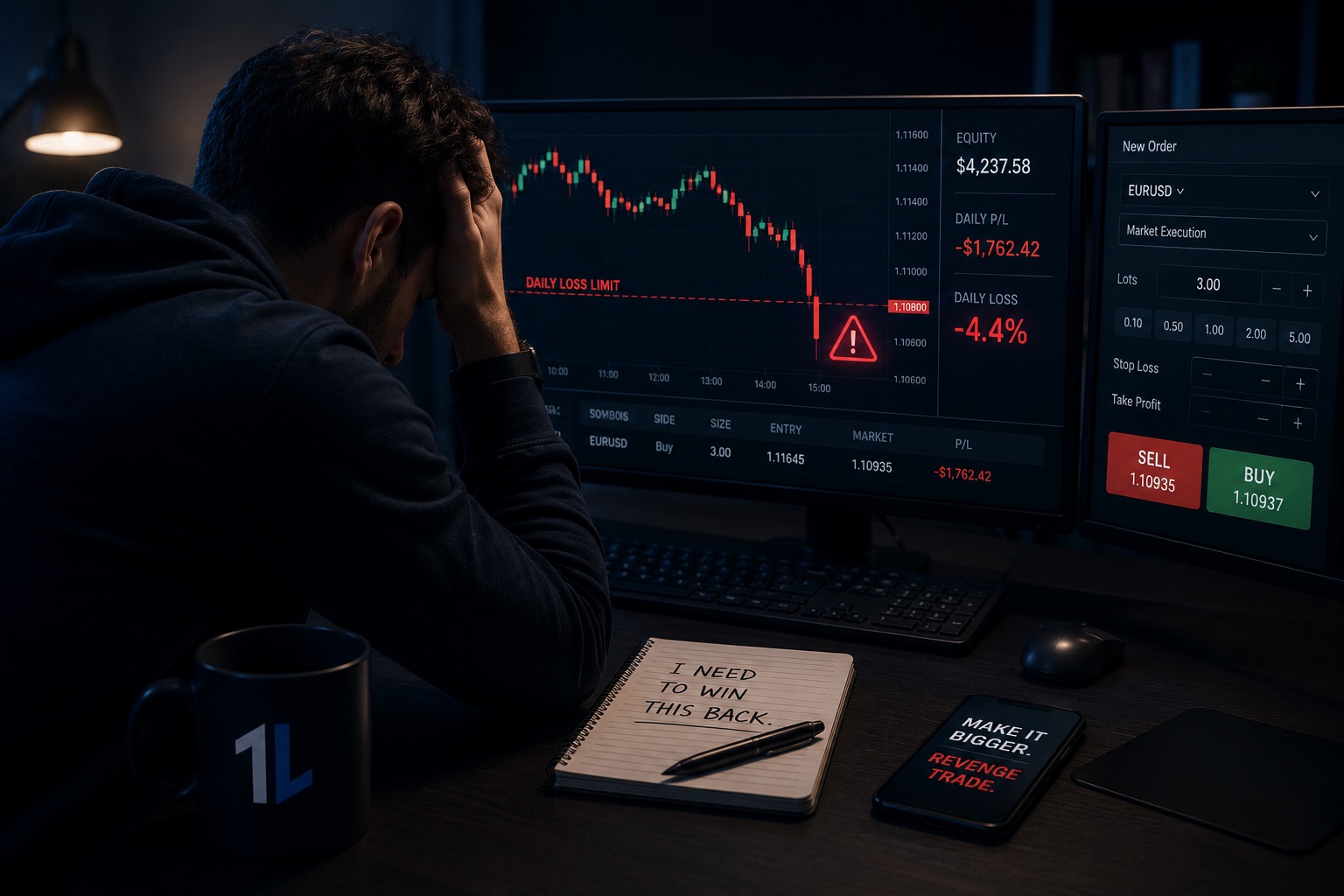
One of the biggest account killers in prop trading is revenge trading, the emotional urge to immediately recover losses by increasing position sizes, overtrading, or abandoning risk management rules. While a single losing trade is a normal part of trading, attempting to win the money back quickly often leads to much larger losses. Prop firms enforce strict drawdown limits, daily loss caps, and consistency requirements, so emotional decision-making can quickly turn a small setback into a challenge-ending mistake.
Prospect Theory research shows people feel the pain of a loss roughly twice as strongly as the pleasure of an equivalent gain, which means every losing trade is pushing your brain to take irrational action. In a prop firm environment where the daily loss limit resets your progress in seconds, this biological instinct is lethal.
The Fix: Process Over Impulse
Anti-martingale is the opposite of doubling down: after a loss, reduce your next position size. A simple rule, cut your position size in half after any losing trade, and only return to normal size after 2 consecutive winning trades, limits damage and psychologically refocuses you from “recovering losses” to “rebuilding with small wins.” If you take 2 consecutive losses in a session, close the platform entirely. Come back tomorrow. That trade will still be there. Your account may not be if you keep going.
Mistake 3: Oversizing Positions to Hit Targets Faster
Position Size Is the Most Controllable Variable
Oversizing positions is the number one killer of prop firm challenges. Traders use position sizes that are far too large relative to their account size, trying to hit profit targets quickly. The logic seems sound: “I need 10% profit in 30 days, so if I risk 5% per trade, I only need 2 winning trades.” One bad trade destroys that plan. One unexpected market move, one stop loss hit, and you’ve blown through your maximum daily loss limit or violated your drawdown threshold.
Research from FundedNext recommends keeping risk per trade between 0.5% and 1% of account balance and taking only high-quality setups. At that rate, a standard 5% daily drawdown limit means you need 5 to 10 losing trades in a single session before you breach, giving you the cushion to survive normal variance.
The Benchmark to Apply Right Now
Professional traders calculate their “Risk of Ruin.” In a prop setting, you should aim to risk 0.25% to 0.50% of the account balance per trade to ensure you have enough “room” to survive a standard losing streak. Run that calculation on your current account size before the next session. If your typical position size exceeds 1% risk per trade, reduce it immediately, not after the next loss.
Pro Tip: Most profitable prop firm traders take between 2 and 5 high-quality trades per day, according to PropTradingVibes’ 2026 analysis. Trade quality drops significantly after the first 5 entries. Setting a hard daily trade limit of 5 is a strong starting baseline for most prop strategies.
Mistake 4: Skimming the Rules Instead of Reading Them
Rule Violations Cost More Than Losing Trades
Most traders who fail a challenge do not fail because of poor trading. They fail because a rule they did not fully understand ended their account before they reached the profit target. Every firm has a different rulebook, and the differences matter enormously. Trailing vs. static drawdown. Consistency rules. News restrictions. Weekend holding policies. Each one can eliminate an account without a single unprofitable trade.
Consistency rules require that no single trade accounts for more than a certain percentage of your total profit. Trailing drawdowns mean the maximum loss limit “trails” your highest unrealized equity peak, effectively locking in losses while you are still in a trade. News restrictions at many firms disqualify accounts if a trade is executed or closed within a 5-minute window of a high-impact news event. None of these rules appear on the marketing page. They live in the fine print.
The Pre-Challenge Rulebook Checklist
Before buying any challenge, answer these 5 questions from the official rules document, not the landing page:
- Is the drawdown static (from starting balance) or trailing (from equity peak)?
- Are there consistency rules capping any single day’s profit?
- Which news events are restricted, and does the restriction apply to entries, exits, or both?
- Are overnight and weekend holds permitted on this account type?
- What triggers a hard breach vs. a soft violation?
At OneStopProp, there are no hidden rules. The parameters are straightforward: maximum daily drawdown of 4%, maximum total drawdown of 8%, and profit targets for the challenge phases of 8% and 5%. Firms with this level of transparency remove a major source of accidental violations before they happen. You can review OneStopProp’s full account structure at help.onestopprop.com.
Mistake 5: Trading Without a Plan or Journal
No Data Means No Improvement
Not tracking performance data is one of the core structural mistakes. Without a journal, you are guessing which setups work during evaluations and which do not. After your first evaluation (pass or fail), your journal data tells you exactly what to adjust for the next one.
Keeping a trading journal is not optional; it is a management tool. Before even attempting a challenge, you should be able to answer key questions clearly. Without this clarity, a challenge becomes a gamble. With it, it becomes a controlled process.
What Your Journal Must Track
Standard P&L tracking is not enough for a prop firm environment. According to MT4Copier’s prop firm journaling guide, your journal must track daily loss limit consumed as a percentage, trailing drawdown buffer in dollars, and current account phase (evaluation vs. funded). Each of these tells you something a raw profit figure cannot.
Add an emotional state tag to every entry. Over time, the correlation between emotional state and trade outcome becomes visible in the data, and when you can see that pattern objectively, the decision to stop trading after 2 losses becomes rational rather than a willpower exercise.
Mistake 6: Overtrading to Chase the Profit Target
The Trap of Deadline Pressure
Overtrading to hit the profit target, taking 15 trades a day because you are trying to reach 8 percent this week, is the fastest way to fail. Quality beats quantity. Your data will show you that fewer, better trades outperform high-frequency desperation.
Overtrading means trading too much, too many trades, too much screen time, too many instruments. In a prop firm, you have a limited drawdown, and every marginal trade you take on low conviction is a direct drawdown risk with no commensurate edge.
Time Pressure Is a Symptom, Not the Real Problem
Firms with no time limits remove a key overtrading trigger entirely. A no-time-limit prop firm challenge simply means there is no deadline for hitting your profit target. You can take 20 days or 90 days, as long as you stay within the drawdown rules, the account stays live. OneStopProp’s challenge structure operates on this principle, removing the artificial deadline that pushes traders into unnecessary trades. If you find yourself forcing entries, that is a signal to step back, not to keep going.
Mistake 7: Holding Through News Events Without Checking the Rules
The Rule You Probably Missed in the Fine Print
News trading rules are an important part of many prop firm programs, but they are also easy to misunderstand. A trader may avoid intentionally trading an economic release and still break a rule because a pending order activates, a stop-loss or take-profit is triggered, or a position is closed inside a restricted time window. There is no universal news trading rule used by every firm.
Before placing a single news trade, read the full rules document, not the marketing copy. The landing page rarely tells the whole story. Some firms restrict only Tier-1 events like FOMC and NFP. Others restrict all scheduled data. Some restrict entries only. Others restrict any execution during the window, including stop-loss fills on existing positions.
Pro Tip: Check the economic calendar every morning before your trading session. Mark any Tier-1 events (FOMC, NFP, CPI) and decide in advance whether you will close positions beforehand, reduce size, or avoid trading entirely that day. The 5-minute rule at many firms means a stop-loss that triggers 4 minutes before a release is still a violation.
Mistake 8: Ignoring Payout Rules on the Funded Account
Getting Funded Is Step 1, Getting Paid Is Step 2
Most traders who pass a prop firm evaluation and receive funded status never actually collect a payout. Research points the finger not at trading incompetence but at rule violations, a distinction that matters enormously for how traders should be preparing for funded accounts.
When a funded account is closed due to a breach, any profit generated before the breach but not yet withdrawn is typically forfeited. This is the most common source of financial pain in a funded account breach. Withdraw profits regularly rather than accumulating them.
Know the Payout Structure Before You Need It
At OneStopProp, the payout structure is transparent and worth understanding before you trade your first funded session. You can withdraw profits after you reach and maintain 4% profit of your account, which is referred to as the buffer zone. For example, on a $50,000 account, the buffer zone is 4% of the account size, equaling $2,000.
For traders seeking faster access to profits, the OneStopProp Faster Payouts Add-On changes the payout cycle. The base payout cycle runs every 14 days. With the Faster Payouts Add-On, there are no minimum trading day requirements or waiting periods between payouts, provided all other account criteria are met. OneStopProp traders receive a 90/10 profit split, which can rise to 95% for life with the Lifetime Profit Split 95% Add-On.
Frequently Asked Questions
What is the single biggest reason traders fail prop firm challenges?
The largest single prop firm challenge mistake is breaching the daily drawdown limit. In OneFunded’s data, 78.7% of all challenge failures come from this one rule violation. The fix is to track your remaining daily loss capacity before every trade entry, not after, and to set a personal daily stop at roughly 50-60% of the firm’s published limit.
What risk percentage per trade should I use on a prop firm account?
According to industry trading guides, a safe range is 0.25% to 1% per trade, depending on the firm’s drawdown limits and risk management rules. Risking more than this can quickly breach the daily or maximum drawdown rule. In practice, most experienced funded traders stay closer to 0.5% per trade to preserve enough cushion for a normal losing streak.
Can I hold trades over the weekend on a prop firm account?
It depends entirely on the firm and the account type. Overnight and weekend holding permissions are usually separate. Be aware of the cutoff, account type, and stage, and check the terms. Holding on an intraday-only account is an instant violation. Always confirm weekend holding from the official rules document for your specific account type, not the firm’s general marketing page.
How do I avoid revenge trading on a funded account?
The fix is structural, not mental. You cannot out-willpower revenge trading. You need a system. Rule one: after any losing trade, close your platform for 30 minutes. Pair this with the anti-martingale approach: cut position size in half after a loss, and only return to full size after 2 consecutive winning trades.
What makes OneStopProp different from other prop firms for avoiding common mistakes?
OneStopProp offers funded resets (and cheaper Top-Up options to restore balance to breakeven) if you hit a drawdown on your funded account, and uses a clean 2-phase challenge system with reasonable profit targets (typically 8% then 5%) that demonstrate skill without forcing excessive risk.Combined with transparent drawdown rules (generally 4% daily / 8% total on 2-Step accounts), relatively light consistency rules that only affect payout eligibility (not account failure), and a Faster Payouts Add-On that removes the minimum trading day requirements and waiting periods between payouts, the structure is designed to reduce many of the friction points that cause traders to fail elsewhere. Explore account options at onestopprop.com/checkout/.
Final Thought
In my experience, the traders who stay funded the longest are rarely the ones with the most sophisticated strategies. They are the ones who treat rule compliance, position sizing, and emotional discipline as non-negotiable daily habits, not as optional extras. Every mistake on this list is avoidable. The only question is whether you address them before they cost you an account or after.
Sources
- Why Traders Fail Prop Firm Challenges, OneFunded. Analysis of the top 5 failure reasons ranked by frequency. https://onefunded.com/blog/trading-psychology/why-traders-fail-prop-firm-challenges/
- The Ultimate Risk Management Plan for Prop Firm Traders, LiquidityFinder. Emotional trigger statistics and violation data. https://liquidityfinder.com/news/the-ultimate-risk-management-plan-for-prop-firm-traders-updated-2025-b161e
- Prop Firm Trading Guide, TradeZella. Journal data and improvement patterns. https://www.tradezella.com/blog/prop-firm-trading
- Why Funded Traders Fail to Get Paid: Rules, Not Returns, The Prop Wire. Research on rule violations as primary non-payment driver. https://thepropwire.com/news/why-funded-traders-fail-to-get-paid-rules-not-returns-c9jtig3w
- 7 Common Mistakes That Cause Traders to Fail Prop Firm Challenges, SyncFutures. Oversizing and rule-violation analysis. https://www.syncfutures.com/blog/common-mistakes-prop-firm-challenges
- Common Mistakes in Prop Trading, HolaPrime. Risk of ruin and position sizing benchmarks. https://holaprime.com/blogs/prop-trading/common-mistakes-traders-make-in-prop-trading/
- Prop Firm Trade Journaling Setup: A 2026 Guide, MT4Copier. Critical journal fields for funded account survival. https://www.mt4copier.com/prop-firm-trade-journaling-setup-a-2026-guide/
- Revenge Trading on a Prop Firm Challenge, YoPips. Emotional drawdown breach mechanics. https://www.yopips.com/blog/revenge-trading-on-a-prop-firm-challenge-how-it-ends-accounts
- How to Stop Revenge Trading: The 3-Step Reset, Traders Second Brain. Anti-martingale approach to position sizing after losses. https://traderssecondbrain.com/guides/trading-psychology-revenge-trading
- 10 Trading Mistakes That Blow Prop Firm Accounts in 2026, PropTradingVibes. Daily trade count analysis and behavioral error statistics. https://www.proptradingvibes.com/blog/trading-mistakes-to-avoid
- News Trading Rules: Why They Exist and How to Avoid Violations, Myfxbook. News window types and pending order violations. https://www.myfxbook.com/articles/news-trading-rules-why-they-exist–how-to-avoid-violations/34
- Why Traders Are Moving Away from Traditional Prop Firms: The OneStopProp Difference, OneStopProp. Transparent rule structure, drawdown parameters, and funded resets. https://onestopprop.com/why-traders-are-moving-away-from-traditional-prop-firms-the-onestopprop-difference/
- Payout Information and Guidelines, OneStopProp. Buffer zone, payout cycle, and profit split structure. https://help.onestopprop.com/faq/payout-rules/
- Prop Firm Trading Without Time Limits for Challenge (2026), OneStopProp. No-time-limit challenge structure and overtrading prevention. https://onestopprop.com/prop-firm-trading-without-time-limits/
- The 5 Most Common Mistakes Prop Firm Traders Make, PipBack. Risk percentage benchmarks and rule compliance analysis. https://www.tradezella.com/blog/prop-firm-trading