Learning how to get funded trading stocks used to mean industry connections and deep personal capital. In 2026, that barrier has largely disappeared. The evaluation-based funding model now dominates retail trading because it decouples skill from bankroll, a trader with a sound edge and no capital can access six-figure buying power that would take years to save personally.
How to get funded trading stocks comes down to 3 steps: pass a structured evaluation, receive a funded account, and keep a share of the profits you generate. Each step has real rules you need to understand before you pay for your first challenge. This guide walks you through every stage in plain language, so you enter the process with eyes open.
Key Takeaways
- The prop firm model is mainstream in 2026: The retail prop trading industry generates an estimated $850 million in 2026 revenue, up 45% year-over-year, across 2.1 million funded traders and 12 million challenge purchases. If you have a tested strategy, there has never been a better time to explore funded trading.
- Funded trading rewards discipline, not luck: Prop firms test whether you can make money while managing risk consistently, a meaningfully harder standard. Therefore, build your risk management rules before you buy a challenge, not during it.
- Most challenges follow the same 4 mechanics: Every prop firm challenge is built on the same 4 mechanics: a profit target, a daily loss limit, a maximum drawdown, and a minimum trading days requirement. Master these numbers at any firm and you stop trading scared.
- Risk per trade is the single biggest lever: Most traders fail because of 5 compounding mistakes: poor risk management (oversizing on a per-trade basis), breaching drawdown rules, revenge trading after a daily loss, not reading the firm’s rulebook carefully, and trading without a tested strategy. Fixing oversizing alone eliminates the most common failure mode.
- Stock traders now have genuine funded options: For years, prop firms served mostly forex and futures traders while equity traders were left on the sidelines. That is changing fast in 2026, with dedicated stock-focused accounts now widely available.
Quick-Start Prioritization Framework
| Strategy | Best For | Effort Level | Time to Results |
|---|---|---|---|
| 2-Phase Challenge (evaluation) | Traders with a tested strategy, want maximum profit splits | Medium | 2-8 weeks |
| 1-Phase Challenge | Traders who want a single, faster evaluation phase | Medium-Low | 1-4 weeks |
| Instant Funded Account | Traders who want to skip evaluation entirely | Low upfront | Same day |
| Practice on Demo First | New traders building a track record | Low | 1-3 months |
Start here if you’re:
- A stock trader with 3+ months of profitable history: Go straight to a 2-phase challenge on a mid-range account ($25K-$100K). The lower evaluation fee compared to instant funding preserves your capital.
- New to funded trading rules: Practice on a demo account at the firm you plan to join, study the drawdown and daily loss rules thoroughly, then attempt the evaluation.
- An experienced multi-asset trader: Look for a firm that lets you combine stocks, forex, and crypto in one funded account. Adapting across asset classes without opening multiple accounts is a practical edge.
Step 1: Understand What Prop Firms Actually Test
Every route to how to get funded trading stocks starts here, with what the firm is measuring.
The Core Model Explained
A proprietary firm provides traders with access to capital, typically through a structured evaluation process. Instead of depositing large personal funds, participants pay a fee to attempt a challenge designed to test trading performance. If the trader meets predefined conditions, they may receive access to a funded account and earn a share of profits generated under the firm’s rules.
The firm absorbs the capital risk. You absorb the challenge fee risk. This is the fundamental trade-off, and it is a reasonable one for traders who already have a profitable system.
Pro Tip: Only attempt a challenge once you have 3-6 months of consistent profitability in a personal account. Entering a challenge before you have this baseline simply speeds up the process of learning expensive lessons.
What Firms Are Really Looking For
At its best, the evaluation process is a structured test of discipline, risk management, and execution under real market conditions. Firms are not looking for the trader who makes the biggest single gain. Prop firms are not looking for aggressive traders. They are looking for disciplined risk managers. The fastest way to fail a challenge is not losing trades, it’s violating drawdown rules.
Evaluation Models: 1-Phase vs 2-Phase
Proprietary trading firms typically utilize 1-step, 2-step, or multi-phase evaluations to test trading strategies before funding. The 2-phase model is the most common structure. Phase 1 profit targets sit at 8-10% across most 2-step and 3-step challenge structures. If there’s a second phase, it drops to 4-5%, the firm has already seen you hit the bigger number once, so it’s checking for repeatability, not raw skill. This is important: plan your Phase 2 with a more conservative position size, because the firm is specifically testing whether you can repeat under pressure.
Step 2: Learn the 4 Rules That Govern Every Challenge
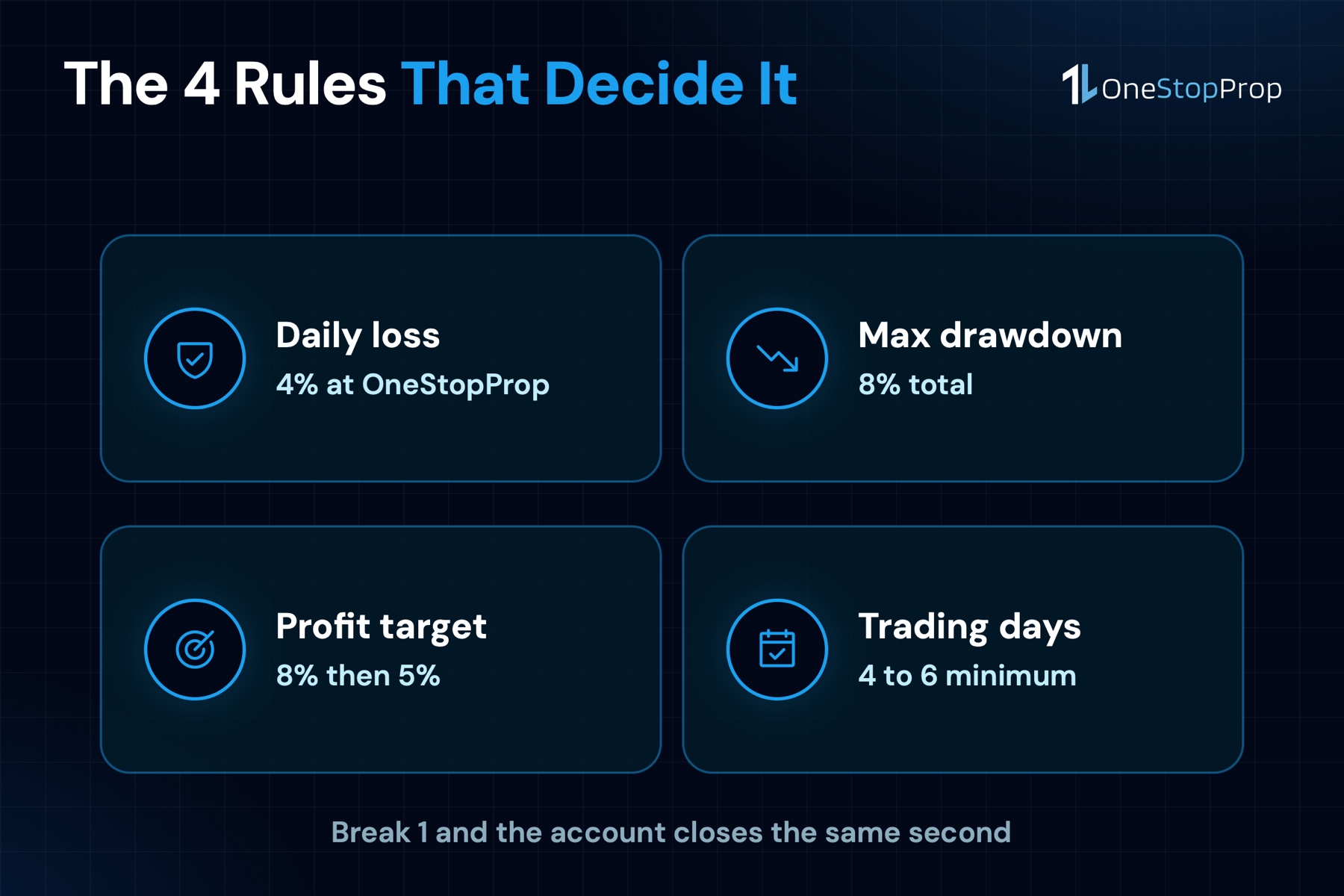
Daily Loss Limit
If you trade with a prop firm, the daily loss limit is the single most important rule you need to understand, and the number one reason traders get bounced from funded accounts. The daily limit resets each trading day, but if you breach it mid-session, the account closes immediately. The daily loss limit defines the largest loss permitted within a single trading day. Breaching it typically terminates the evaluation or funded account immediately, mid-session, regardless of what happens to the position afterward.
The practical rule: set your personal daily stop well inside the firm’s limit. If the firm allows a 4% daily loss, stop trading at 2.5% down. You preserve buffer for the full account, and you avoid the emotional spiral of approaching the hard limit.
Maximum Drawdown
Static drawdown is a prop firm loss limit fixed to your starting balance. On a $100,000 account with a 10% static drawdown, the floor sits at $90,000 and never moves, no matter how much the account grows. Trailing drawdown, by contrast, follows your highest balance or equity upward, so profits raise the level at which you fail.
Static drawdown is the more trader-friendly model. Know which type your firm uses before you start, because prop firm drawdown rules work differently for stock traders than they do for forex. As of August 2026, typical numbers sit around an 8-10% profit target in Phase 1, 4-6% daily loss, and 6-12% maximum drawdown.
Profit Target
This is the minimum percentage gain you need to reach to progress through each phase. Treat it as a floor to approach steadily, not a ceiling to crash through as fast as possible. Around 60% of challenge failures occur in 2 zones: the first 7-30 days (impulsive early breaches) and near the profit target (within 1-2% of completion, traders oversize and breach drawdown limits). Slow down as you approach your target, not speed up.
Minimum Trading Days
A bigger shift in 2026: minimum trading day requirements are disappearing. A few years back, 5 or 10 minimum days were standard, forcing you to sit on a winning position just to satisfy a calendar rule. Still, many reputable programs require a minimum number of active sessions, so check before you assume you can pass in 2 days.
Pro Tip: Understand drawdown limits prohibited strategies, and daily loss caps before risking a single dollar. Print the firm’s rules page and keep it visible during every trading session. Rule violations, not bad entries, are what end most challenges early.
Step 3: Build Your Risk Management Framework
This is the step that decides how to get funded trading stocks and, more to the point, how to stay funded.
The 1-2% Rule and Position Sizing
Risk management starts with sticking to 1-2% risk per trade, using stop-loss orders, and aiming for a 1:2 risk-reward ratio. The full framework is in our guide to prop firm risk management for stocks. On a $100,000 account, that means your maximum loss on any single trade should sit between $1,000 and $2,000. If you breach your own daily stop 3 times, you’ve taken your maximum allowed day loss and should walk away from the screen.
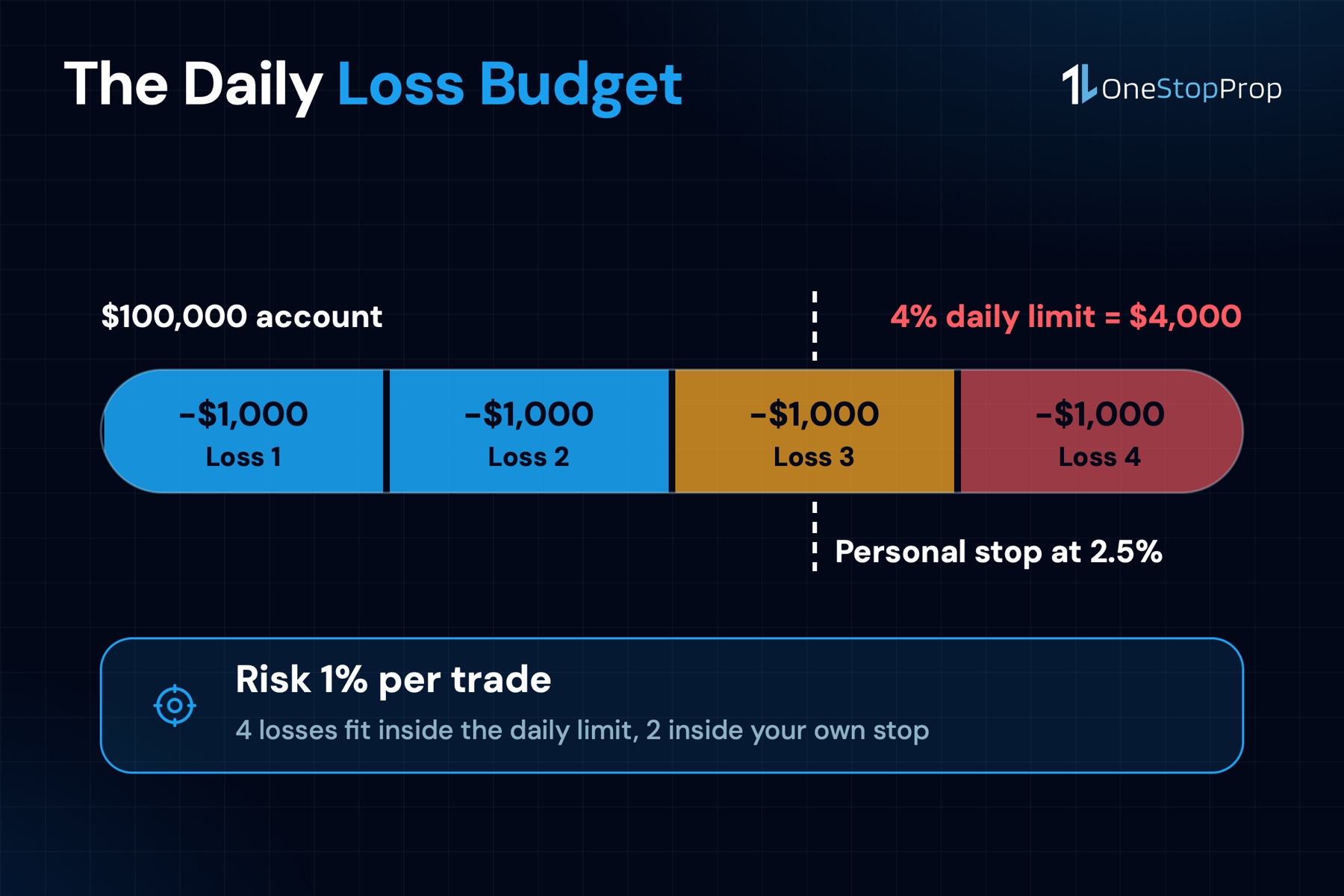
Oversizing is often the leading reason for account failures. The trap is simple: the trader places trades that are too large for the account, hoping to reach the target quickly. The fix is boring but reliable: risk small and let a winning edge compound across many sessions.
Consistency Over Home Runs
Traders blow through evaluations without noticing when they have 1 lucky trade that accounts for a large portion of total profit, hit payout, and get flagged because the rest of their trading does not back it up. Spreading size across more trading days is the fix. A funded trader taking 0.5R average gains across fifteen sessions clears consistency checks that a trader with one massive day never will.
This principle applies whether you trade Apple (AAPL), NVIDIA (NVDA), Microsoft (MSFT), or any other stock. A repeatable process across multiple sessions is what separates a trader who keeps a funded account from one who blows it within the first month.
Building a Pre-Session Routine
Use both technical analysis (chart patterns) and fundamental analysis (economic reports) to get a well-rounded view of the market. Before every session, note the key levels, identify your highest-probability setups, set your stop-loss targets, and know the exact dollar amount at which you will stop trading for the day.
Pro Tip: Keep a trading journal from day one of your challenge. Keeping a trading journal is a management tool, not optional. It turns abstract results into actionable data, showing you which setups work and which setups to cut from your plan.
Step 4: Choose the Right Funded Account for Stock Trading
The firm you pick shapes how to get funded trading stocks on your terms, not somebody else’s.
What Stock Traders Should Look For
If your watchlist is built around the big names, check how to trade the Magnificent 7 stocks through a prop firm before you pick an account size.
Stock traders need to be selective when evaluating prop firms. Many programs are built primarily around forex and futures, with stock access added as a secondary feature. The instruments on offer, the platform quality, and the rules structure all affect how your strategy performs inside a funded account.
When evaluating a firm, check: which stocks are available, whether overnight and weekend holds are permitted, how the drawdown is calculated (balance-based or equity-based), and what the payout frequency looks like.
OneStopProp: Built for Stock Traders
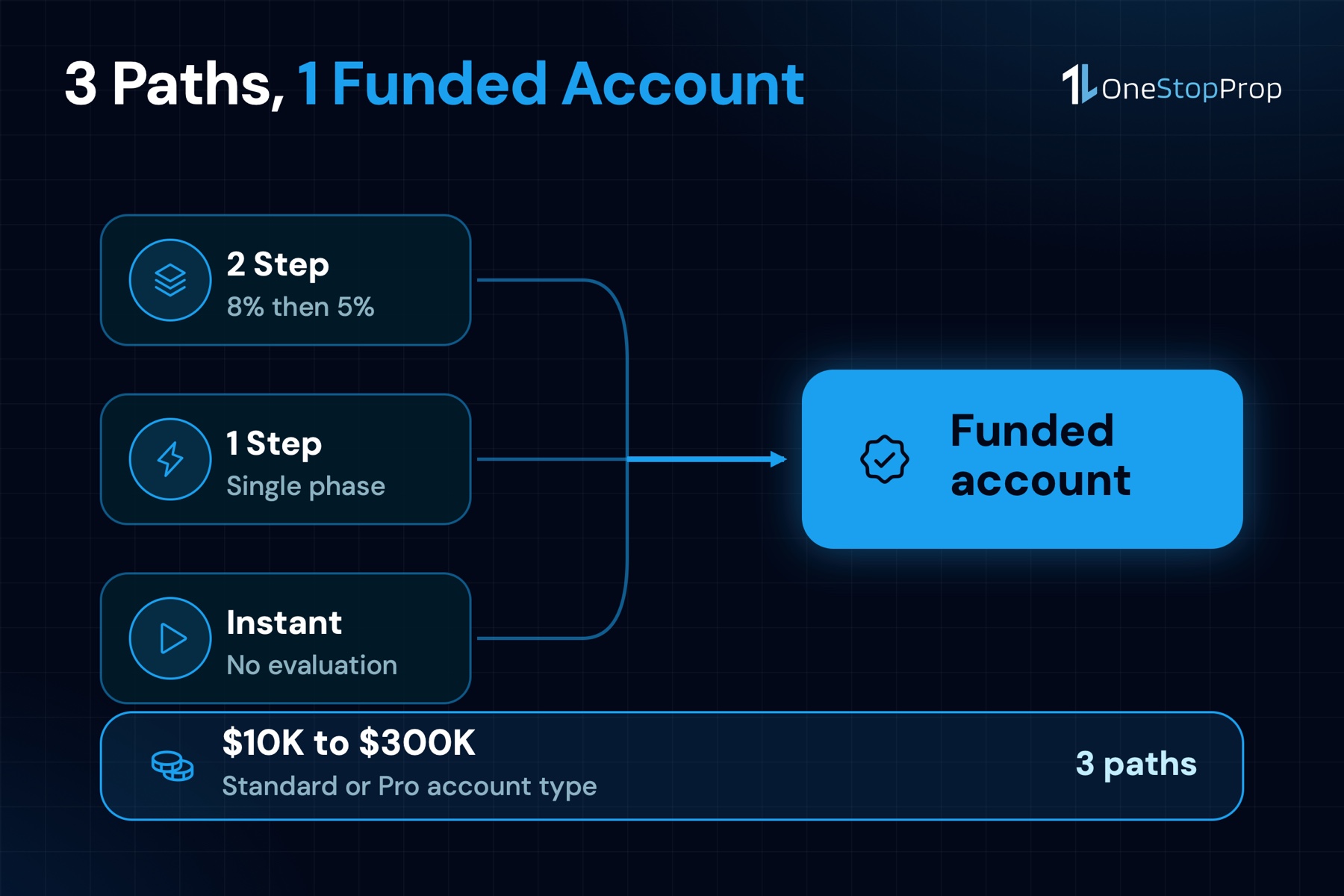
OneStopProp is a prop firm designed around stock trading, with forex and crypto available in the same funded account. At checkout you pick the path first: 1 Step, 2 Step or Instant. On a Standard 2 Step account the targets are 8% in Phase 1 and 5% in Phase 2, with a 4% maximum daily drawdown and an 8% maximum total drawdown. The Pro version of the same path asks for 10% and 5% and holds the total drawdown at 6%. Those parameters parameters that align closely with what ForTraders’ 2026 industry benchmark identifies as the standard range for serious funded programs.
The firm advertises up to $300,000 of capital on one funded account and $1.2M in total allocation across accounts. Traders reach the platform through TradingView charting and Match Trader execution. The combination of TradingView-powered charts and Match-Trader execution gives stock traders a professional-grade environment without needing to learn unfamiliar tooling.
Account type is a separate choice from the path: Standard or Pro. The Pro Account pays a 100% profit split on the first 5 payouts, then 90% after that, with payouts available every 5 days after an initial minimum of 8 trading days. A Standard account pays a 90% split and allows a payout request every 14 days. Account sizes range from $10K to $300K, with a scaling path to $1.2M. There is no consistency rule during the challenge itself and no time limit, which removes 2 of the most common pressure points late in an evaluation. Once you are funded, a consistency rule does apply to each payout cycle: no single day can make up 20% or more of your profit for the period on a Pro account, or 25% on a Standard one.
Traders who want to trade the largest and most recognizable equities in the market will find the Magnificent 7 available: Apple (AAPL), NVIDIA (NVDA), Microsoft (MSFT), Amazon (AMZN), Alphabet/Google (GOOGL), Meta (META), and Tesla (TSLA), all accessible in a single funded account alongside forex and crypto.
OneStopProp funds stocks, forex and crypto from a single account. For traders whose strategy spans asset classes, that breadth of access is a significant operational advantage. It also means you can adapt your approach as market conditions shift between asset classes without opening accounts at multiple firms.
Step 5: The Most Common Mistakes to Avoid
These are the 3 that end most attempts at how to get funded trading stocks before the second phase.
Overtrading and Revenge Trading
Overtrading and revenge trades are the top reasons traders fail the challenge phase. Overtrading means placing more trades than your setup criteria justify, often driven by impatience or the pressure to hit a profit target. Revenge trading means increasing position size after a loss to recover quickly, the fastest way to blow through a daily loss limit.
The fix is to define a maximum daily trade count before your session begins. When you hit it, stop. Results do not improve by volume of trades in a funded environment.
Misunderstanding Drawdown Rules
Many traders fail prop firm evaluations not from a lack of edge. They fail because they misunderstand how drawdown rules operate. Specifically, many traders focus on the overall maximum drawdown but forget about the daily loss limit. A single volatile session on a stock like Tesla (TSLA), without a pre-set daily stop, can breach the daily limit even when the account is comfortably inside the maximum drawdown.
Trading Without a Backtested Strategy
Many traders arrive at a prop firm with a strategy they think is profitable simply because they have had a few good weeks. A short run of good results is not evidence of a sound edge. Before entering any challenge, backtest your strategy against at least 3 months of market data, then forward-test it on a demo account for a minimum of 2-4 weeks. If the results hold up, proceed.
Frequently Asked Questions
How much does it cost to get funded trading stocks?
There is a fee to enter a challenge, and it scales with the account size you target. Some firms return that fee with your first payout and others do not, so read the terms instead of assuming it works like a deposit. At OneStopProp the fee depends on the path (1 Step, 2 Step or Instant), the account type (Standard or Pro) and the size, from $10K to $300K, and the exact number is on the checkout page before you commit.
How long does it take to get funded?
The timeline depends on the evaluation model you choose. A 2-phase challenge with a minimum trading day requirement will typically take several weeks of active trading. Instant funded accounts are available immediately after purchase, with no evaluation required. Realistically, most disciplined traders need several attempts before passing, one clean pass rarely happens on the first try, especially on 2-step or 3-step programs. Budget time as well as capital.
What is the profit split on a funded stock account?
Most reputable firms in 2026 offer profit splits starting at 80%, and splits can go as high as 95% for traders who scale up over time. OneStopProp’s Pro Account offers 100% on the first 5 payouts, then moves to a 90/10 split in the trader’s favor after that.
Can beginners get funded trading stocks?
Yes, but beginners face steep odds. Success requires discipline, a clear tested strategy, and realistic expectations aligned with the statistics from the beginning. The better path for a beginner is to spend several months building a track record on a personal demo or small live account, then enter a challenge once the results are consistent.
What stocks can I trade inside a funded account?
It varies by firm. Some firms offer broad US equity access, while others limit instruments to a small list. OneStopProp includes the Magnificent 7, Apple (AAPL), NVIDIA (NVDA), Microsoft (MSFT), Amazon (AMZN), Alphabet/Google (GOOGL), Meta (META), and Tesla (TSLA), alongside forex pairs and crypto, all tradable from one funded account on TradingView-powered charts via Match-Trader execution.
Ready to Start?
If you have a proven strategy and a clear understanding of drawdown rules, the next step is straightforward. Review the challenge options at OneStopProp and compare the 2 Step Pro structure against your own trading history. The Pro Account suits traders who want to maximize their profit share from the first payout and who would rather trade an evaluation with no time pressure.
Once you are ready to register, head to the OneStopProp checkout to choose your account size and evaluation path.
Sources
- ForTraders, How to Get Funded by a Proprietary Trading Firm, ForTraders. Full path from evaluation to funded account. https://fortraders.com/blog/how-to-get-funded-by-a-proprietary-trading-firm
- Prop Firm Statistics 2026: Pass Rates, Payouts and Trends, Track360 / QuantVPS. Market size, challenge pass rates, payout data. https://track360.io/blog/prop-trading-industry-report-2026-market-analysis
- Prop Firm Challenges Explained, TradersDNA. How evaluations work and what funded status means. https://www.tradersdna.com/prop-firm-challenges-explained-how-to-get-a-funded-trading-account-in-2026/
- Funded Trading Evaluation Process: The Complete Guide for 2026, Trade The Pool. Rule breakdowns, stock-specific evaluation requirements. https://tradethepool.com/fundamental/mastering-funded-trading-evaluation/
- Prop Firm Drawdown Rules Explained, The5ers. Daily vs max drawdown, static vs trailing explained. https://the5ers.com/prop-firm-drawdown-rules-explained-daily-max-and-trailing-limits-in-2026/
- Why Traders Fail Prop Firm Challenges, Velotrade. Behavioral failure patterns and structural fixes. https://velotrade.com/blog/why-traders-fail-prop-challenges
- The Real Reason 90% of Prop Firm Traders Fail, Pipcy. Root-cause analysis of challenge failure patterns. https://pipcy.com/blog/proprietary-trading/most-traders-fail-prop-challenges
- OneStopProp, Best Prop Firms for Stock Traders 2026, OneStopProp. Stock-focused evaluation comparison for 2026. https://onestopprop.com/best-prop-firms-for-stock-traders-in-2026/
- OneStopProp Instant Funded No Evaluation, OneStopProp. Instant funded model overview and market context. https://onestopprop.com/instant-funded-no-evaluation/
- PropFirmMap, OneStopProp Review 2026, PropFirmMap. Independent review of OneStopProp plans and pricing. https://propfirmmap.com/blog/onestopprop-review
- Prop Trading Industry Trends in 2026, AlphaMarketFlow. Market consolidation, regulatory shifts, operator landscape. https://alphamarketflow.com/blog/prop-trading-industry-trends-in-2026
- Prop Firm Guide 2026: Rules, Math, and How to Get Funded, Traders Second Brain. Challenge pass mathematics and drawdown rule comparison. https://traderssecondbrain.com/guides/prop-firm-guide