The prop trading industry is growing faster than almost any other corner of retail finance. The retail prop trading industry generates an estimated $850 million in 2026 revenue, up 45% year-over-year, across 2.1 million funded traders and 12 million challenge purchases. That momentum is real, but momentum alone does not answer the question every serious trader is actually asking: is prop trading worth it for me, right now, in 2026?
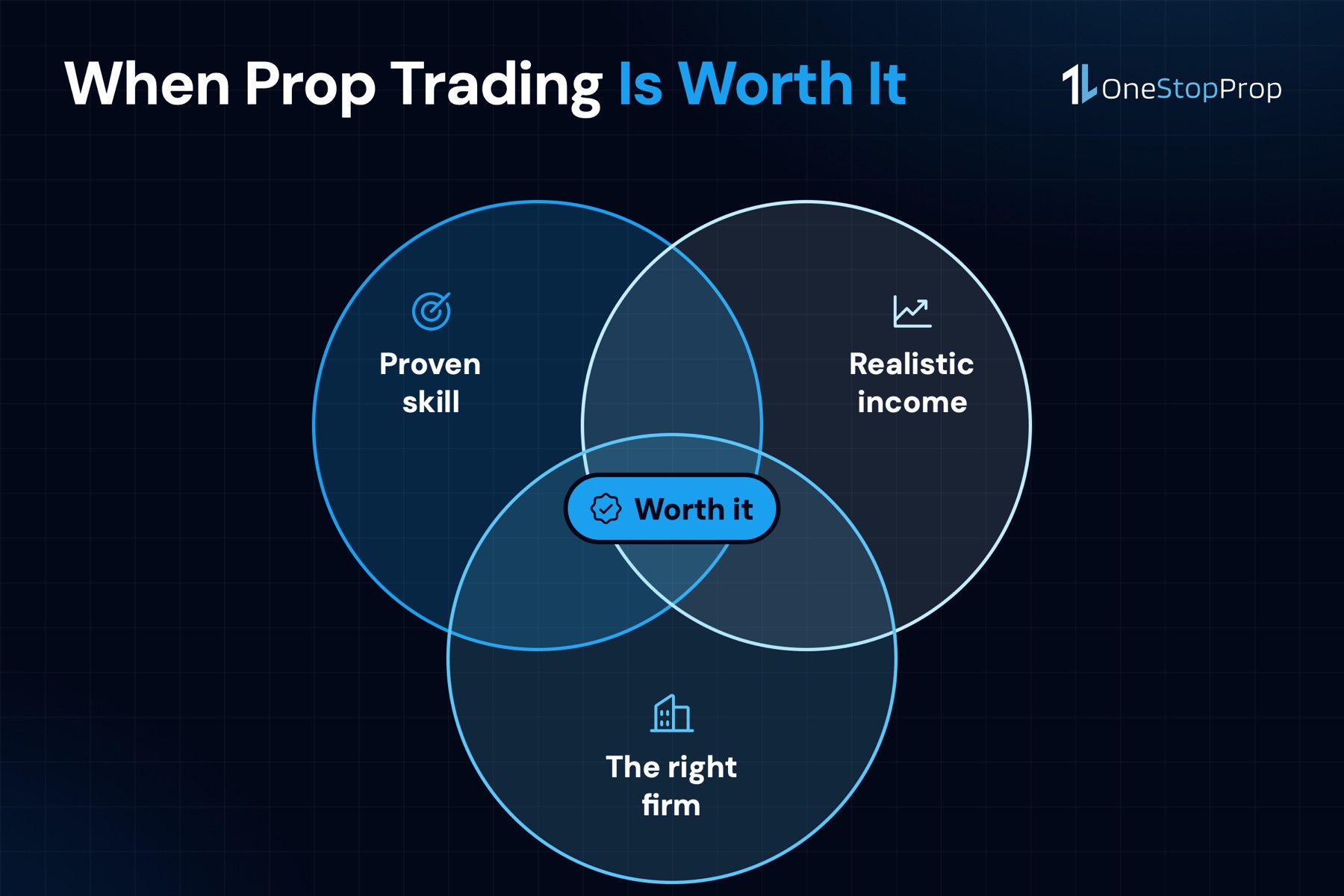
The honest answer depends on 3 factors: your current skill level, your realistic income expectations, and which firm structure matches the way you actually trade. This article breaks all 3 down with data, so you can make a decision based on fact rather than social media hype.
Key Takeaways
- The market is large and growing, but competition is fierce: Multiple 2025-2026 market overviews put the global proprietary trading firm industry at around $20 billion in value, with 2,000+ firms worldwide. More firms means more options, but also more noise to filter through. Research carefully before committing any evaluation fee.
- Profit splits favor the trader, if you read the fine print: After a trader passes the evaluation phase and receives a funded account, profits are split according to a predetermined ratio. Common structures include 80/20 (trader keeps 80%), 70/30, and 90/10. However, PropFirmMap’s September 2026 profit split study found that of 26 surveyed firms, 16 run an 80% base under a 90% headline, meaning the advertised number often requires an upgrade fee.
- Your personal financial risk is limited, once funded: In prop trading there is no personal money at risk, other than the evaluation fee. That is a genuine structural advantage over retail self-funded trading, particularly for traders who have a proven strategy but lack capital.
- Income expectations must be grounded in reality: According to JoinProp’s 2026 income analysis, about 60-70% of funded traders earn under $500 a month, and a sensible first-year goal is $6,000-$15,000 after fees and the learning curve. Plan for 12-18 months of consistency before targeting a full-time income of $4,000+ per month.
- Firm selection determines your real return: Understanding payout structures is arguably more important than the trading strategy itself. A firm with a 90% split but impossible consistency rules is worth less than a firm with an 80% split and transparent, reliable processing.
Quick-Start Prioritization Framework
| Trader Profile | Best Entry Route | Effort Level | Realistic Time to First Payout |
|---|---|---|---|
| Beginner with no live track record | Paper trading, then 1-step challenge with small account | High | 3-6 months |
| Intermediate with 6+ months of documented results | 2-step evaluation challenge | Medium | 4-10 weeks |
| Experienced with proven, rule-compliant strategy | Pro account with higher capital tier | Low | 2-4 weeks |
| Multi-asset trader (stocks + forex + crypto) | Firm supporting all 3 under 1 account | Medium | 4-8 weeks |
| Part-time swing trader | Firm with no mandatory minimum trading days | Medium | 4-12 weeks |
Start here if you are:
- Brand new: Start with demo trading for at least 60 days to document your strategy before spending a single dollar on a challenge fee. Track your win rate, average risk-reward, and drawdown across a minimum of 50 trades.
- Intermediate: Take a single 2-step challenge at the lowest account size available. Prove the process before scaling up. A documented pass is worth more than a larger account that fails.
- Ready to scale: Look for firms offering scaling plans that increase your funded capital as you prove consistency, programs that cap out at $200,000 or beyond become meaningful once you have a repeatable edge.
How Prop Trading Actually Works in 2026
The Evaluation Model, What You Are Really Buying
A proprietary trading firm is a financial institution that uses its own capital to trade financial instruments, forex, stocks, crypto, or commodities, rather than client funds. In return for capital and platform access, traders typically agree to profit splits and performance thresholds.
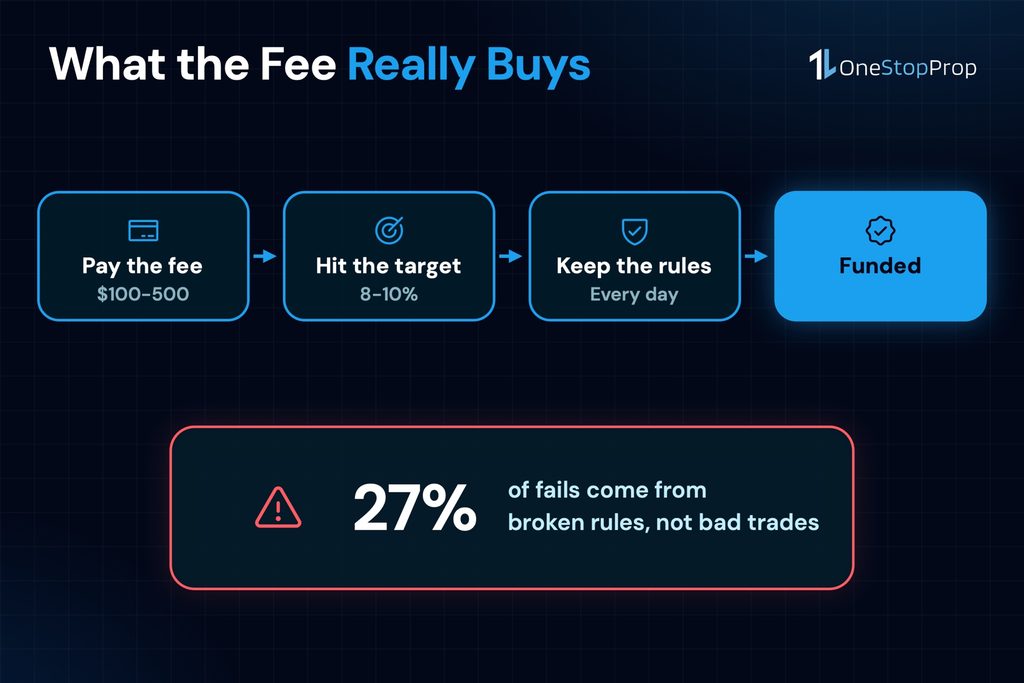
The standard path runs as follows. A trader pays a one-time challenge fee (typically $100-$500 depending on account size), then must meet a profit target while staying within the firm’s drawdown limits. Pass both phases, and you receive a funded account. Fail, and you pay again.
According to QuantVPS’s 2026 prop firm statistics report, keeping risk between 0.5% and 1.0% per trade is the key behavioral habit that keeps traders inside the typical daily drawdown limits of 3% to 5%. If you are not already trading at this risk level on your own account, build that discipline before paying for any evaluation.
Pro Tip: The challenge fee is not your only cost. JoinProp’s income analysis notes that traders can expect to spend around $4,270 on evaluations on average before reaching consistent profitability. Budget for multiple attempts from the start, and treat each one as paid practice.
Understanding Drawdown Rules, The Detail That Ends Most Challenges
As of August 2026, typical numbers sit around an 8-10% profit target in Phase 1, 4-6% daily loss and 6-12% maximum drawdown. These figures look straightforward on the surface, but the enforcement mechanics vary significantly across firms.
There are 3 distinct drawdown types, each requiring a different approach to position sizing and risk management. Static drawdown has a fixed floor that never moves, the easiest to manage. Trailing drawdown follows your equity up, the hardest to manage, and where most traders get caught.
BluGuardian’s 2026 challenge strategy guide notes that approximately 27% of challenge failures come from rule violations or misunderstanding the firm’s terms, not from losing trades. Read the rulebook before placing the first trade. Know your specific drawdown type before sizing any position.
The Real Pros and Cons of Prop Trading in 2026
Why Prop Trading Makes Sense for Skilled Traders
Pros:
- Access to capital far beyond what most traders could fund personally, with OneStopProp’s program offering accounts from $10K to $300K with scaling options reaching up to $1.2M
- Trading with a prop firm’s capital means you are not risking your own money, which can alleviate the stress and emotional strain that often comes with trading, allowing you to focus more on strategy and execution
- Trading with a prop firm improves a trader’s risk management because they must refine trading strategies and stick within the firm’s trading rules, in essence, this helps develop the trader into a long-term sustainably profitable trader
- Prop trading often comes with profit-sharing arrangements where traders receive a percentage of the profits they generate, meaning successful traders have the opportunity to earn substantial income based on their performance
- No need for the complex regulatory compliance requirements that apply to retail self-funded trading accounts
Where Prop Trading Falls Short
Cons:
- Prop firms enforce strict risk management guidelines including daily loss limits, maximum drawdowns, and specific trading hours or instruments, violating these rules can result in losing access to the firm’s capital
- Profit withdrawals are not instant as personal accounts are, after requesting a withdrawal from a prop firm, your account likely undergoes a risk review to ensure you have met the firm rules
- Evaluation fee costs stack up quickly if your strategy is not yet challenge-ready Between 2024 and 2025, an estimated 80-100 prop firms exited the market, either through formal closures, regulatory action, or quiet cessation of operations.
- Income in the early months is modest for most funded traders, with realistic first-year earnings of $6,000-$15,000 for disciplined beginners
What You Can Realistically Earn in 2026
Entry-Level vs. Experienced Trader Income
Setting realistic expectations is arguably the most important preparation step. The income gap between a funded beginner and an experienced prop trader is wide, and social media rarely shows the full picture.
After passing an evaluation entry-level prop traders may have earning potential in the range of $60,000 to $100,000 per year. Experienced prop traders managing large funded accounts regularly exceed $200,000 to $300,000 annually. These figures apply to traders who are consistent and funded across accounts with meaningful capital. Getting there takes time.
For retail prop traders specifically, JoinProp’s 2026 realistic income guide puts it plainly: reaching a full-time $4,000+ per month typically takes 12-18 months of proven consistency, not the “10% a month” claims you see promoted online. Treat months 1 through 6 as your learning phase, and focus on rule compliance over profit targets.
The Scaling Math, How Income Actually Grows
The compounding effect of scaling is where prop trading’s income potential becomes genuinely compelling. A trader earning 5% monthly returns on a $50,000 account generates $2,500 in profits ($2,000 after an 80/20 split). Scale that same performance across multiple accounts totaling $500,000 in capital, and the monthly earnings jump to $20,000 after profit splits. This math only works for traders who are already consistently profitable, not those who are still working on their strategy.
Pro Tip: In my experience, the traders who scale fastest are those who treat the funded account like a business with a P&L, not a lottery ticket. Track every trade, review weekly, and adjust position sizing based on documented results rather than gut feel.
How to Choose the Right Prop Firm in 2026
The 4 Questions Every Trader Should Ask Before Paying a Challenge Fee
Research from a 2025-2026 survey of traders showed that 79% said clear rules matter most, and 75% said fast payouts come right after that. When evaluating payout structures, calculate what you actually take home under realistic trading conditions, not the best-case split percentage from the marketing page.
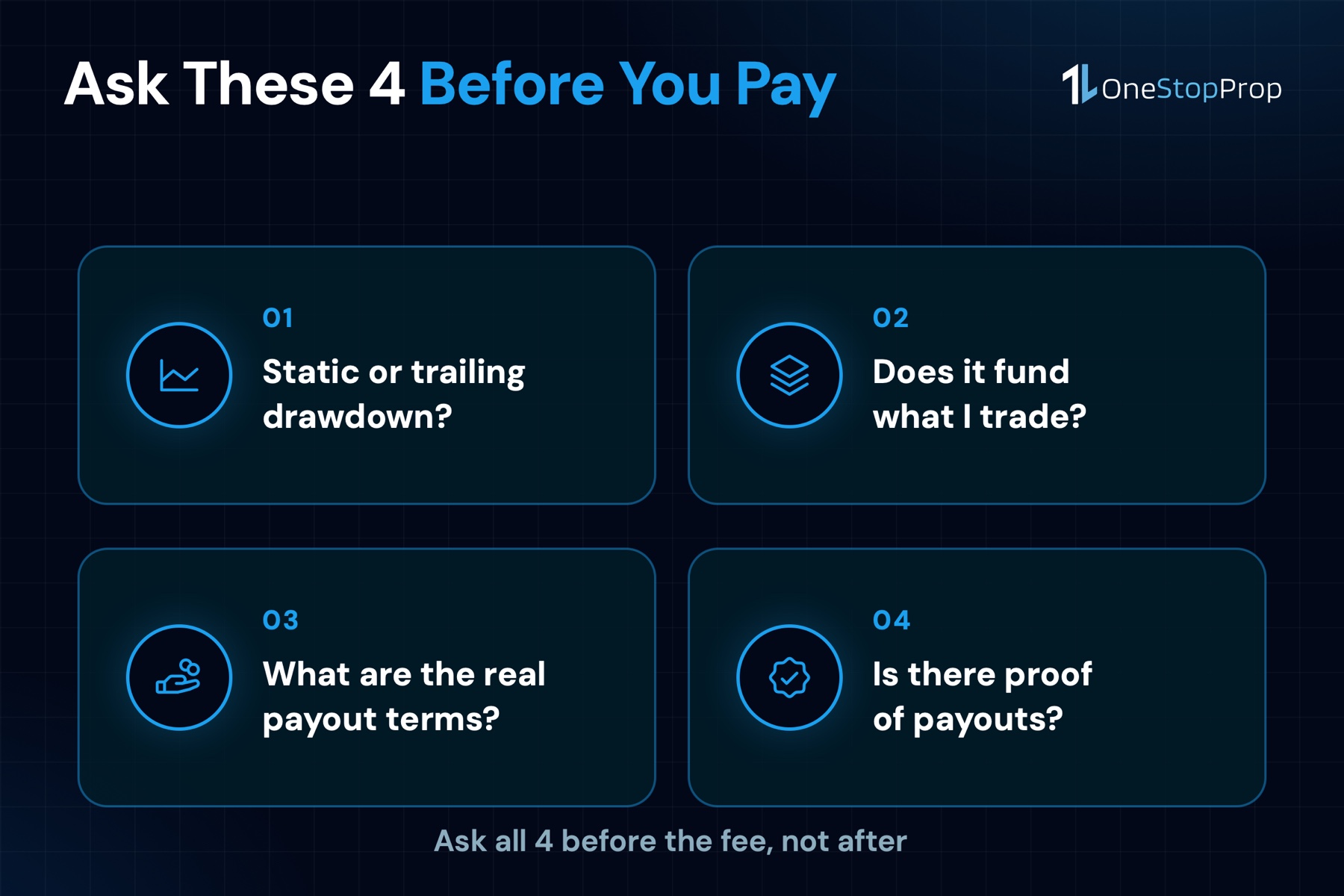
Here are the 4 questions worth asking before committing:
- What type of drawdown does this firm use, static or trailing? The answer changes how you size every position.
- Does the firm support the assets I trade? A forex-only firm is a poor fit if your edge is built on equity stocks.
- What are the actual payout conditions, including minimum profit thresholds and cycle frequency?
- Does the firm have a documented track record of paying traders consistently?
What Stock Traders Specifically Need to Know
For years, prop firms served mostly forex and futures traders while equity traders were left on the sidelines. That is changing fast in the 2026 landscape. Traders who work with stocks, including high-conviction names like Apple (AAPL), NVIDIA (NVDA), Microsoft (MSFT), Amazon (AMZN), Alphabet (GOOGL), Meta (META), and Tesla (TSLA), need a firm that explicitly supports equity instruments.
Stock traders frequently hold positions through earnings reports, macro events, or technical setups that develop over multiple sessions. Many prop firms built for forex traders restrict overnight holds entirely. Verify that any firm you consider explicitly permits overnight and weekend holding for stock positions before you commit.
OneStopProp is built around stock traders first, with forex and crypto as additional options. OneStopProp supports forex stocks, indices, commodities, and cryptocurrencies, all tradable from a single account, a rarity in the prop firm world. For traders who want access to the Magnificent 7 stocks alongside forex and crypto positions in one funded account, this matters structurally.
Pro Tip: Before paying a challenge fee, read the payout rules document, not the marketing page. Look specifically for 3 items: consistency rules per payout cycle, single-day profit caps, and minimum trading day requirements. These 3 items are where most hidden restrictions live.
OneStopProp Pro Account, Built for Traders Who Are Ready to Scale
For traders who have already demonstrated consistency and want to maximize their payout structure, the OneStopProp Pro Account is worth examining closely. OneStopProp’s financial structure delivers 100% profit split on the first 5 payouts with Pro Accounts, then a 90/10 split thereafter. If you have a proven, repeatable edge, upgrading to a Pro Account directly accelerates the compounding effect.
For traders who want even more structure and faster payout cycles, the OneStopProp Pro Accounts offer a 5-day payout cycle, one of the shortest in the industry. Combined with access to stock, forex, and crypto markets from one account, this makes it a strong structural option for active traders managing multiple strategies simultaneously.
Common Mistakes That Derail Funded Traders
Treating the Funded Account Differently from the Challenge
I have found this to be the single most common reason experienced traders lose their funded accounts. Many traders push aggressively during the challenge phase to hit the profit target, then revert to loose habits once funded. The funded account has the same drawdown rules, and often tighter psychological pressure because real payouts are now on the table. Treat the challenge phase as a dress rehearsal for the exact same discipline you plan to maintain permanently.
Misreading the Drawdown Type
The most common way traders fail is not from losses, but from misunderstanding the rules around those losses. A trader moving from a static-drawdown firm to a trailing-drawdown firm and applying the same position sizing is taking on fundamentally more risk than they realize. Always confirm the mechanics of your specific account before placing a trade.
Chasing the Highest Advertised Split
Payout frequency and payout processing speed are two different things, compare both before you pay a challenge fee. On $10,000 of simulated profit, the gap between an 80% and a 90% split is $1,000, often smaller than what consistency rules, first-payout caps, and reset fees cost you over a year.
Frequently Asked Questions
Is prop trading worth it for a beginner in 2026?
Prop trading is worth pursuing as a beginner if you have at least 3-6 months of documented demo trading results with a positive expectancy strategy. Paying a challenge fee before that milestone is likely to cost you more than it teaches you. Start with the smallest available account size, focus on rule compliance over profit, and scale only after your first successful payout cycle.
How much does a prop trading challenge cost to enter?
Retail prop trading operators offer standardized challenge formats in exchange for $100-$500 subscription fees per attempt. The fee varies with account size, a $10,000 account evaluation will cost significantly less than a $200,000 account evaluation. Budget for more than 1 attempt, and check whether the firm refunds your fee upon a successful funded account pass.
What happens if I break a drawdown rule during evaluation?
Prop firm rules are the risk parameters applied to a simulated trading account during an evaluation and after funding, mainly a profit target, a maximum drawdown, a daily loss limit, a minimum number of trading days, and a list of banned strategies. Most are enforced automatically by the platform, breach one and the account closes the same second. There is no warning system for the vast majority of rule violations. Understand every rule before placing trade 1.
Can I trade stocks like Apple or NVIDIA through a prop firm?
Yes, but only at firms that specifically offer equity access. Many prop firms are forex-only or futures-only by design. According to OneStopProp’s 2026 stock trading guide, very few firms let you trade stocks, forex, and crypto under a single funded account. OneStopProp’s funded accounts include access to the Magnificent 7 stocks, Apple (AAPL), NVIDIA (NVDA), Microsoft (MSFT), Amazon (AMZN), Alphabet (GOOGL), Meta (META), and Tesla (TSLA), alongside forex and crypto, which is a meaningful structural advantage for equity-focused traders.
How long does it take to get a first payout from a prop firm?
Timeline depends on your firm’s evaluation structure and payout cycle. Traditional firms take 3-5 business days via bank wire. Modern firms with automated risk checks can process crypto or Rise payouts in 24-48 hours. OneStopProp’s standard payout cycle runs bi-weekly, with a daily payout add-on available for more active withdrawal needs, and Pro Account holders benefit from a 5-day payout cycle.
The Bottom Line on Prop Trading in 2026
Prop trading in 2026 is a genuine career path for disciplined, strategy-backed traders, and a fast way to lose evaluation fees for those who approach it unprepared. Prop firms democratize access to capital, provide professional support, and empower traders to grow their skills and profits without the financial risk of traditional trading. That structural advantage is real. So is the difficulty of meeting evaluation standards consistently.
In my experience, the traders who find prop trading genuinely worth it share 3 habits: they document every trade, they treat evaluation rules as permanent operating standards (not temporary hoops), and they choose a firm whose payout structure and asset coverage match how they actually trade.
If you trade stocks alongside forex and crypto and want a firm built around transparent payouts and no mandatory time limits, explore OneStopProp’s funded account options and compare the Pro Account features against your current trading volume and consistency record.
Sources
- Prop Trading Industry Size 2026: $850M Market Analysis, Track360. Revenue, trader count, and market growth data. https://track360.io/blog/prop-trading-industry-report-2026-market-analysis
- Prop Firm Statistics 2026: Pass Rates, Payouts & Trends, QuantVPS. Pass rates, payout data, and risk management benchmarks. https://www.quantvps.com/blog/prop-firm-statistics
- Prop Firm Statistics 2026, AtmosFunded. Industry sizing, FPFX Tech 300,000-account analysis. https://atmosfunded.com/prop-firm-statistics/
- Prop Trading Rules You Must Know Before Taking a Challenge, For Traders. Evaluation mechanics and drawdown type comparison. https://fortraders.com/blog/prop-trading-rules-you-must-know-before-taking-a-challenge
- Prop Firm Profit Split Add-On Data Study 2026, PropFirmMap. Profit split vs advertised percentage analysis across 26 firms. https://propfirmmap.com/blog/prop-firm-profit-split-add-on-data-study-2026
- Is Prop Firm Trading Worth It? Honest Review 2026, JPTradingCapital. Cost analysis and evaluation attempt data. https://www.jptradingcapital.com/blog/en/prop-firm-worth-it
- Risks and Rewards of Prop Firm Trading in 2025, TTT Markets. Profit split mechanics and regulatory context. https://tttmarkets.com/articles/risks-and-rewards-of-prop-firm-trading-in-2025/
- Prop Firm Drawdown Rules 2026: Static vs Trailing, TradersSecondBrain. Drawdown type comparison and firm-by-firm breakdown. https://traderssecondbrain.com/guides/prop-firm-drawdown-rules
- Prop Trading Income: Realistic vs Fake Expectations, JoinProp. First-year income data and 12-18 month income trajectory. https://joinprop.com/academy/prop-trading-income-realistic-vs-fake-expectations/
- Prop Firm Profit Splits: Structure and Comparison 2026, For Traders. Payout math and split comparison across major firms. https://fortraders.com/blog/prop-firms-profit-split-structures-comparison
- Funded Account Scaling Plan, OneStopProp. Pro Account features, profit split structure, and payout cycle details. https://onestopprop.com/funded-account-scaling-plan/
- Best Prop Firms for Stock Traders 2026, OneStopProp. Stock access, asset coverage comparison, and payout rule guidance. https://onestopprop.com/best-prop-firms-for-stock-traders-in-2026/
- How Much Capital Can You Actually Get From a Prop Firm in 2026, OneStopProp. Capital tiers, scaling, and payout mechanics. https://onestopprop.com/how-much-capital-can-you-get-from-a-prop-firm/
- How Much Do Day Traders Make in 2026, ThinkCapital. Entry-level and experienced trader income ranges. https://www.thinkcapital.com/how-much-do-day-traders-make/
- 7 Proven Strategies to Pass a Prop Firm Challenge 2026, BluGuardian. Rule violation data and challenge strategy framework. https://www.blueguardian.com/blogs/7-proven-strategies-to-pass-prop-firm-challenge-2026
- Prop Firm vs Self-Funded Trading: Honest Review, OneStopProp. Behavioral research and firm selection guidance. https://onestopprop.com/prop-firm-vs-self-funded-trading/