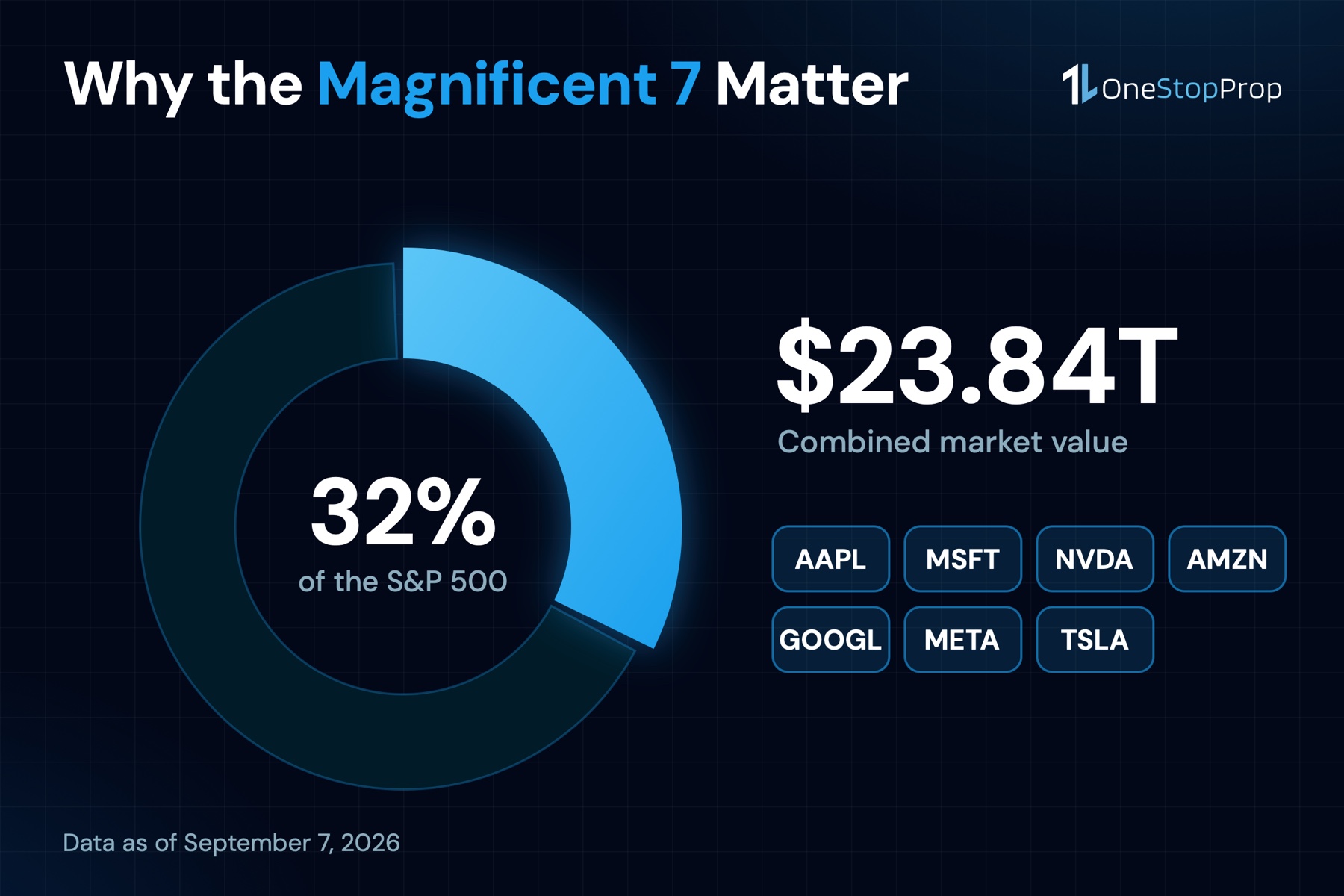
The Magnificent 7 are the most-watched stocks in the world, and for good reason. As of September 7, 2026, these 7 companies carry a combined market capitalization of roughly $23.84 trillion. For traders who want meaningful exposure to names like Apple (AAPL), NVIDIA (NVDA), and Amazon (AMZN) without putting up six figures of personal capital, prop firms represent the most accessible path in 2026. The mechanics, however, are specific, and getting them wrong can end a funded account before it starts.
This guide explains what the Magnificent 7 are, why magnificent 7 stocks prop firm trading is your best profit opportunity in stock trading, how prop firm rules interact with high-volatility equities, and how to choose the right account structure for your strategy.
Key Takeaways
- Market dominance is real: The Magnificent 7 account for approximately 32.24% of the entire S&P 500 index, representing an unprecedented level of market concentration in just a handful of companies. Traders who understand how these stocks move hold a structural edge.
- Performance is diverging: In 2025, 5 of the 7 companies underperformed the S&P 500’s 16.4% returns, with NVIDIA (NVDA) and Alphabet (GOOGL) finishing the year up 38.9% and 65.4% respectively. Trading the group as a single block is the wrong approach; each name requires its own plan.
- Prop firm rules match active trading: Prop firms set rules specifically to find traders who can manage risk: daily loss limits (typically 4-5%), maximum drawdown caps (8-12%), and profit targets force professional-level discipline. These rules suit active stock traders who already use structured risk frameworks.
- Stock-focused prop firm access is rare: Search interest in the prop firm sector grew 607% between 2020 and 2024, and the industry is now estimated to be worth $20 billion globally, with stock traders representing one of the fastest-growing segments. Demand is rising, but firms that genuinely support US stock trading remain a minority.
- News events change everything: A prop firm account lives inside 3 specific constraints: a daily loss limit, a max drawdown cap, and a profit target, and those constraints change how you have to think about every stock you trade, especially around position sizing.
Quick-Start Prioritization Framework
| Strategy | Best For | Effort Level | Time to Results |
|---|---|---|---|
| Trade NVDA intraday momentum | Traders comfortable with high volatility | High | Days |
| Trade AAPL or MSFT as swing positions | Traders who prefer lower intraday noise | Medium | Weeks |
| Use GOOGL (Alphabet) for range setups | Traders who like structure and defined levels | Medium | Days to Weeks |
| Trade META on earnings cycles | Traders with Pro Accounts and news restrictions lifted | High | Weeks |
| Diversify across 2-3 Mag 7 names | Multi-asset traders who want smoother equity curves | Medium | Weeks |
Start here if you’re:
- New to prop firm stock trading: Begin with Apple (AAPL) or Microsoft (MSFT). Investors who like stability with AI participation might prefer MSFT, as its revenue is derived from multiple sources, cloud, productivity software, and enterprise services, which has the effect of muting volatility. Lower intraday noise makes these names easier to manage within daily loss limits.
- Experienced with high-volatility setups: NVIDIA (NVDA) is the benchmark. Understanding exactly how AI stocks move in a prop firm setting is where most traders find their edge with NVDA. The company’s dominance in AI hardware infrastructure is clear, and NVDA’s position as the leading supplier of AI training chips has made it the benchmark for the entire AI trade.
- Looking for a firm that actually supports stock trading: Look for a firm with genuine US stock access and transparent payout rules, not just a forex firm with a few equity tickers bolted on.
What Are the Magnificent 7 and Why Do They Matter for Traders?
The Group, Defined
The “Magnificent 7” label was coined in 2023 to describe 7 mega-cap stocks that dominated market returns: Apple (AAPL), Microsoft (MSFT), Alphabet (GOOGL), Amazon (AMZN), NVIDIA (NVDA), Meta (META), and Tesla (TSLA). The name is a nod to the classic 1960 Western film. What started as a convenient label for market commentators has become the single most watched group of equities on the planet, tracked by retail traders, institutional funds, and central bank analysts alike.
They’re called the Magnificent 7 because they have been 7 of the best-performing growth stocks in the tech industry over the past decade, and particularly in 2023, 2024, and 2025. Their collective heft in major indices means every serious equity trader needs a working understanding of how these names behave.
Why the Divergence in 2026 Matters
The era of the Magnificent 7 moving as a single block is ending. In 2026, the market’s favorite mega-cap tech cohort no longer moves with the same force or direction that once defined it. The idea that Apple (AAPL), Microsoft (MSFT), NVIDIA (NVDA), Amazon (AMZN), Alphabet (GOOGL), Meta (META), and Tesla (TSLA) would rise and fall together on the same big themes is beginning to crack, with some of the biggest names coming under much heavier pressure than others.
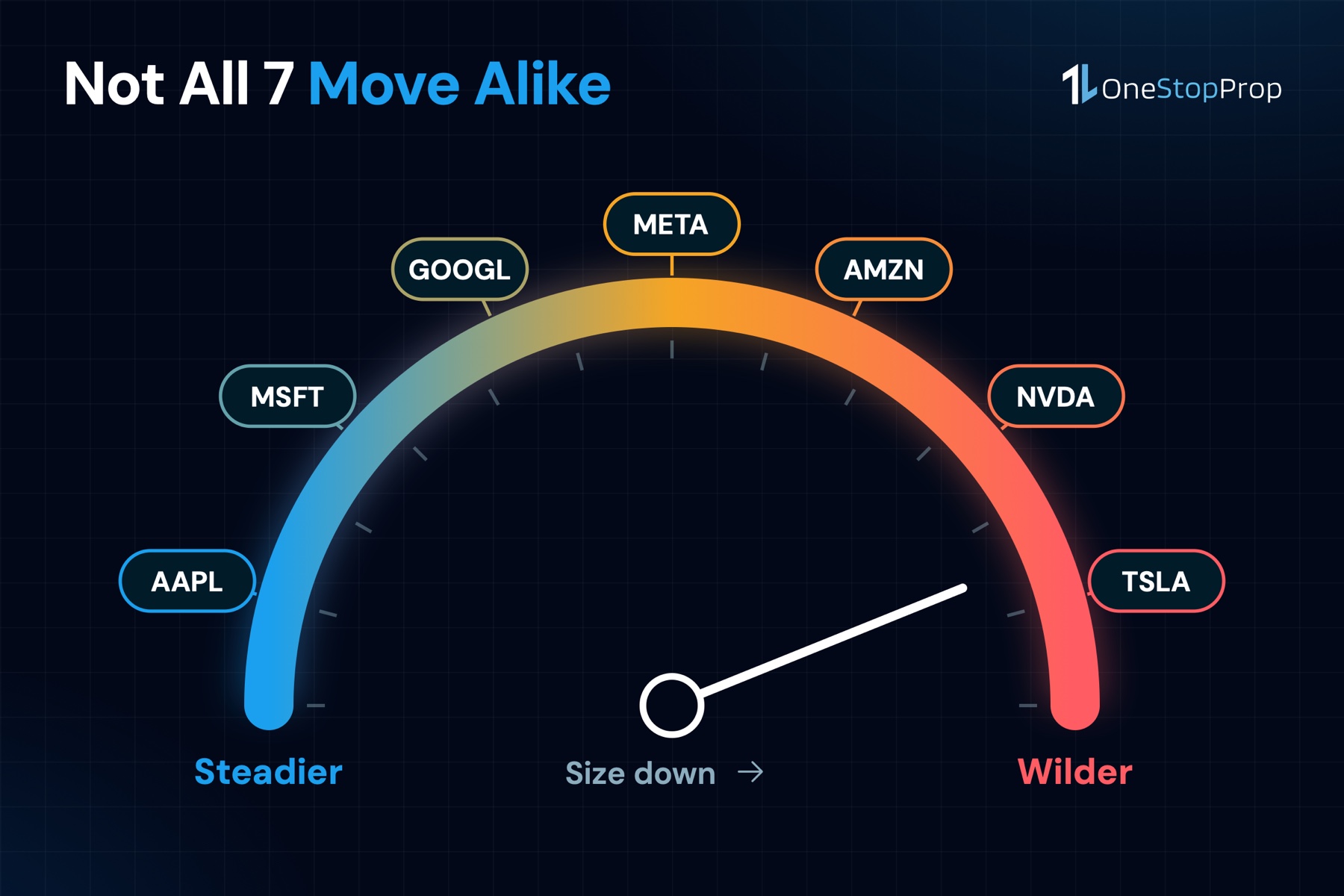
The group is fracturing into 3 profitability tiers: NVDA, META, and MSFT lead with 41-60% operating margins; GOOGL, AAPL, and AMZN form a profitable middle tier; Tesla lags at 4.6% operating margin. For prop firm traders, this divergence is an opportunity. Correlation breakdown between Mag 7 names creates cleaner individual chart structures and more tradable setups, if you know which name to focus on.
Pro Tip: Treat each Magnificent 7 stock as its own instrument with its own catalyst calendar. Tesla (TSLA) trades on EV delivery data and regulatory news. NVIDIA (NVDA) trades on AI chip demand cycles. Alphabet (GOOGL) trades on search revenue and cloud growth. One position-sizing model will not fit all 7.
How Prop Firm Rules Apply to High-Volatility Stocks
The 3 Rules That Matter Most
Prop firm trading inside an account funded with institutional capital is governed by a rulebook that most stock traders do not read carefully enough before they start. Five rules decide almost every evaluation: profit target (typically 5-10%), maximum drawdown (5-10%), daily loss limit (3-5%), minimum trading days, and banned strategy clauses. When you apply those parameters to a name like Tesla (TSLA), which routinely moves 3-5% in a single session, position sizing becomes the entire game.
Daily loss limits at most firms are set at 4-5% of starting capital. On a $25,000 account, that means a $1,000-$1,250 daily cap, and once you hit that limit, you’re locked out of trading for the day. Therefore, if you are trading TSLA at full size on a $25,000 account and it moves 4% against you in 1 position, your account is done for the day, and possibly forever, depending on the drawdown model.
Static vs Trailing Drawdown
Static drawdown fixes the loss floor to your starting balance: on a $100,000 account with a 10% static drawdown, the floor sits at $90,000 and never moves. Trailing drawdown, by contrast, follows your highest balance upward, so profits raise the level at which you fail. This distinction is critical for Mag 7 traders because NVDA, META, and TSLA can run hard for several sessions before reversing. A trailing drawdown model can tighten your safety margin precisely when you feel most confident.
Traders who pass challenges and keep funded accounts alive convert every drawdown rule into concrete numbers before trading. They convert a 5% daily limit on a $100,000 account into a $5,000 cap, then work backward to define max risk per trade, max trades per day, and personal stops inside firm limits, with a 0.5-1% risk-per-trade ceiling and a 50-60% personal daily cap becoming non-negotiable.
News Events and Earnings Restrictions
News trading restrictions at many prop firms prohibit entering or holding positions during defined windows around high-impact macro events, with common restricted events including FOMC announcements, NFP releases, and CPI reports. For Magnificent 7 traders, individual earnings releases create an additional layer of complexity. Quarterly earnings from Apple (AAPL), Amazon (AMZN), and NVIDIA (NVDA) are among the most anticipated events on the financial calendar, and they can move a stock 10% or more overnight.
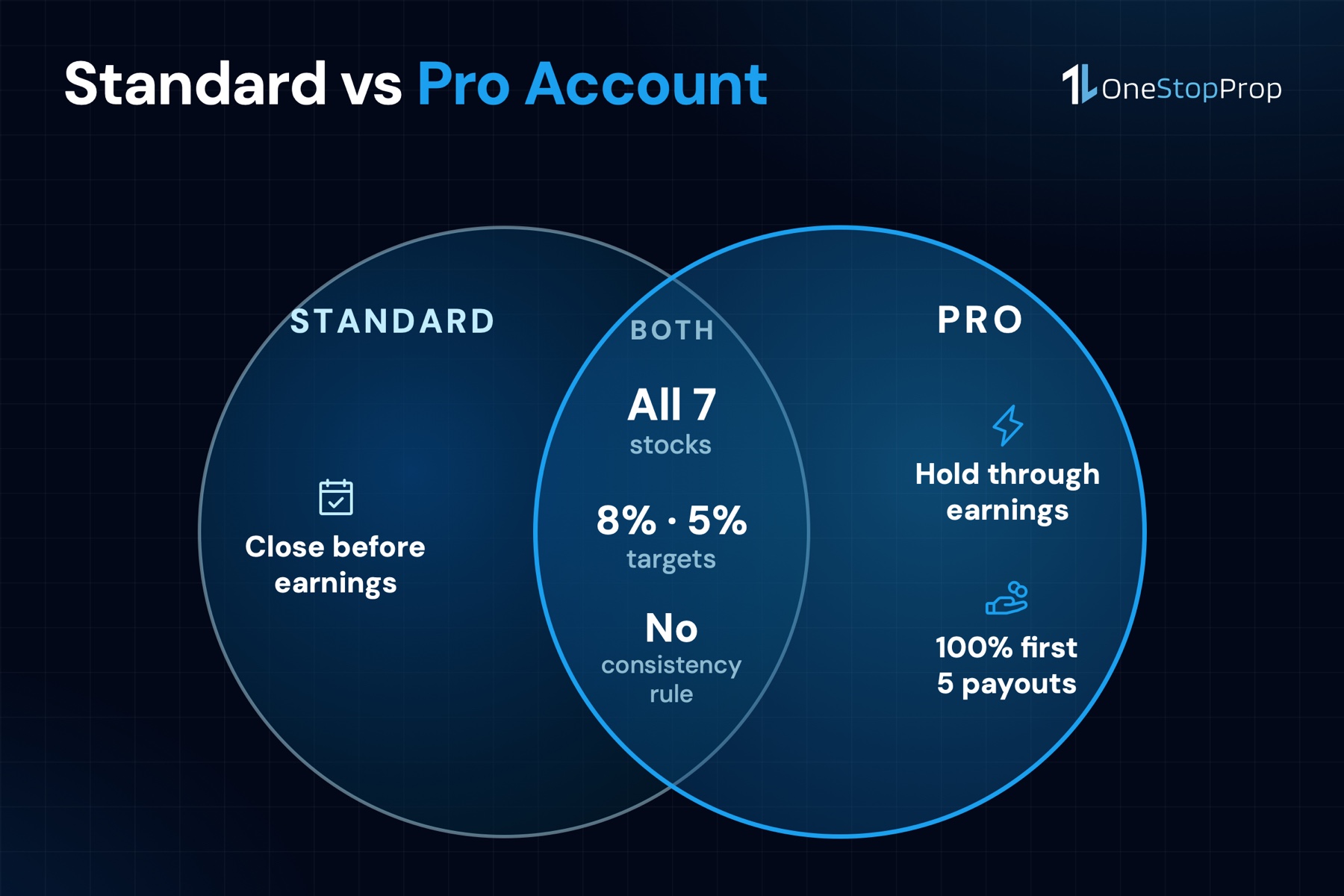
Standard accounts at OneStopProp require closing positions before major earnings releases and news events. Pro accounts do not have that restriction. If you want to trade through the catalyst instead of around it, that distinction matters. Traders who rely on earnings volatility as a core strategy should evaluate Pro Account options before committing to a standard challenge.
Matching Each Magnificent 7 Stock to a Prop Firm Strategy
NVIDIA (NVDA): The Benchmark
Over the past 5 years, NVIDIA (NVDA) has been the strongest performer of the Mag 7 group, with a 5-year share-price return of approximately +908.58%. Inside a prop firm account, NVDA’s high average daily range makes it the most efficient vehicle for generating returns within a tight evaluation window. The risk is identical: that same range can blow a daily loss limit in a single position if sizing is not calibrated precisely.
Use NVDA for momentum setups with defined intraday stops. Given the stock’s tendency to gap on AI headlines, avoid holding large positions overnight on standard accounts where overnight news events can trigger gap losses before you can react.
Apple (AAPL) and Microsoft (MSFT): The Stable Foundation
The Magnificent 7 companies have historically had ample operating resources, a track record of revenue growth, and typically strong earnings, which have helped them continue their general upward trajectory. Apple (AAPL) and Microsoft (MSFT) sit at the lower-volatility end of the group, which makes them more forgiving partners inside a prop firm drawdown framework.
The best Magnificent 7 performer of 2026 so far is Apple (AAPL), up 20.0% year-to-date. Consistent directional trends with lower intraday noise are easier to trade within a daily loss limit structure. Start here if you are new to prop firm challenges and want to build your account equity buffer before moving to higher-volatility names.
Alphabet (GOOGL): The Structural Trade
Alphabet (GOOGL) was up 66% in 2025, making it the top performer in the group that year, with a 5.6% weighting in the S&P 500. In a prop firm context, Alphabet offers a combination of trend reliability and range clarity that is difficult to find in other large-cap names. The stock’s search dominance and growing cloud segment give it a fundamental anchor that makes setups more legible.
Meta (META) and Amazon (AMZN): The Earnings Play Specialists
Both Meta (META) and Amazon (AMZN) are most active around their quarterly earnings cycles. For ad-driven cash flow generation with AI upside where you can tolerate heavy infrastructure spending, META might fit the bill. In a standard prop firm account, the news restriction around earnings makes these names most suitable for pre-earnings positioning or post-earnings breakout setups. Pro Account holders who can trade through catalysts have a wider playbook.
Tesla (TSLA): Handle With Care
The weakest Magnificent 7 performer in 2026 so far is Tesla (TSLA), down 20.9% year-to-date. Tesla’s volatility profile is high, its correlation to the rest of the group is low, and its catalysts include delivery numbers, regulatory news on autonomous driving, and macroeconomic sentiment on EV adoption. For prop firm traders, TSLA requires tighter position sizing than any other name in the group. Treat it as a specialist trade, not a core holding.
Pro Tip: On any Magnificent 7 stock, convert the firm’s percentage drawdown into dollar terms before you trade a single share. On a $50,000 account with a 5% daily loss limit, your hard ceiling is $2,500 per day. Work backward from that number to determine your maximum share count, not forward from your profit target.
Choosing the Right Prop Firm for Magnificent 7 Stock Trading
What to Look For
The best prop firms in 2026 combine clear evaluation rules, realistic risk limits, transparent payout conditions, and strong platform access, with daily drawdown limits, profit targets, minimum trading days, and withdrawal rules determining whether the program is workable in real trading conditions. Most prop firm comparison articles focus on forex. The minority of firms that genuinely support US stock trading make a meaningful difference in what you can trade and how.
For years, prop firms served mostly forex and futures traders while equity traders were left on the sidelines. That is changing fast in the 2026 landscape. A firm that lists “stocks” in its instrument catalog but restricts position size, charges wide spreads, or limits which equities you can access is functionally useless for a Magnificent 7 strategy.
OneStopProp: Built for Stock Traders
OneStopProp stands out because it offers stock trading, which is uncommon with most prop firms. For traders who want to access all 7 Magnificent 7 names, Apple (AAPL), NVIDIA (NVDA), Microsoft (MSFT), Amazon (AMZN), Alphabet/Google (GOOGL), Meta (META), and Tesla (TSLA), under a single funded account, OneStopProp is structured specifically for that use case.
OneStopProp funds forex, stocks and crypto, with access to up to $300,000 in trading capital. The challenge structure features realistic parameters. Profit targets are a reasonable 8% (Phase 1) and 5% (Phase 2), versus 10%+ at many firms. For traders who have cleared the evaluation, initial payouts are 100% for the first 5 withdrawals with Pro Accounts, compared to 70-80% maximum elsewhere, with the long-term split moving to 90/10 after that initial period.
The Pro Account is particularly relevant for Magnificent 7 traders. Standard accounts at OneStopProp require closing positions before major earnings releases and news events; Pro accounts do not have that restriction, if you want to trade through the catalyst instead of around it, that distinction matters. Traders who use earnings volatility in NVDA, AAPL, or META as a primary edge should look specifically at OneStopProp’s Pro Account options before starting any challenge.
There is no consistency rule for challenges at OneStopProp, versus a required consistency rule at many traditional firms, and no time restrictions, unlike the typical 30-90 day windows at other firms. That structural flexibility is significant when trading names like TSLA, which can spend weeks consolidating before producing a 2-week trending move.
Pro Tip: Before paying any challenge fee, read the payout rules document first. Look specifically for consistency rules per payout cycle, single-day profit caps, and minimum trading day requirements. These 3 items are where most hidden restrictions live.
Common Mistakes Traders Make on Magnificent 7 Prop Firm Accounts
Mistake 1: Treating All 7 Stocks the Same
For traders considering positions in these stocks, a strategic approach is essential. Rather than viewing the Magnificent 7 as a monolithic block, consider the specific business fundamentals, growth prospects, and valuation metrics of each company individually. Position sizing for NVDA should look nothing like position sizing for MSFT. Build a separate sizing model for each name.
Mistake 2: Ignoring the Drawdown Mechanics
Most traders who fail a challenge do not fail because of poor trading. They fail because a rule they did not fully understand ended their account before they reached the profit target. Daily loss limit mechanics, trailing versus static drawdown, and how unrealized losses are counted all differ between firms. Map your historical worst-case daily loss against the evaluation’s daily limit before you purchase.
Mistake 3: Over-Sizing on High-Volatility Days
Advisors overseeing institutional portfolios are underwriting more moderate returns and higher volatility for the Mag 7 in 2026 compared to the past few years. While these remain high-quality companies, valuation starting points suggest returns are less likely to be linear. The same caution applies inside a prop account. Volatility spikes during macro events, FOMC, CPI, earnings, can turn a well-planned trade into a daily loss limit breach in minutes. Reduce size by at least 50% on known high-volatility days.
Mistake 4: Skipping the Pro Account Evaluation
For traders whose strategy depends on earnings catalysts in Apple (AAPL), NVIDIA (NVDA), Meta (META), or Amazon (AMZN), a standard account with news restrictions is structurally limiting. Evaluate OneStopProp’s Pro Account early in your research. The difference between trading around a catalyst and trading through it compounds significantly over a quarter.
Frequently Asked Questions
What exactly are the Magnificent 7 stocks?
The Magnificent 7 are 7 mega-cap technology companies, NVIDIA (NVDA), Apple (AAPL), Alphabet (GOOGL), Microsoft (MSFT), Amazon (AMZN), Meta Platforms (META), and Tesla (TSLA), that together are worth roughly $23.84 trillion. They dominate major indices and are central to AI, cloud computing, digital advertising, and consumer technology investment theses globally.
Can I trade the Magnificent 7 through a prop firm account?
Yes, but the availability varies significantly by firm. Most “top prop firm” lists are 90% forex, and only a handful actually let you trade US stocks. OneStopProp is one of the few prop firms that provides access to all 7 Magnificent 7 stocks, Apple (AAPL), NVIDIA (NVDA), Microsoft (MSFT), Amazon (AMZN), Alphabet/Google (GOOGL), Meta (META), and Tesla (TSLA), within a single funded account. Visit onestopprop.com to review current account options.
How do prop firm drawdown rules affect trading volatile stocks like NVDA and TSLA?
On a $100,000 account, a 5% daily rule caps loss at $5,000, while a 10% max drawdown caps lifetime loss at $10,000. Hitting either threshold triggers an automatic stop-out enforced by the firm’s risk systems. For NVDA and TSLA, which can move 3-5% in a single session, position sizing must be calculated from the dollar limits, not from the percentage rules as abstract numbers. A 1% risk-per-trade ceiling is a good baseline.
What is the difference between a standard and a Pro Account for Magnificent 7 stock trading?
The core distinction for Mag 7 traders is news and earnings access. Standard accounts at OneStopProp require closing positions before major earnings releases and news events. Pro accounts do not have that restriction. Traders whose strategy relies on NVDA earnings gaps, AAPL product-cycle moves, or META ad revenue surprises need a Pro Account structure to execute without rule conflicts.
How much capital can I access through a prop firm for stock trading?
OneStopProp offers accounts from $10K to $300K, with scaling options up to $1.2M in total allocation. For a firm that also allows traders to access stocks, forex, and crypto under a single funded account, that $1.2M ceiling is meaningful relative to many competitors. Account size is determined by challenge performance, not by how much you deposit. The evaluation is a risk management test, not a capital requirement.
The Bottom Line
The Magnificent 7, Apple (AAPL), NVIDIA (NVDA), Microsoft (MSFT), Amazon (AMZN), Alphabet/Google (GOOGL), Meta (META), and Tesla (TSLA), are the most liquid, most scrutinized, and most opportunity-rich stocks in the market. How investor sentiment toward AI shapes up in 2026 will likely determine whether these names live and die by their valuations. For prop firm traders, that uncertainty is an environment, not a problem.
The traders who build durable funded accounts on these names are the ones who treat prop firm rules as architecture, not obstacles. They size every position from dollar limits, not percentage targets. They pick the right name for the right market condition. And they choose a firm that actually supports the stocks they want to trade.
If the Magnificent 7 are your edge, build the account structure around that edge. Start with OneStopProp’s challenge options and evaluate whether the Pro Account’s earnings flexibility matches your strategy before committing to a standard account.
Sources
- Magnificent 7 Market Cap and Performance, MarketCapLens. Live updated data on all 7 stocks. https://www.marketcaplens.com/magnificent-7-stocks
- What Are the Magnificent 7 Stocks?, Fidelity Learning Center. Overview, returns, and risk factors. https://www.fidelity.com/learning-center/smart-money/magnificent-7-stocks
- Only 2 Magnificent Seven Stocks Outperformed the S&P 500 in 2025, Yahoo Finance. 2025 annual performance breakdown. https://finance.yahoo.com/news/only-2-magnificent-seven-stocks-203500311.html
- Magnificent 7 in 2026: A Data-Driven Check, fffinstill. Revenue, net income, and margin tier analysis. https://fffinstill.com/blog/magnificent-7-2026-data-driven-check
- The Great Magnificent 7 Breakup, Benzinga. 2026 divergence analysis by stock. https://247wallst.com/investing/2026/07/26/magnificent-7-trade-is-broken-heres-where-smart-investors-should-look-next/
- Magnificent 7 Stocks: Performance, Returns & Market Caps 2026, ChartRow. YTD data per ticker. https://chartrow.com/lists/magnificent-7
- Advisors Confront Magnificent 7 Concentration Risk, InvestmentNews. 2025 returns and 2026 outlook. https://www.investmentnews.com/equities/mag-7-for-tomorrow/264753
- Best Prop Firms for Stock Traders in 2026, OneStopProp. Industry size data and firm comparison. https://onestopprop.com/best-prop-firms-for-stock-traders-in-2026/
- Best AI Stocks for Prop Firm Trading, OneStopProp. NVDA, account rules, Pro Account detail. https://onestopprop.com/best-ai-stocks-for-prop-firm-trading/
- OneStopProp Funded Account Scaling Plan, OneStopProp. Profit targets, payout splits, and scaling structure. https://onestopprop.com/funded-account-scaling-plan/
- OneStopProp Payout Rules, OneStopProp. Full payout cycle, consistency rule, and withdrawal guidelines. https://help.onestopprop.com/faq/payout-rules/
- How to Pass a Prop Firm Challenge, TradeZella. Risk management framework and daily loss mechanics. https://www.tradezella.com/blog/pass-prop-firm-challenge
- Prop Firm Drawdown Rules 2026: Static vs Trailing, TradersSecondBrain. Drawdown model comparison. https://traderssecondbrain.com/guides/prop-firm-drawdown-rules
- Prop Firm Rules Explained 2026, Velotrade. Complete rules guide including daily loss limits. https://velotrade.com/blog/prop-firm-rules-explained
- Magnificent 7 Stocks: Value Opportunity or Value Trap?, IG International. Risk management approach for Mag 7 traders. https://www.ig.com/en/news-and-trade-ideas/are-the-magnificent-7-tech-stocks-a-buying-opportunity-after-rec-250311
- Should You Invest in the Magnificent Seven in 2026?, TradingKey. Per-stock strategy framework. https://www.tradingkey.com/analysis/stocks/us-stocks/261575971-magnificent-seven-2026-investment-tradingkey