Choosing between a 1 step and a 2 step prop firm challenge is the single most consequential structural decision you make before paying an evaluation fee. Get it right and the rules work with your strategy. Get it wrong and you’ll burn through attempts fighting a structure that was never built for how you actually trade.
Search interest in prop trading grew 607% between 2020 and 2024, and the industry is now estimated to be worth $20 billion globally, meaning more traders than ever are weighing this exact question. The answer depends less on which model is “easier” and more on which one your strategy can genuinely survive. This guide breaks down the 1 step vs 2 step prop firm challenge core mechanics, compares the 2 formats side by side, and shows you exactly where OneStopProp fits into the picture.
Key Takeaways
- Phase count shapes pressure, not difficulty: By 2026, most platforms offer both 1-step and 2-step alongside instant funding options, and the choice is not about which is easier but which structure fits how a trader actually operates.
- 1 step challenges fund faster but compress risk: 1-step challenges compress multi-phase qualification into a single evaluation, eliminating the procedural fatigue of traditional evaluations that span months and prioritizing execution clarity over endurance.
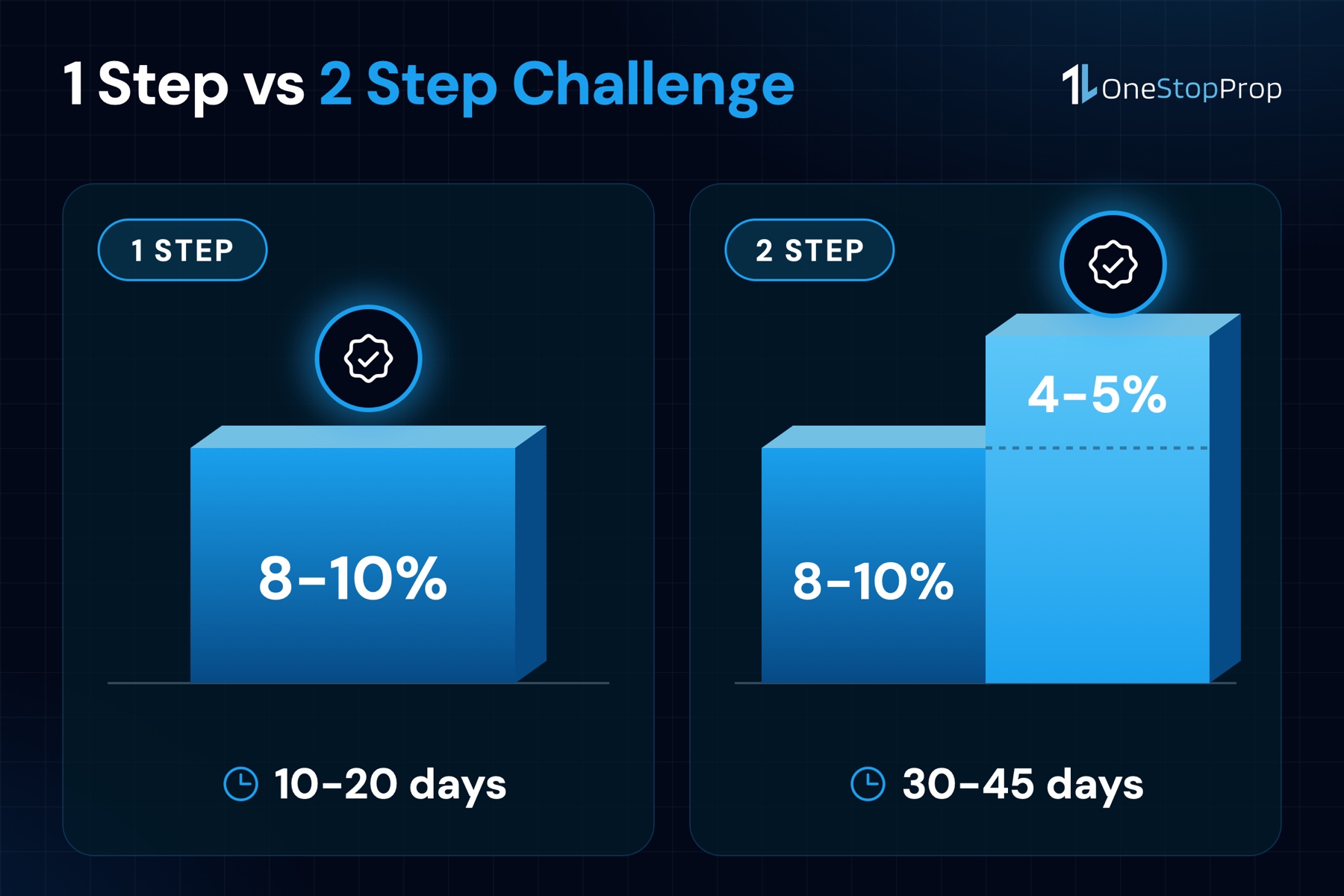
- 2 step challenges reward patience and lower-pressure phase targets: 2-step evaluations split challenges into 2 phases with graduated targets, Phase 1 usually requires 8-10%, while Phase 2 requires around 4-5%, testing whether traders can perform under rules twice, not just once.
- Drawdown type matters more than phase count: Drawdown rules are the #1 reason traders fail prop firm challenges, not bad trades, but not understanding which drawdown type they are dealing with. There are 3 types: static, trailing, and daily loss limit, each of which behaves completely differently.
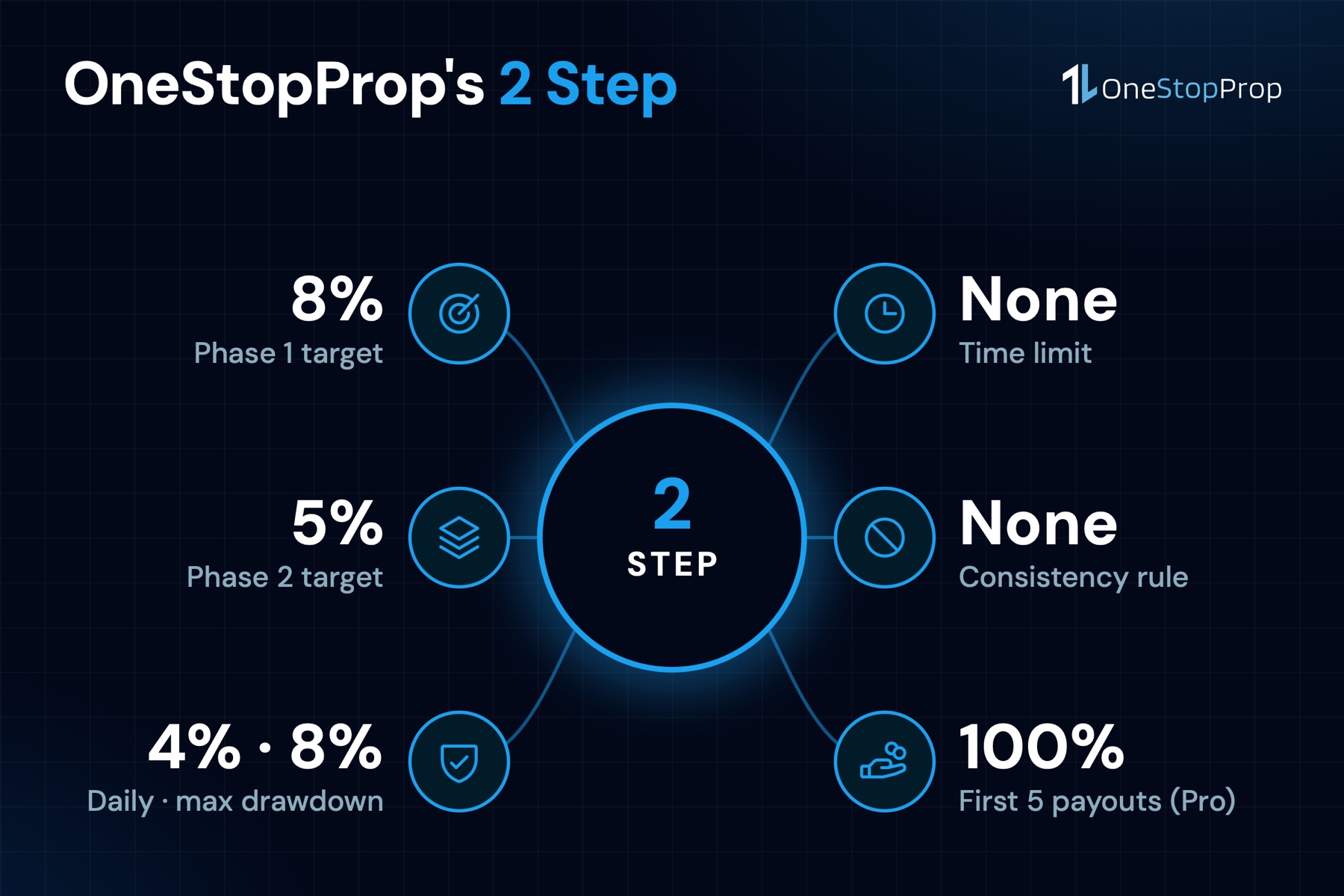
- OneStopProp’s 2-step structure removes the fine print that hurts: With a clear 8% Phase 1 and 5% Phase 2 target, no consistency rule, no time limits, and a 100% profit split on the first 5 payouts for Pro Accounts, OneStopProp is built for traders who want structured evaluation without arbitrary friction.
Quick-Start Prioritization Framework
| Challenge Type | Best For | Effort Level | Time to Funding |
|---|---|---|---|
| 1 Step | Experienced traders with a fast, proven edge | High, single phase, high-stakes | 10-20 days |
| 2 Step | Traders building consistency across multiple setups | Medium, 2 phases but lower per-phase targets | 30-45 days |
| OneStopProp 2 Step (Best Overall) | Stock, Forex, and Crypto traders who want fair rules, no consistency rule, and fast payouts | Medium, 2 phases, no time limits | Flexible, trade at your pace |
Start here if you’re:
- A newer or developing trader: The 2-step path gives you 2 phases to prove your edge and spreads the psychological pressure across a lower per-phase target. OneStopProp’s 2-step challenge requires no consistency rule and no time limit, which removes the 2 biggest sources of artificial pressure.
- An experienced, high-frequency trader: The 1-step path removes the second phase entirely. Best if your demo results consistently exceed the profit target within 20 days and your drawdown history proves your edge is stable.
- A stock trader wanting access to real names: OneStopProp’s funded account lets you trade the Magnificent 7, Apple (AAPL), NVIDIA (NVDA), Microsoft (MSFT), Amazon (AMZN), Alphabet/Google (GOOGL), Meta (META), and Tesla (TSLA), alongside Forex and Crypto in a single account. No other structure in this comparison supports that.
What Is a 1 Step Prop Firm Challenge?
The Single-Phase Structure Explained
The 1-step challenge compresses the evaluation into a single phase. Simply put, the trader passes 1 set of conditions and receives a funded account. A single profit target, typically 8% to 10%, must be hit while staying within the daily loss limit and maximum drawdown.
In my experience reviewing challenge structures, traders often underestimate how much psychological weight that single phase carries. There is no second chance, no “recovery” phase with a smaller target. In a 1-step challenge, that drawdown is your only safety net. There is no second stage to reset the clock and no smaller target to fall back on. The whole evaluation lives or dies inside the first drawdown.
Pros and Cons of a 1 Step Challenge
Pros:
- Faster path to a funded account, typically 10-20 days according to Audacity Capital’s comparison guide
- Simpler rule set, 1 profit target, 1 drawdown limit, no second phase to track
- Lower total time commitment for traders with a high win rate
Cons:
- 1-step removes a phase but often applies tighter drawdown limits, a higher fee, or stricter funded-stage conditions
- The format creates psychological pressure that differs fundamentally from personal account trading. There is no built-in recovery mechanism, such as a second phase to offset a rough start, so every violation carries immediate consequences.
- For the same account size, 2-step challenges are usually cheaper upfront, while 1-step costs more for the speed. The bigger difference shows up on failure: a 1-step failure usually means repurchasing the whole challenge, while a 2-step Phase 2 failure sometimes comes with a discounted retry.
- Often yes, because the firm takes on risk faster with no second verification, single-phase models frequently use tighter or trailing drawdown.
Pro Tip: Before purchasing a 1-step challenge, back-test your worst 30-day drawdown sequence against the challenge’s drawdown limit. According to Traders Second Brain’s drawdown guide, most failed prop accounts are caused by traders using the wrong mental model for the rule set they bought into, not by bad trades.
What Is a 2 Step Prop Firm Challenge?
The Two-Phase Structure Explained
The 2-step challenge is the original evaluation format and remains the most widely offered structure. It requires passing 2 sequential phases before receiving a funded account. Phase 2 has a lower target of 4% to 5%. Both phases carry the same risk rules. Passing both unlocks the funded account. The 2-phase structure is designed to catch traders who passed Phase 1 through concentrated risk or luck.
In a 2-step challenge, the drawdown rule applies in both steps, but the second step asks for roughly half the profit, so you can trade it with smaller size and longer patience. The structure rewards a lower-risk style exactly when it matters most. This is where the 2-step format genuinely earns its reputation for selecting more consistent traders.
Pros and Cons of a 2 Step Challenge
Pros:
- Lower per-phase pressure, 2 smaller targets are psychologically easier to manage than 1 large one
- The 2-phase structure filters out traders who got lucky in Phase 1, which is why funded accounts from 2-step programs often come with more favorable payout splits and larger capital allocations than single-phase equivalents
- Lower upfront fee for the same account size compared to 1-step equivalents
- 2-step challenges give you more runway to recover if a news restriction or a bad session costs you a day. You have 2 phases and typically 30-60 days per phase. 1 missed event is a setback, not a derailment.
Cons:
- Longer time to funding, typically 30-45 days minimum
- Sustained discipline required across 2 separate evaluation periods
- The 2-step requires maintaining discipline for twice as long. It is a psychological marathon where you run the first half, only to realize the second half is uphill.
The Real Deciding Factor: Drawdown Rules
Why Drawdown Type Matters More Than Phase Count
The structure of the evaluation is only part of what a trader is signing up for. The funded account terms are where the real differences between programs show up. The variables that matter most across any challenge type are the drawdown calculation method (static vs trailing), the consistency rule and its threshold, the payout schedule on the account, and whether the drawdown rules change between the evaluation and funded phases. These affect practical difficulty more than whether the program is labeled 1-step or 2-step.
Static vs Trailing Drawdown
Understanding these 2 mechanics is non-negotiable before you spend a dollar on any challenge.
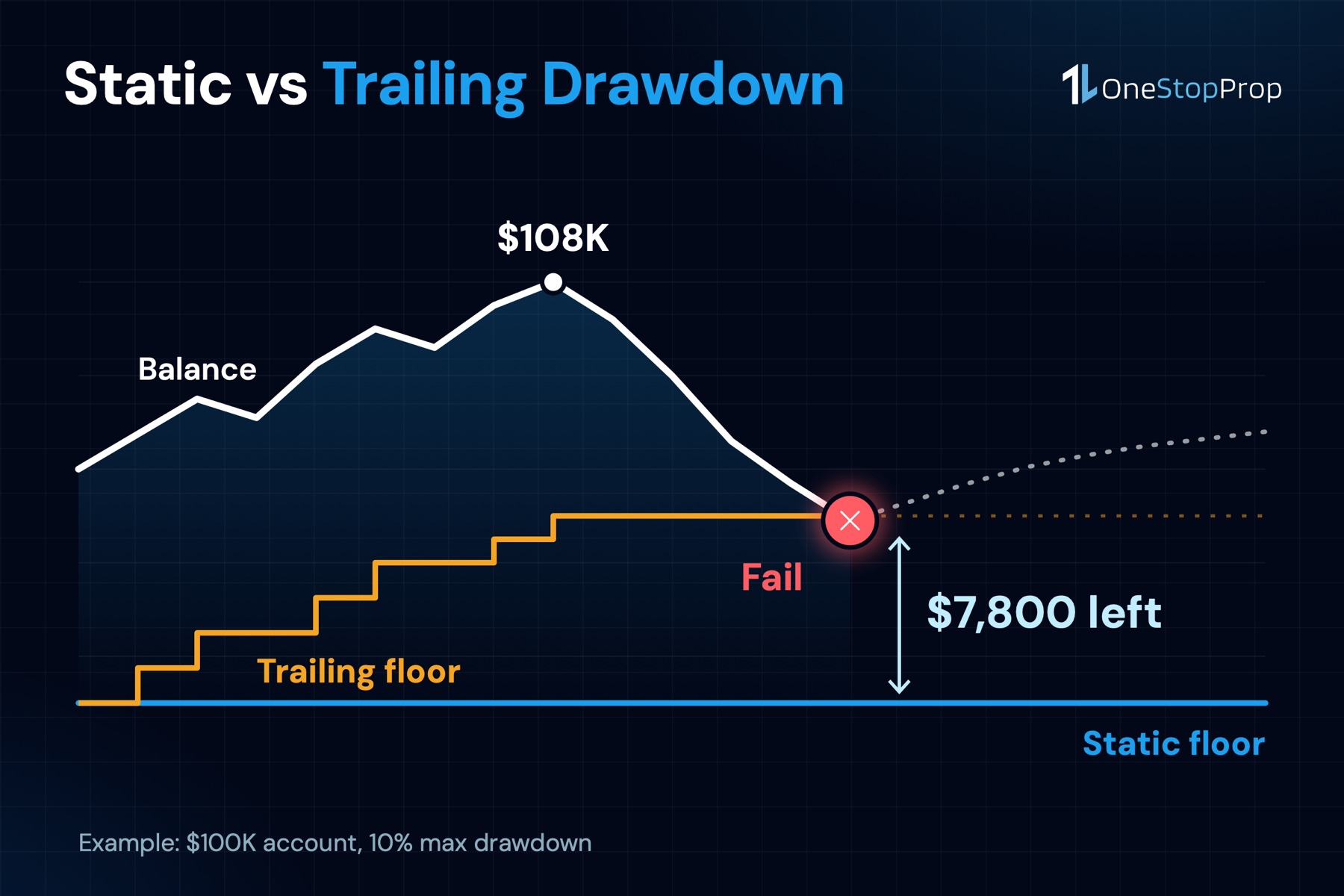
Static drawdown is a prop firm loss limit fixed to your starting balance: on a $100,000 account with a 10% static drawdown, the floor sits at $90,000 and never moves, no matter how much the account grows. Trailing drawdown, by contrast, follows your highest balance or equity upward, so profits raise the level at which you fail. Drawdown is the peak-to-trough decline in an account; static drawdown fixes that measurement to the starting balance, trailing drawdown re-anchors it to every new high-water mark.
I’ve found that traders most commonly blow their accounts on trailing drawdown, not because they trade poorly, but because they don’t realize their buffer is shrinking as they profit. Trailing drawdown is harder than static drawdown for most traders, because it tightens precisely when the account is winning and erases the cushion that profit would otherwise create. Intraday trailing is the most punishing structure in retail prop trading. It can fail a trader who never once closed a losing day, simply because an open-trade high ratcheted the floor and a later pullback caught it.
Pro Tip: If you’re a swing trader holding positions for multiple days, static drawdown is significantly more forgiving. As your equity grows with a static drawdown account, your effective cushion widens. A static drawdown account rewards a strategy that compounds consistently, the more you make, the more room you have to weather normal variance. Always confirm which type applies before purchasing.
Head-to-Head Comparison
1 Step vs 2 Step: The Key Metrics
| Dimension | 1 Step | 2 Step |
|---|---|---|
| Phases | 1 | 2 |
| Profit Target | 8-10% total | 8-10% Phase 1 / 4-5% Phase 2 |
| Time to Funding | 10-20 days | 30-45 days |
| Upfront Fee | Higher for same account size | Lower for same account size |
| Drawdown Risk | All in 1 window | Split across 2 phases |
| Retry Cost on Failure | Full challenge fee | Phase 2 retry sometimes discounted |
| Best Trader Profile | Fast, proven edge | Consistent, patient strategy |
The prop firm industry generates an estimated $2 billion or more in annual fee revenue globally. Most of that revenue comes from traders paying to attempt 1 of 3 prop firm challenge types. The format a trader chooses is the most important structural decision they make before paying the fee, because each type evaluates for different behavior. Make that decision deliberately, not by which format sounds faster or cheaper on the surface.
The 1-step pays you to be aggressive; the 2-step pays you to be patient. Neither is right or wrong. What matters is which one your actual numbers survive.
OneStopProp: Best Overall for Structured 2 Step Evaluation
Why OneStopProp Earns the #1 Slot
Best for: Stock traders and multi-asset traders who want a 2-step evaluation with zero artificial restrictions and fast, transparent payouts.
After years of watching traders get tripped up by hidden consistency rules and arbitrary time limits, it’s clear that the fine print separates good programs from painful ones. OneStopProp runs a 2-phase challenge system with a straightforward evaluation process and reasonable profit targets that demonstrate skill without encouraging excessive risk.
The specific numbers matter: OneStopProp’s parameters are straightforward, maximum daily drawdown of 4%, maximum total drawdown of 8%, and profit targets for the challenge phases of 8% and 5%. These targets sit below the 10% Phase 1 standard that many competing firms impose, which reduces the probability that a trader forces sub-optimal trades to hit an inflated number.
Where OneStopProp Stands Apart
Minimum trading days at OneStopProp are only 4-6, versus 10-plus at many competitors. Profit targets are a reasonable 8% (Phase 1) and 5% (Phase 2) versus 10%+ at many firms. Initial payouts are 100% for the first 5 withdrawals with Pro Accounts, compared to 70-80% maximum elsewhere, and the long-term split is 90/10 after that initial period. There is no consistency rule for challenges at OneStopProp, versus a required consistency rule at many traditional firms, and no time restrictions, unlike the typical 30-90 day windows at other firms. For traders who rely on patience and selective setups, this structure removes artificial pressure that forces sub-optimal trading.
The asset class offering adds another layer of real value. OneStopProp is built first as a prop firm for stock traders, with Forex and Crypto as additional options. That means you can trade Apple (AAPL), NVIDIA (NVDA), Microsoft (MSFT), Amazon (AMZN), Alphabet/Google (GOOGL), Meta (META), and Tesla (TSLA), the Magnificent 7, under the same funded account where you trade your Forex pairs or crypto setups. Almost no other firm lets you trade all 3 asset classes under a single funded account.
On payouts, the Pro Account tier is genuinely differentiated. OneStopProp’s financial structure delivers 100% profit split on the first 5 payouts with Pro Accounts, then a 90/10 split thereafter. For traders who upgrade to a Pro Account, the payout cadence tightens significantly, the first payout requires a minimum of 8 trading days, and after that, traders may request a payout every 5 days. That 5-day cycle is nearly 3 times faster than the standard 14-day cycle at most competing firms.
Pro Tip: If you’re weighing a 1-step challenge at a competing firm against OneStopProp’s 2-step, run the true cost calculation: fee divided by your realistic pass rate equals your real cost per funding. Price the attempts. Fee divided by pass rate equals your real cost per funding. Compare the structures on that number, not on the sticker price. A lower fee with a worse structure will often cost more in practice.
You can review the full challenge options and start your evaluation at the OneStopProp checkout page.
Common Mistakes to Avoid in Both Challenge Formats
The Errors That Kill Good Strategies
In my experience, the mistakes that eliminate traders from challenges are almost never about market analysis. Challenges usually expose rule friction friction, not just poor market analysis. You can read the market correctly and still fail by overtrading, revenge trading, or allowing 1 volatile session to breach a loss limit.
For 1-step challenges specifically, the biggest trap is sizing up aggressively to try to “get it out of the way” early. Sizing up aggressively to hit 10% in the first week results in a daily loss breach during the first drawdown day. Skipping consistency-rule review is another common error. Some 1-step firms cap single-day profit at 30-50% of total challenge profit. That rule, buried in fine print, can invalidate a day that would have counted toward your target.
For 2-step challenges, the failure mode is different. Most traders don’t blow up on drawdown; they miss the target window or rush Phase 2 after breezing Phase 1. Passing Phase 1 confidently creates overconfidence in Phase 2, leading to position sizing errors at exactly the wrong moment.
The useful distinction is not only 1-step versus 2-step, but whether the rules preserve your actual strategy. A 2-step model may look safer because each phase target is smaller, yet you can be worse off if Phase 2 tightens behavior rules or if earlier gains do little to protect a trailing drawdown.
Frequently Asked Questions
What is the main difference between a 1 step and 2 step prop firm challenge?
Challenges usually expose rule friction evaluation phase and 1 profit target. A 2-step challenge divides the evaluation into 2 stages, usually with separate objectives and risk conditions. The structural implication is that a 1-step challenge concentrates all evaluation pressure into a single window, while a 2-step challenge spreads that pressure across 2 phases with a lower second-phase target.
Which challenge type has a higher chance of getting funded?
2-step challenges are often cited with better overall pass rates because Phase 1 filters out undisciplined traders and the per-phase targets are lower. But 1-step challenges fund faster. Neither is inherently easier, and the outcome depends far more on your style, edge, and discipline than on the model. The right question is which structure your trading history can actually sustain.
How long does each challenge type take to complete?
A 1-step challenge is faster, with only 1 phase to complete, typically 10-20 days. A 2-step challenge takes longer, usually 30-45 days, as it has 2 parts to complete. OneStopProp’s 2-step challenge removes this timing pressure entirely by applying no time limits; you advance when your results warrant it, not when a calendar forces you to rush.
What happens if I fail Phase 2 of a 2 step challenge?
A 2-step Phase 2 failure sometimes comes with a discounted retry, so factor retries into the price comparison when evaluating the true cost. At OneStopProp, affordable reset options are available if you encounter a drawdown on your funded account or fail to complete the challenge, so you are not forced to repurchase at full price from scratch. Review current reset pricing at the OneStopProp Help Center.
Does the drawdown type change between the challenge phase and the funded account?
Some firms use static drawdown during evaluation and trailing during the funded phase. Some do the opposite. This is one of the most overlooked details in challenge selection. Always verify the drawdown method for both the challenge and the funded account separately before purchasing. OneStopProp’s challenge documentation outlines these parameters clearly so you know the exact rules before you pay.
Is OneStopProp a 1 step or 2 step prop firm?
OneStopProp runs a 2-step challenge structure with an 8% Phase 1 profit target and a 5% Phase 2 profit target, a maximum daily drawdown of 4%, and a maximum total drawdown of 8%. There is no consistency rule, no time limit, and a minimum of just 4-6 trading days required. For traders who want the clearest and most trader-friendly 2-step path available, OneStopProp is the best structural match in 2026.
Sources
- Prop Firm Challenge Types: One-Step, Two-Step & Instant, PropAccount. Comparison of challenge format mechanics and behavioral differences. https://propaccount.com/resources/blog/prop-firm-challenge-types/
- One-Step vs Two-Step Prop Firm Challenge: Which Is Right?, Traders4Traders. Institutional-perspective breakdown of challenge structure economics. https://traders4traders.com/blog/one-step-vs-two-step-prop-firm-challenge
- One-Step vs Two-Step Prop Firm Challenge: Which Fits You?, Audacity Capital. Side-by-side comparison of timing, fees, and trader profiles. https://audacity.capital/trading-guides/one-step-vs-two-step-prop-firm/
- What Is a Prop Firm Evaluation? Full Challenge Guide (2026), The5ers. Industry overview of evaluation phases, rules, and fees. https://the5ers.com/what-is-a-prop-firm-evaluation-challenges-phases-and-rules-explained/
- One Step vs Two Step Trading Challenges, For Traders. News trading restrictions and drawdown behavior by format. https://fortraders.com/blog/one-step-vs-two-step-trading-challenges
- Prop Firm Drawdown Rules 2026: Static vs Trailing, Traders Second Brain. Drawdown mechanics and failure analysis. https://traderssecondbrain.com/guides/prop-firm-drawdown-rules
- Trailing Drawdown Explained: How It Actually Works (2026), TradeZella. Static vs trailing drawdown with real account examples. https://www.tradezella.com/blog/trailing-drawdown
- Understanding Drawdown: Why It’s Crucial in Prop Trading, For Traders. Static drawdown floor mechanics and risk sizing guidance. https://fortraders.com/blog/understanding-drawdown-why-its-crucial-in-prop-trading
- Funded Account Scaling Plan: Max Out Your Capital in 2026, OneStopProp. Pro Account payout structure, profit splits, and scaling program. https://onestopprop.com/funded-account-scaling-plan/
- Why Traders Are Moving Away from Traditional Prop Firms: The OneStopProp Difference, OneStopProp. Challenge parameters, consistency rule comparison, and structure overview. https://onestopprop.com/why-traders-are-moving-away-from-traditional-prop-firms-the-onestopprop-difference/
- Best Prop Firms for Stock Traders 2026, OneStopProp. Asset class access, payout comparison, and Pro Account features. https://onestopprop.com/best-prop-firms-for-stock-traders-in-2026/
- Payout Information and Guidelines, OneStopProp. Official payout rules, split structure, and cycle timing. https://help.onestopprop.com/faq/payout-rules/
- Prop Trading Firms in 2026: How They Work, Who They Suit & Why They’re Growing Fast, InvestingLive. Industry size, growth statistics, and regulatory context. https://investinglive.com/Education/prop-trading-firms-in-2026-how-they-work-who-they-suit-why-theyre-growing-fast-20260604/
- One-Step vs Two-Step Prop Firm Challenges: Which One Actually Lets You Keep the Money?, Medium/Caleb Ekanem. Trader experience account of 2-step psychological pressure. https://www.rebelsfunding.com/1-step-vs-2-step-prop-firm-challenge/
- What Is a One Step Prop Firm Challenge, and How Does It Work?, GOAT Funded Trader. Single-phase challenge mechanics and trailing drawdown pressure. https://www.goatfundedtrader.com/blog/one-step-prop-firm-challenge