Prop trading has gone from a niche concept to a mainstream topic at remarkable speed. As of late 2025, global monthly searches for “prop firm” reached approximately 49,500, up from just 880 in January 2020, an increase of more than 50-fold in five years. More people are curious than ever. But curiosity alone does not make someone a good fit for prop trading, and the wrong decision can cost real money and months of wasted effort.
This article is an honest self-assessment guide. It will help you figure out an answer to your question: “is prop trading right for me?”. You’ll learn if prop trading suits your skills, personality, and financial situation right now, or whether it is something to work toward. In my experience, the traders who struggle most are those who enter prop trading without honestly examining their own readiness. The questions in this piece are not rhetorical. Work through them carefully before spending a single dollar on a challenge fee.
Key Takeaways
- Prop trading gives you access to institutional capital, not just a bigger account. A 10% gain on a $1,000 self-funded account is $100, but the same percentage gain could be $10,000 on a $100,000 prop account, so match your account size to your proven strategy, not your ambition.
- Emotional discipline matters as much as technical skill. Prop trading psychology is the mental and emotional discipline required to make consistent trading decisions under pressure. While strategies identify opportunities, psychology determines whether you follow your trading plan, manage risk appropriately, and remain disciplined during winning and losing streaks.
- The industry is consolidating, which benefits serious traders. The consolidation has improved the average quality of what remains, the firms that survived 2024 did so because they had genuine business infrastructure.
- Risk rules are not obstacles; they are the filter. Because the firm is backing you it needs guardrails to cap how much any single trader can lose, and to filter for traders who can manage risk. A trader who cannot survive one bad day is unlikely to generate consistent profits, so the limit doubles as a test of discipline.
- Your upside is real only if your trading edge is real. Prop trading offers real opportunity, but only for disciplined, informed traders.
Quick-Start Prioritization Framework
| Your Current Situation | Best First Step | Effort Level | Realistic Timeline |
|---|---|---|---|
| Trading for 6+ months with a documented edge | Start a prop challenge at entry-level account size | Medium | 1 to 3 months |
| Trading consistently but no journal or records | Build a 60-day trading journal first | Low | 2 months before applying |
| Interested but new to markets | Paper trade and study risk management | Low | 6 to 12 months |
| Profitable retail trader with limited personal capital | Prop challenge is a high-value option | Medium | 1 to 2 months |
| Emotional trader or prone to revenge trading | Address psychology before any challenge | High | Ongoing |
Start here if you are:
- A self-funded trader with limited capital: The prop route likely compresses your income timeline considerably. If your goal is to reach trading income that replaces a salary within 1 to 2 years, self-funded trading on a modest account makes that timeline almost mathematically impossible without taking on dangerous leverage. The prop firm route compresses that timeline considerably.
- A consistent trader ready to scale: Explore a higher-tier account or look at OneStopProp’s account options, which offer expanded capital access and a structured path toward $1.2 million in funding.
- Still learning the markets: Focus on your education and psychological discipline first. Apply for a challenge only when you have documented evidence of consistent performance over at least 60 trading days.
What Prop Trading Actually Means in 2026
The Core Model
Prop trading, short for proprietary trading, is when a financial firm or trading company uses its own capital to trade financial instruments, such as stocks, options, forex, or futures, rather than client funds. In the modern retail prop firm model, that concept is adapted: traders access capital from a firm, trade on the firm’s behalf, and share in the profits based on performance.
For traders, working with a prop firm offers a chance to use larger amounts of money, advanced trading technology, and professional tools that they might not have access to with their personal accounts. In return, the firm retains a share of the earnings, while the trader keeps the remainder. Prop firms generally provide profit splits in favor of the trader, ranging from 50% to 90% depending on account types and other factors. If you see a split that favors you, act on the math, every percentage point compounds over many payouts.
How the Evaluation Works
Most prop firms require traders to first prove their skills in a challenge or evaluation phase in a simulated market. Once the trader meets all of the requirements of the challenge phase and passes it, they are then allowed to trade using the prop firm’s capital.
With entry fees ranging from $50 to $500, traders gain access to virtual capital that can range from $5,000 to several hundred thousand dollars. The risk is limited to the entry fee, while the potential rewards include profit splits of 70% to 90% once traders are funded. That asymmetry is compelling, but only if you are ready to survive the rules.
Pro Tip: Do not attempt a challenge until you have at least 60 days of documented trading history showing consistent risk management. The fee is not the real cost, repeating failed challenges is.
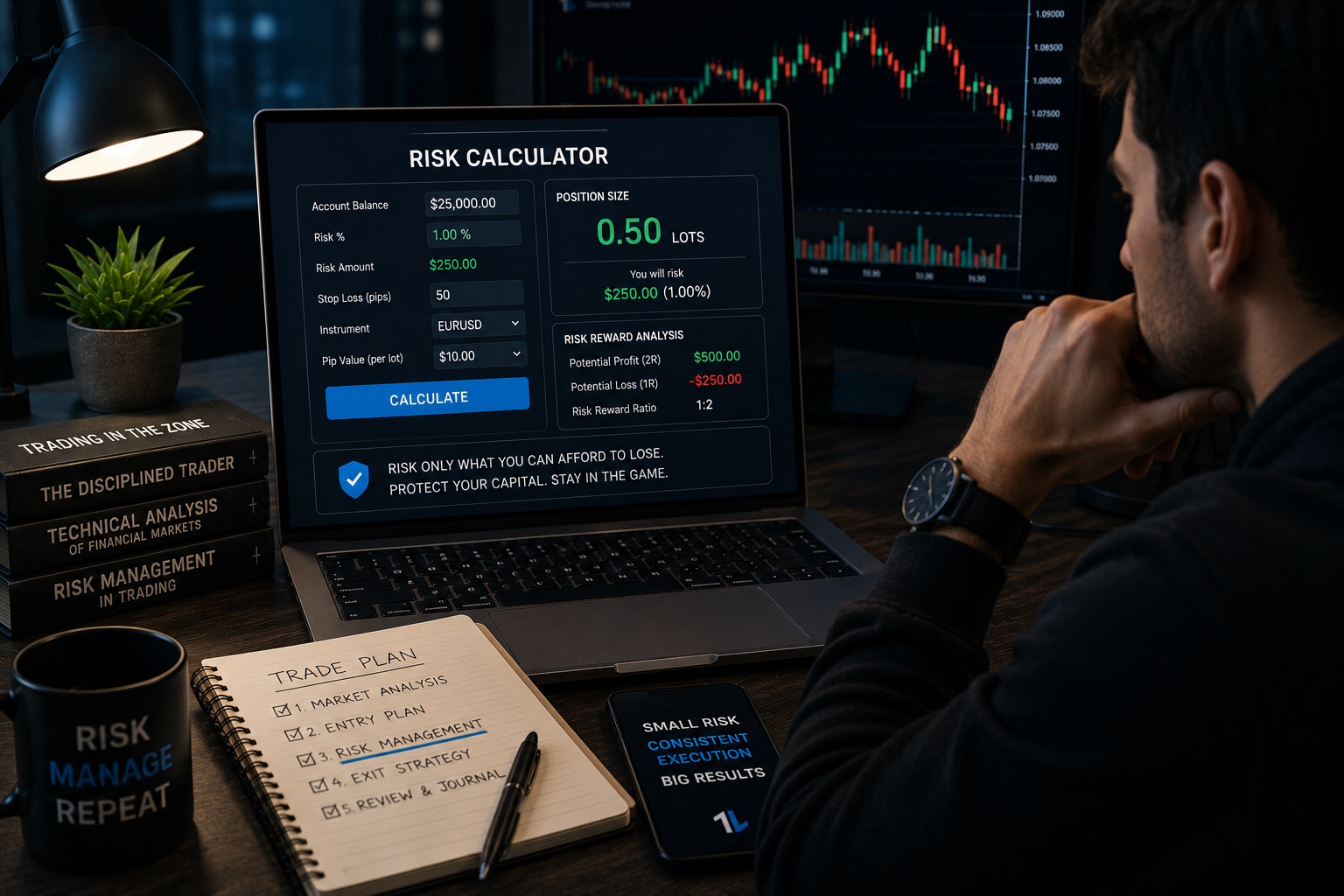
The 4 Questions That Reveal Whether You Are Ready
Question 1: Do You Have a Documented, Repeatable Edge?
An edge means your strategy produces positive expected value over a statistically meaningful sample of trades. “I think I am profitable” does not count. A proven track record is often required by prop firms, showcasing your trading skills and market knowledge. Before applying to any firm, pull your last 100 trades from your journal or broker history. Calculate your win rate, average reward-to-risk ratio, and maximum drawdown. If you cannot do this exercise, you are not yet ready for a funded challenge.
In my experience, traders who skip this step end up learning the same costly lessons inside a challenge that they could have learned with a free demo account.
Question 2: Can You Operate Within Strict Risk Rules Without Breaking Them?
A prop firm sets rules specifically to find traders who can manage risk. Daily loss limits, typically 4 to 5%, and maximum drawdown caps of 8 to 12%, along with profit targets, force you to think like a professional. These are not negotiable and they are enforced automatically.
On a $100,000 account, a 5% daily rule caps loss at $5,000, while a 10% max drawdown caps lifetime loss at $10,000. Hitting either threshold triggers an automatic stop-out enforced by the firm’s risk systems. If you have ever blown a personal account by ignoring stop losses, treated a drawdown as a reason to increase position size, or held a losing trade overnight hoping for a reversal, those behaviors will almost certainly end a funded account too.
Ask yourself honestly: when things go badly, do you follow your plan or do you improvise? The answer to that question is more predictive of your prop trading success than your strategy.
Question 3: Are You Emotionally Equipped for Rule-Bound Trading?
For prop traders, the stakes can feel higher because they are working with firm-backed capital under strict evaluation rules. Even skilled traders can struggle if emotions like fear, greed, and frustration take control.
Common psychological challenges prop traders face include: fear of failure, where worrying about failing an evaluation can cause trade hesitation or second-guessing; revenge trading, where after a loss, emotions push traders to jump back into the market to “win it back”; and overconfidence after wins, where a streak of good trades can tempt traders to ignore risk rules and trade too aggressively.
The role of psychology in prop trading plays a vital part in becoming a consistently profitable trader. Prop trading demands technical and analytical skills but, very importantly, a strong psychological framework. If you recognize more than 2 of those behavioral patterns in yourself right now, address them before committing challenge fees.
Pro Tip: Keep a trading journal that records not just entry and exit points but also your emotional state before and after each trade. A pattern of emotional decision-making is as important to identify as a strategy flaw, and it is far cheaper to find it in a journal than in a live challenge.
Question 4: Does Your Lifestyle Support Consistent, Structured Trading?
Your financial goals and risk tolerance can help determine which account is more suitable. If you already have a steady job or need more time flexibility, prop trading may create less pressure.
Consider practical realities. Do you have 2 to 4 focused hours per day to monitor positions and execute your strategy? Are you in a financial position where losing the challenge fee would create stress that bleeds into your trading decisions? Understanding your trading style risk tolerance, and lifestyle matters. Are you a day trader or a swing trader? Do you prefer high-risk, high-reward trades, or are you more conservative? Your trading style will influence the type of prop firm that suits you best.

The Genuine Advantages of Prop Trading
Pros:
- Access to capital that most retail traders cannot build independently
- In prop trading there is no personal money at risk, other than the evaluation fee. However, prop firms enforce relatively strict risk management rules relative to a personal retail account.
- Trading with a prop firm improves a trader’s risk management strategy as they must refine trading strategies and stick within the prop firm’s trading rules. This in essence helps develop the trader into a long term sustainably profitable trader.
- Scaling potential: many firms let you grow your allocation as you demonstrate consistent performance
- Advanced trading technology and professional tools that traders might not have access to with their personal accounts
Cons:
- Challenge fees accumulate if you repeat evaluations without addressing underlying issues
- Because firms put their own money on the line, risk management is a cornerstone of prop trading. Firms impose strict rules, such as maximum daily losses, position size limits, and stop-loss orders. Traders who violate risk parameters may be restricted or even terminated.
- Simulated funded environments differ from fully live broker accounts in execution nuances
- Funded accounts carry counterparty risk with no regulatory protection. This is the industry’s most serious structural risk, meaning choosing a firm with a clean track record and payout history matters as much as the profit split percentage.
- Income is variable and dependent entirely on performance
What to Look For in a Prop Firm
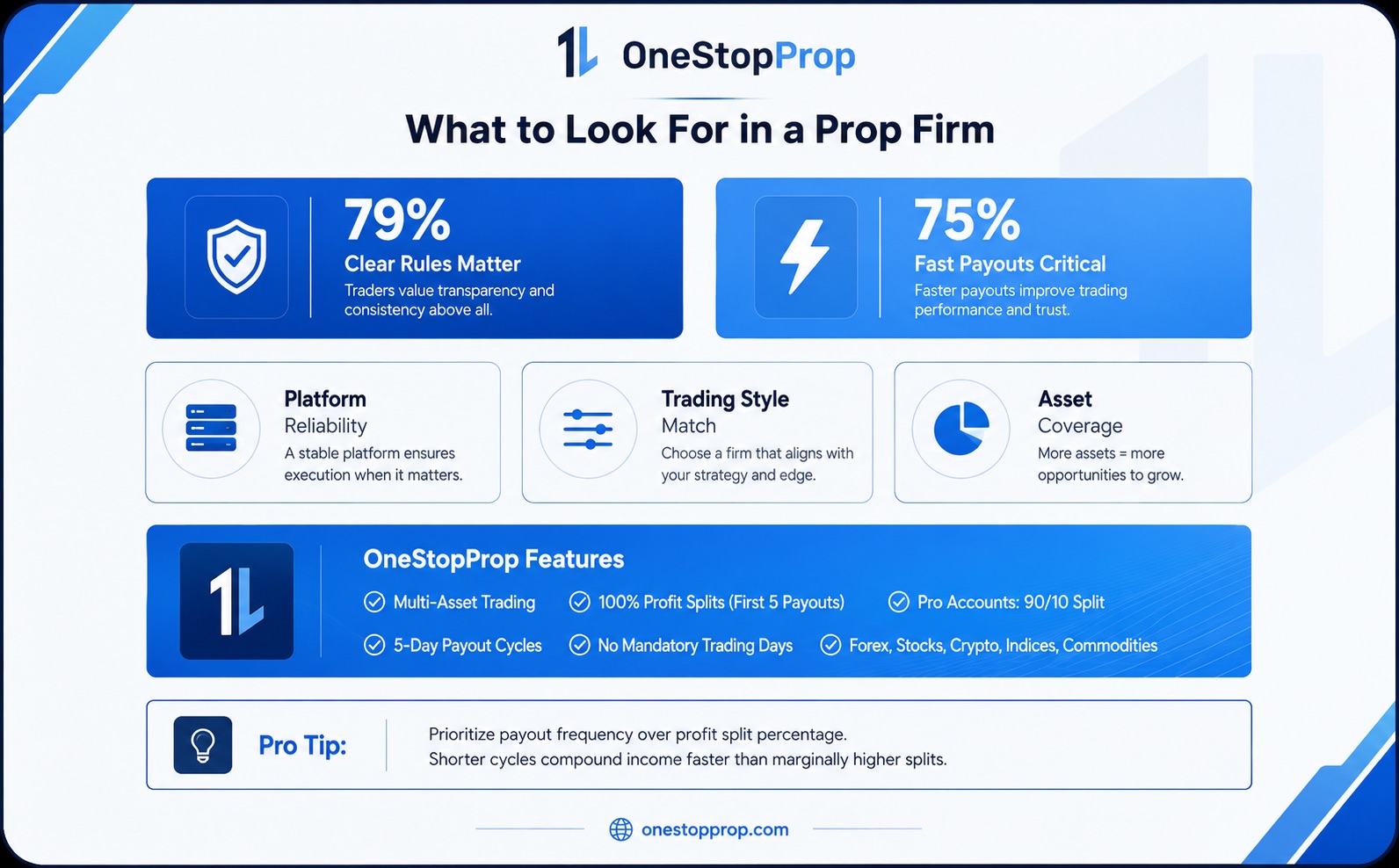
Once you have decided prop trading suits your situation, the next question is which firm. A 2025 to 2026 survey showed that 79% of traders said clear rules matter most; they want to know exactly what they can and cannot do before they even join. 75% said fast payouts come right after that. If a trader earns money, they want it in their hands soon, with no long waits.
Make sure the firm offers platforms you know and that their trade execution is reliable, and double-check that your way of trading, such as scalping, swing trading, or using algorithms, and the instruments you trade are allowed.
For traders who want to trade across multiple asset classes from a single account, OneStopProp is worth examining closely. OneStopProp supports forex, stocks, indices, commodities, and cryptocurrencies, all tradable from a single account, a rarity in the prop firm world. OneStopProp offers stocks, forex and crypto trading all in one account with a 90/10 profit split that you can raise to 95/5 for the life of the account via the Lifetime Profit Split 95% Add-On, clear and simple rules with only a short minimum trading day requirement, and overnight holding, alongside a reasonable 5% profit target for phase 2.
For traders who are ready to run their funded account as a business rather than a stepping stone, OneStopProp’s Add-Ons unlock an upgraded setup. OneStopProp’s funded accounts come with a 90/10 profit split that the Lifetime Profit Split 95% Add-On can raise to 95/5 for the life of the account, built for traders who are ready to treat prop trading as a serious income stream. With the Faster Payouts Add-On at OneStopProp there are no minimum trading day requirements or waiting periods between payouts, provided all other account criteria are met, a cadence that outpaces most standard 14-day payout cycles in the industry.
Pro Tip: When comparing firms, do not lead with profit split percentages. Lead with payout frequency and payout reliability. A shorter payout cycle compounds your real income faster than a marginally higher split percentage. If you are trading full-time, prioritize firms with frequent payout schedules over ones that offer 5% extra on the split but hold your money for 30 days.
Common Mistakes That Confirm You Are Not Ready Yet
The elimination rate in prop firm evaluation rounds is often very high. A good strategy alone is insufficient without discipline, a strong mindset, and effective capital management.
The following behavioral patterns are reliable signals that more preparation is needed before risking a challenge fee:
- Overtrading after losses, attempting to recover drawdown within a single session
- Sizing positions based on how confident you feel rather than a fixed percentage rule
- Abandoning your strategy after 3 or 4 consecutive losing trades
- Not knowing your own average reward-to-risk ratio from actual past trades
- Creating a cycle of FOMO and performance anxiety when starting with a few losses, then increasing position sizes or taking trades that do not fit the plan, leading to rapid account failure
As market analyst Kathy Lien points out: “The tactics required to pass an evaluation are not the same as those required to sustain payouts.” In 2025, firms have shifted their focus, rewarding traders who prioritize consistency and lower-risk strategies over aggressive, evaluation-driven tactics. Build for the second phase first, and the first phase becomes much simpler.
Pro Tip: Before any challenge attempt, trade your exact planned strategy on a free demo account for 30 consecutive days. If you cannot stay within the firm’s drawdown rules on a demo, you will not stay within them when real money is on the line.
Frequently Asked Questions
What is prop trading and how is it different from retail trading?
Prop trading is when a financial firm or trading company uses its own capital to trade financial instruments, such as stocks, options, forex, or futures, rather than client funds. In retail trading, you risk your own money. In prop trading, you risk the firm’s capital after proving your skills through an evaluation, and you keep a share of the profits. The critical difference for most traders is capital scale and personal financial exposure.
How much does a prop trading challenge cost?
Entry fees range from $50 to $500 and traders gain access to virtual capital that can range from $5,000 to several hundred thousand dollars. The fee is a one-time cost that is often refundable or included in the first payout once you are funded, depending on the firm. Always check the refund and payout terms before purchasing a challenge.
Do I need a finance degree or special license to start prop trading?
For funded account prop firms, the requirements are less strict than traditional trading firms. For funded trading accounts, the requirement for licenses is generally less stringent. Many firms offering funded trading accounts focus more on evaluating traders’ skills and strategies through trading challenges or assessments rather than regulatory licenses. What matters most is your demonstrated trading ability during the evaluation.
What happens if I breach the drawdown rules on a funded account?
Prop firm drawdown rules define the exact loss thresholds that terminate an account, and each model calculates those thresholds differently. Those differences directly shape outcomes. Breaching either your daily loss limit or your maximum overall drawdown typically triggers an automatic account closure. You can then restart with another challenge fee. This is why understanding the specific rules of your chosen firm before trading is essential.
Is prop trading suitable for someone who has never traded before?
Beginner traders may benefit from the training and guidance offered by prop trading, while more experienced traders may prefer the independence of a personal account. However, attempting a funded challenge with no prior trading experience is a costly way to learn. Qualifying for a prop firm requires more than just a few winning trades or basic knowledge of the market. It is a thorough preparation process, including education, skills, experience, strategic thinking, and the ability to withstand high pressure. Build your foundation first, then apply.
The Honest Bottom Line
Prop trading works well for a specific kind of trader: someone with a documented edge, genuine emotional discipline, and the patience to operate within structured rules consistently over time. This balanced approach between risks and rewards makes prop trading a compelling option for disciplined individuals. For traders who are undercapitalized but skilled, the prop route makes mathematical sense. For traders who are still developing consistency, more preparation time is a better investment than a challenge fee.
If you have worked through the questions in this article and feel genuinely ready, the next step is straightforward: choose a firm with clear rules, a reliable payout history, and instruments that match your strategy. Explore OneStopProp’s account options to find a challenge size and structure that fits where you are right now, and the Add-Ons for where you want to go.
Sources
- Prop Trading Made Easy: What Is It and How Does It Work, Scalar/USC. Overview of the prop trading model and firm structure. https://scalar.usc.edu/works/eiltebook/prop-trading-made-easy-what-is-it-and-how-does-it-work
- What Is Prop Trading, A Beginner’s Guide, InvestingLive. Overview of prop firm mechanics for new traders. https://investinglive.com/Education/what-is-prop-trading-a-beginners-guide-to-proprietary-trading-20251231/
- What Is Prop Trading and How Does It Work, NinjaTrader. Evaluation model and capital access explained. https://prop.ninjatrader.com/blogs/what-is-prop-trading-and-how-does-it-work/
- What Are The Requirements For Prop Traders, Traders Union. Skills, licenses, and evaluation criteria. https://tradefundrr.com/prop-trading-requirements/
- How to Become a Prop Trader, Fortunly. Steps, verification, and track record requirements. https://fortunly.com/articles/how-to-become-a-prop-trader/
- Qualifying for a Prop Firm: All the Skills You Need; We Master Trade. Psychological and strategic requirements. https://wemastertrade.com/qualifying-for-a-prop-firm/
- The Psychology of Prop Trading, Tradovate. Emotional challenges and discipline strategies. https://prop.tradovate.com/blogs/psychology-of-prop-trading
- Prop Psychology, FinTorro. Consistency, emotional discipline, and psychology frameworks. https://www.blog.fintorro.com/prop-psychology/
- The Role of Psychology in Prop Trading, TTT Markets. Why psychology separates profitable and unprofitable traders. https://tttmarkets.com/articles/the-role-of-psychology-in-prop-trading/
- Risks and Rewards of Prop Firm Trading in 2025, TTT Markets. Comprehensive risk-reward breakdown for funded traders. https://tttmarkets.com/articles/risks-and-rewards-of-prop-firm-trading-in-2025/
- What Are the Main Risks Associated With Prop Trading, Funded Account PRO. Structural risks, behavioral traps, and how to avoid them. https://fundedaccountpro.com/guides/prop-trading-risks
- Prop Trading Industry Size 2026: $850M Market Analysis, Track360. Industry revenue data and growth drivers. https://track360.io/blog/prop-trading-industry-report-2026-market-analysis
- Prop Trading Firms in 2026: How They Work, Who They Suit, InvestingLive. Search volume data and industry consolidation trends. https://investinglive.com/Education/prop-trading-firms-in-2026-how-they-work-who-they-suit-why-theyre-growing-fast-20260604/
- Prop Firm Statistics 2026, Atmos Funded. Industry data, search growth, and market size. https://atmosfunded.com/prop-firm-statistics/
- Prop Firm Market Trends and Predictions, HashCodeX. Trader priorities and regional interest data. https://www.hashcodex.com/prop-firm-market-trends
- How to Pass a Prop Firm Challenge: Risk Management Framework, TradeZella. Daily loss limits, drawdown caps, and evaluation strategy. https://www.tradezella.com/blog/pass-prop-firm-challenge
- Prop Trading vs Self-Funded Trading, OneFunded. Comparative analysis of both models. https://onefunded.com/blog/prop-trading-basics/prop-trading-vs-self-funded-trading/
- Prop Firm vs Self-Funded Trading: Honest Review, OneStopProp. Capital timeline analysis and funded account details. https://onestopprop.com/prop-firm-vs-self-funded-trading/
- OneStopProp Payout Guidelines, OneStopProp. Payout frequency, rules, and Add-On terms. https://help.onestopprop.com/faq/payout-rules/
- OneStopProp Prop Firm Trading Without Time Limits, OneStopProp. Account structure, asset coverage, and payout cadence. https://onestopprop.com/prop-firm-trading-without-time-limits/
- Best Prop Firms for Stock Traders in 2026, OneStopProp. Profit split structure and Faster Payouts Add-On speed. https://onestopprop.com/best-prop-firms-for-stock-traders-in-2026/
- How to Choose a Prop Firm That Fits Your Lifestyle and Goals, EAERA. Lifestyle and trading style alignment criteria. https://eaera.com/smart-prop-trader-how-to-choose-a-prop-firm-that-fits-your-lifestyle-and-goals/