Stock traders are finally getting the prop firm attention they deserve. For years, prop firms served mostly forex and futures traders while equity traders were left on the sidelines, but that is changing fast in the 2026 landscape. The challenge is that most “best prop firm” lists still recycle the same forex-heavy names, leaving stock traders to figure out which firms actually let you hold overnight, trade high-conviction names like Apple (AAPL) or NVIDIA (NVDA), and get paid without friction.
Between 2021 and 2026, the retail prop trading market expanded from approximately $450 million to $850 million, despite increased regulatory headwinds. That growth means more choices, but also more noise. In my experience, the deciding factor for stock traders is never the headline profit split. It is the combination of overnight holding rules, stock availability, and how quickly cash lands in your account after a request.
This ranked list of best prop firms for stock traders US cuts through the marketing pages and focuses on what stock traders in the US actually need in 2026.

Key Takeaways
- Clear rules and fast payouts matter most: According to a 2025-2026 trader survey cited by HashCodeX, 79% of traders say clear rules matter most and 75% prioritize fast payouts, therefore, eliminate any firm whose payout mechanics require a spreadsheet to decode.
- Most prop firm lists are forex-first: Most “top prop firm” lists are 90% forex, only a handful actually let you trade individual US stocks. Verify stock access before paying any challenge fee.
- Overnight holding is non-negotiable for equity traders: Stock traders frequently hold positions through earnings reports, macro events, or technical setups that develop over multiple sessions. Many prop firms built for forex traders restrict overnight holds entirely. Verify that any firm you consider explicitly permits overnight and weekend holding for stock positions before you commit.
- Profit split quality beats profit split size: A firm with a 90% split but impossible consistency rules is worth less than a firm with an 80% split and transparent, reliable processing. Prioritize clear payout rules first.
- The market is consolidating around reliable operators: Approximately 120-150 retail prop firms actively acquire traders in 2026, down from a 2023 peak of more than 220, after an estimated 80-100 firms ceased operations between February 2024 and late 2025. Stick with firms that have a documented payout track record.
Quick-Start Prioritization Framework
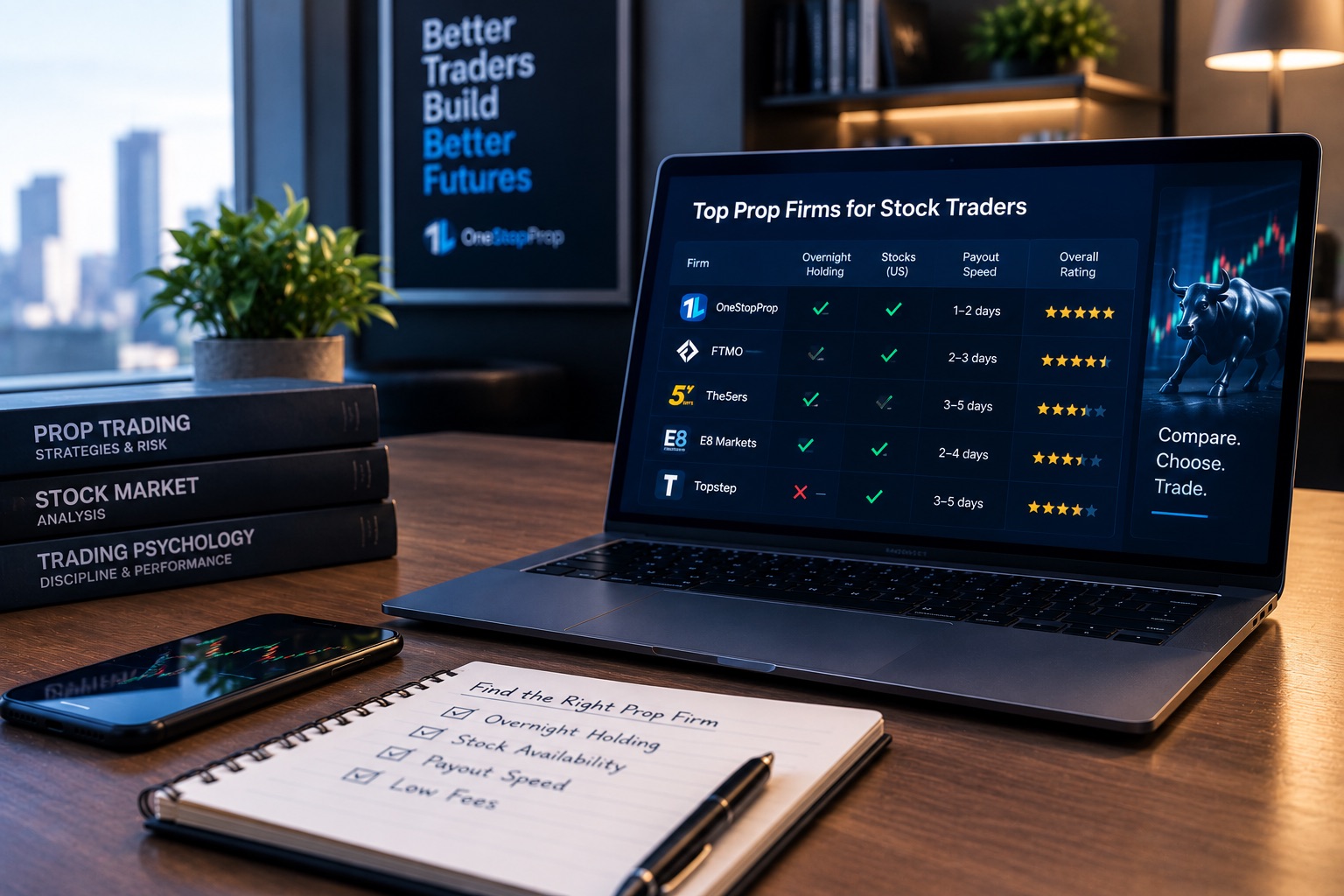
| Firm | Best For | Stock Access | Overnight Holding | Effort Level | Payout Cycle |
|---|---|---|---|---|---|
| OneStopProp | Multi-asset stock traders wanting Mag 7 names + fast payouts | Magnificent 7 + 154 instruments | Yes | Low-Medium | 14 days or faster |
| Trade The Pool | Pure equities specialists wanting 12,000+ US tickers | 12K+ US stocks/ETFs | Yes (Swing) | Medium | 14 days |
| FTMO | Disciplined traders comfortable with strict rules | Stock indices | Yes | Medium-High | 14-21 days |
| E8 Markets | Forex-first traders adding stock indices | Indices + forex | Yes | Medium | 8-14 days |
| Topstep | Futures-focused traders (not stock traders) | No stocks | N/A | Medium | Per cycle |
Start here based on your situation:
- Stock trader wanting Magnificent 7 access with flexible rules: OneStopProp, the firm in this list combining Apple (AAPL), NVIDIA (NVDA), Microsoft (MSFT), Amazon (AMZN), Alphabet (GOOGL), Meta (META), and Tesla (TSLA) under a funded prop account with no consistency rule during the challenge.
- Pure equities day trader who wants maximum US ticker selection: Trade The Pool, 12,000+ instruments through Interactive Brokers is hard to beat for breadth.
- International or disciplined rule-followers with EU timezone: FTMO, best track record in the industry, though US traders should verify state restrictions before signing up.
1. OneStopProp, Editor’s Pick and Best for Stock Traders Who Want Multi-Asset Funded Accounts
OneStopProp supports forex stocks, indices, commodities, and cryptocurrencies, all tradable from a single account, a rarity in the prop firm world. For US stock traders, this matters because your edge rarely lives in 1 asset class. You might have a technical setup on NVIDIA (NVDA) on Monday and a macro forex thesis on Wednesday. OneStopProp is one of the only funded programs that lets you act on both under the same account.
What really separates OneStopProp from the pack is the Magnificent 7 stock access. The Magnificent 7 consists of Alphabet, Amazon, Apple, Meta Platforms, Microsoft, Nvidia, and Tesla, the 7 largest market cap names in the US market. These are the tickers stock traders actually want to trade with funded capital, not obscure penny stocks with liquidity gaps.
Challenge Rules and Account Structure
Minimum trading days are only 4-6 days, versus 10-plus at many competitors. Profit targets on a 2 Step account are 8% (Phase 1) and 5% (Phase 2) versus 10%+ at many firms. There is no consistency rule applied during the challenge (it applies to each payout cycle once you are funded, at 25% on 1 Step and 2 Step and 20% on Instant), which means a strong week does not penalize you the way it would at firms that cap your single best day.
OneStopProp offers accounts from $10K to $300K, with scaling options up to $1.2M in total allocation, giving traders a credible and transparent path from their first challenge to significant capital. The OneStopProp funded account is particularly worth considering: the profit split is 90% by default and rises to 95% for the life of the account with the Lifetime Profit Split 95% Add-On, compared to the 70-80% maximum common elsewhere.
Payout Speed
The base payout cadence is every 14 days, with a $150 minimum and 6 trading days in the cycle. With the Faster Payouts Add-On, there are no minimum trading day requirements or waiting periods between payouts, provided all other account criteria are met. You can review full payout details on the OneStopProp payout page.
Pro Tip: The Faster Payouts Add-On removes the minimum trading day requirements and waiting periods between payouts, so cash can land faster than the 14-day cycle at most competing firms. Over a year of consistent profitability, that cadence compounds into a meaningful income difference. If cash flow matters as much as split percentage, add Faster Payouts to your OneStopProp account from the start.
Pros:
- Magnificent 7 stocks (AAPL, NVDA, MSFT, AMZN, GOOGL, META, TSLA) available in a single funded account
- No consistency rule during challenge, strong days count in your favor
- 90% profit split by default, raised to 95% for the life of the account with the Lifetime Profit Split 95% Add-On
- Overnight and weekend holding allowed, which is essential for stock traders
- No time limit on the challenge, trade at your own pace
- Faster Payouts Add-On removes minimum days and waiting periods between payouts, among the fastest in the industry
Cons:
- Stock selection focuses on the Magnificent 7 rather than offering thousands of tickers
- The instant funded account carries a permanent 85/15 split rather than the standard 90/10
2. Trade The Pool, Best for Pure Equities Specialists
Trade The Pool (TTP) represents the first specialized stock trading prop firm on the market. With Trade The Pool, you can trade more than 12,000 stocks and ETFs, including shorting penny stocks, on various US exchanges with up to $260,000 in buying power, clearly distinguishing the platform from other proprietary trading companies which are historically focused on Forex and contract trading.
Trade The Pool connects traders to real stock markets through Interactive Brokers, offering access to over 12,000 instruments including large caps, small caps, ETFs, and select penny stocks. That exchange connectivity is a genuine differentiator; you are trading actual US equities rather than synthetic instruments.
Rules and Profit Split
Trade The Pool offers 2 profit targets: 6% for the Day Trade program and 15% for the Swing program. Traders are allowed a maximum daily loss of 3%, a maximum total drawdown of 7%, and unlimited time for flexible accounts. The profit split caps at 70%, which is honest but lower than the industry leaders. Account sizes range from $2,000 to $200,000, with profit splits reaching 70% to the trader and first payouts processed after a 14-day delay.
Pro Tip: If your primary style is swing trading individual US stocks over multiple sessions, Trade The Pool’s Swing Flex program is one of the few evaluation paths in the industry built specifically for that setup. The 15% profit target is higher, but the unlimited time window and overnight holding permission make it far more realistic than day-trading challenges with hard close-of-day rules.
Pros:
- 12,000+ US stocks and ETFs through Interactive Brokers, widest selection in this list
- One-step evaluation with no minimum trading days on Flex accounts
- Real exchange connectivity rather than synthetic instruments
- Low entry cost (from around $47 for the smallest account)
Cons:
- 70% profit split is the lowest on this list
- Proprietary Trader Evolution platform, no TradingView integration, some user reports of chart freezing
- Stock-only: no forex or crypto if you want multi-asset flexibility
- Commissions run $0.01 per share with a $0.50 minimum, can add up for high-frequency styles
3. FTMO, Best for Disciplined Traders With a Rule-Follower Mentality
FTMO is the firm that made challenge-based prop trading mainstream. It has run since 2015, has paid out more than $500 million, and in December 2025 it bought the regulated broker OANDA, which puts it on firmer ground than almost any rival.
For US traders specifically, the picture is more complicated. Due to the regulatory complexities of the independent prop firm model, FTMO’s main platform does not accept US residents. They offer a fragmented alternative (FTMO x OANDA) that restricts traders to MT5 and completely excludes residents of 5 US states. Check your state eligibility before committing a challenge fee.
Rules and US-Specific Considerations
US-based traders lose the full New York session close window before the CET daily loss limit resets, a structural problem for strategies running past 17:00 EST. The consistency rule also applies: the 50% single-day profit cap on Normal accounts penalizes traders who generate outsized returns on high-conviction setups.
The evaluation is a 2-step process with no hard daily time limit on either phase, which suits stock traders whose style favors patience over forced activity. Profit split starts at 80% and scales up to 90%, with payouts processed every 14 days.
Pros:
- Longest payout track record in the industry, $500M+ paid since 2015 per FTMO’s public reports
- 80-90% profit split with clear, published rules
- No time limit on challenge phases, suits patient stock traders
- OANDA acquisition adds regulated broker backing
Cons:
- Does not accept all US residents, 5 states excluded from the OANDA-backed program
- Strict consistency rule on Normal accounts limits outsized single-day wins
- News trading restriction on standard funded accounts
- 14-21 day minimum wait before first payout is slower than OneStopProp, whose Faster Payouts Add-On removes the waiting period between payouts
4. E8 Markets, Best for Traders Who Want Flexible Evaluation Paths
Founded in Dallas in 2021, E8 Markets has paid out over $68M to traders across 18,900+ withdrawals. That payout volume in under 5 years of operation signals genuine operational scale.
On E8 One funded accounts, the profit split increases by 10% for each consecutive profitable day, starting at 80% and capping at 100% after 10 profitable days. This is a genuinely unique feature not offered by other major prop firms. For stock traders who run consistent winning streaks, that escalating split is a real structural advantage.
What to Watch Out For
Equity-based drawdown is E8’s most significant structural limitation for a large segment of traders. With equity-based drawdown, your open floating positions count against your daily limit in real time. A trade that goes 2% negative before recovering can breach your limit before it closes. You don’t need to close at a loss to lose the account.
Pros:
- Escalating profit split (80% to 100%) rewards consistency streaks
- Fast first payout, as early as 8 days per E8 Markets official terms
- Clearly displays drawdown and max loss inside the dashboard, so you never accidentally breach an account
- Dallas-based, US-founded firm with good domestic accessibility
Cons:
- Equity-based drawdown is unforgiving for stock trades that dip before recovering
- The 40% Best Day Rule applies on funded accounts, no single trading day can account for 40% or more of your total profits
- Primarily a forex and index platform; dedicated individual US stock access is limited compared to Trade The Pool or OneStopProp
5. Topstep, Best for Futures Traders (Important Caveat for Stock Traders)
Topstep launched in 2012, making it the longest-running futures prop firm in the United States, and it has paid funded traders consistently for over a decade. That track record earns a place on this list. However, stock traders need to understand 1 critical limitation before they read further.
Stock, options, and forex traders get no path here. The futures-only scope is the first filter any reader should apply before reading another word about pricing. If your primary instrument is individual equities like NVIDIA (NVDA) or Amazon (AMZN), Topstep cannot fund that activity. What Topstep does offer is futures exposure to equity indices like the ES (S&P 500 futures) and NQ (Nasdaq futures), which some stock-minded traders use as a companion to their equity exposure.
Pros:
- 14-year operating track record, most durable firm on this list by far
- Topstep Brokerage is an NFA-registered introducing broker under CFTC oversight, more regulatory standing than most prop firms carry
- 90% profit split on funded accounts fixed since January 2026
Cons:
- No individual stock trading, futures only (ES, NQ, CL, GC)
- The monthly subscription model is uneconomic for traders who need more than 3 months to clear the evaluation
- Not a practical fit for stock-first traders despite strong institutional credibility
How to Choose the Right Stock Prop Firm for You
Evaluate Stock Access First, Split Second
The biggest mistake stock traders make is selecting a prop firm based on the advertised profit split before confirming what stocks they can actually trade. Leverage on stock instruments is lower than forex, usually 1:2 to 1:5, since equities are more volatile and require higher margin. Prop firms often impose additional rules, such as banning low-liquidity penny stocks or restricting trades around earnings releases. Read the specific instrument list and rule set before any challenge fee leaves your account.
Check the Drawdown Mechanics, Not Just the Number
Risk management rules vary meaningfully across prop firms, particularly around drawdown type, daily loss limits, and consistency requirements. Before committing to any firm, make sure you understand not just the numbers but the mechanics behind them. A 5% daily drawdown limit calculated on your equity (including open floating P&L) is a completely different animal from a 5% daily drawdown calculated on your closed balance. The first can stop you out on a trade that ultimately ends profitable.
Match Payout Speed to Your Income Goals
A high profit split can look attractive, but what matters just as much is whether a firm has a strong record of paying traders and how quickly those payouts are processed. Calculate your expected monthly earnings and then check whether the firm’s payout cycle actually supports the cash flow you need. A 90% split paid every 30 days is worth less to a full-time trader than an 85% split paid on a much faster cycle.
Pro Tip: When comparing prop firms, always calculate your net monthly take-home under realistic trading conditions, not best-case scenarios. A firm with a 90% split that adds a consistency rule, a best-day cap, and a 30-day minimum payout window will often deliver less cash than a firm with an 80% split and no restrictions. Run the actual numbers before signing up.
Common Stock Prop Trading Mistakes to Avoid
Ignoring Overnight Holding Restrictions
Many traders discover overnight holding restrictions only after they are already funded and holding a position heading into the market close. OneStopProp traders consistently highlight the absence of overnight holding restrictions as one of the firm’s standout features. Confirm this in the firm’s published rules, not just the marketing page.
Treating the Evaluation as a Casino Play
A study of 25,000 retail traders found that 65% had win rates above 50%, yet 82% of those traders still lost money overall. The reason is asymmetric trade sizing, their average winning trade gained around 1.2%, while their average losing trade cost 2.8%. Therefore, a high win rate means nothing without positive risk-reward discipline, and a prop firm’s enforced drawdown rules can actually protect traders from their own behavioral tendencies.
Underestimating the Value of Multi-Asset Flexibility
Multi-asset flexibility lets you follow market opportunities wherever they arise rather than being locked into a single instrument category. If NVIDIA (NVDA) is in a consolidation phase but USD/JPY is breaking out, a multi-asset funded account means you are not sitting idle while the market moves.
Frequently Asked Questions
What is a prop firm, and how does it work for stock traders?
Proprietary trading firms trade their own capital rather than the capital of clients. Typically, traders’ earnings at proprietary trading firms are based on their performance, and profits are split between the trader and the firm. For stock traders, the practical path is: pay a challenge fee, meet profit and drawdown targets in a simulated account, then receive a funded account where your profits are shared with the firm according to the agreed split.
Can US residents access all prop firms on this list?
Not equally. FTMO’s main platform does not accept US residents, and their OANDA-backed alternative restricts traders to MT5 and excludes residents of 5 US states. OneStopProp, Trade The Pool, E8 Markets, and Topstep all have cleaner US accessibility, but always verify your specific state before purchasing a challenge.
How much can I realistically earn from a stock prop funded account?
Account sizes typically range from $25,000 to $250,000, with profit targets between 6% and 10%. Daily drawdown limits are typically 3% to 5%, and maximum drawdown is normally 8% to 12%. Your realistic monthly earnings depend on your account size, your consistency, and the firm’s payout mechanics. A $100,000 account generating 3% monthly profit at a 90% split returns $2,700 per month, a meaningful income for traders who can sustain that performance.
What stocks can I trade with a prop firm funded account?
It depends entirely on the firm. With Trade The Pool, you can trade more than 12,000 stocks and ETFs on various US exchanges. OneStopProp focuses on the Magnificent 7, Apple (AAPL), NVIDIA (NVDA), Microsoft (MSFT), Amazon (AMZN), Alphabet (GOOGL), Meta (META), and Tesla (TSLA), alongside forex and crypto. FTMO and E8 Markets trade stock indices rather than individual equities. Verify the exact instrument list with each firm before committing.
Is a 100% profit split ever real?
Yes, with conditions. With OneStopProp, the profit split is 90% by default and can be raised to 95% for the life of the account with the Lifetime Profit Split 95% Add-On. E8 Markets offers up to 100% splits on certain accounts, the split ranges from 80% to 100% with some accounts allowing customization for a higher split.
Conclusion
Stock traders in the US have more funded account options in 2026 than at any point in the industry’s history, but most prop firms were still built with forex traders as the primary customer. The firms on this list represent the clearest paths to funded equity trading, each with a distinct use case.
If you trade the Magnificent 7, want overnight holding, no consistency rule during the challenge, and faster payouts with no waiting period between withdrawals, OneStopProp is the structure built around you. If your edge is in 12,000-ticker equities depth with real market execution, Trade The Pool is the specialist option worth exploring.
Either way, run the drawdown mechanics, the payout timeline, and the instrument list through your own trading style before paying a challenge fee. The right prop firm is the one whose rules match the way you already trade, not the one with the biggest number on the marketing page.
Ready to get started? Visit the OneStopProp checkout page to choose your account size and get funded.
Sources
- Best Prop Firms for Stock Traders 2026, OneStopProp. Ranked overview of top firms for equity access, payout rules, and stock trader conditions. https://onestopprop.com/best-prop-firms-for-stock-traders-in-2026/
- OneStopProp Payout Information and Guidelines, OneStopProp. Official payout terms, cycle details, and account and Add-On split structure. https://help.onestopprop.com/faq/payout-rules/
- OneStopProp Funded Account Scaling Plan, OneStopProp. Account sizes, challenge targets, and scaling path to $1.2M allocation. https://onestopprop.com/funded-account-scaling-plan/
- Prop Trading Industry Size 2026, $850M Market Analysis, Track360. Market expansion data from 2021 to 2026. https://track360.io/blog/prop-trading-industry-report-2026-market-analysis
- Prop Trading Statistics 2026, Track360. Active firm count, search volume data, and market concentration analysis. https://track360.io/blog/prop-trading-industry-statistics-2026
- Trade The Pool Review 2026, Fortunly. Platform features, account structure, and equities coverage for TTP. https://fortunly.com/reviews/trade-the-pool-review/
- Trade The Pool Prop Firm Review 2026, Prop Firm Bridge. Rules, volume caps, profit split, and Interactive Brokers connectivity. https://propfirmbridge.com/prop-firms/trade-the-pool
- FTMO Review 2026, Responsible Trading. Payout track record, OANDA acquisition details, and US trader access analysis. https://responsibletrading.com/prop-firm-reviews/ftmo-review/
- E8 Markets Review 2026, Responsible Trading. Payout history, Best Day Rule, and escalating profit split details. https://responsibletrading.com/prop-firm-reviews/e8-markets-review/
- Topstep Review 2026, Phidias Prop Firm. NFA registration details, evaluation mechanics, and futures-only scope. https://en.wikipedia.org/wiki/Topstep
- What Are the Magnificent 7 Stocks?, Fidelity. Definition and composition of the Magnificent 7 stock group. https://www.fidelity.com/learning-center/smart-money/magnificent-7-stocks
- Best Prop Firms for Stock Traders in the US (2026 Guide), OneStopProp. Payout transparency, US stock trader conditions, and firm comparison. https://onestopprop.com/best-prop-firms-for-stock-traders-us/
- Prop Firm Market Trends, HashCodeX. 2025-2026 trader survey data on rule clarity and payout speed preferences. https://www.hashcodex.com/prop-firm-market-trends
- Prop Firm vs Self-Funded Trading, OneStopProp. Behavioral trading data and multi-asset prop firm structure analysis. https://onestopprop.com/prop-firm-vs-self-funded-trading/