Apple (AAPL) is one of the most recognizable tickers on the planet, and for good reason. It sits at a market cap that has touched $4.67 trillion, it moves on catalysts that every financial headline tracks, and it offers the kind of clean price structure that traders can analyze with confidence. Trading it with your own capital, however, puts a real ceiling on what you can earn per move. Trading it inside a prop firm account removes that ceiling.
This guide walks you through the entire process to trade apple stock at a prop firm, from understanding how prop firms work, to building an AAPL strategy that survives an evaluation, to collecting your first funded payout. If you have been watching Apple’s price action for months and wondering how to turn that knowledge into real capital access, this is where to start.

Key Takeaways
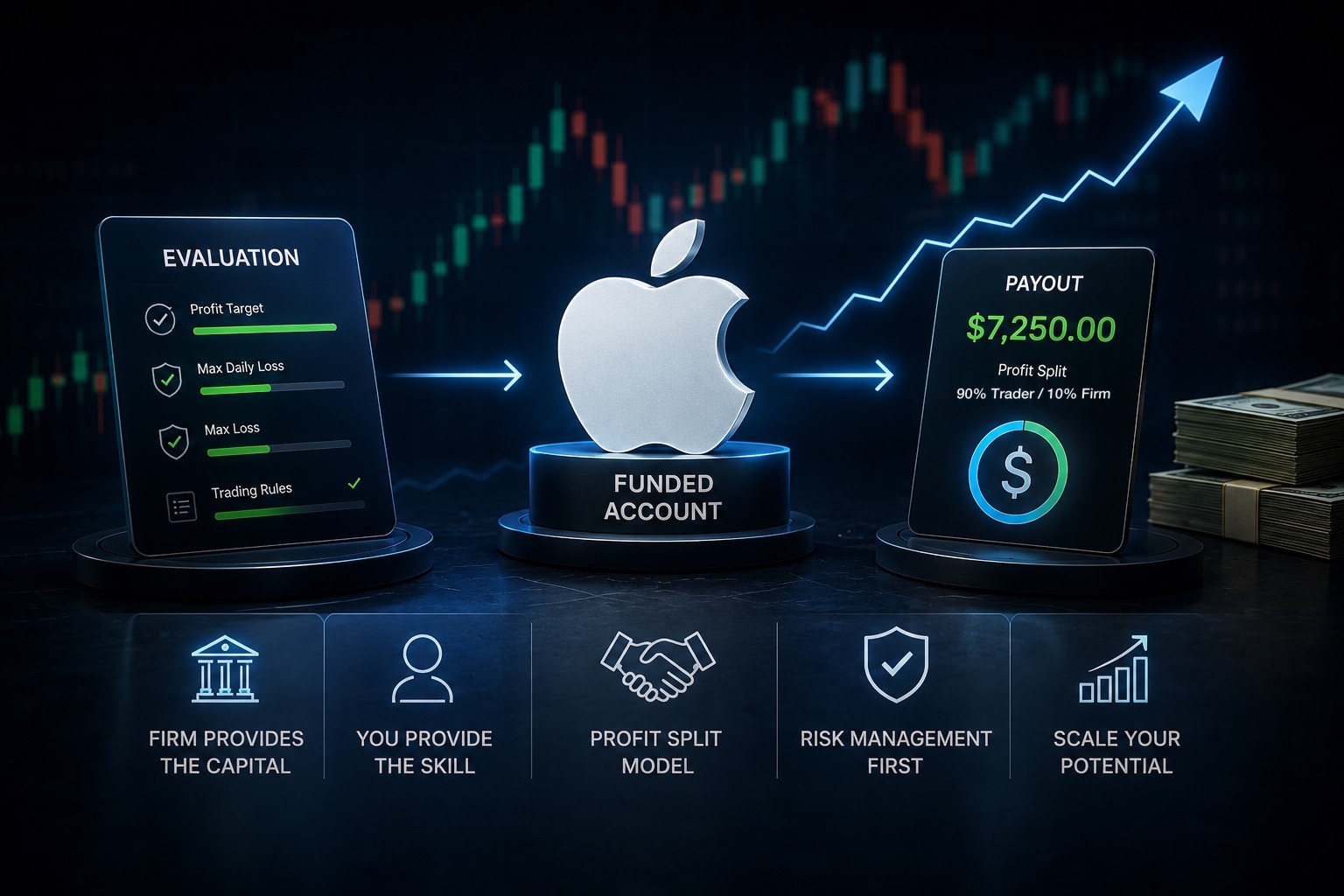
- Prop firms provide the capital, you provide the skill: The core concept is simple, the firm provides the money, the trader provides the skill, and profits are split between them. That means your AAPL edge can scale far beyond what your personal account allows.
- The prop industry is worth an estimated $20 billion globally: In 2026, the prop trading industry is worth an estimated $20 billion globally, with over 2,000 firms funding skilled traders worldwide. More competition means better conditions for traders, but also means you need to choose your firm carefully.
- Apple (AAPL) is a top-tier instrument for prop traders: The 7 best swing trading stocks for beginners in 2026 include AAPL, NVDA, TSLA, AMZN, MSFT, AMD, and META. AAPL leads that list because it has structure, liquidity, and identifiable catalysts.
- Risk management beats strategy during evaluations: Most traders fail from risk-control mistakes early, not lack of skill. Therefore, your first job during any prop challenge is staying inside the rules, not chasing big gains.
- Overnight holding matters for stock traders: Stock traders frequently hold positions through earnings reports, macro events, or technical setups that develop over multiple sessions. Many prop firms built for forex traders restrict overnight holds entirely. Confirm this before you commit to any challenge.
Quick-Start Prioritization to Trade Apple Stock at a Prop Firm
| Strategy | Best For | Effort Level | Time to Results |
|---|---|---|---|
| Earnings swing setup | Traders who track Apple’s quarterly cycle | Medium | Days per cycle |
| Support/resistance pullback | Traders with a structured rule set | Low | 1-5 days |
| Trend-continuation on breakout | Traders who use daily-chart structure | Medium | 1-2 weeks |
| News-catalyst momentum | Active traders monitoring macro headlines | High | Hours to 1 day |
| Range trade between key levels | Patient traders in consolidation phases | Low | 2-7 days |
Start here if you are:
- New to prop trading: Pullback-to-support on AAPL, the most repeatable, rule-friendly setup with the smallest drawdown exposure.
- Experienced swing trader: Earnings-cycle swing setups, timed to Apple’s quarterly report schedule (January, April, July, October).
- Multi-asset trader: Consider OneStopProp, where you can trade Apple (AAPL) alongside forex and crypto inside a single funded account without juggling separate evaluations.
Step 1: Understand How Prop Firm Trading Works
Before you place a single trade on AAPL in a challenge, you need to understand the model you are operating inside.
The Core Prop Firm Model
Proprietary trading, or “prop trading” trading”, is when a financial firm trades stocks, futures, currencies, or other instruments using its own capital rather than client funds. The firm takes on the market risk directly and keeps the profits or absorbs the losses. Traders working for the firm are compensated through a share of the profits they generate, not through commissions or management fees. The retail version of this model means you access that capital by passing an evaluation, commonly called a challenge.
Prop trading lets you trade financial markets using a firm’s capital instead of your own money. In 2026, the prop trading industry is worth an estimated $20 billion globally, with over 2,000 firms funding skilled traders worldwide. Through an evaluation challenge, where you prove your skills on a demo account; you can earn access to funded accounts ranging from $10,000 to $1,000,000, keeping up to 80-95% of your profits.
What a Prop Firm Evaluation Looks Like
A prop firm challenge is a simulated-capital evaluation where you must hit a profit target (typically 8-10%) without breaching a daily loss limit (usually 5%) or maximum drawdown (usually 10%). These numbers are firm-specific, so always read the rule sheet before you purchase.
Almost every prop firm challenge is structured around 2 core risk limits: the maximum daily loss, which caps how much a trader can lose in a single day, and the maximum overall drawdown, which caps how much a trader can lose from their starting balance or high watermark before the account is closed. Breaching either ends the challenge immediately, not at the end of the day.
Pro Tip: Before purchasing any challenge, read the payout terms first, then the challenge rules. The challenge rules tell you how to pass. The payout terms tell you whether passing is actually worth anything. This is where many traders discover that a seemingly flexible firm still has restrictive conditions on the funded side.
Step 2: Choose the Right Prop Firm for Apple Stock
Not every prop firm supports stock trading. The majority of the industry grew out of the forex and futures markets, and many platforms still do not carry individual equity instruments like AAPL.
What to Look for in a Prop Firm for Stock Trading
Account sizes usually range from $25,000 to $250,000, with profit targets between 6% and 10%. Daily drawdown limits are typically 3% to 5%, and maximum drawdown is normally 8% to 12%. Leverage on stock instruments is lower than forex, usually 1:2 to 1:5, since equities are more volatile and require higher margin.
Beyond leverage, you also need to confirm overnight holding permissions. A swing-capable firm gives you the flexibility to trade multi-day setups, hold through an overnight catalyst, or carry a position over a weekend, all on the firm’s capital. Apple regularly moves on after-hours earnings and pre-market macro news, so a firm that forces you to close intraday removes a significant portion of the opportunity.
OneStopProp: A Purpose-Built Option for Stock Traders
For traders who want to access Apple (AAPL) inside a prop account alongside other instruments, OneStopProp is built specifically for stock traders, with forex and crypto available as additional asset classes in the same funded account. OneStopProp offers accounts from $10K to $300K, with scaling options up to $1.2M in total allocation.
Profit targets on a 2 Step account are 8% (Phase 1) and 5% (Phase 2) versus 10%+ at many firms. The base profit split is 90%, and the Lifetime Profit Split 95% Add-On raises it to 95% for the life of the account, compared to 70-80% maximum elsewhere. At OneStopProp there is no consistency rule during the challenge and no time limit to finish it, unlike the typical 30 to 90 day windows elsewhere. The consistency rule applies once you are funded, to each payout cycle: no single day can make up 25% or more of your profit for the period on a 1 Step or 2 Step account, or 20% on Instant.
OneStopProp explicitly permits overnight and weekend holding across its accounts. That matters for any strategy built around Apple’s earnings cycle or multi-day technical setups.
The OneStopProp funded account is worth particular attention. OneStopProp’s financial structure delivers a base 90% profit split, which the Lifetime Profit Split 95% Add-On raises to 95% for the life of the account. That lifetime split is a genuine differentiator. For traders actively generating profit on AAPL positions, keeping 95% of every payout accelerates reinvestment and account growth significantly.
On news trading: funded accounts at OneStopProp have a five-minute prohibited window before and after major earnings releases and high-impact news events. The News Trading Allowed Add-On removes that restriction. If earnings-cycle trading on Apple is central to your strategy, the News Trading Allowed Add-On removes a rule that would otherwise force you out of position at exactly the wrong moment.
Step 3: Build an AAPL Trading Strategy That Survives a Prop Evaluation
The difference between a retail Apple trade and a prop-evaluated Apple trade is the rule layer. Your strategy has to generate profit without touching the daily loss cap or the maximum drawdown. That forces a level of discipline that most retail traders never develop until they are required to.
Understanding Apple’s Price Behavior
AAPL stock is 2.32% volatile with a beta coefficient of 0.82. That relatively contained beta means Apple does not swing wildly with every market move; it tends to trend, pull back, and trend again. For prop traders working under a daily loss cap, that behavoir is an asset. You can define clean support and resistance levels, set precise stop losses, and keep drawdown within the firm’s limits.
From January through the end of April 2026, Apple shares traded between $243.39 and $280.88. In May, AAPL surged to $314.94 by month-end after reporting strong quarterly results. The upward trend continued into the summer: On July 28, the stock closed at a record high of $340.08. A correction began in August, and by the end of the month, the stock was trading around $310.00-$315.00. That kind of structured movement, surge on earnings, consolidation, pullback, is exactly what technical setups are built around.
The 3 Core AAPL Setups for Prop Traders
Setup 1, Pullback to Prior Support
This is the oldest swing trade in the book, and for good reason; it works. You find a price level where a stock has bounced before, it comes back to that level, and you buy the bounce. The setup is simple. A stock is in an uptrend and pulls back. For AAPL, look for tested support zones on the daily chart, confirmed with volume. Set your stop below the zone, size accordingly so a breach does not exceed 1-2% of account equity, and target the prior swing high.
Setup 2, Post-Earnings Continuation
The biggest IV spikes on AAPL typically cluster around quarterly earnings reports, major product reveal events, and broader macro or sector rotations that affect growth and consumer spending sentiment. Apple reports every quarter in January, April, July, and October. When the earnings beat is genuine, revenue growth, margin expansion, Services acceleration, AAPL typically continues the direction of the initial gap for several sessions. A prop trader can capture that continuation with a defined stop at the prior close, rather than gambling on the actual report.
Setup 3, Range Trade Within Consolidation Bands
Between major catalysts, AAPL often consolidates inside a recognizable range. The nearest target is the $319.00-$336.00 range, where partial profits can be taken. A firm consolidation above this zone would strengthen the outlook for further gains. Range trading lets you take both directions with defined risk, long at the bottom of the range, short at the top, without needing a directional macro view.
Pro Tip: Position size first, then find the setup. On a $100K prop account with a 5% daily loss limit ($5,000), risking 1% per trade ($1,000) gives you 5 consecutive full losers before the daily limit is hit. Risk 0.25-0.5% per trade, trade only your A+ setups, and treat the rules as hard boundaries, not suggestions. That buffer is what keeps you in the challenge after a bad day.
Key Apple Catalysts to Track
Growth catalysts include new product categories, expanding services revenue, and iPhone demand. From a prop trading perspective, each of these creates a window. New product launches (especially iPhone cycles in September) trigger multi-week trend moves. Services beats on earnings create upside momentum. iPhone demand weakness, particularly in China, creates short-side opportunity. Track these dates on a calendar and plan your position sizing accordingly.
The regulatory angle also matters. The most significant risk is adverse regulatory action from the US Department of Justice (DOJ) and the EU’s Digital Markets Act (DMA), which directly targets Apple’s App Store policies. A negative outcome could force Apple to permit alternative payment systems or third-party app stores, which would structurally damage the high-margin commission revenue from the App Store. Regulatory headlines can create sharp intraday moves on AAPL, a trader with a well-placed stop and awareness of the schedule can use those moves rather than being blindsided by them.
Step 4: Pass the Evaluation Without Blowing the Rules
The evaluation phase is where most traders lose the challenge, not because their Apple strategy was wrong, but because they broke a rule they did not fully understand.
The Rules That Matter Most
The profit target is the threshold a trader must reach to pass the evaluation phase, typically 8% to 10% of the account size. Reaching the target does not automatically pass the challenge if other rules have not been met. Minimum trading days, consistency requirements, and daily loss caps all interact. Read them all before placing your first trade.
Passing a prop firm evaluation is really about staying consistent and sticking to the rules around risk. It’s less about rushing to hit the target and more about showing steady, disciplined trading over time. This is especially true for stock traders, where Apple can generate a 4-5% single-session move that might seem like a reason to oversize, which is exactly when the daily loss cap punishes undisciplined traders most severely.
Pro Tip: Never trade Apple on the day of an earnings release during a challenge unless your firm explicitly permits it and you have a defined pre-earnings risk plan. Options imply roughly ±4% move on earnings, and a move in the wrong direction can breach a 5% daily loss limit in a single session.
Step 5: Get Funded and Manage Payouts
Passing the evaluation is step 1. Staying funded and collecting payouts is the actual goal.

How Payout Structures Work
Across major firms in August 2026 the split runs 80-100%, and the realistic gap between clicking request and money settling is 1 to 5 business days. The headline profit split is the least important number, payout frequency, minimum withdrawal, consistency rules, and rail fees decide what you actually keep. Therefore, when comparing firms, calculate what you take home under realistic trading volume, not the best-case headline percentage.
At OneStopProp, the payout mechanics are straightforward. The base profit split is 90%, and the Lifetime Profit Split 95% Add-On raises it to 95% for the life of the account. Traders can request a payout every 14 days, with a six-trading-day cycle.
For traders who want faster access, if you have the Faster Payouts Add-On, there are no minimum trading day requirements or waiting periods between payouts, provided all other account criteria are met. The minimum payout request is $150, which makes this accessible even on smaller funded accounts.
Staying Funded Long-Term
OneStopProp offers traders a clear entry point and a transparent path to significant capital. Minimum trading days are only 4-6 days, versus 10-plus at many competitors. Once funded, the discipline shifts from hitting a profit target to protecting your funded status. Keep position sizing consistent, reduce size after losing days, and avoid overtrading during AAPL’s low-volatility consolidation phases, that is when frustration leads to rule breaches.
Common Mistakes When Trading Apple Stock at a Prop Firm
Trading Through Earnings Without a Plan
Apple reports quarterly. Earnings cycles in January, April July, and October create predictable IV spikes. Without a defined position size and stop-loss level set before the report, an adverse move can breach a daily loss limit in minutes. Either close before earnings or size down significantly, and confirm your firm’s rules allow position holding through earnings before you do either.
Ignoring the Drawdown Interaction Between Positions
Many traders focus on the daily loss cap and forget that the overall drawdown accumulates across sessions. Almost every prop firm challenge is structured around 2 core risk limits: the maximum daily loss and the maximum overall drawdown. These 2 rules interact in ways traders regularly underestimate. A string of 3 moderate losing days that each stay under the daily cap can still push you close to the maximum drawdown limit.
Chasing AAPL After a Big Move
Apple’s strongest sessions tempt traders into momentum chases at extended prices. The main strategy is to buy pullbacks within the prevailing uptrend, avoid chasing sharp rallies, and take profits incrementally as key resistance levels are reached. That principle applies directly to prop trading, chasing a breakout that has already run 3-4% in a session puts you at maximum risk exposure when the natural retracement arrives.
Frequently Asked Questions
Can I trade Apple (AAPL) stock at a prop firm in 2026?
Yes. Prop firms that allow stock trading let traders trade on the price movements of company shares such as Apple, Tesla, or Microsoft. Not all prop firms support individual equities, many focus exclusively on futures or forex, so confirm the instrument list before purchasing a challenge. OneStopProp offers Apple (AAPL) alongside the other Magnificent 7 stocks including NVIDIA (NVDA), Microsoft (MSFT), Amazon (AMZN), Alphabet/Google (GOOGL), Meta (META), and Tesla (TSLA).
How much capital can I access to trade Apple at a prop firm?
For most traders entering a funded program, the realistic starting range sits between $10,000 and $200,000. Prop firms can offer accounts from $25,000 to over $1,000,000, depending on your performance. At OneStopProp specifically, accounts start at $10K and scale to $1.2M in total allocation through the scaling program.
What is the profit split at most prop firms?
Most prop firms offer favorable profit splits, often 70/30, 80/20, or 90/10 in favor of the trader. OneStopProp delivers a base 90% profit split, which the Lifetime Profit Split 95% Add-On raises to 95% for the life of the account, one of the strongest structures available for stock traders in 2026.
Do I need to close my Apple positions before earnings during a challenge?
It depends on the firm and account type. Most prop firms require closing positions before major news events like earnings. Funded accounts at OneStopProp have a five-minute prohibited window before and after major earnings releases and high-impact news events. The News Trading Allowed Add-On removes that restriction. If earnings-cycle trading is part of your Apple strategy, the News Trading Allowed Add-On is the more flexible choice.
What are the most common reasons traders fail their Apple stock prop challenge?
Most traders who fail a prop firm challenge do not fail because they cannot trade. They fail because they broke challenge rules they did not fully understand. The gap between knowing a rule exists and knowing how it is calculated is where most evaluations end. The fix is straightforward: read the full rule sheet before placing your first trade, translate drawdown limits into position sizes, and treat the daily loss cap as an absolute stop, not a soft boundary.
Ready to Trade Apple With Prop Capital?
In my experience, the traders who succeed inside prop firm evaluations are rarely the ones with the most sophisticated strategy. They are the ones who understand the rules completely, size positions conservatively, and let their Apple edge compound across multiple sessions rather than swinging for a single big day.
Apple (AAPL) gives you the structure to do that. It has identifiable catalysts, clean technical levels, and the kind of consistent liquidity that lets you enter and exit without slippage eating your edge. Inside a prop firm account, those advantages are multiplied by the firm’s capital instead of capped by your own balance.
If you are ready to access that model, start your funded account at OneStopProp and choose the account size that matches your current strategy. OneStopProp’s Add-Ons are the strongest structural fit for traders who want maximum payout flexibility, overnight holding, and no restrictions on Apple’s earnings cycle.
Sources
- AAPL Stock Price and Volatility Data, TradingView. Real-time Apple stock metrics and beta coefficient data. https://www.tradingview.com/symbols/NASDAQ-AAPL/
- Apple Stock Forecast and Price Predictions 2026, LiteFinance. Analyst price range and technical outlook through 2026. https://www.litefinance.org/blog/analysts-opinions/apple-stock-forecast-and-aapl-stock-predictions/
- AAPL Stock Price Prediction 2025-2026, 24/7 Wall St. 12-month price target and analyst rating breakdown. https://247wallst.com/companies/aapl/price-prediction/
- The Complete Guide to Prop Trading in 2026, GetLeveraged. Industry size, funded account ranges, and profit splits. https://getleveraged.com/traders-library/the-complete-guide-to-prop-trading-in-2026/
- Prop Firm Challenge Rules Explained, PropAccount. Drawdown mechanics, profit targets, and evaluation structure. https://propaccount.com/resources/blog/prop-firm-challenge-rules-explained/
- Best Prop Firms for Stock Traders 2026, OneStopProp. Comparison of leading prop firms for equity traders. https://onestopprop.com/best-prop-firms-for-stock-traders-in-2026/
- OneStopProp Funded Account Scaling Plan, OneStopProp. Account and Add-On structure, payout splits, and scaling path details. https://onestopprop.com/funded-account-scaling-plan/
- OneStopProp Payout Information and Guidelines, OneStopProp. Payout request rules, bi-weekly cycle, and minimum withdrawal details. https://help.onestopprop.com/faq/payout-rules/
- 5 Catalysts to Monitor for AAPL Stock, Trefis. Regulatory risks and growth drivers for Apple through 2026. https://www.trefis.com/stock/aapl/articles-v3/597019/5-catalysts-to-monitor-over-in-the-next-2-quarters-for-aapl-stock/2026-04-21
- Best Swing Trading Stocks for Beginners in 2026, BetterSwingTrader. Stock selection criteria and AAPL swing setup examples. https://betterswingtrader.com/blog/best-swing-trading-stocks-beginners-2026/
- Best AI Stocks for Prop Firm Trading, OneStopProp. Guidance on trading Magnificent 7 stocks inside funded accounts. https://onestopprop.com/best-ai-stocks-for-prop-firm-trading/
- Best Prop Firms for Stock Traders in the US 2026, OneStopProp. US-focused review of prop firm structures for equity traders. https://onestopprop.com/best-prop-firms-for-stock-traders-us/