Tesla (TSLA) is one of the most actively traded stocks in the world, and for prop firm traders, that volatility is the entire point. This guide walks you through exactly how to approach TSLA inside a funded account: from understanding why the stock moves the way it does, to sizing your positions correctly, to keeping your account alive when the stock decides to gap 7% overnight.
To trade Tesla stock through a prop firm, the basic process involves choosing a firm that offers actual stock access, passing or bypassing an evaluation challenge, building a position-sizing framework calibrated to TSLA’s volatility, and protecting your drawdown budget every single session.
Key Takeaways
- Tesla is genuinely volatile and that creates opportunity: Tesla’s (TSLA) annualized volatility reached 44.69% in mid-2026, meaning price swings are frequent and tradable, but they demand tight position sizing or they will eat your drawdown budget fast.
- Most prop firm failures happen on the daily loss limit, not the max drawdown: According to For Traders’ 2025 data, 80% of traders fail their first prop firm evaluation by breaching the daily loss limit rule, so your number-one priority is staying inside that daily cap, especially on high-volatility stocks like TSLA.
- Fewer firms offer real stock access than you think: If trading individual stocks such as NVDA, Apple (AAPL), or Tesla (TSLA) alongside forex and crypto is important to your strategy, OneStopProp covers all 3 asset classes under a single funded account.
- Tesla’s 52-week range is nearly $200 wide: In the last year, Tesla (TSLA) shares hit a 52-week high of $498.83 and a 52-week low of $297.38, a range that rewards directional traders with a plan, and punishes anyone without one.
- Position sizing beats strategy every time: According to Traders’ Second Brain’s prop sizing guide, getting funded is 20% strategy and 80% risk management, therefore, lock in your position sizing rules before you place a single TSLA trade.
Quick-Start Prioritization Framework
| Approach | Best For | Effort Level | Time to Results |
|---|---|---|---|
| Instant Funded Account (no challenge) | Experienced traders ready to trade immediately | Low | Days |
| 2-Step Challenge | Traders who want to prove their process first | Medium | Weeks |
| Earnings Catalyst Swing Trade | Directional traders with a TSLA thesis | Medium | Days to weeks |
| Intraday Momentum Trade | Active day traders comfortable with news-driven volatility | High | Same day |
| Overnight/Multi-Day Swing | Traders with overnight holding permissions | Medium | Days |
Start here if you’re:
- New to prop firms: Begin with a straightforward 1-step or instant funded account, less pressure means better execution on a volatile stock like TSLA. The post-earnings swing has historically run around 3.5% over the past four quarters according to recent earnings data.
- A multi-asset trader: Use a OneStopProp funded account to trade Tesla (TSLA) alongside other Magnificent 7 names and forex in one funded account, no fragmentation across multiple firms.
Step 1: Understand Why Tesla Moves the Way It Does
Before sizing a single position, you need to understand what actually drives TSLA’s price action, because the reasons matter for timing your entries.
The Volatility Profile
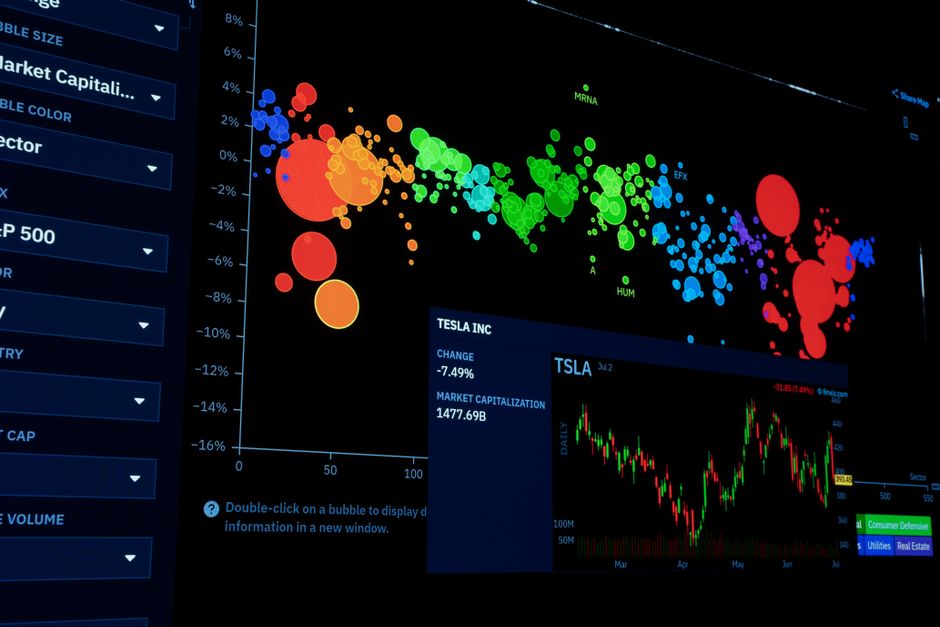
Volatility is a statistical measure of the dispersion of returns for a given security or market index, showing how the price swings around its mean. The volatility here is measured as the annualized standard deviation between monthly returns over the past year. In most cases, the higher the volatility, the riskier the security. As of 2026, Tesla’s (TSLA) annualized. That figure places TSLA in a different risk category from most blue-chip stocks. For a prop firm trader, this is both the opportunity and the threat: more movement means more profit potential, but also faster drawdown consumption if you are positioned incorrectly.
The stock has fluctuated within a 52-week range spanning from $297.38 to $498.83. That $200 range rewards traders who understand direction, and destroys those who guess.
The Key Price Catalysts
Earnings reports and delivery numbers, particularly vehicle deliveries and gross margins, are the single most market-moving data points for TSLA. A delivery miss or margin compression will typically trigger sharp sell-offs; a beat drives rallies. Therefore, always mark Tesla’s earnings calendar and delivery report dates before the start of each quarter, and plan your position sizing accordingly.
Recent earnings data shortly after earnings is pricing in roughly a 7% move in TSLA stock, which sits below Tesla’s long-term average post-earnings swing of about 9%, according to recent earnings data. In practical terms: if you hold TSLA into earnings without hedging, you need your account’s drawdown buffer to absorb a potential 7-9% gap in the wrong direction.
Autonomous driving milestones, Optimus robot production updates, and Cybercab rollout news all function as secondary catalysts. Every positive Optimus milestone is a direct stock catalyst, and every missed deadline adds downside pressure, per OptimUSK’s TSLA catalyst analysis. Track these announcements on Tesla’s investor relations page and build them into your weekly pre-market prep.
Pro Tip: Set a price alert at the prior week’s high and low for TSLA every Sunday evening. When price approaches either level on earnings week, TSLA tends to accelerate quickly, the move is often worth trading, but only with reduced size relative to your normal position.
Step 2: Choose a Prop Firm That Actually Offers Stock Trading
This is where most traders make their first and most costly mistake. The majority of prop firms specialize in forex, and finding one that grants genuine access to individual equities like Tesla (TSLA) is harder than it sounds.
What to Look For in a Stock-Focused Prop Firm
Prop firm trading has become a popular avenue for traders seeking to leverage substantial capital without risking personal funds. To succeed in this domain, understanding and adhering to the specific prop firm trading rules set by each firm is crucial. These rules are designed to ensure consistent performance, risk management, and profitability.
Beyond the general rule structure, stock traders need to verify 4 specific features before committing to any firm:
- Confirmed access to individual US equities (not just indices)
- Overnight and weekend holding permissions for swing trades
- Absence of restrictions on news trading during earnings windows
- A payout structure that doesn’t penalize you for a single large winning day
As one funded trader noted, being able to short stocks freely without worrying about the PDT rule made a huge difference in strategy. Most brokers limit you unless you have a big account, but a prop firm allows you to trade like a pro from day one.
OneStopProp for Stock Traders
OneStopProp is built specifically for traders who want real stock access without fragmenting accounts across multiple firms. OneStopProp offers stocks, forex and crypto trading all in one account with a 90% profit split that can rise to 95% for the life of the account with the Lifetime Profit Split 95% Add-On, with a challenge structure featuring clear and simple rules, 4-6 minimum trading days, and overnight holding permissions included as standard.
Traders highlight features like no trading restrictions on holding trades overnight, with the News Trading Allowed Add-On opening up trading through news events, as key differentiators. For a TSLA trader who wants to hold a position through an earnings catalyst, that overnight flexibility matters enormously.

Step 3: Size Your Positions for Tesla’s Volatility
In my experience, this is where most funded traders get into trouble with volatile stocks. They use the same position size they would apply to a slow-moving index, and then TSLA gaps 5% at the open and wipes out half their daily loss limit in the first 10 minutes.
The Volatility-Adjusted Sizing Rule
Volatile stocks need smaller positions because price swings are wider. A stock moving $5 per day requires a wider stop than one moving 50 cents, meaning fewer shares for the same dollar risk. TSLA regularly moves $10-$20 in a single session. That means your stop loss has to be wider, which means your share count has to come down to keep dollar risk constant.
The formula is straightforward. Decide the maximum dollar amount you are willing to lose on a single TSLA trade, for most prop firm traders, this should be 0.5% to 1% of account equity. Then divide that dollar amount by your stop distance in dollars per share. The result is your maximum share count for that trade.
For example: on a $100,000 account with a 0.5% risk per trade ($500), and a stop 10 points below your entry on TSLA, your maximum position is 50 shares. That is conservative by most retail standards, and exactly right for a prop firm account.
For high-volatility markets, ThinkCapital’s position sizing guide recommends 0.10% to 0.25% risk per trade, lower risk helps when conditions are unstable or when you are already in a drawdown. During evaluations, 0.25% to 0.50% is the recommended range, creating room for a losing streak and helping protect your daily drawdown limit.
Pro Tip: On days Tesla is reporting earnings or delivery numbers, cut your normal position size by at least 50% before the number is released. The options market is currently pricing in a roughly 7.6% post-earnings swing on TSLA, that can eat your entire daily drawdown allowance in a single candle if you are oversized.
Daily Loss Limits and TSLA’s Intraday Range
Most prop firms set a daily loss cap at 4-5% of starting capital. If you start with $25,000, your daily loss limit might be $1,000-$1,250. Once you hit that limit, you are locked out of trading for the day. On a $100,000 account, a 5% daily cap gives you a $5,000 buffer, which sounds comfortable until TSLA gaps down $15 on a bad delivery print and you are holding 200 shares.
The math is simple: risk 1% per trade on prop firm challenges, never 3%. At 3% risk, just 5 consecutive losses equal a 14.2% drawdown, challenge over. At 1%, the same streak equals 4.9%, survivable, according to Traders’ Second Brain’s position sizing guide. Therefore, keep single-trade risk at or below 1%, and reduce to 0.5% or lower on high-volatility sessions involving Tesla news events.
Step 4: Build Your TSLA Trading Framework
Reading the Earnings Window
Tesla (TSLA) has earnings scheduled for October 28, 2026, according to TipRanks. The 2 weeks before and after an earnings print are the highest-volatility periods for the stock. In my experience, the best risk-adjusted setups come from fading extreme pre-earnings moves, when TSLA runs hard into a report on optimism, the post-earnings “sell the news” reaction is often more reliable than the earnings beat itself.
A delivery miss or margin compression will typically trigger sharp sell-offs; a beat drives rallies, per Just2Trade’s Tesla forecast. The actionable rule: know the consensus delivery estimate before every quarterly report, and have your directional thesis ready before the number drops.
Swing Trading vs. Intraday Scalping on TSLA
Both approaches work, but they require different tools inside a prop firm account.
Swing trading Tesla across multiple days means you need overnight holding permission, which not all prop firms grant. OneStopProp explicitly permits overnight and weekend holding across its accounts, which makes it structurally suited for traders who want to hold a TSLA position through a catalyst event and exit after the dust settles.
Intraday scalping on TSLA works best around market open (9:30-10:30 AM EST) and into the close (3:00-4:00 PM EST), when volume and volatility are highest. TSLA stock carries a beta coefficient of 1.95 according to TradingView’s TSLA data, meaning it moves nearly twice as fast as the S&P 500 index. That beta demands disciplined intraday stops, a 1-point move on TSLA has roughly the same dollar impact as a 2-point move on an average index component.
Step 5: Protect Your Drawdown and Stay Funded
The Drawdown Math That Most Traders Ignore
Prop trading firms provide traders with funded capital, but that capital carries strict risk limits designed to protect the firm’s balance sheet. Every evaluation and funded account operates inside a defined loss boundary, and crossing that boundary ends the account. With TSLA, this boundary is tested faster than on slower instruments.
On a $100,000 account, a 5% daily rule caps loss at $5,000, while a 10% max drawdown caps lifetime loss at $10,000. Hitting either threshold triggers an automatic stop-out enforced by the firm’s risk systems, per The5ers’ drawdown rules guide. The key distinction: your maximum drawdown is not a buffer to spend freely. It is the absolute floor, and every dollar you shave off it early in the month narrows your room to trade later.
Pro Tip: Set a personal daily stop at 70-80% of the firm’s official daily limit, not 100%. If the firm allows a $5,000 daily loss, stop trading at $3,500-$4,000. The remaining buffer absorbs slippage, commissions, and the occasional bad fill on a fast-moving TSLA print.
Common Mistakes When Trading Volatile Stocks in a Prop Account
Do not think of the prop firm daily loss limit as a circuit breaker. Hit it and the account is breached, not paused: the evaluation or the funded account ends right there. The circuit breaker is the personal stop you set below it. It’s a rule new traders breach often, usually by revenge trading to win back a loss. Tesla is particularly dangerous for revenge traders because the intraday range is wide enough to make a comeback look plausible, right up until you breach the limit chasing it.
The 3 most common mistakes when trading TSLA in a prop account:
- Holding a full position into an earnings print without accounting for the expected move
- Using the same share count as you would on a slower-moving stock
- Averaging down into a losing TSLA position without hard exit rules in place
The fix is simple and effective set a personal daily stop tighter than the firm’s, and walk away when you reach it. A hard stop you actually honor beats a generous limit you keep testing.

Step 6: Getting Paid, The Payout Structure
Once you are funded and profitable on Tesla trades, the payout structure determines how quickly your gains convert to cash in your account.
Traders can request a payout every 14 days at OneStopProp. With the Faster Payouts Add-On, there are no minimum trading day requirements or waiting periods between payouts, provided all other account criteria are met. The 14-day countdown begins from the day the previous payout request is processed.
Payouts come with a 90% profit split, which you can raise to 95% for the life of the account with the Lifetime Profit Split 95% Add-On, compared to 70-80% maximum elsewhere. That matters for a stock trader targeting high-volatility plays on TSLA: a larger share of every dollar you earn on a big catalyst move stays yours, rather than being split with the firm at a lower rate.
The consistency rule means that no single trading day can account for 25% or more of your total profits during the payout period. For TSLA traders who make outsized gains on earnings day, this is worth noting, spread profits across multiple active trading days to stay inside the consistency threshold. At OneStopProp, 25% is the threshold on 1 Step and 2 Step accounts; on Instant it is 20%.
If you want to explore the OneStopProp funded account and its full structure for stock traders, the checkout page has current pricing and Add-On details.
Frequently Asked Questions
Can I trade Tesla (TSLA) stock inside a prop firm account?
Yes, but only at firms that explicitly offer individual US equity access. Most prop firms deal exclusively in forex and sometimes indices, so verifying stock availability before signing up is essential. OneStopProp is among the few firms offering direct access to Tesla (TSLA) alongside other stocks, forex, and crypto in a single funded account.
How much capital do I need to start trading TSLA at a prop firm?
You pay an evaluation fee (or instant funding fee) rather than depositing the full account balance. Traders typically pay an evaluation fee of $100-$500, attempt to pass a challenge with strict profit targets and drawdown limits, and if successful, receive access to a funded account, according to New York City Servers’ prop firm guide. The funded account itself is the firm’s capital, your personal exposure is limited to the initial challenge fee only.
How should I size my TSLA positions inside a funded account?
Start with 0.5% risk per trade as a baseline, and reduce to 0.25% or lower around earnings and major news events. Volatile stocks need smaller positions because price swings are wider. A stock moving $5 per day requires a wider stop than one moving 50 cents, meaning fewer shares for the same dollar risk. Traders who adjust position size based on volatility maintain more consistent equity curves than those using fixed share counts, per Goat Funded Trader’s position sizing guide.
What are the most important rules to follow when trading Tesla in a prop account?
The daily loss limit is the most critical rule. Risk desks track equity tick by tick, not at end of day, a daily loss limit is usually breached on floating drawdown, before you ever close the position, according to For Traders’ risk monitoring guide. This means a TSLA position that is still open and moving against you can breach your daily limit before you hit the sell button. Always use hard stop-loss orders, never mental stops.
Can I hold a Tesla position overnight in a prop firm account?
This depends entirely on the firm’s rules. Many prop firms require all positions to be closed before market close. OneStopProp explicitly permits overnight and weekend holding across its accounts, making it one of the few options for swing traders who want to carry a TSLA position through a multi-day catalyst setup. Always confirm overnight permissions before placing a trade you plan to hold.
Final Words
Tesla (TSLA) is one of the most rewarding instruments available to prop firm stock traders, and one of the most dangerous if you ignore the rules. The volatility that creates 7-9% earnings swings is the same volatility that can burn through your daily loss limit before you’ve had your first cup of coffee. I’ve found that traders who treat position sizing as a non-negotiable rule, not a suggestion that bends on conviction, last far longer in funded accounts and pull far more out of big TSLA moves when they do come.
If you are ready to start trading Tesla and the other Magnificent 7 stocks with funded capital, OneStopProp’s checkout page is a straightforward starting point. The funded account offers a 90% profit split that can rise to 95% for the life of the account with the Lifetime Profit Split 95% Add-On, overnight holding permission, and access to TSLA alongside Apple (AAPL), NVIDIA (NVDA), Microsoft (MSFT), Amazon (AMZN), Alphabet/Google (GOOGL), and Meta (META), all under one funded account.
Sources
- Tesla (TSLA) Volatility Data, GuruFocus. Annualized volatility and historical data. https://www.gurufocus.com/term/volatility/TSLA
- Tesla Stock Price and 52-Week Range, Investing.com. Live TSLA price data and historical range. https://www.investing.com/equities/tesla-motors
- TSLA 52-Week High and Low, Robinhood. Real-time Tesla price data. https://robinhood.com/us/en/stocks/TSLA/
- Tesla Q2 2026 Earnings Preview, IndMoney. Expected price swing and earnings analysis. https://www.cnbc.com/2026/07/21/tesla-shares-poised-for-biggest-earnings-move-in-a-year.html
- Tesla TSLA Catalyst Analysis 2026, OptimUSK Blog. Optimus and robotaxi milestones. https://optimusk.blog/blog/tesla-optimus-stock-catalyst-2026/
- Tesla (TSLA) Q2 2026 Earnings Preview, TradingKey. Options swing estimate and delivery data. https://www.tradingkey.com/analysis/stocks/us-stocks/262039494-tesla-tsla-q2-2026-earnings-preview-july-22-480k-deliveries-tradingkey
- TSLA Stock Price, TradingView, TradingView. Beta coefficient and live chart data. https://www.tradingview.com/symbols/NASDAQ-TSLA/
- Tesla Stock Forecast 2026, Just2Trade. Delivery catalyst and price forecast analysis. https://j2t.com/solutions/blogview/tesla-stock-forecast/
- Tesla StockInvest Rating, StockInvest.us. Earnings date and technical score. https://www.tipranks.com/stocks/tsla/earnings
- OneStopProp Homepage, OneStopProp. Funded stock trading accounts. https://onestopprop.com/
- OneStopProp Payout Rules, OneStopProp. Full payout guidelines and cycle. https://help.onestopprop.com/faq/payout-rules/
- OneStopProp vs Self-Funded Trading, OneStopProp. Account and Add-On feature comparison. https://onestopprop.com/prop-firm-vs-self-funded-trading/
- Best Prop Firms for Stock Traders 2026, OneStopProp. Stock access and account structure overview. https://onestopprop.com/best-prop-firms-for-stock-traders-in-2026/
- Funded Account Scaling Plan, OneStopProp. Account and Add-On payout splits and scaling. https://onestopprop.com/funded-account-scaling-plan/
- Prop Trading Risk Management, NinjaTrader. Daily loss limit and drawdown rules. https://prop.ninjatrader.com/blogs/how-to-manage-risk-in-prop-trading/
- Position Sizing for Day Trading, Goat Funded Trader. Volatile stock sizing principles. https://www.goatfundedtrader.com/blog/position-sizing-day-trading
- Position Sizing for Prop Firms, Traders’ Second Brain. 1% rule and challenge survival math. https://traderssecondbrain.com/guides/position-sizing-for-prop-firms
- Prop Firm Rule Changes 2026, New York City Servers. Evaluation fee structure and rule trends. https://newyorkcityservers.com/blog/prop-firm-rule-changes-2026
- OneStopProp Overnight Holding, OneStopProp. Prop firm trading without time limits. https://onestopprop.com/prop-firm-trading-without-time-limits/