Alphabet/Google (GOOGL) is one of the most actively traded stocks in the world, and in 2026 it sits at the center of the AI investment story. If you have ever wanted to trade a stock with real capital behind you, without risking your own savings, a prop firm is the most direct path to get there. To trade Google stock prop firm accounts, the basic process involves choosing a firm that offers stock access, passing a structured evaluation challenge, and then applying a disciplined risk strategy inside your funded account.
OneStopProp stands out because it offers stock trading, which is not common with most prop firms. That distinction matters when you want access to Google (GOOGL) alongside the other Magnificent 7 names, Apple (AAPL), NVIDIA (NVDA), Microsoft (MSFT), Amazon (AMZN), Meta (META), and Tesla (TSLA), all under a single funded account.
This guide walks through the exact steps to get funded, what makes GOOGL a compelling stock to trade, and how to apply a rule-friendly strategy that keeps your account alive.

Key Takeaways
- GOOGL is a high-conviction trade vehicle in 2026: Alphabet’s Q1 2026 revenues increased 22% to $109.9 billion, and Google Cloud grew 63% to $20 billion, the kind of fundamental momentum that creates sustained price trends and tradeable volatility.
- Most prop firms share the same 5 core rules: Profit target (typically 5-10%) maximum drawdown (5-10%), daily loss limit (3-5%), minimum trading days (commonly 0-4), and banned strategy clauses decide almost every evaluation. Know these before you pay a challenge fee.
- OneStopProp offers a trader-friendly structure for stock trading: OneStopProp offers stocks, forex and crypto trading all in one account with 100% profit splits on the first 5 payouts for Pro Accounts, with clear and simple rules, 4-6 minimum trading days, and overnight holding allowed, plus a reasonable profit target of just 5% for phase 2.
- Drawdown type matters more than drawdown size: There are 3 distinct drawdown types, each requiring a different approach to position sizing. Static drawdown has a fixed floor that never moves and is the easiest to manage; trailing drawdown follows your equity up and is the hardest to manage.
- Risk per trade, not just strategy, determines outcomes: Most traders do not lose accounts because of bad strategies, but because they misunderstand how risk limits actually work. It often comes down to position sizing, drawdown mismanagement, or a single bad session triggering an automatic violation.
Quick-Start Prioritization Framework
Use the table below to match your trader profile to the right entry point before committing any challenge fee.
| Strategy | Best For | Effort Level | Time to Results |
|---|---|---|---|
| Learn the firm’s rules first | All traders | Low | 1-2 days |
| Paper-trade GOOGL around earnings | New stock traders | Low | 1 quarter |
| Build a GOOGL swing trade playbook | Intermediate traders | Medium | 2-4 weeks |
| Pass a 2-phase funded challenge | All levels | Medium-High | 4-8 weeks |
| Scale capital via OneStopProp Pro Account | Proven funded traders | High | 3-6 months |
Start here if you are:
- New to prop firms: Learn the 5 core rules (profit target, daily drawdown, max drawdown, minimum trading days, banned strategies) before anything else. This one step eliminates the most common failure mode.
- Experienced retail trader: Map your existing GOOGL strategy against the firm’s specific drawdown mechanics. Static vs. trailing drawdown changes your position sizing significantly.
- Ready to scale: The OneStopProp Pro Account is built for traders who want higher capital allocation and the 100% profit split on the first 5 payouts, with scaling available up to $1.2 million in total allocation.
Why GOOGL Is Worth Trading at a Prop Firm in 2026
The Fundamental Story Behind the Price Action
Alphabet (GOOGL) is the stock with the clearest AI-driven growth narrative in the Magnificent 7 group right now. Consolidated Alphabet revenues increased 18% to $113.8 billion in Q4 2025, reflecting strong momentum across the business and acceleration in both Google Services and Google Cloud. That kind of consistent double-digit top-line growth creates predictable catalysts for traders, quarterly earnings, product announcements, and analyst target revisions all become events you can plan setups around.
Google Cloud revenues accelerated to 82% growth in Q2 2026 to $24.8 billion, led by enterprise AI Solutions and AI Infrastructure, with Alphabet revenues growing 24% year-over-year. That acceleration, filed directly with the Google Cloud revenues accelerated, means GOOGL has real business momentum behind it, not just sentiment. For a prop firm trader, that translates into cleaner trend-following setups on the daily and 4-hour charts.
Liquidity and Volatility, What Prop Firm Traders Actually Need
Liquidity is non-negotiable when you are trading a funded account. A stock you cannot exit quickly will chew into your drawdown buffer in a prop firm context. GOOG has an average volume of approximately 21 million traded shares per day, which is a good sign as it is always nice to have a liquid stock. High daily volume means tight spreads, fast fills, and minimal slippage, all of which protect your drawdown headroom.
According to consensus analyst estimates, the 1-year price target is $428.07, implying 28.7% upside. Volatility remains elevated at 16.87% annualized, implying wide price swings for short-term traders. That 16.87% annualized volatility figure is meaningful: it gives active traders enough daily range to capture meaningful moves while being manageable compared to smaller-cap names. If you are not generating at least a 1:2 risk-reward ratio on your GOOGL setups, the volatility profile of this stock is working against you, tighten your entries or wait for cleaner setups.

Step-by-Step: How to Trade GOOGL at a Prop Firm
Step 1: Choose a Prop Firm That Actually Offers Stock Trading
This sounds obvious, but most prop firms do not offer individual stock access. They focus on forex pairs and futures. Stock access, particularly to names like Alphabet (GOOGL), NVIDIA (NVDA), or Apple (AAPL), is the exception.
OneStopProp supports forex stocks, indices, commodities, and cryptocurrencies, all tradable from a single account, which is a rarity in the prop firm world. OneStopProp offers 6 accounts to choose from with funding up to $300,000. This is the structure that makes trading the Magnificent 7 stocks, including Alphabet/Google (GOOGL), from a single funded account genuinely practical.
Pro Tip: Before paying a challenge fee, read the firm’s full instrument list, not just the marketing page. Confirm GOOGL or GOOG appears explicitly in the tradable assets. Some firms list “stocks” but restrict access to a narrow set of ETFs or indices only.
Step 2: Understand the Challenge Rules Before You Trade a Single Share
Most failed evaluations come from breaching a measurement mechanic, equity vs balance calculations, trailing vs static drawdown, server-time resets, rather than from a genuinely bad trade. This is where most new prop traders lose money they could have kept.
OneStopProp’s parameters are straightforward: maximum daily drawdown of 4%, maximum total drawdown of 8%, and profit targets of 8% and 5% for the 2 challenge phases. That clarity is one of the practical advantages of trading with a firm that publishes simple, consistent rules. When rules are simple, you spend less time interpreting them and more time executing your strategy.
The key question to answer before you place your first GOOGL trade: does your firm use static or trailing drawdown? Know which type your firm uses before you place a single trade. Static drawdown is the most forgiving because the floor never rises while you are trading well.
Step 3: Build a GOOGL-Specific Position Sizing Framework
Position sizing on a funded account follows a different logic than personal trading. Traders who pass challenges and keep funded accounts alive translate every drawdown rule into concrete numbers before trading. They convert a 5% daily limit on a $100,000 account into a $5,000 cap, then work backward to define max risk per trade, max trades per day, and personal stops inside firm limits. A 0.5-1% risk-per-trade ceiling and a 50-60% personal daily cap become non-negotiable.
Apply that math directly to GOOGL. As of September 12, 2026, Alphabet (GOOGL) is trading at approximately $338.50, with a 52-week range spanning from $235.84 to $408.61. On a $100,000 funded account with a 4% daily drawdown limit, your maximum daily loss cap is $4,000. Risking 0.5% per trade means no single GOOGL position carries more than $500 of risk. Set your stop accordingly, and size down before you size up.
Step 4: Map GOOGL Catalysts to Your Trading Calendar
Alphabet’s next earnings report is scheduled for October 27, 2026. Based on moving averages and other technical indicators, the daily buy/sell signal is currently Neutral. That earnings date is your highest-volatility window of the quarter. Position yourself in advance, either reduce size heading into the report to protect your drawdown buffer, or use the volatility expansion as a planned catalyst trade with strictly defined risk.
Pro Tip: On a prop firm account, earnings trades require extra caution. GOOGL can move 8-12% in a single session after results. If your daily drawdown limit is 4%, a full-sized position into an earnings print can end your challenge in one trade. Scale down to 25-30% of your normal size on earnings days, or wait for the post-earnings range to establish before entering.
Many prop firms prohibit trading high-impact news events. This means you cannot open or close trades within a few minutes before or after such a release. This rule exists because news releases can trigger extreme volatility, widening spreads, slippage, and erratic price moves. Check your firm’s news trading policy before every major catalyst.
Step 5: Apply Consistent Risk-Reward Discipline Every Session
A study of 25,000 retail traders found that 65% had win rates above 50%, yet 82% of those traders still lost money overall. The reason was asymmetric trade sizing, their average winning trade gained around 1.2%, while their average losing trade cost 2.8%. Therefore, a high win rate means nothing without positive risk-reward discipline, and a prop firm’s enforced drawdown rules can actually protect traders from their own behavioral tendencies.
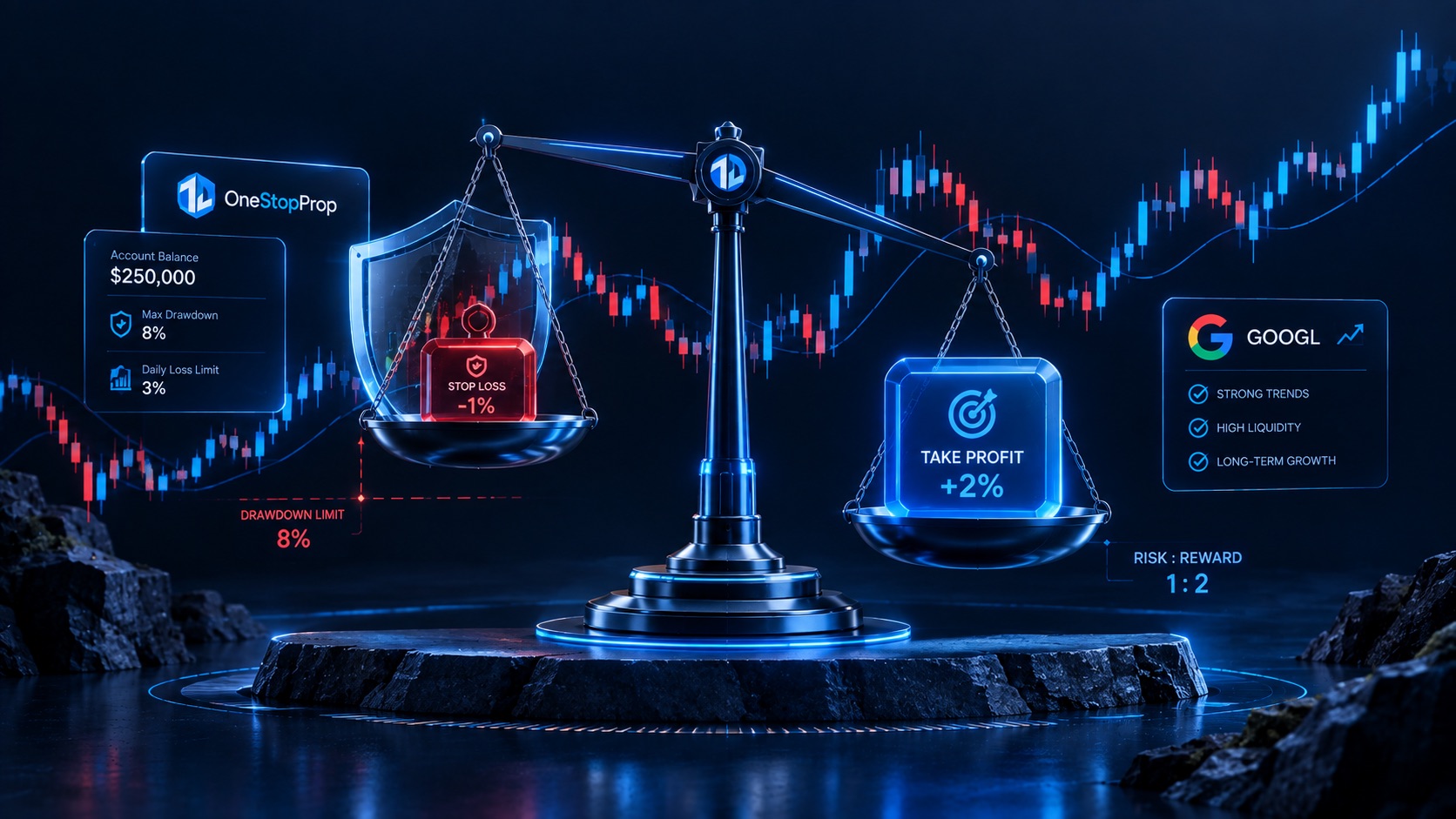
Target a minimum 1:2 risk-reward on every GOOGL trade. If your stop is $200 away, your target should be at least $400. This one rule, applied consistently, makes your challenge mathematics work in your favor even with a sub-50% win rate.
Common Mistakes When Trading GOOGL on a Prop Firm Account
Oversizing Into Earnings Volatility
GOOGL’s volatility remains elevated at 16.87% annualized, implying wide price swings for short-term traders. The fundamental picture shows solid revenue growth of 24.2% year-over-year alongside significant competitive pressures. That combination means GOOGL can move sharply in both directions on macro news or earnings surprises. Treating it like a slow-moving blue chip is a mistake. Size accordingly.
Ignoring Drawdown Type Until It Costs You
Some firms use trailing drawdown instead of static drawdown, which means the floor rises as your equity grows. This distinction matters because a profitable week can still shrink your safety margin if you do not understand how trailing drawdown works. A winning trade that moves your equity to a new high tightens your buffer on a trailing drawdown account. Build this into your position sizing from day 1, not after the fact.
Trading GOOGL Without an Overnight Holding Policy
GOOGL regularly gaps overnight on analyst upgrades, regulatory news, or AI-sector sentiment shifts. Holding a full-sized GOOGL position through the close without a clear overnight plan is a drawdown risk that has nothing to do with your analysis. OneStopProp’s funded account structure allows overnight holding, which gives you flexibility, but flexibility requires a deliberate plan. Decide before market close whether you hold, scale back to half-size, or close.
Pro Tip: Track GOOGL’s average daily range relative to your drawdown limit every week. When implied volatility rises (as it typically does heading into earnings), reduce position size proportionally. Let the market’s volatility expand while your dollar risk stays constant.
Scaling Your GOOGL Trading After Getting Funded
Getting funded is the beginning, not the destination. OneStopProp offers accounts from $10,000 to $300,000, with scaling options up to $1.2 million in total allocation. For a firm that allows traders to access stocks, forex, and crypto under a single funded account, that $1.2 million ceiling is meaningful relative to many competitors. If GOOGL is your primary instrument, that scaling structure means you can compound the same edge across progressively larger positions without switching firms or platforms.
OneStopProp’s financial structure is designed to maximize trader success: keep 100% of your first 5 payouts, then enjoy a generous 90/10 split ongoing. The OneStopProp payout structure also includes a bi-weekly payout schedule, with a daily payout option available as an add-on. If you are building toward a consistent income from stock trading, that payout frequency matters as much as the profit split percentage.
Standard scaling rules include a minimum profit target, a minimum trading period, profitable month requirements, payout requirements, positive account balance, drawdown compliance, and consistency standards. Build these milestones into your trading calendar like any other business objective. Consistent profitability on a $50,000 GOOGL trading account is the proof of concept that unlocks access to a $150,000 account.
Frequently Asked Questions
What is the difference between GOOGL and GOOG when trading at a prop firm?
Alphabet operates as 2 stocks A-class shares with voting rights trade under GOOGL, while C-class shares with no voting rights trade as GOOG. Most retail investors have little interest in voting on company affairs, and the C-class shares tend to trade at a slight discount to the A-shares due to this discrepancy. For most prop firm traders, the practical difference is minimal. Both track the same underlying business. Check which ticker your firm lists before placing a trade.
How much capital can I access to trade GOOGL at a prop firm?
A prop firm gives you access to a funded trading account, typically ranging from $10,000 to $200,000 or more, after you pass an evaluation process commonly called a challenge. You pay a one-time fee to attempt it, meet performance and risk targets over a set period, and if you pass, you receive a funded account. At OneStopProp, starting accounts range from $10,000 to $300,000, with scaling up to $1.2 million in total allocation for consistent performers.
Does GOOGL’s earnings volatility create a risk for my prop firm account?
It does, and you should plan for it directly. Risk management in a prop firm challenge comes down to one core principle: never risk more than your daily loss limit on any single trade, and structure your day so that if you take multiple losses, you stay within bounds. Around GOOGL earnings, this means reducing position size, checking your firm’s news trading restrictions, and treating the event as a volatility expansion period rather than a directional bet.
What makes Google (GOOGL) a good stock to trade in a prop firm context?
GOOGL combines high daily volume, consistent fundamental catalysts from quarterly earnings, and an AI-driven growth story that creates sustained price trends. In 2025, Alphabet’s revenue was $402.84 billion, an increase of 15.09% compared to the prior year, and earnings were $132.17 billion, an increase of 32.01%. Those compounding fundamentals, tracked via Stock Analysis’s GOOGL overview, translate into trending price action that rewards disciplined trend-followers and swing traders.
Can I hold GOOGL positions overnight on a prop firm account?
This depends on your firm’s rules. Many prop firms restrict overnight holding. OneStopProp allows overnight holding and has no restrictive profit targets, which gives stock traders meaningful flexibility, particularly for GOOGL, where multi-day trends around earnings or product announcements are common. Confirm overnight holding policy before placing any trade you intend to carry past the market close.
Start Trading GOOGL With Institutional Capital
Trading Alphabet (GOOGL) through a prop firm is one of the most practical ways to access institutional-level capital without the overhead of running a hedge fund or risking your personal savings. The steps are clear: choose a firm with real stock access, master the 5 core evaluation rules, build a GOOGL-specific position sizing framework, and scale consistently.
If you are ready to take the next step, OneStopProp’s funded account challenge offers one of the most trader-friendly structures for stock traders in 2026, stock access including the full Magnificent 7, overnight holding, no time limits on the challenge, and 100% profit splits on your first 5 payouts through the Pro Account.
Sources
- Alphabet Q4 2025 Earnings (Form 8-K), U.S. Securities and Exchange Commission. Official quarterly earnings filing. https://www.sec.gov/Archives/edgar/data/1652044/000165204426000012/googexhibit991q42025.htm
- Alphabet Q1 2026 Earnings (Form 8-K), U.S. Securities and Exchange Commission. Official quarterly earnings filing. https://www.sec.gov/Archives/edgar/data/1652044/000165204426000043/googexhibit991q12026.htm
- Alphabet Q2 2026 Earnings (Form 8-K), U.S. Securities and Exchange Commission. Official Q2 2026 results. https://www.sec.gov/Archives/edgar/data/0001652044/000165204426000066/googexhibit991q22026.htm
- GOOGL Stock Price & Overview, Stock Analysis. Revenue, earnings, and analyst data. https://stockanalysis.com/stocks/googl/
- Alphabet (GOOGL) Stock Price & Analysis, Tickzen. Volatility metrics and analyst consensus. https://tickzen.app/stocks/googl/overview
- GOOGL Technical Analysis, ChartMill. Daily volume and technical setup. https://www.chartmill.com/stock/quote/GOOG/technical-analysis
- Alphabet (GOOGL) Stock Quote, Investing.com. Live price and 52-week range data. https://www.investing.com/equities/google-inc
- Prop Trading Rules You Must Know, For Traders. Drawdown types, profit targets, and evaluation mechanics. https://fortraders.com/blog/prop-trading-rules-you-must-know-before-taking-a-challenge
- Prop Firm Drawdown Rules 2026: Static vs Trailing, Traders Second Brain. Drawdown structure comparison. https://traderssecondbrain.com/guides/prop-firm-drawdown-rules
- Risk Management in Prop Firm Challenges, TradeZella. Challenge risk framework. https://www.tradezella.com/blog/pass-prop-firm-challenge
- Best Prop Firms for Stock Traders 2026, OneStopProp. Stock-specific prop firm comparison. https://onestopprop.com/best-prop-firms-for-stock-traders-in-2026/
- Prop Firm vs Self-Funded Trading, OneStopProp. Capital comparison and behavioral data. https://onestopprop.com/prop-firm-vs-self-funded-trading/
- Why Traders Are Moving Away from Traditional Prop Firms, OneStopProp. Challenge structure and profit split details. https://onestopprop.com/why-traders-are-moving-away-from-traditional-prop-firms-the-onestopprop-difference/
- Funded Account Scaling Plan, OneStopProp. Scaling milestones and capital allocation ceiling. https://onestopprop.com/funded-account-scaling-plan/
- Prop Firm Trading Without Time Limits, OneStopProp. Payout frequency and challenge structure. https://onestopprop.com/prop-firm-trading-without-time-limits/
- Alphabet Q2 2026 Earnings: Revenue Up 24%, Cloud Surges 82%, Yahoo Finance. Revenue and cloud growth data. https://finance.yahoo.com/markets/stocks/articles/alphabet-q2-2026-earnings-revenue-203058727.html
- Funded Trading Rules Explained, Writofinance. Minimum trading day requirements. https://propjournal.net/guides/news-trading-prop-firms