You open the OneStopProp checkout and the first thing it asks is not how much money you want. It asks how you want to get funded.
Most traders skip past that question and go straight to the account size.
That is the wrong order.
The route you pick decides your profit target, your loss limits, how much of the profit you keep, and how the account behaves under pressure. The size only decides the dollars behind it.
Pick the wrong route and you will spend funded capital fighting a rule set that was never built for how you trade.
Here is a full breakdown of the three routes, the Add-Ons that sit on top of them, and how to match both to your strategy.
Key Takeaways
- You choose a route first, then a size: OneStopProp is built around three routes, 1 Step, 2 Step and Instant, with account sizes from $10K to $300K ($25K to $200K on Instant).
- The route sets the rules: at $100K, 1 Step and 2 Step run a 90% profit split, Instant runs 85%, and each route carries its own profit target and loss limits.
- Payouts are the same cadence across routes: withdrawals run every 14 days with a $150 minimum, and the consistency rule (25% on 1 Step and 2 Step, 20% on Instant) delays a payout rather than closing the account.
- Add-Ons are optional and bought separately: seven Add-Ons let you raise the split, unlock news trading, speed up withdrawals, double leverage, and loosen the loss limits, each priced as a percentage on top of the account.
- The account is refundable: OneStopProp refunds the account fee in full after your third payout, and the minimum withdrawal is $150.
Start With the Route, Not the Size
Every OneStopProp account is the same underneath. Real stocks, forex and crypto in one account, 1:50 leverage, no time limit to pass the challenge, and overnight and weekend holds allowed.
What changes from one route to the next is the path to funding and the rules you trade under once you are there.
These rules exist for a specific reason, and understanding them before you open an account saves you from a costly surprise later.
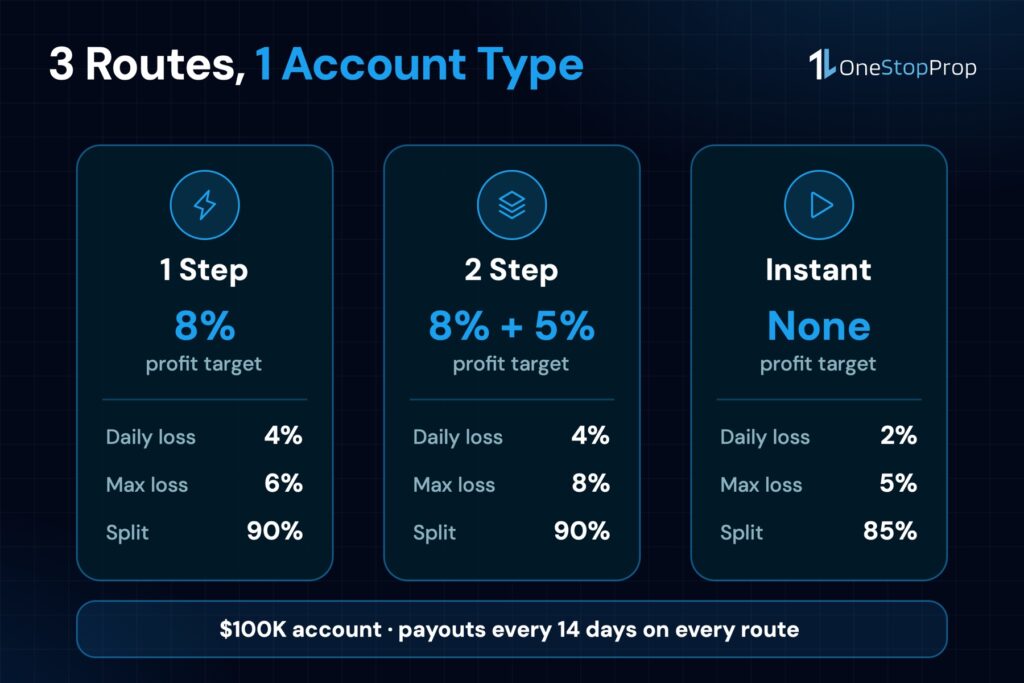
Account sizes run from $10K to $300K on 1 Step and 2 Step, and from $25K to $200K on Instant. The numbers below are for a $100K account so the three routes line up side by side.
The 1 Step Route
One evaluation phase, then you are funded.
On a $100K 1 Step account you hit a single 8% profit target to pass. Your limits are a 4% max daily loss and a 6% max total loss. Once funded, you keep 90% of the profit.
Payouts run every 14 days with a $150 minimum, you need 6 trading days in a cycle, and the consistency rule caps any single day at 25% of the period’s profit.
This is the most direct path to funding. One target, one phase, and you are trading real capital. It suits traders who are confident they can hit a clean target without a long drawn-out evaluation.
The 2 Step Route
Two evaluation phases, a slightly wider safety net.
On a $100K 2 Step account you clear an 8% target in phase one and a 5% target in phase two. The daily loss limit is 4%, the same as 1 Step, but the max total loss is wider at 8%. Funded, you keep 90% of the profit.
Payouts match 1 Step: every 14 days, $150 minimum, 6 trading days per cycle, and a 25% consistency rule.
The extra phase asks for more patience, but the wider 8% total loss buffer gives your strategy more room to breathe through a drawdown. It suits traders who want more margin for error on the way to funding and do not mind a second target.
The Instant Route
No evaluation at all. You start funded.
Instant has no profit target because there is no challenge to pass. In exchange, the risk rules are tighter: on a $100K account the max daily loss is 2% and the max total loss is 5%. The split is 85%, and the consistency rule is 20%.
Payouts still run every 14 days with a $150 minimum, and a cycle asks for 8 trading days. Account sizes on Instant run from $25K to $200K.
Instant is for traders who want to skip the evaluation entirely and are willing to trade inside tighter loss limits and a slightly lower split to do it. If waiting through a challenge is the part that trips you up, this is the route that removes it.
What Stays the Same Across All Three
A few things do not change no matter which route you pick.
Leverage is 1:50. Payouts run on a 14-day cycle with a $150 minimum withdrawal. The account fee is 100% refundable after your third payout. And you get the same instrument access: real stocks, forex and crypto in one account.
For a full breakdown of how prop firm payouts work for stock traders, including how withdrawal cycles are structured, that article covers the full picture.
The consistency rule is worth repeating because traders misread it most often. A single day that lands at 25% or more of the period’s profit (20% on Instant) does not close your account. It delays the payout until your profit is spread more evenly.
The Add-Ons: Build the Account Around Your Strategy
Once you have your route, the Add-Ons let you reshape the account. Each one is optional, priced as a percentage on top of the account fee, and bought at checkout. Here is what the seven do and who each one is for.
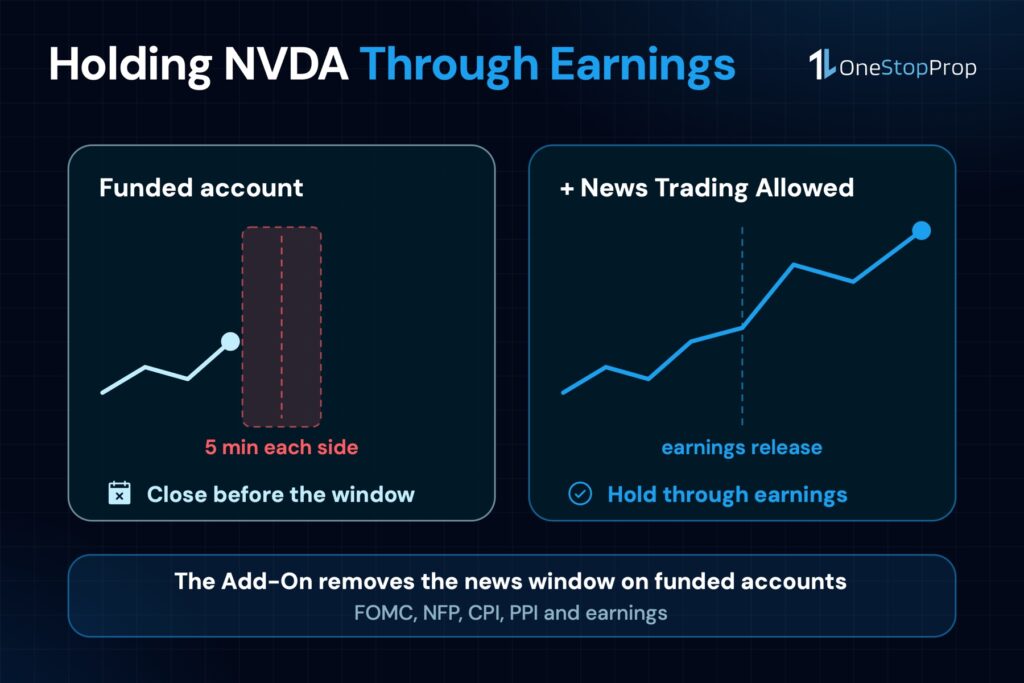
News Trading Allowed (+30%). By default, scheduled news events like FOMC, NFP, CPI, PPI and earnings carry a trading window around the release. This Add-On lets you trade through those events. If you hold positions into earnings or trade into a catalyst, this is the one you want.
Faster Payouts (+35%). With this Add-On, there are no minimum trading day requirements or waiting periods between payouts, provided all other account criteria are met. For traders who want access to their profit as soon as they have earned it, this removes the wait.
Lifetime Profit Split 95% (+15%). This raises your split to 95% and keeps it there for the life of the account. On a profitable account, this one pays for itself fast and is the first Add-On most consistent traders look at.
Double Leverage (+15%). Doubles the leverage on the account. For traders who run tight, well-defined risk and want more buying power behind each setup.
Account Double-Up (+50%). You instantly receive a second account of the same size. Two accounts, double the opportunity.
12% Max Total Loss + 6% Max Daily Loss, Special (+35%). Loosens the loss limits to a 12% total and 6% daily drawdown. For strategies that need more room through volatility and would otherwise get stopped out of the account by a normal swing.
Zero Profit Buffer (+50%). You are not required to reach or maintain a minimum buffer before requesting a payout. It is available on 1 Step, 2 Step and Instant, and all other payout requirements stay in place, except that an account with this Add-On is subject to a 15% consistency rule instead of 25% or 20%.
If You Trade News and Earnings
Earnings announcements are some of the most powerful single-session moves in the stock market.
Fidelity breaks down exactly how earnings events create tradeable volatility, and why some traders build their entire strategy around them.
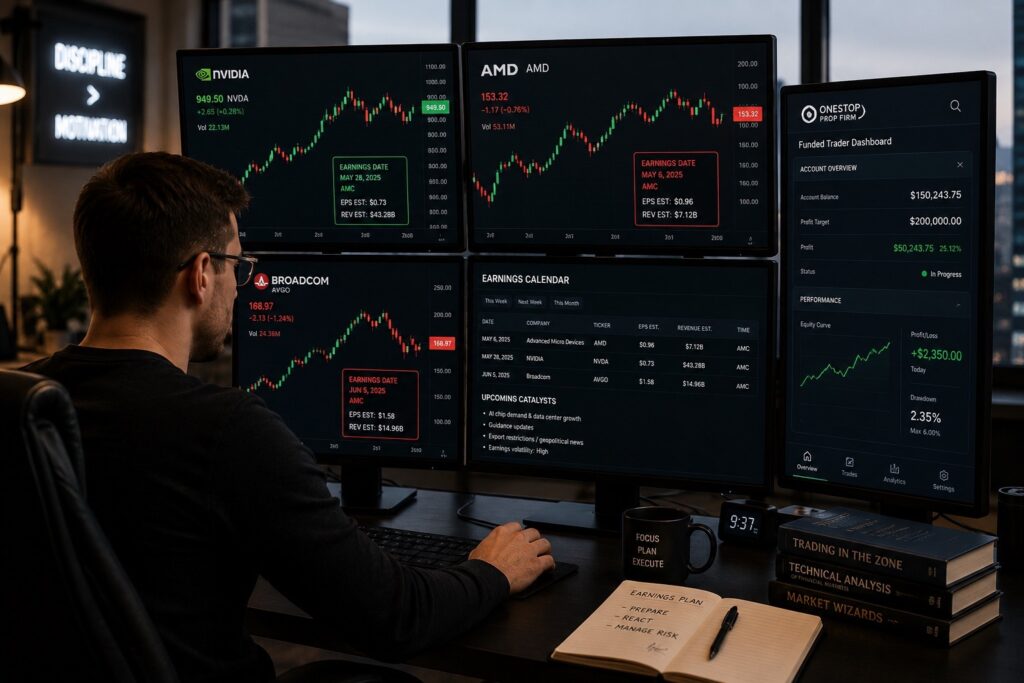
If you are trading AI names like NVDA, AMD or AVGO, those stocks generate their biggest moves around earnings and data center announcements.
To hold through those events, pick any route and add News Trading Allowed. Without it, you sit out the exact sessions your strategy is built around. With it, you can run event-driven setups on a funded account.
A Simple Way to Decide
There is a straightforward way to think through this. Start with the route, then layer the Add-Ons.
If you want the fastest path to funding, choose 1 Step. One target, one phase.
If you want more room for error through the evaluation, choose 2 Step. Two targets, but a wider 8% total loss buffer.
If you want to skip the challenge entirely, choose Instant. No target, tighter loss limits, start funded.
If you hold through news or earnings, add News Trading Allowed.
If you want to get paid without waiting, add Faster Payouts.
If you want to keep more of the profit, add Lifetime Profit Split 95%.
If your strategy needs more drawdown room, add the 12% Max Total Loss, 6% Max Daily Loss Special.
The traders who blow funded accounts after passing a challenge almost never do it because of the route they picked. They do it because of position sizing and risk management. Pick the route that fits your path to funding, then add only what your strategy actually uses.
Not sure which setup fits your current strategy? The One Stop Blueprint walks you through how to match your trading style to the right prop firm structure.
Same Instruments. Different Conditions.
One thing worth clarifying before you decide.
Every route gives you access to the same instruments. NVDA, AAPL, MSFT, AMD, AVGO are all available on 1 Step, 2 Step and Instant.
The instrument list at OneStopProp is broader than most prop firms.
Stock traders who have struggled in forex-focused firms usually find that access to real equities changes how they approach funded trading entirely.
The difference between the three routes is not what you can trade. It is the conditions under which you trade it, and the Add-Ons you choose to layer on top.
Conclusion
Choosing your OneStopProp account comes down to two decisions.
First, the route. 1 Step for the fastest path, 2 Step for more room on the way to funding, Instant to skip the evaluation. Each one carries its own profit target, loss limits and split.
Second, the Add-Ons. Start with the base account, then layer on only the ones your strategy uses: news trading, faster payouts, a higher split, more leverage, a bigger account, wider loss limits, or no profit buffer.
Know your strategy. Pick the route that fits it, then build the account around it.
OneStopProp is one of the few prop firms where stock traders can shape a funded account around how they actually trade.
If you are ready to get started, you can compare your options side by side here.
Frequently Asked Questions
What is the difference between 1 Step, 2 Step and Instant?
1 Step has a single evaluation phase, 2 Step has two phases with a wider total loss buffer, and Instant has no evaluation at all but tighter loss limits and an 85% split instead of 90%.
How often can I get paid?
Payouts run every 14 days with a $150 minimum withdrawal. With the Faster Payouts Add-On there are no minimum trading day requirements or waiting periods between payouts, provided all other account criteria are met.
Can I trade through news and earnings?
Scheduled news events carry a trading window by default. To hold positions through FOMC, NFP, CPI, PPI and earnings, add the News Trading Allowed Add-On to any route.
Is the account fee refundable?
Yes. OneStopProp refunds the account fee in full after your third payout.
What is the consistency rule?
No single day can make up 25% or more of a payout period’s profit on 1 Step and 2 Step, or 20% on Instant. Crossing that line delays the payout until your profit is spread more evenly. It does not close the account.