When we start the conversation of semiconductor stocks in a prop firm, everyone talks about NVDA.
And NVDA deserves the attention. It moves, has volume, and trades cleanly.
But NVDA is not the only semiconductor name worth knowing inside a prop firm challenge.
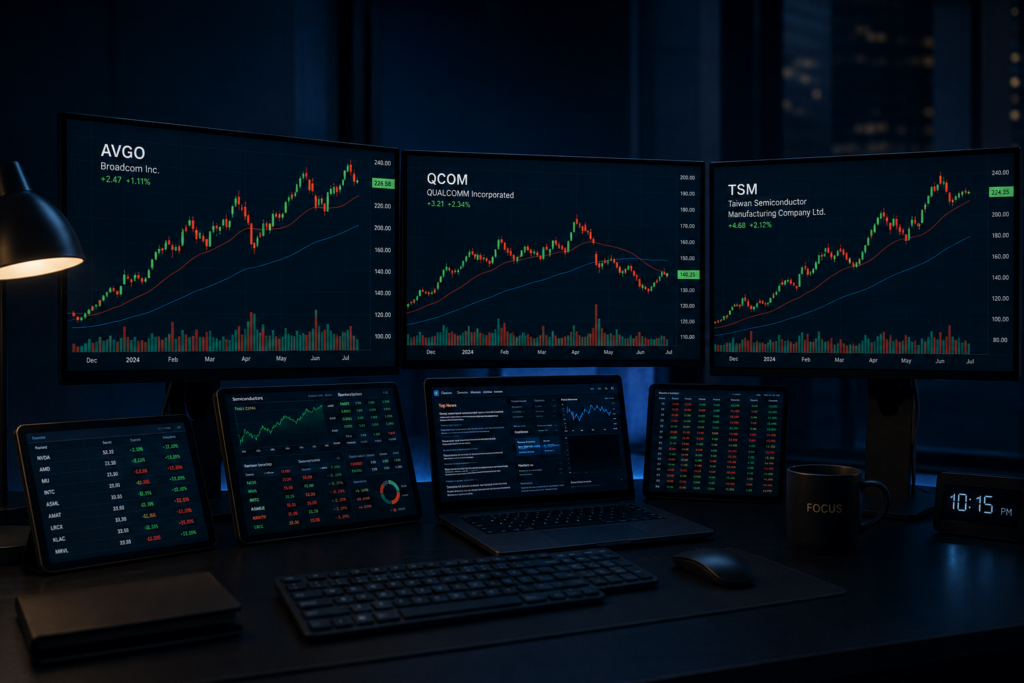
AVGO, QCOM, and TSM each trade differently from NVDA and from each other.
Understanding those differences matters more than most traders realize when they are inside an evaluation with a daily loss limit sitting above their head.
Key Takeaways
- Semiconductors are more than NVDA: AVGO, QCOM, and TSM each trade on their own catalysts (earnings, AI capital expenditure, export control news, Fed rate decisions) and each one moves differently, so treating them as interchangeable is the mistake.
- Daily range should set your position size: the article pegs NVDA around a 4% average daily range versus roughly 2% for QCOM, so size each name so a normal move against you does not reach the loss limit.
- The loss limit is what you size against: on a $100K 2-Step account at OneStopProp, the max daily loss is 4% ($4,000) and the max total loss is 8% ($8,000), with targets of 8% in Phase 1 and 5% in Phase 2.
- Earnings and geopolitics are the real gap risk: all three can move 8 to 12% on earnings, and a Taiwan Strait headline can move TSM 4 to 6% before the US open, which is why holding TSM overnight is also a geopolitical call.
- Holding overnight is allowed, which is why these setups work: OneStopProp has no time limit to pass and allows overnight and weekend holds, and pays 90% on 1-Step and 2-Step accounts, raised to 95% with the Lifetime Profit Split 95% Add-On.
Why Semiconductor Stocks in a Prop Firm Work Well
Semiconductor stocks share a few characteristics that make them well-suited for prop firm trading.
They are large-cap, highly liquid, and they trade on real earnings and real macro data instead of social media momentum.
That gives them something valuable: structure.
When NVDA moves 6%, it usually moves for a reason you can point to. An earnings beat. An AI infrastructure spending update. A competitor announcement.
The same is true for AVGO, QCOM, and TSM.
That reasonableness matters inside a challenge.
Random volatility with no identifiable cause is what destroys prop accounts.
Semiconductor names fit into the broader category of stocks that work cleanly inside a prop firm environment: liquid, structured, driven by identifiable catalysts.
AVGO: Broadcom Is Not What Most Traders Think It Is
A lot of traders see AVGO on the AI hype radar and assume it trades like NVDA when it doesn’t.
Broadcom is one of the largest semiconductor and infrastructure software companies in the world.
After the VMware acquisition closed in 2023, AVGO became significantly more diversified than a pure chip play.
What that means practically:
- AVGO tends to move less violently on AI narrative swings than NVDA
- Earnings quarters are event-driven but the stock often reacts in a more measured way
- It correlates with the broader SOX semiconductor index but also has software business exposure
For a prop firm challenge, AVGO can be a cleaner trade than NVDA on non-earnings days.
The daily move range tends to be tighter.
Which means more predictable risk.
The danger is earnings.
AVGO can gap 10% or more on a strong earnings beat. Hold through that unplanned and the daily loss limit is at serious risk if it goes the wrong way.
QCOM: The One Traders Underestimate
Qualcomm does not get the same attention as NVDA or AVGO.
That is actually an advantage.
QCOM is primarily a mobile chip company, with growing exposure to automotive and edge AI applications.
The trading characteristics are different from pure AI plays:
- Lower average daily volatility than NVDA
- More range-bound on non-catalyst days
- Cleaner intraday structure because it does not attract the same meme stock energy
For traders who prefer structured setups with defined levels, QCOM often delivers that more reliably than the higher-profile semiconductor names.
It still moves on AI sector news.
A broad semiconductor rally from an Nvidia earnings beat will lift QCOM.
But the beta is lower. Which means the swings are smaller. Which means the risk to a daily loss limit is more manageable on most days.
Understanding how the AI stock universe fits inside a prop firm helps traders identify where QCOM sits in the bigger picture: adjacent to the AI theme but with its own independent earnings cycle.
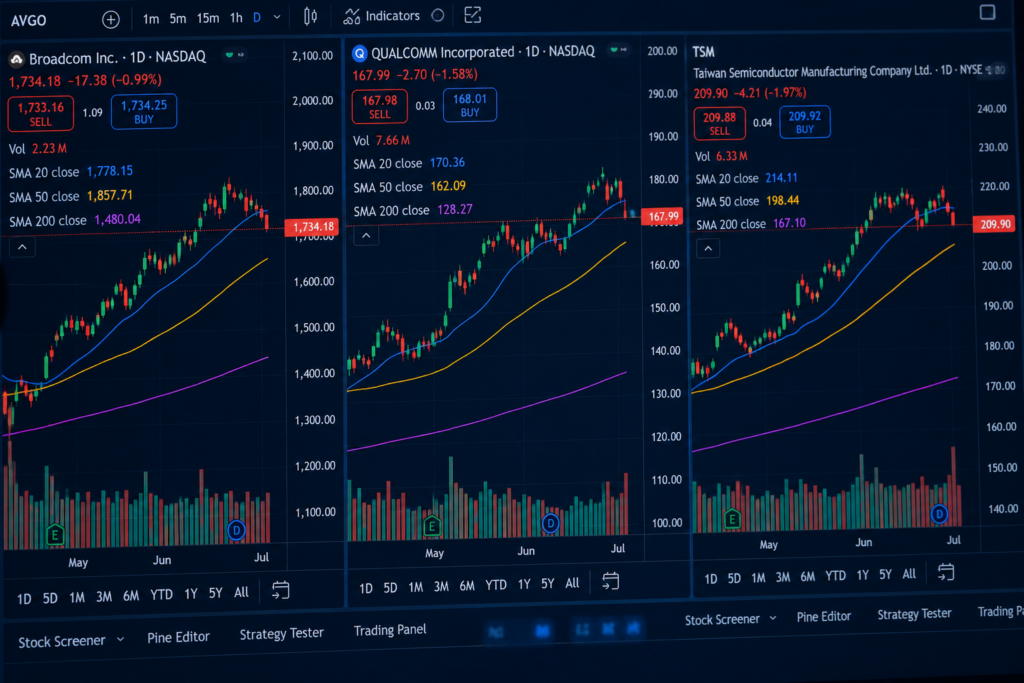
TSM: Taiwan Semiconductor Is a Different Animal
TSM is the most unique of the three.
Taiwan Semiconductor Manufacturing does not design chips. It makes them.
NVIDIA, Apple, AMD, Qualcomm: they all manufacture through TSMC.
That makes TSM a proxy for the entire semiconductor supply chain, not just one segment of it.
The trading implication is significant.
TSM responds to the same AI tailwinds that drive NVDA and AVGO.
But it also carries a risk layer that the others do not: geopolitical exposure.
Because TSMC’s primary manufacturing is based in Taiwan, geopolitical tension in the region can create overnight gap moves in TSM that have nothing to do with earnings, AI spending, or chip demand.
A news headline about Taiwan Strait activity can move TSM 4 to 6% before the US market opens.
That is a gap risk profile that is genuinely different from NVDA or QCOM.
Inside a prop firm challenge, that distinction matters.
Holding TSM overnight is not just an earnings call. It is a geopolitical call.
Most traders do not think about it that way until they get caught by it once.
Want a clear framework for trading stocks inside a prop firm challenge without blowing up on risk events?
The One Stop Blueprint covers exactly that. It is free: get it here.
What All Three Have in Common for Prop Trading
Despite their differences, AVGO, QCOM, and TSM share characteristics that make them manageable inside an evaluation.
They are all high-liquidity names.
Tight bid-ask spreads. Deep order books. Entries and exits execute cleanly without significant slippage.
They all move on identifiable catalysts: earnings, AI capital expenditure announcements, export control news, Fed rate decisions.
They all have significant options activity, which means there is usually a clear idea of where the market expects movement around major events.
And they all trade with enough volume that technical levels tend to hold.
That last point is underappreciated.
When support and resistance levels hold in a liquid large-cap, it gives you a framework.
A framework means a defined entry. A defined stop. And a defined risk per trade.
That is exactly what successful trading strategies inside prop firm challenges are built on: defined risk, not hope.
The SOX Index: Your Leading Indicator for All Three
If you are trading AVGO, QCOM, or TSM inside a challenge, the Philadelphia Semiconductor Index (SOX) deserves your attention every morning before you open a position.
The SOX is a basket of the largest semiconductor companies in the US market.
When the SOX is running, individual semiconductor names tend to follow.
When the SOX breaks support, it can pull down individual names even if their own fundamentals are fine.
Trading semiconductor stocks without checking the SOX is like trading AAPL without checking the broader tech sector.
You might be right about the stock and still lose to sector-level pressure.
The habit of checking SOX direction before entering AVGO, QCOM, or TSM positions adds context that reduces surprises inside a challenge.
Sizing These Positions Inside a Challenge
The daily volatility profile of each name should directly inform position size.
NVDA with a 4% average daily range requires tighter sizing than QCOM with a 2% average daily range.
The logic is simple: your position size should be calibrated so that a normal daily move against you does not touch the daily loss limit.
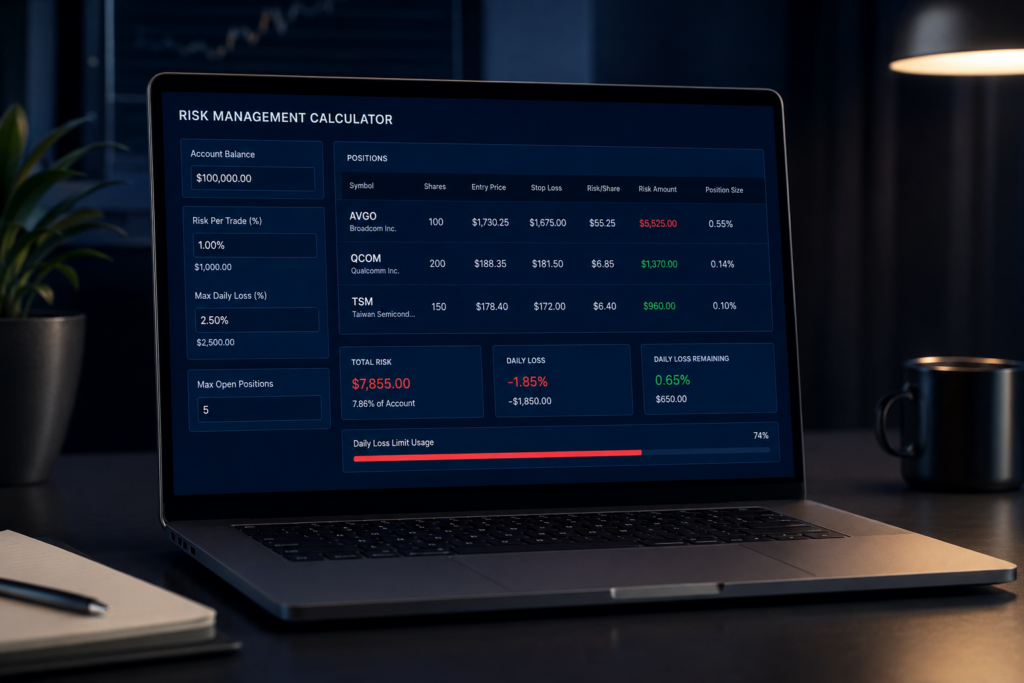
For a $100,000 prop firm account with a 4% daily loss limit ($4,000 max loss per day), the math looks like this:
- A 2% adverse move in a $50,000 QCOM position = $1,000 loss
- A 4% adverse move in a $50,000 AVGO position = $2,000 loss
- A 6% adverse move in a $50,000 TSM position on geopolitical news = $3,000 loss
None of those touch the daily limit by themselves.
But stack two of them and the day is over.
This is why traders who survive prop firm challenges with semiconductor stocks tend to trade one or two names per day maximum.
Not because they lack confidence in the others, it’s because concentration protects the account.
The max daily loss rule explained using real stock examples is worth reviewing before you build a sizing framework around these names.
The Earnings Calendar Is Not Optional
Before entering any position in AVGO, QCOM, or TSM, check the earnings date.
Not approximate. Exact.
All three can move 8 to 12% on earnings.
AVGO in particular has shown massive single-day moves when AI infrastructure demand data surprises the market.
Inside a prop firm challenge, an unplanned 10% gap against you on overnight earnings is not bad luck.
It’s a risk management failure.
The fix is straightforward: either close the position before earnings or size down significantly so the worst-case scenario does not threaten the account.
Most experienced funded traders pick one.
Very few try to hold through earnings at full size.
The reward is not worth the risk when the account itself is on the line.
The broader framework for protecting a funded account from the rules that end challenges applies directly here: know the risk events before they happen, not after.
Trading semiconductor stocks inside a prop firm requires a clear system.
The One Stop Blueprint lays out the challenge process, risk rules, and execution habits that funded traders use. It is free: download it here.
Which One Should You Focus On?
Honestly, that depends on your trading style.
If you prefer momentum with higher volatility and do not mind earnings risk: AVGO.
If you prefer structure, cleaner intraday setups, and lower daily swings: QCOM.
If you want broad semiconductor sector exposure and understand geopolitical risk: TSM.
None of them are wrong.
The mistake is treating them as interchangeable.
They each have a personality.
Trading QCOM like you trade NVDA will get you in trouble.
Trading TSM without knowing the geopolitical risk layer is a blind spot waiting to hit you.
Learn the one that fits your style first.
Get familiar with how it moves in different market conditions.
Then add the others as you build confidence.
OneStopProp lets you trade these names directly inside a funded challenge alongside the AI stocks the firm is specifically built for.
The stock-focused structure means you are not forced into forex setups when semiconductor momentum is the better opportunity.
Conclusion
Semiconductor stocks are not just NVDA.
AVGO, QCOM, and TSM each offer distinct advantages depending on what kind of trader you are.
They are all liquid enough for clean execution inside a challenge.
They all move on identifiable catalysts.
And they all reward traders who understand the difference between a normal trading day and an earnings-week risk event.
That awareness is what separates traders who survive challenges from the ones who get caught by a gap they did not see coming.