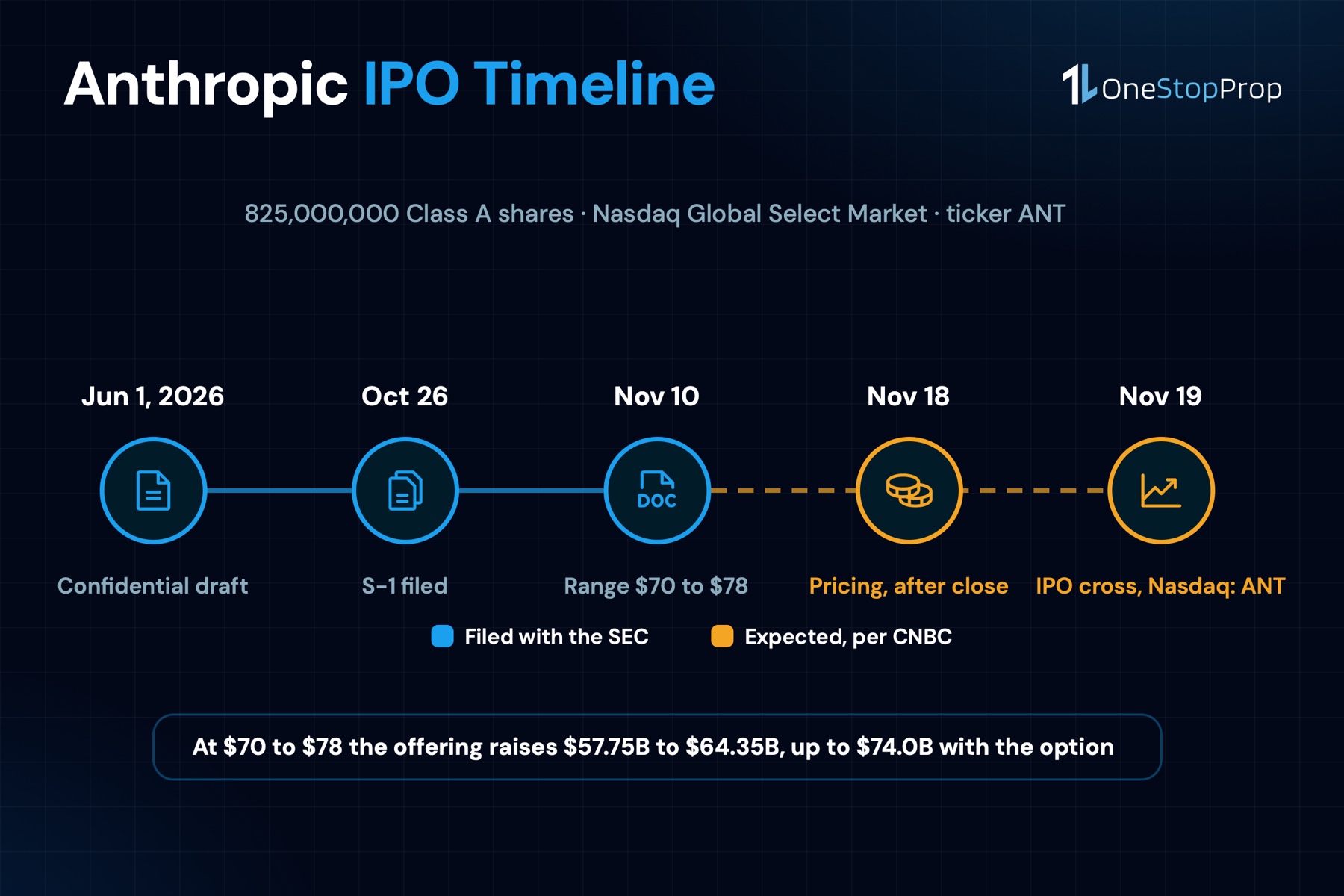
Type anthropic ipo into a search bar on Tuesday, November 17, 2026, and the most useful thing to know is that the stock does not exist yet. Anthropic, the company behind the Claude models, is expected to price its initial public offering on Wednesday, November 18, after the close, and its Class A shares are expected to begin trading on the Nasdaq Global Select Market under the ticker ANT on Thursday, November 19.
The filed terms are public: 825 million shares at $70 to $78, which would raise $57.75 billion to $64.35 billion before the underwriters’ option, with a lock-up of 180 days for most holders. What is not public is the number that matters to a trader. The price of the first trade will be set by a Nasdaq cross some time after 9:30 AM ET on Thursday, not by the prospectus.
This guide measures what 7 of the biggest U.S. IPOs since 2023 did on their first day and over the 20 sessions after, from Arm to SpaceX, and puts that range against the daily loss limit of a funded account. The direction of ANT on day 1 is unknown. The size of the move, going by those 7, is not a mystery.
Key Takeaways
- The terms are filed, the price is not. The November 10 S-1/A puts the range at $70 to $78 for 825 million shares on the Nasdaq Global Select Market under ANT. CNBC reports pricing on November 18 and trading on November 19. The final price lands after the close on the 18th.
- The offer price is not your entry. Of the 7 big IPOs measured, 6 opened above their offer price, by a median of 38%. Figma opened 158% above. The first trade is an IPO cross that Nasdaq runs after a 15-minute display-only period and an open-ended pre-launch period, so the stock can start trading long after the bell.
- Day 1 is wide. The median high-to-low range on the first day was 24.7% of the opening price, from 11.5% (CoreWeave) to 57.6% (Circle). 6 of 7 closed above their open; the median dip below the first print was 3.9%, the worst 14.3% (Cerebras).
- The 20 days after were worse than the day. 5 of the 7 were below their day-1 close 20 sessions later, and the median move across the 7 was 14.0% down. None was below its offer price.
- 300 shares at $75 is more than a $100K account’s daily limit. A 24.7% range on a $75 stock is $18.50 a share. 300 shares is $5,550 of range against a $4,000 daily limit on a $100K 1 Step or 2 Step account, and a $2,000 limit on Instant.
What the Anthropic IPO Is Selling, From the S-1/A
Everything in this section comes from the amended registration statement Anthropic filed with the SEC on November 10, 2026, available on EDGAR, and from the deal page on Nasdaq.
| Term | Filed value |
|---|---|
| Shares offered | 825,000,000 Class A shares: 801,351,354 sold by the company, 23,648,646 by selling stockholders |
| Price range | $70.00 to $78.00 per share |
| Underwriters’ option | Up to 123,750,000 additional shares |
| Exchange and ticker | Nasdaq Global Select Market, ANT |
| Money raised at the range | $57.75 billion to $64.35 billion, up to $74.0 billion with the option, before expenses |
| Shares outstanding after the offering | 13,086,672,593 across all classes, including the private placement |
| Lock-up | 180 days for most holders, 365 days for co-founders and holders above 0.5%, with early release provisions |
| Banks | Goldman Sachs, Morgan Stanley and J.P. Morgan listed first, 22 underwriters in all |
A few terms that will shape the first weeks of trading.
The company is a public benefit corporation. Anthropic, PBC is incorporated in Delaware as a public benefit corporation, and its Long-Term Benefit Trust elects a majority of the board through a special class of stock. For a trader it means the Class A shares you can buy do not elect most of the board.
$26 billion is being bought alongside the IPO, at the IPO price. AMD, Broadcom, Google, Micron, Microsoft, Nvidia and TSMC have agreed to buy an aggregate of $26.0 billion of Class N stock in a private placement priced at the IPO price. Those shares are not registered in the offering and are not subject to the underwriters’ lock-up.
Part of the lock-up releases on day 1. The S-1/A says up to 10% of the locked shares held by non-founder directors, officers and current and former employees may be transferred from the first trading day, and that about 3.6 billion shares under the 180-day lock-up may become eligible for sale before it expires. Supply on listing day is not limited to the 825 million shares in the offering.
Retail gets a slice. The filing says a portion of the shares will, at the company’s request, be offered to retail investors through Charles Schwab, Fidelity, Robinhood, Trade-PMR, SoFi and E*TRADE. CNBC reports the company is targeting a retail allocation of about 20%, against 5% to 10% in a typical IPO.
On valuation, the arithmetic depends on which share count you use. On the 13.09 billion shares the S-1/A says will be outstanding after the offering and the private placement, $70 to $78 is $916 billion to $1.02 trillion. CNBC reports a fully diluted valuation of up to $1.405 trillion at the top of the range. Revenue for the quarter ended September 30, 2026 was $17.0 billion, per the company’s own description on Nasdaq’s deal page.
The Anthropic IPO Timeline: November 18 and November 19
The public record runs like this. Anthropic filed a confidential draft registration statement on June 1, 2026, the public S-1 on October 26, and amendments on November 2 and November 10, the second of which carried the price range. Nasdaq’s IPO calendar lists ANT with an expected date of November 19, and notes that expected dates are estimated from the filings and are not official.
Wednesday, November 18, after the close: pricing. CNBC reports, citing people familiar with the plans, that the company intends to price on November 18 and trade on November 19. Pricing means the company and the underwriters set the single price at which the 825 million shares go to the investors who received allocations, inside the range, above it or below it.
As of Tuesday, November 17, that number is not set. The range is $70 to $78, and anyone quoting a precise ANT price before the evening of the 18th is quoting a guess.
Thursday, November 19, from 9:30 AM ET: the cross, not the open. On Nasdaq, an IPO does not trade at 9:30. The stock opens in a halt. Nasdaq’s rules, described in a notice the SEC published in the Federal Register, set a 15-minute Display Only Period in which members enter and cancel orders, followed by a Pre-Launch Period that has no fixed length. Every 5 seconds, Nasdaq disseminates a Current Reference Price: an indication of where the IPO cross would execute if it ran at that moment.
The Pre-Launch Period continues until the underwriter tells Nasdaq the security is ready to trade and there is no order imbalance, and the underwriter selects price bands around the expected price so the cross cannot print far from it. Only then does the IPO cross execute, and that single print is the opening price. The rule puts no cap on how long the Pre-Launch Period can run. SpaceX’s first print on June 12, 2026 was $150.00 against a $135 offer price, per Nasdaq’s daily data.
After the cross: Limit Up-Limit Down applies. Once ANT is trading, it is an NMS stock under the Limit Up-Limit Down plan, which the LULD Plan site describes and the NYSE summarizes on its trading information page. Trades cannot occur outside price bands set a percentage above and below the average price of the prior 5 minutes. Tier 1 is the S&P 500, the Russell 1000 and select ETPs, with 5% bands above $3; everything else is Tier 2, with 10% bands.
A stock listing for the first time is in neither index on day 1, so ANT starts under the 10% bands. When the best bid or offer sits at a band for 15 seconds, the listing exchange declares a 5-minute trading pause. A new listing that moves 25% in a day can spend part of it paused, and the guide to trading halts covers what happens to a stop inside a pause: nothing fills until the reopen.
Pro Tip: on November 19, treat the first Current Reference Price you see as information. It will move for an hour or more as orders come in and get cancelled. The number that matters is the cross price, and the first 5-minute bar after it is the first real evidence of where the buyers and the sellers actually are.
What 7 Big IPOs Did on Day 1 and in the Next 20 Sessions
The claim that IPOs pop is easy to make and easy to check. This measurement took the daily open, high, low, close and volume from Nasdaq’s quote data for the 7 largest first-time U.S. listings since 2023 that drew ANT-scale attention, and the offer price and listing date from Nasdaq’s IPO calendar. SpaceX’s figures were cross-checked against the candles used in the SPCX listing-day guide.
| IPO | Day 1 | Offer | Open vs offer | Close vs open | Day-1 range | Low vs open | 20 sessions later vs day-1 close |
|---|---|---|---|---|---|---|---|
| Arm (ARM) | Sep 14, 2023 | $51 | +10.0% | +13.4% | 19.1% | -1.0% | -14.0% |
| Reddit (RDDT) | Mar 21, 2024 | $34 | +38.2% | +7.3% | 27.1% | -4.1% | -17.3% |
| CoreWeave (CRWV) | Mar 28, 2025 | $40 | -2.5% | +2.6% | 11.5% | -3.9% | +3.8% |
| Circle (CRCL) | Jun 5, 2025 | $31 | +122.6% | +20.6% | 57.6% | -7.2% | +126.8% |
| Figma (FIG) | Jul 31, 2025 | $33 | +157.6% | +35.9% | 47.7% | -1.1% | -39.5% |
| Cerebras (CBRS) | May 14, 2026 | $185 | +89.2% | -11.1% | 24.7% | -14.3% | -27.2% |
| SpaceX (SPCX) | Jun 12, 2026 | $135 | +11.1% | +7.3% | 18.1% | -0.4% | -13.6% |
The day-1 range is the high minus the low as a share of the opening price. SK hynix’s Nasdaq listing of July 10, 2026 was measured too (open 14.1% above its $149 offer, a 6.4% range, down 14.6% at 20 sessions) but left out of the summary, because the company already traded in Korea and its U.S. shares had a price to anchor to.
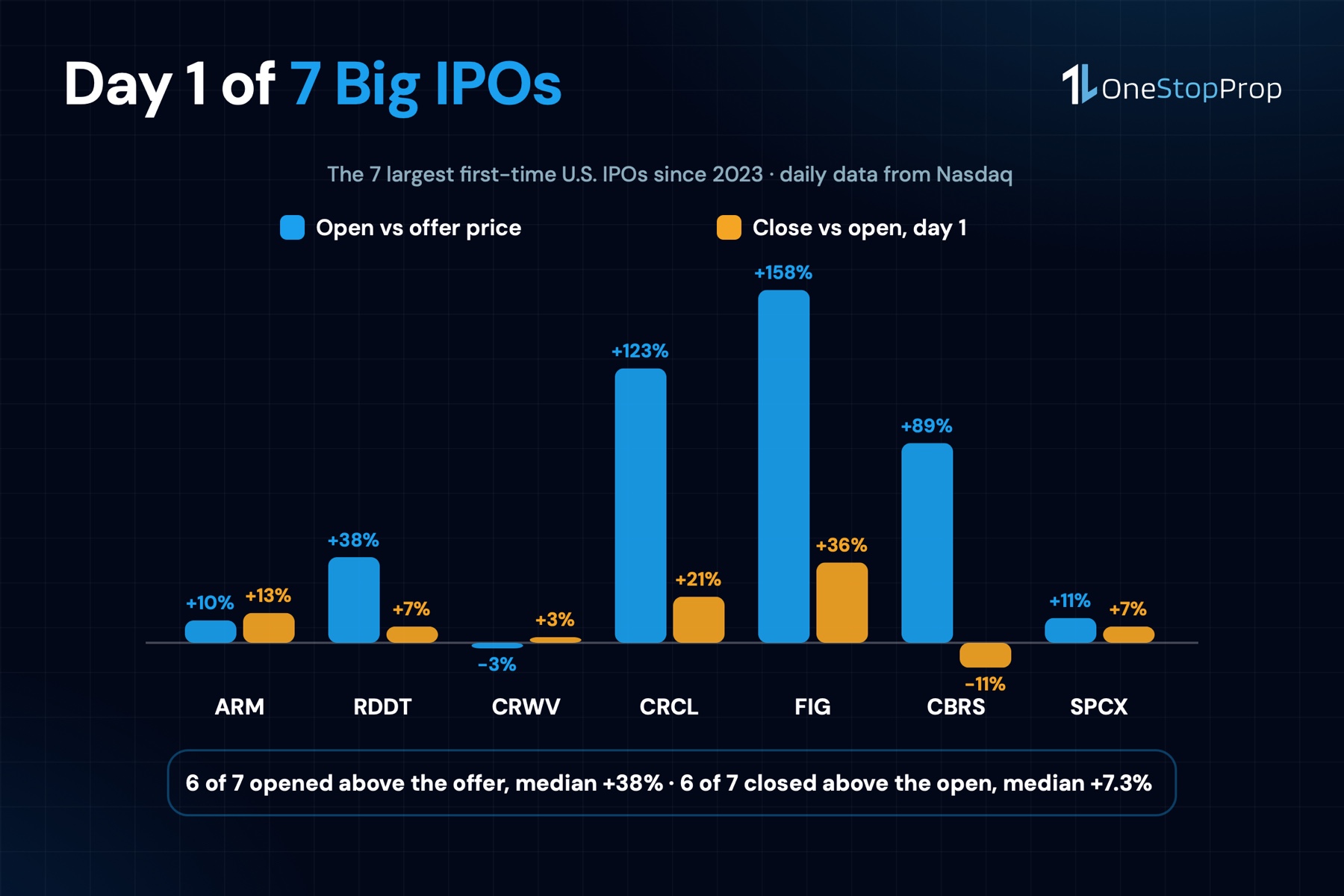
5 readings from the 7.
The offer price was almost never available. 6 of 7 opened above the offer price, by a median of 38.2%. Only CoreWeave opened below, by 2.5%, and it closed the day at exactly its $40 offer. A trader who plans around the offer price is planning around a price that, on this record, the open market did not offer.
The first day mostly held its open. 6 of 7 closed above the first print, by a median of 7.3%. The exception was Cerebras, which opened 89% above its offer and closed 11.1% below that open.
The range was the risk. The median day-1 range was 24.7% of the open. The median dip below the open was 3.9%, and the worst was 14.3%. On a stock that first prints at $100, those are $24.70 of range, a $3.90 median dip and a $14.30 worst dip, all inside 1 session.
The month after gave it back. 5 of 7 were below their day-1 close 20 sessions later, the median move across the 7 was 14.0% down, and the 2 that were higher, CoreWeave and Circle, were the 2 with the smallest and the largest day-1 pop. None of the 7 was below its offer price at 20 sessions.
Day 1 was the volume peak 5 times out of 7. Arm, Reddit, Figma, Cerebras and SpaceX all printed their highest-volume session on listing day; SpaceX traded 522 million shares. CoreWeave’s peak came on day 38 and Circle’s on day 12. For a stock with no history, relative volume has nothing to compare against on day 1; the day-1 figure becomes the baseline.
ANT Stock on a Funded Account: the Range Against the Daily Limit
Here is how those numbers meet the rules of a funded account.
On OneStopProp the maximum daily loss is 4% of the initial balance on 1 Step and 2 Step accounts and 2% on Instant, measured at the 12:00 AM EST day change from the higher of balance or equity, as the Help Center’s maximum daily loss page describes. On a $100K account that is $4,000 on 1 Step and 2 Step, and $2,000 on Instant. The maximum total loss is 6% on 1 Step, 8% on 2 Step and 5% on Instant.
OneStopProp is adding ANT to its stock list for listing day, so a funded account can trade it from its first session, long or short, with the same daily and total loss limits as the rest of the list. OneStopProp is the only prop firm offering ANT at launch. The full list of U.S. stocks lives on the Help Center’s what instruments can I trade page.
For IPO week there is a code as well: ANT takes 30% off any OneStopProp challenge at checkout and adds 2 free Add-Ons, through Thursday, November 19.
Take a working price of $75 a share, close to the midpoint of the filed range, and a day-1 range equal to the measured median of 24.7%. That is $18.50 of range per share. The median dip below the first print, 3.9%, is $2.93 a share.
| Position at $75 | Exposure | Full day-1 range (24.7%, $18.50 a share) | Share of $4,000 limit (1 Step, 2 Step) | Share of $2,000 limit (Instant) | Median dip from the open (3.9%) |
|---|---|---|---|---|---|
| 100 shares | $7,500 | $1,850 | 46% | 93% | $293 |
| 200 shares | $15,000 | $3,700 | 93% | 185% | $586 |
| 300 shares | $22,500 | $5,550 | 139% | 278% | $879 |
The table says 2 things. First, if ANT does what the median did, 200 shares on a $100K 1 Step or 2 Step account can travel 93% of the daily limit in 1 session, and on Instant it is more than the limit. A stop set inside a 24.7% range is a stop that gets found.
Second, if the first print is higher than $75, which 6 of 7 precedents say to expect, every dollar figure scales up with it. A $100 first print turns 200 shares into $4,940 of range.
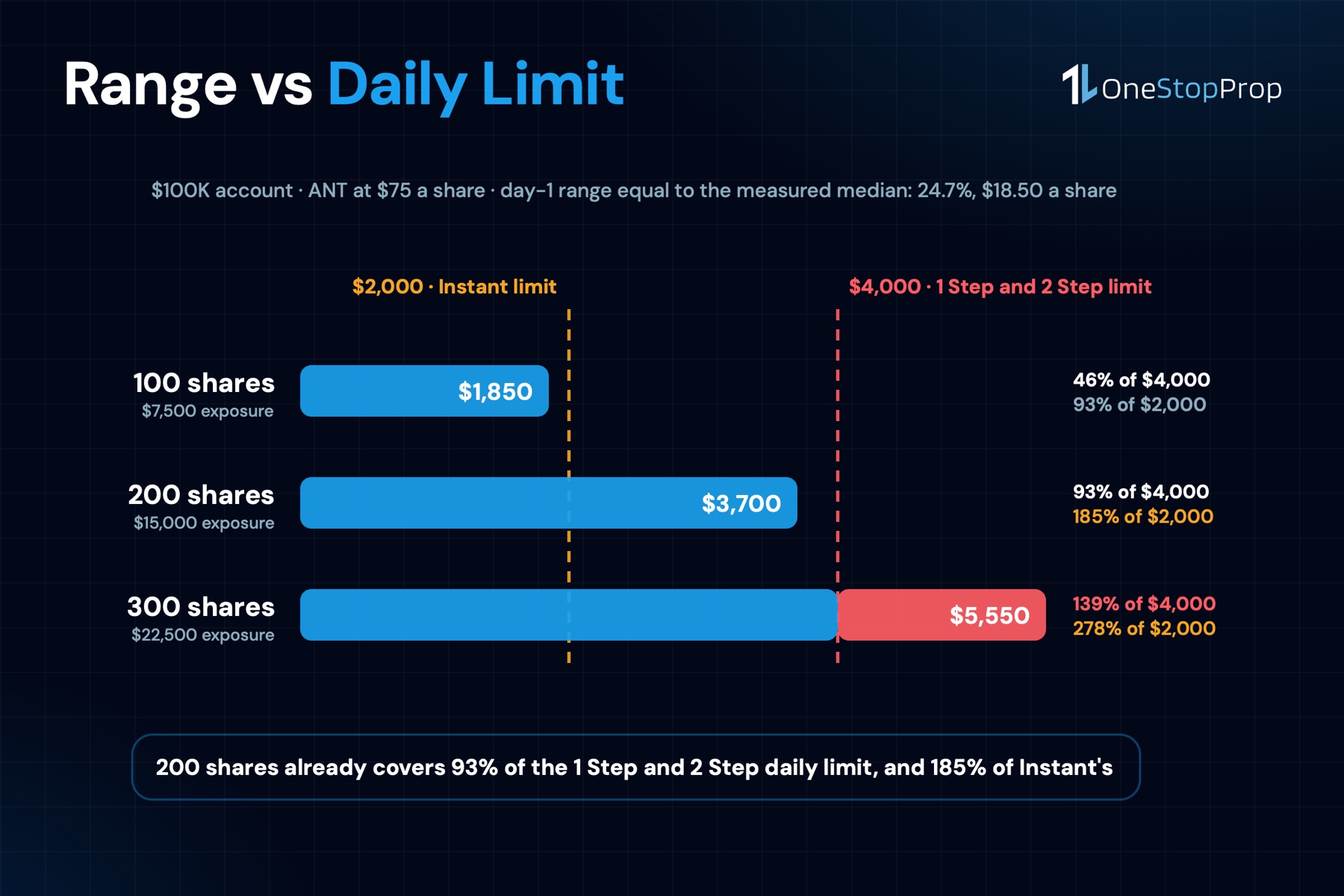
The Cerebras case is the one to size for. A 14.3% dip from the open on 300 shares at $75 is $3,218, 80% of the $4,000 limit on 1 Step and 2 Step, and 161% of the Instant limit, before the stock does anything else.
3 more rules apply on the day.
Shorting is allowed on all instruments. The Help Center’s answer to is shorting allowed is yes, on forex, crypto and stocks, and on a stock CFD a short is a sell order with no borrow and no locate, as the how to short a stock guide explains. Whether a particular instrument is available on a particular day is a question for the instrument list. A short on a stock that opened 89% above its offer and ran another 20% is sized as carefully as the long.
Halts are a reason to be flat. The Help Center’s page on halts and abnormal trading conditions says OneStopProp strongly recommends closing positions during halts, flash crashes and unexpected volatility spikes, and that trades placed in those periods on a funded account may be reviewed. An IPO that hits a LULD band is exactly that situation.
Overnight is allowed, and the gap is yours. You can hold ANT overnight and over weekends. The record says the median move 20 sessions after the first day was 14% down, and that Reddit and Figma both traded more than 26% below their day-1 close inside those 20 sessions.
Pro Tip: decide the dollar risk before the cross prints, then divide it by the distance you are willing to be wrong by, in dollars per share. $500 of risk and a $5 stop is 100 shares whether ANT opens at $75 or $110. If you size by dollars of exposure instead, the higher the open, the bigger the position you end up holding into the widest day the stock will ever have.
A 5-Step Plan for Trading ANT Stock on Listing Day
- Know the price on Wednesday night. The final offer price lands after the close on November 18. Write it down, and write down 1.38 times that number: on the median of the 7 precedents, that is roughly where the open landed. Neither is a target; both show how far the crowd has moved before you can click.
- Watch the Current Reference Price, trade the cross. Nasdaq publishes the indication every 5 seconds during the Display Only and Pre-Launch Periods. The opening print is the first real number, and the first 5-minute bar after it is the first range you can measure.
- Size for 25%, place the stop inside 4%. The median day-1 range was 24.7%. Use that to pick a share count that keeps the full range inside the daily limit, then place a stop that costs a fraction of it. On a $100K 1 Step or 2 Step account, 100 shares at $75 keeps the full median range at 46% of the $4,000 limit.
- Respect the bands. If ANT pauses under Limit Up-Limit Down, a stop does not fill until the reopen, and the reopen can be far from the band. The size you chose is the protection that still works inside a pause, which is why step 3 comes before any entry.
- Decide the hold before the close. The 20-session record is 5 of 7 lower, with a median move of 14% down. Holding without a written reason for why this one is CoreWeave or Circle rather than Figma or Cerebras is a guess with the account as collateral.
One scheduling note for the week. Nvidia reports earnings on Tuesday, November 17 after the close, the evening before Anthropic prices, per CNBC’s week-ahead coverage. On a funded account without the News Trading Allowed Add-On, individual stock earnings are inside the 5-minute restricted window, which applies to positions in NVDA. ANT has no earnings date yet.
Common Mistakes on Listing Day
Planning around the offer price
6 of 7 big IPOs opened above their offer price, by a median of 38%. The $70 to $78 range tells you what allocation holders paid, little about where you will be able to buy.
Treating 9:30 AM as the open
An IPO on Nasdaq opens in a halt. The first trade comes from the IPO cross after the Display Only and Pre-Launch Periods, when the underwriter says the book is ready.
Sizing ANT like a stock with a chart
300 shares of a $75 stock is a normal position on a name that moves 2% a day. On a name whose median first-day range is 24.7%, it is $5,550 of range against a $4,000 daily limit on a $100K 1 Step or 2 Step account.
Adding during a pause
A stock sitting on a LULD band has no price for 5 minutes. On a funded account, OneStopProp recommends closing positions during halts and abnormal conditions, and trades placed during them may be reviewed.
Buying the day for the month
5 of the 7 precedents were below their day-1 close 20 sessions later, and the median move across the 7 was 14% down.
Frequently Asked Questions
When is the Anthropic IPO?
Anthropic is expected to price its IPO on Wednesday, November 18, 2026, after the close, and its Class A shares are expected to begin trading on the Nasdaq Global Select Market under the ticker ANT on Thursday, November 19, according to CNBC, citing people familiar with the plans. Nasdaq’s IPO calendar lists November 19 as the expected date.
What is the Anthropic IPO price?
The November 10 S-1/A estimates a price between $70.00 and $78.00 per share for 825,000,000 Class A shares. The final price is set at pricing, after the close on November 18, and can be inside, above or below that range.
What will ANT trade at when it opens?
Nobody knows until the IPO cross executes on November 19. The 7 largest first-time U.S. IPOs since 2023 opened a median of 38.2% above their offer price, with 1 opening below it.
How much could ANT move on its first day?
The measured median day-1 range of those 7 IPOs was 24.7% of the opening price, with a low of 11.5% (CoreWeave) and a high of 57.6% (Circle). The median dip below the first print was 3.9% and the deepest was 14.3% (Cerebras).
Can you trade ANT on a funded account?
Yes. OneStopProp is adding ANT to its U.S. stock list for listing day, so a funded account can trade it from the first session, long or short, with the same daily and total loss limits as the rest of the list. The daily limit is 4% of the initial balance on 1 Step and 2 Step and 2% on Instant. OneStopProp is the only prop firm offering ANT at launch; the Help Center’s instrument list carries the full list.
When does the Anthropic lock-up expire?
The S-1/A sets a lock-up of 180 days for most holders and 365 days for co-founders and holders of more than 0.5% of fully diluted shares, with early release provisions: up to 10% of the locked shares held by non-founder directors, officers and employees may be sold from the first trading day, and about 3.6 billion shares may become eligible before the 180 days end.
The Bottom Line
The Anthropic IPO is the biggest U.S. listing since SpaceX in June, going by the filed range. The filed terms are clear: 825 million shares, $70 to $78, Nasdaq, ANT, pricing after the close on November 18 and a first trade on November 19 that Nasdaq’s cross will set some time after the bell.
The precedents are clear too. 6 of 7 opened far above the offer, the median first day covered a quarter of the stock’s price, and 5 of 7 were lower a month later. The trader who does well on November 19 sized for a 25% range before the cross printed, kept the stop inside the daily limit and treated the 20-session record as the real calendar.
If you want to trade ANT on listing day, long or short, with those limits in writing before Thursday’s cross, start a funded account at OneStopProp with the code ANT for 30% off and 2 free Add-Ons through November 19: 1 Step, 2 Step or Instant, from $10K to $300K, with U.S. stocks, forex, indices, commodities, metals and crypto in the same account, no time limit on the challenge and overnight and weekend holds allowed.
Sources
- Form S-1/A, Anthropic, PBC, filed November 10, 2026, U.S. Securities and Exchange Commission. The 825,000,000 shares, the $70.00 to $78.00 range, the Nasdaq Global Select listing under ANT, the 22 underwriters, the $26.0 billion concurrent private placement, the lock-up terms, the retail selling group and the share count after the offering. https://www.sec.gov/Archives/edgar/data/2130357/000162828026072484/anthropicpbc-sx1ax2.htm
- Anthropic, PBC (ANT) IPO Overview, Nasdaq. The deal page: exchange, price range, shares offered, over-allotment, 180-day lock-up, shares outstanding, the company’s revenue statement, and the note that expected dates are estimated from the filings. https://www.nasdaq.com/market-activity/ipos/overview?dealId=1407642-119728
- IPO Calendar, Nasdaq. Offer prices and listing dates for ARM, RDDT, CRWV, CRCL, FIG, CBRS, SPCX and SKHY, and the ANT entry with its expected date. Daily open, high, low, close and volume for the 8 tickers from Nasdaq’s quote data. https://www.nasdaq.com/market-activity/ipos
- Anthropic sets IPO price range of $70 to $78, looks to start trading Nov. 19, sources say, CNBC, November 10, 2026. Pricing on November 18 and trading on November 19, the 20% retail target, the $1.405 trillion fully diluted valuation and the $64.35 billion top-of-range proceeds. https://www.cnbc.com/2026/11/10/anthropic-sets-price-range-of-70-to-78-in-upcoming-ipo.html
- The AI trade faces big tests next week, starting with Nvidia earnings and capped by Anthropic IPO, CNBC, November 13, 2026. The week’s calendar, including Nvidia’s report on Tuesday after the close. https://www.cnbc.com/2026/11/13/stock-market-next-week-outlook-for-nov-16-20-2026.html
- Self-Regulatory Organizations; The NASDAQ Stock Market LLC; Notice of Filing of Proposed Rule Change Relating to Proposed Changes to NASDAQ Rule 4120(c), Federal Register, September 9, 2014. The SEC notice describing Nasdaq’s IPO release process: the 15-minute Display Only Period, the Pre-Launch Period with no fixed duration, the Current Reference Price every 5 seconds, the underwriter’s readiness notice and the price bands. https://www.federalregister.gov/documents/2014/09/09/2014-21356/self-regulatory-organizations-the-nasdaq-stock-market-llc-notice-of-filing-of-proposed-rule-change
- Limit Up Limit Down, LULD Plan. The plan overview: price bands around the 5-minute reference price, the Tier 1 and Tier 2 definitions and percentages, and the participating exchanges. https://www.luldplan.com/
- Trading Information, NYSE. The exchange’s summary of Limit Up-Limit Down and market-wide circuit breakers. https://www.nyse.com/markets/nyse/trading-info
- Initial Public Offering (IPO), Investor.gov. The SEC’s investor definition of an IPO, with its pointers on IPO allocations and lock-up agreements. https://www.investor.gov/introduction-investing/investing-basics/glossary/initial-public-offering-ipo
- What Instruments Can I Trade?, OneStopProp Help Center. The U.S. stock CFD list and the other asset classes on a funded account. https://help.onestopprop.com/faq/what-instruments-can-i-trade/
- What is the Maximum Daily Loss?, OneStopProp Help Center. 4% of the initial balance, measured at the 12:00 AM EST day change from the higher of balance or equity. https://help.onestopprop.com/faq/what-is-the-maximum-daily-loss/
- Is shorting allowed?, OneStopProp Help Center. Shorting is allowed on all instruments, including stocks. https://help.onestopprop.com/faq/is-shorting-allowed/
- What happens during halts or abnormal trading conditions?, OneStopProp Help Center. The recommendation to close positions during halts and volatility spikes, and the review of trades placed during them. https://help.onestopprop.com/faq/what-happens-during-halts-or-abnormal-trading-conditions/
- Can I hold trades overnight and over weekends?, OneStopProp Help Center. Overnight and weekend holds are allowed. https://help.onestopprop.com/faq/can-i-hold-trades-overnight-and-over-weekends/