The phrase “free prop firm challenge” gets searched a lot.
And it makes sense. The standard challenge fee is real money. $100, $300, sometimes more depending on the account size, and account type.
So the idea of getting into funded trading without paying that fee is genuinely appealing.
But “free” in this space means different things depending on where you look.
Some of it is marketing. Some of it is real.
This article explains the difference, what you actually get with the free path, and what you give up compared to a paid evaluation.

Key Takeaways
- “Free” means two different things: a promotional free trial evaluation (rare and usually restricted) or a trading competition, which is the legitimate free path most established firms actually offer.
- OneStopProp runs monthly trading competitions: free to enter, built on a $100K account with 1:50 leverage, a 4% max daily loss and a 10% max total loss. The prizes change each round.
- A competition ranks you against other traders: there is no individual profit target and no time limit against yourself, so your result depends on the leaderboard, not only on your own numbers.
- A funded account is the same no matter how you earn it: whether you win a competition or pass a paid challenge, OneStopProp pays 90% of profits on 1-Step and 2-Step accounts (85% on Instant), and the Lifetime Profit Split 95% Add-On raises it to 95%.
- Competitions run on a fixed calendar: a new cycle starts every 30 days, and the field is stock-focused, letting you trade names like AAPL, NVDA and MSFT inside the same multi-asset account you would get through a paid challenge.
Two Very Different Things Get Called “Free”
When a trader searches for free prop firm challenges, he’s usually looking for one of two things:
The first is a free evaluation. A trial period where you can attempt the challenge without paying upfront.
This exists but it is rare, usually heavily restricted, and often tied to a promotional condition like a purchase or referral.
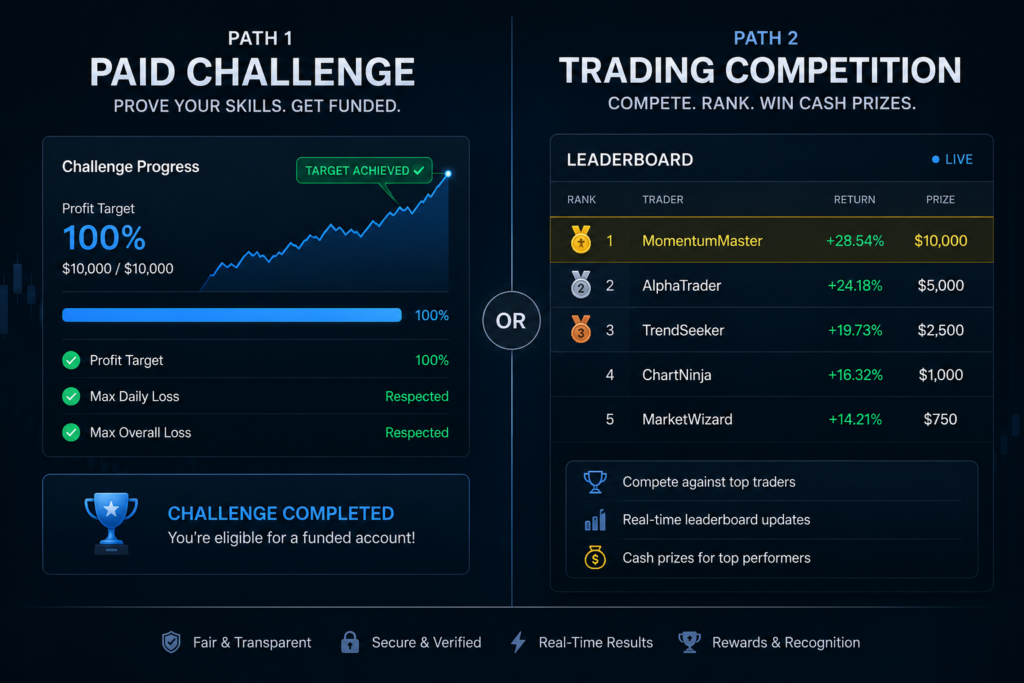
The second is a trading competition. This is the legitimate free path that most established prop firms actually offer.
No fee to enter. Real capital on the line for winners. A genuine funded account as the prize.
These are structurally different products.
Confusing the two leads traders to expect one thing and experience another.
The underlying model for both paths is the same: the firm provides capital, the trader provides strategy, profits are split. What changes is how you qualify for that capital.
Free Trial Evaluations: What You Should Know
Some firms run promotional free trials. A week or two of paper trading or simulated evaluation with no upfront fee.
These can be legitimate.
But they usually come with meaningful limitations:
- Smaller account sizes than paid evaluations
- Stricter profit targets or shorter time windows
- Tied to specific promotions that may not recur
- No guarantee the funded account offer matches a standard paid challenge
The free trial is essentially a lead generation tool. The firm wants to show you the platform, get you engaged, and then convert you into a paying customer.
That is not inherently bad. But it is worth understanding the intention before you commit time to it.
If you pass a free trial evaluation and get funded, the account terms matter.
A funded account from a free trial with worse payout terms or lower account size than the standard product is not necessarily a better deal than just paying the challenge fee.
Free Prop Firm Challenge via Competition: The Real Path
This is where the genuine free-to-funded opportunity lives.
Trading competitions are run by established prop firms on a regular schedule.
Traders enter for free (or for a very small entry fee) and compete over a defined period.
The top performers on the leaderboard earn funded accounts.
No evaluation fee. No profit target to hit individually. No time limit against yourself.
Just performance relative to the other traders in the competition.
The structure of how prop firm competitions work is different enough from standard challenges that it deserves its own understanding before you enter one.
Want a clear breakdown of the funded trading process before you choose a path?
The One Stop Blueprint covers both challenge and competition routes. It is 100% free: get it here.
What You Get With a Free Prop Firm Challenge
Zero financial risk.
That is the obvious one. You cannot lose money you did not put in.
But there are less obvious advantages too.
A competition removes the psychological weight of the fee.
Traders in paid challenges often carry a “I paid for this, I need to make it back” mindset that drives bad decisions. Tight exits. Forced trades. Over-management of small losses.
In a competition, that pressure does not exist in the same way.
You trade to perform. Not to recover a cost.
That mental difference shows up in execution.
Competitions also give you real market experience in a structured, high-stakes environment without the financial consequence of failing.
For traders who are still building confidence in their strategy, this is valuable.
The specific skills that translate from competition trading to a funded account become clearer once you understand what prop firm competitions are actually measuring.
What You Give Up
This is the part the marketing rarely explains clearly.
The biggest trade-off with competitions is certainty.
In a paid challenge, your path to funding is individual. You hit the profit target, stay within the rules, and you pass. Your result does not depend on what anyone else does.
In a competition, you are ranked against other traders.
You can have your best trading month ever and still not finish in a funded position if other traders performed better.
That is a fundamentally different risk model.
The second trade-off is timing.
Competitions run on fixed schedules. Monthly cycles, usually. If you miss the window or do not finish in a funded rank, you wait for the next cycle.
A paid challenge can be started at any time.
The third trade-off is account size predictability.
Paid challenges usually offer a specific account size tied to the fee you paid. $50K challenge, $50K funded account.
Competition prizes vary. The funded account size offered to winners may differ from what you would get through a paid evaluation.
None of this makes competitions worse by the way. It just makes them different.
When a “Free Prop Firm Challenge” Makes More Sense
If you are still testing your strategy, a prop firm competition is a better first step than a paid challenge.
You get real market conditions. Real performance feedback. No financial loss if you do not finish in a funded position.
That information is worth more than what most traders spend on a failed challenge.
If you are confident in your relative performance, competitions can also suit traders who know they tend to rank well when measured against peers.
Some traders are built for relative performance. They perform better when they can see a leaderboard and calibrate.
And if your financial situation makes a challenge fee genuinely difficult right now, a competition is the honest responsible path.
There is no shame in that.
Getting funded through a competition is the same funded account as getting funded through a paid challenge.
The source does not affect the trading.
When the Paid Path Makes More Sense
If you have a tested, consistent strategy and want a guaranteed path to a specific account size, the paid challenge is more reliable.
You control the outcome. Hit the targets, pass the rules, get funded.
No dependency on what 200 other traders did that month.
The paid challenge also gives you more flexibility on timing.
Start when you are ready. Take it at a pace that fits your schedule.
A competition runs on its own calendar.
For traders who want to scale quickly or who have a very defined strategy that performs consistently in isolation, the paid path is usually the faster route to a meaningful funded account.
Understanding the difference between a 1-step and 2-step challenge structure helps clarify which paid evaluation format fits your strategy before you commit.
Monthly Competitions: The OneStopProp Solution
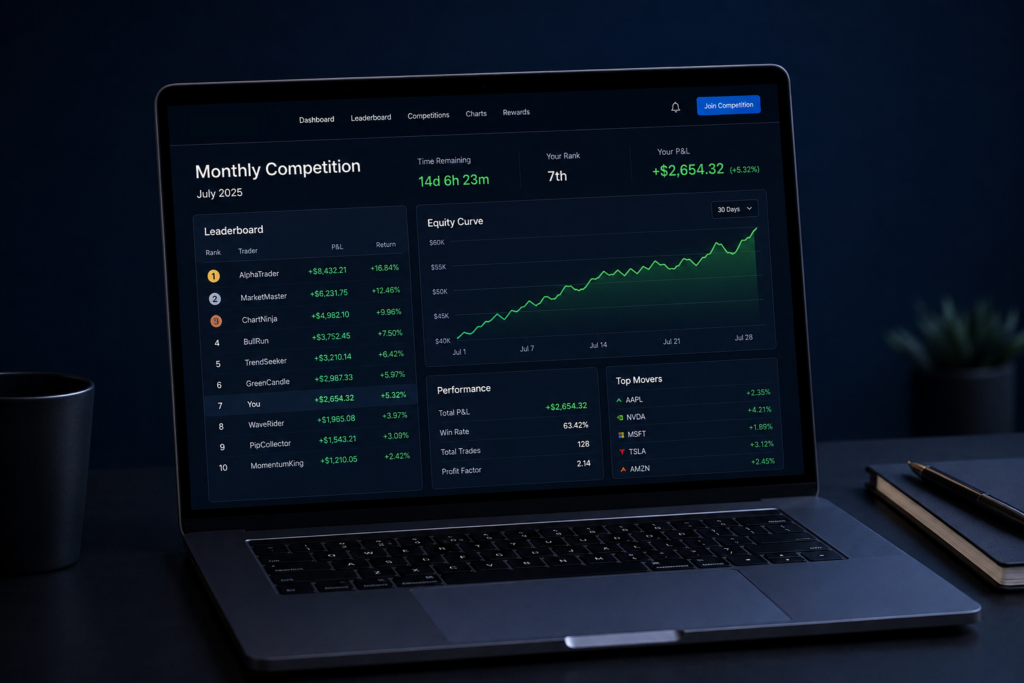
OneStopProp runs monthly trading competitions.
Free to enter. Real funded accounts for top performers.
The competition structure is built around the same stock-focused environment that makes OSP different from most prop firms.
Traders can compete trading the same names they would trade in a paid challenge: AAPL, NVDA, MSFT, and other highly liquid equities.
Not a forex-only environment dressed up with a leaderboard.
The monthly cycle means a new entry point every 30 days.
If one month does not work, the next one starts fresh.
The question of whether a monthly or weekly competition format suits your trading style comes down to how you manage consistency over longer periods versus shorter bursts.
The Honest Comparison
Free path: lower risk, lower certainty, dependent on leaderboard performance, fixed monthly windows.
Paid path: requires upfront fee, individual outcome, flexible timing, guaranteed access to specific account size if targets are met.
Neither is better in the abstract.
It depends on where you are in your trading development, what your financial situation looks like, and how confident you are in your strategy under competitive conditions.
The traders who get the most from competitions tend to treat them as real evaluations, not free practice.
And the traders who get the most from paid challenges tend to enter them with a strategy they have already tested, not one they plan to figure out during the evaluation.
If you want to understand how top competition traders approach their preparation, the best advice for winning a prop firm competition covers the habits that separate leaderboard finishers from the rest.
Whether you go the competition route or the paid challenge route, the preparation is similar. The One Stop Blueprint gives you a framework for both. And it’s also free: download it here.
Conclusion
Free prop firm challenges are real. We have them as “trading competitions”
They are the most legitimate version of a free path, and they also lead to real funded accounts.
But “free” comes with its own trade-offs:
- you compete against other traders
- you work on a fixed monthly schedule
- and the result is not entirely in your hands.
Knowing that going in makes you a better competitor.
You stop treating competitions like casual practice and start treating them like the serious evaluations they are.
That shift in mindset is usually the difference between traders who make it to the leaderboard, and traders who wonder why it did not work.