Two formats for prop firm competitions. One question: Monthly or weekly?
Which one should you actually enter?
Most traders pick one without really thinking about it.
They see a competition, register, and trade. That’s it.
And that works until you realize you’ve been entering the wrong format for your trading style for months.
How the Two Prop Firm Competition Formats Actually Look Like
Before anything else, it helps to understand what a prop firm competition actually is and how the scoring works.
Weekly competitions run for 5 trading days. Short window, fast results, smaller prizes. You know where you stand by Friday.
Monthly competitions run a full calendar month, usually 20 trading days. The prize pools are bigger. The fields are more competitive. And the window to recover from a rough start is completely different.
Neither format is harder to win in the abstract. They’re just harder in different ways.
The Pressure Difference Is Real
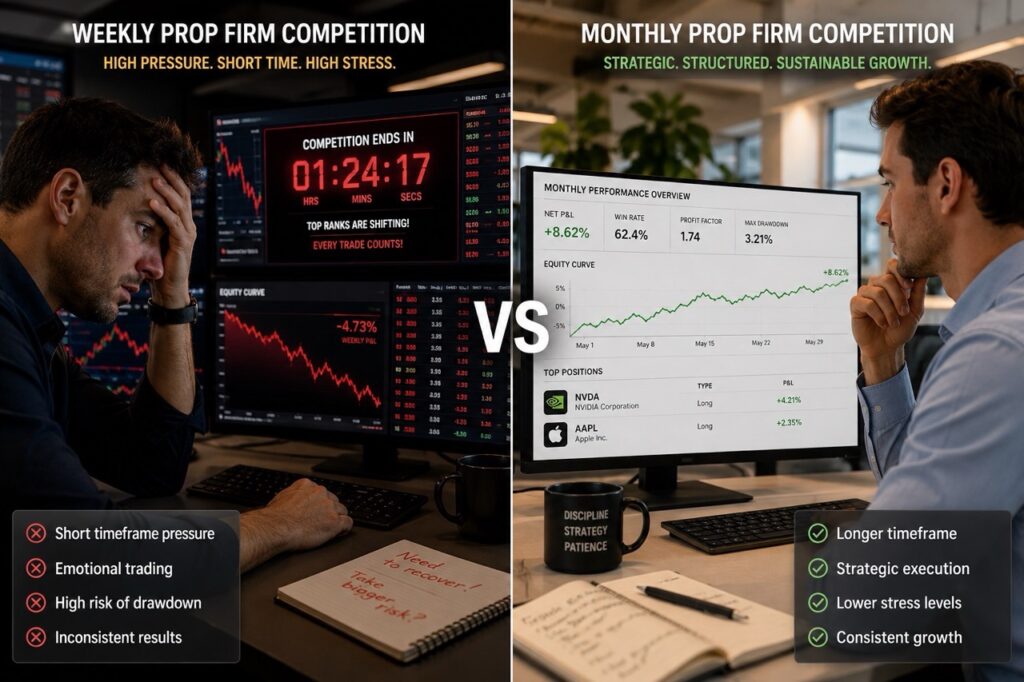
Weekly: lose two bad days in a row and you’re mathematically out of contention before Wednesday.
And obviously the stress compounds fast.
Monthly: a rough week is a rough week. It’s not fatal. You still have three more weeks to trade your way back into the top half.
For most traders, the monthly format matches how they naturally measure their own performance. You think about your month, not your Tuesday.
There’s a reason for that.
Because the key trading performance metrics like expectancy and drawdown only become meaningful over a sample size that a single week can’t give you.

Stock Traders Have a Specific Problem With Weekly Prop Firm Competitions
Stock setups don’t always resolve in 5 sessions.
A breakout on NVDA or AAPL can take 2 or 3 days to develop, and another 2 to play out.
If you’re in a weekly competition, you might be holding a position that’s working and still watching your rank drop because the clock is running out.
Weekly formats tend to reward high-frequency traders. Scalpers. Futures traders who are in and out multiple times a session.
Stock traders who hold structured setups get punished by the clock, not the market.
Quick pause.
If you’re trying to figure out which format fits your trading style, the One Stop Blueprint walks through how funded traders think about:
- performance cycles
- risk management
- and entry timing
Get the free Blueprint here before you register for your next prop firm competition.

The Prize Pool Question
Weekly prop firm competitions offer smaller prizes more frequently.
If you’re thinking about this like cashflow, weekly starts to look attractive.
But the consistency required to win week after week is harder to maintain than the consistency required to win one good month. The math looks easier on a short window. The execution isn’t.
Monthly prize pools are bigger, because the field is bigger and the commitment is longer.
When you win a monthly competition, the number is meaningful.
What Both Prop Firm Competition Formats Punish Equally
The format doesn’t change what kills competition accounts.
Overtrading. Chasing a bad day. Going oversized to catch up fast.
Study the decisions that end competitions and you’ll notice they look identical whether the window is 5 days or 20.
Monthly just gives you more time to make the same mistakes, which is either an advantage or a trap depending on your discipline.
How to Actually Decide
One question. Do you know by Friday whether your trading week was good?
If yes, weekly works. You can assess fast and move on.
If you usually need to see how a few positions develop across more than a week, monthly gives you the room your setups actually need.
The trading strategies that work inside prop firm challenges only hold up if the format gives you enough time to run them.
Most stock traders fall into the second category.
Conclusion
Monthly prop firm competitions are better for stock traders. That’s the honest answer.
The format aligns with how stocks actually move. You have room to hold a setup. You have room to recover from a rough day.
You can think in terms of a performance cycle that actually matches your edge.
Weekly is fine for high-frequency traders who can measure 5 sessions and know exactly what happened.
If you’re trading NVDA, AAPL or SPCX with structured setups, you’re probably not that trader.
OneStopProp runs monthly competitions. That’s a deliberate choice, not a default.
The monthly format was built for the trader who thinks in setups and performance cycles, not daily scorecards.
Enter the current competition at OneStopProp. It’s free, and the June competition is already in progress.