The retail prop trading market hit $850 million in 2026, up 45% year-over-year, and the promise of a “free” challenge is one of the most-searched entry points into that market. The problem is that the word “free” is doing a lot of heavy lifting. Before you enter your email address anywhere, you need to understand what the landscape actually looks like, because in most cases, the path to a funded account involves real costs, even when the marketing says otherwise.
This guide explains what a free prop firm challenge 2026 is, the different forms they take, what to watch for when evaluating any offer, and how to find a genuine pathway to funded trading in 2026.
Key Takeaways
- “Free” takes 4 distinct forms: Competitions, promotional codes, fee-refund programs, and pay-after-pass models each carry different real costs. Know which type you are looking at before committing any time or money.
- Industry challenge pass rates are 5% to 14%: According to FPFX Tech’s analysis of 300,000+ prop accounts, only 14% of challenges result in a funded account, and just 45% of those funded traders ever reach a payout. Therefore, your evaluation structure matters as much as your trading strategy.
- Genuinely no-cost routes exist but are limited: FundedFast’s research on major firms confirms that only a handful of permanently scheduled free routes exist across the industry, mostly biweekly or monthly competitions with cash prizes, not funded accounts.
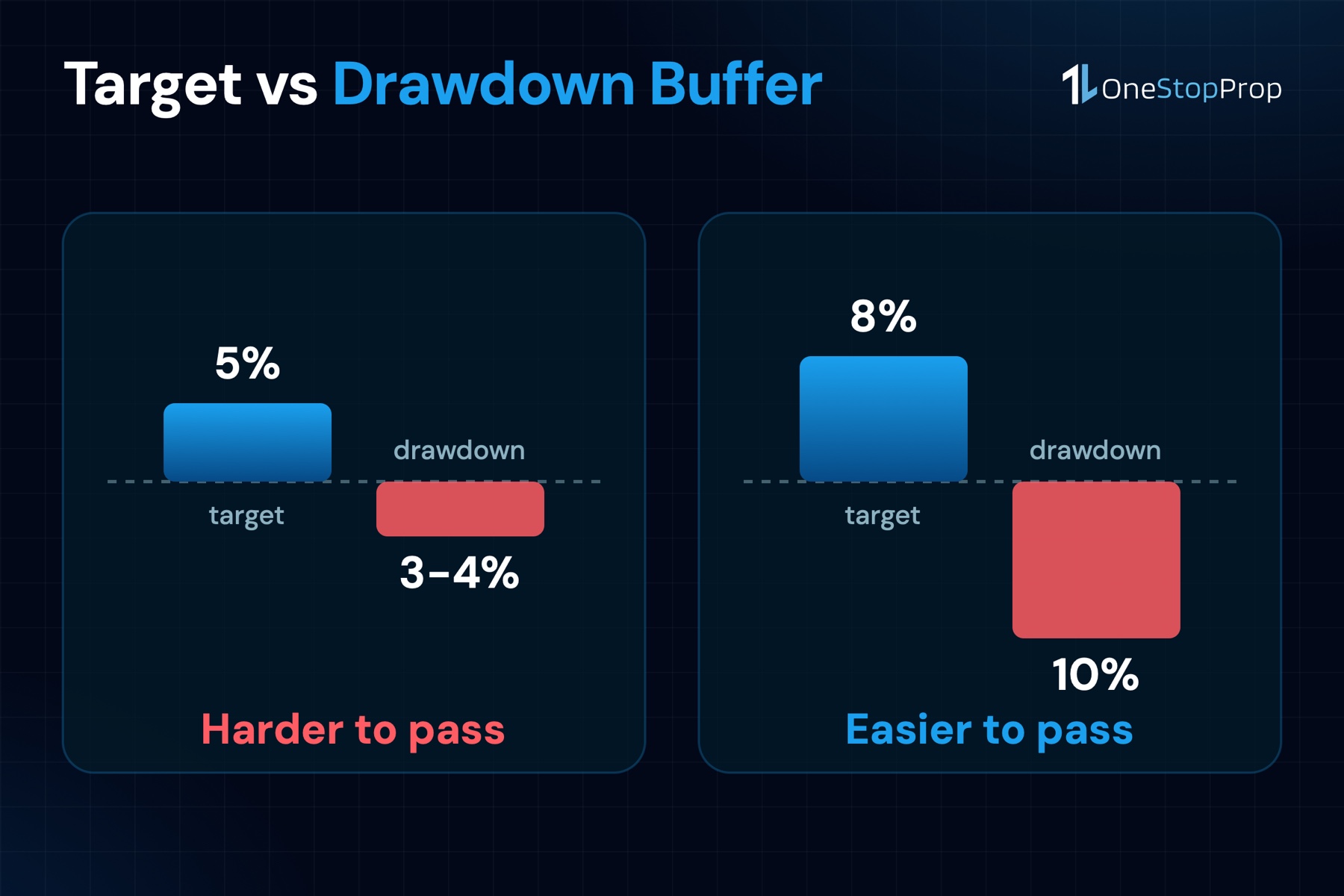
- Profit targets and drawdown interact: For Traders’ 2026 analysis shows that a 5% profit target paired with a 3% to 4% max drawdown is statistically harder to pass than an 8% target with a 10% drawdown buffer. Never evaluate a target percentage without checking the drawdown beside it.
- Rule clarity is the top trader priority: A 2025-2026 trader survey cited by HashcodeX found 79% of traders rank clear rules as their top selection criterion, above profit splits and account size.
Quick-Start Prioritization Framework
| Route Type | Best For | Real Cost | Time to Results |
|---|---|---|---|
| Free Competition | Traders wanting zero financial risk | $0 upfront, prizes not funded accounts | 2-4 weeks per cycle |
| Promo / Discount Code | Traders ready to pay but want to reduce fee | Reduced fee, not zero | 2-6 weeks |
| Fee-Refund Program | Disciplined traders who will pass first attempt | Full fee upfront, returned on payout | 4-10 weeks |
| Pay-After-Pass | Traders with no upfront budget | Deducted from first payout | 3-8 weeks |
| Standard Paid Challenge | Experienced traders wanting best conditions | $50-$500 depending on account size | 2-6 weeks |
Start here if you are:
- New to funded trading with $0 budget: Enter a free monthly or biweekly competition first. Treat it as a live test of your discipline before you commit a fee.
- Ready to pay but want to minimize cost: Look for firms with fee-refund programs, where the evaluation fee returns on your first payout. This is the closest equivalent to “free” for a serious trading candidate.
- Experienced with a repeatable system: Skip the free routes and prioritize rule quality, payout speed, and asset access. The OneStopProp Pro Account offers 100% profit splits on the first 5 payouts for traders ready to move directly into a structured evaluation.
What a Free Prop Firm Challenge Actually Is
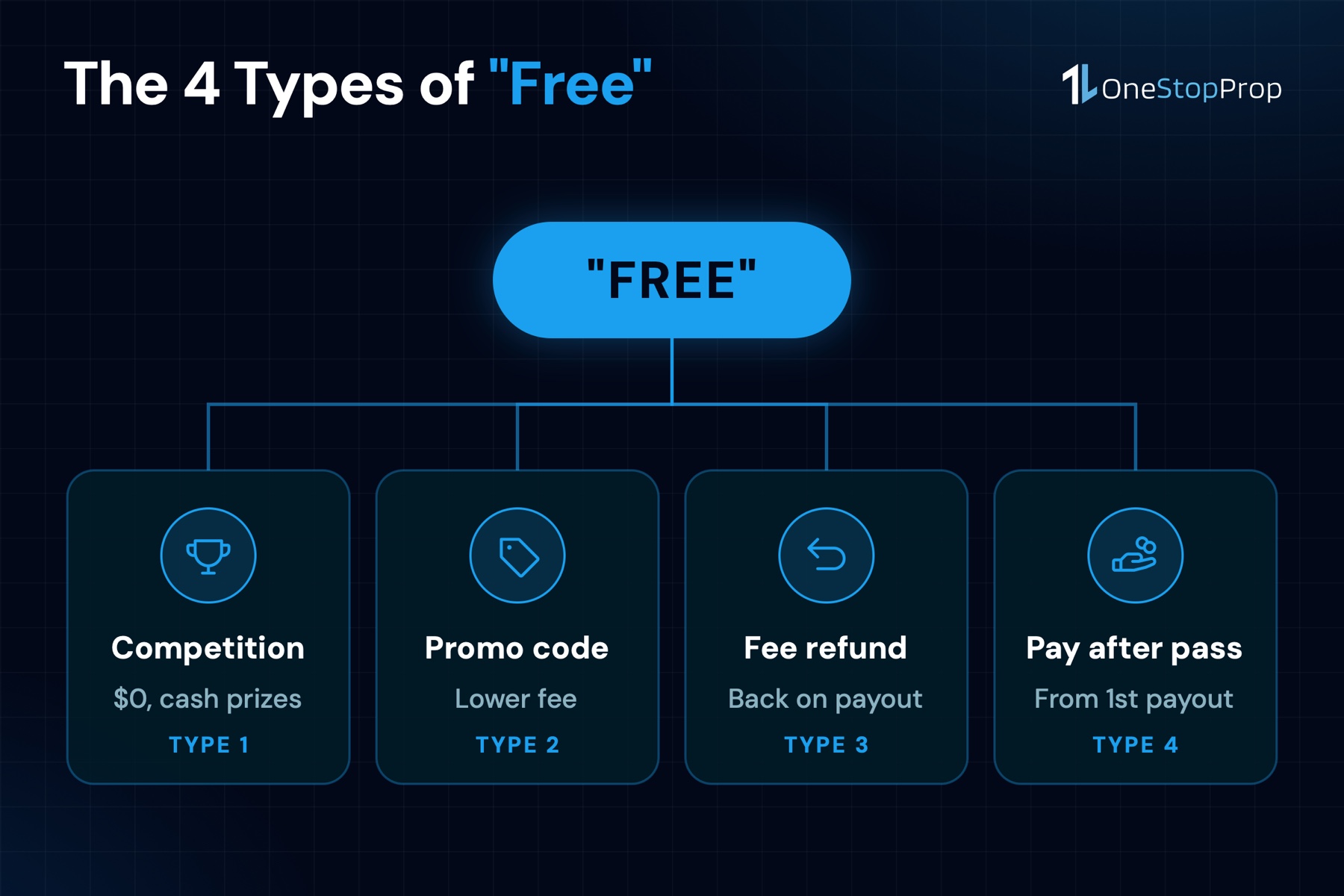
The 4 Types of “Free”
A free prop firm challenge usually means traders can access a competition, giveaway, promotion, pay-after-pass model, or rare no-deposit funded account without paying a standard challenge fee upfront. That definition sounds straightforward, but the practical experience across each type is very different.
Type 1: Free competitions. The closest legitimate route to a free funded account is a free, biweekly trading competition with a virtual account, cash prizes for top finishers, and no entry fee, no payment method on file, and no automatic upgrade into a paid evaluation. These competitions award cash, not funded accounts, so winning one still leaves you needing a paid evaluation to access real prop capital. OneStopProp runs monthly trading competitions, free to enter, with real funded accounts for top performers, built around the same stock-focused environment that makes it different from most prop firms.
Type 2: Promotional codes. A firm runs a limited-time campaign with free access to the evaluation for a set period, or 100% off for the first batch of signups. These are real but not permanent products, and extremely rare. Treat these as a timing opportunity, not a structural feature.
Type 3: Fee-refund programs. These charge a standard fee upfront, then return it alongside your first qualifying payout. Across multiple attempts, a firm with a fee refund and good trading conditions often costs less in total than a free challenge at a firm whose rules make passing harder. This is a critical point, the long-run cost of an evaluation depends on how many attempts your trading style requires, not just the upfront fee.
Type 4: Pay-after-pass. The evaluation fee is deducted from your first funded payout rather than collected upfront. This model is genuinely zero cost to start, but the fee still exists; it just hits your account at the moment you would otherwise be celebrating your first withdrawal.
What “Free” Does Not Mean
However, “free” does not always mean real funding, instant payout access, or zero cost after passing. Most “free” prop firm challenges are only free at the entry stage. Traders may still face activation fees, payout restrictions, consistency rules, withdrawal caps, reset costs, or refund conditions before they can withdraw any profit. Read every section of the terms before signing up, because the entry point is rarely where the real costs are hidden.
Pro Tip: Read the payout terms before the challenge rules. The challenge rules tell you how to pass. The payout terms tell you whether passing is actually worth anything. Many traders discover that a flexible-looking firm still has restrictive conditions on the funded side, after they have already committed a fee.
The Rules That Actually Decide Whether You Pass
Profit Targets and Drawdown
As of August 2026, typical numbers sit around an 8 to 10% profit target in Phase 1, 4 to 6% daily loss and 6 to 12% maximum drawdown. These numbers look simple, but they interact in ways that determine whether your specific trading strategy can realistically pass. A 5% target paired with a 3 to 4% max drawdown is statistically harder to pass than an 8% target with a 10% drawdown buffer. Target percentage alone tells you almost nothing without the drawdown context sitting next to it.
OneStopProp’s minimum trading days are only 4 to 6 days, versus 10-plus at many competitors. Profit targets are a reasonable 8% for Phase 1 and 5% for Phase 2, versus 10%+ at many firms. That combination gives traders more time per target dollar to build a clean, disciplined record instead of forcing rushed trades near a deadline.
Static vs. Trailing Drawdown
Some firms use trailing drawdown instead of static drawdown, which means the floor rises as your equity grows. This distinction matters because a profitable week can still shrink your safety margin if you do not understand how trailing drawdown works. A profitable trading session that later partially reverses can breach a trailing drawdown account while leaving a static drawdown account unaffected. Always confirm which model a firm uses before you start trading.
Strategy Restrictions
Strategy restrictions often decide pass probability more than the raw target does because they filter which edges are compatible with the evaluation. News trading bans, overnight holding restrictions, and copy-trading prohibitions can each eliminate entire categories of profitable approaches. OneStopProp traders specifically highlight no trading restrictions on holding trades overnight and trading during news events as a key differentiator.
Pro Tip: Before paying for any challenge, map your last 30 trades against the firm’s daily loss limit, max drawdown, and profit target. If your normal losing streaks would have breached the account 3 or more times, the rules do not fit your strategy, regardless of how “free” the entry appears.
How to Evaluate Whether a Free Challenge Is Worth Your Time
Check the Firm’s Legitimacy First
Between 2024 and 2025, an estimated 80 to 100 proprietary trading firms shut down worldwide. The primary trigger was MetaQuotes revoking MT4/MT5 trading platform licenses from firms serving US clients or operating without proper broker relationships in February 2024. Many of those firms took challenge fees with them. A free entry fee does not eliminate the risk of a firm collapsing before you receive a payout.
Reputable firms make their rules easy to find and understand. Details like profit targets, drawdown limits, and payout schedules should be prominently displayed on their pricing page, long before you make a purchase. If you have to dig through Discord messages or log in to access basic information, that is a red flag.
Scam prop firms tend to set evaluation rules that are mathematically near-impossible to achieve in combination. Common examples include extremely tight daily loss limits combined with high profit targets, mandatory minimum trading days that conflict with consistency requirements, and hidden rules that only appear in the fine print of a terms-of-service document.
The Payout Verification Test
Payout delays are the most frequently reported complaint across Reddit, Discord, and independent review platforms. Before committing, search for recent payout screenshots from real users, not marketing testimonials on the firm’s own website. A firm with transparent payout records and a verifiable track record is worth a small evaluation fee. A firm offering a “free” challenge with no verifiable payout history is worth nothing, regardless of its entry cost.
79% of traders say clear rules matter the most when choosing a firm; they want to know exactly what they can and cannot do before they join. 75% said fast payouts rank right after that. If a trader earns money, they want it in their hands soon, with no long waits and no excuses.
The Real Cost Comparison: Free vs. Paid Evaluations
When Free Costs More
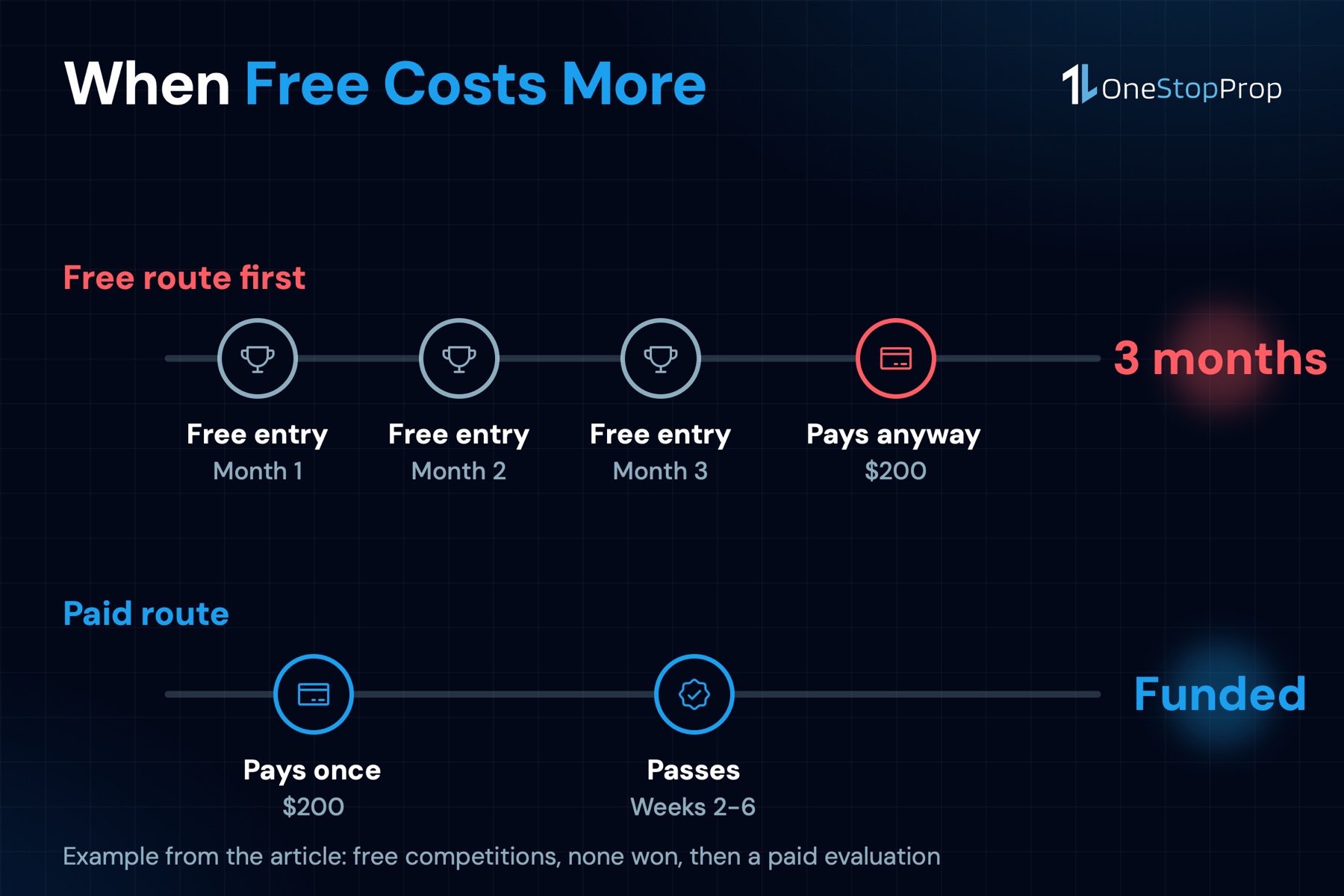
A free competition that you cannot win without weeks of preparation has a real cost measured in opportunity and time. The lowest-cost path to a funded account depends on how many attempts it takes you to pass. Traders who need multiple attempts should look at firms with the lowest challenge fees relative to account size, and rule structures that genuinely fit their strategy rather than optimizing for the entry cost.
The math is straightforward. A trader who pays $200 for a well-structured evaluation and passes on the first attempt spends less than a trader who enters 6 free competitions over 3 months, wins none, and then pays for a paid evaluation anyway.
When Paid is Actually Cheaper
Paid models charge up front but can offer better profit splits or wider buffers after passing. Free or no-fee structures may recover cost through tighter limits, lower payouts, or stricter consistency rules. The economics of “free” only hold up if the trading conditions after passing are genuinely comparable to paid alternatives.
Pro Tip: Reduce position size by 50% after 2 consecutive red days during any challenge, free or paid. OneStopProp’s scaling guidance identifies this single discipline rule as one of the most effective funded account protection measures available. It converts a potential losing streak into a minor setback.
Choosing the Right Account Type for Your Trading Style
1-Step vs. 2-Step Challenges
1-step challenges require meeting a single profit target before receiving funding, while 2-step challenges require passing 2 phases with separate profit targets. One-phase challenges are structurally easier than two-phase, but instant funding trades ease-of-entry for tighter drawdown and lower initial capital. The tradeoff is usually visible in the drawdown limits: 1-step accounts tend to have tighter risk parameters to compensate for the shorter evaluation window.
Stock Traders vs. Forex and Crypto Traders
Most prop firm guides are built around forex. Most comparisons online are built around 1 type of trader: the forex trader. If you trade stocks, you are usually reading a guide that was not written for you. Stock traders specifically should look for firms that offer real equity exposure or stock price access, with rules that account for market hours, session gaps, and instrument-specific volatility.
A trader covering stocks, forex and crypto in 1 account will find OneStopProp the best structural match, almost no other firm lets you trade all 3 asset classes under a single funded account. For traders who want to access names like Apple (AAPL), NVIDIA (NVDA), Microsoft (MSFT), Amazon, Alphabet, Meta, and Tesla, the Magnificent 7 stocks, from a single funded account, OneStopProp’s account structure is one of the few options that supports this alongside forex and crypto.
What the Pro Account Adds
For traders who are ready to commit to a paid evaluation and want maximum payout terms, OneStopProp’s Pro Account changes the economics significantly. Initial payouts are 100% for the first 5 withdrawals with Pro Accounts, compared to 70 to 80% maximum elsewhere, and the long-term split is 90/10 after that initial period. With a Pro Account at OneStopProp the first payout requires a minimum of 8 trading days, and after that, traders may request a payout every 5 days, a cadence that outpaces most standard 14-day payout cycles in the industry.
Frequently Asked Questions
What is a free prop firm challenge?
A free prop firm challenge usually means traders can access a competition, giveaway, promotion, pay-after-pass model, or rare no-deposit funded account without paying a standard challenge fee upfront. However, “free” does not always mean real funding, instant payout access, or zero cost after passing. The 4 main forms are: free competitions (cash prizes, not funded accounts), promotional codes (reduced or zero-cost entry windows), fee-refund programs (fee returned on payout), and pay-after-pass models (fee deducted from first withdrawal).
How hard is it to pass a prop firm challenge in 2026?
When FPFX Tech analyzed 300,000+ prop accounts from 100,000 traders across 10 firms, 14% passed a challenge, 45% of all funded traders reached a payout, and average payouts were about 4% of the funded account size. Therefore, if you are not among the top 14% at your firm, increasing your pass probability requires either improving your risk discipline or switching to a firm with rules that better match your trading style, not simply finding a cheaper or free entry point.
Are free prop firm challenges legitimate?
Some are, some are not. A genuinely free prop firm challenge is rare in 2026: most “free” offers are limited promo codes, demo trials, or evaluations that still require payment up front. Across the firms tracked, the only routes that are free with no payment method on file and no automatic upgrade to a paid evaluation are scheduled live competitions. Verify any free offer against the firm’s current pricing page, free offers and their terms change frequently.
What rules matter most in a prop firm challenge?
Prop firm rules are the risk parameters applied to a simulated trading account during an evaluation, mainly a profit target, a maximum drawdown, a daily loss limit, a minimum number of trading days, and a list of banned strategies. Most are enforced automatically by the platform, meaning a breach closes the account the same second it occurs. Of these, drawdown type (static versus trailing) and strategy restrictions tend to be the least visible and most consequential.
Is OneStopProp’s monthly competition a genuine free entry?
Yes. OneStopProp offers traders a unique opportunity with a monthly trading competition that is completely free to join, giving access to the platform’s premium features and tools with no cost or risk. Top performers in the competition can earn real funded accounts, making it a legitimate zero-cost entry into the OneStopProp ecosystem before committing to a paid evaluation. Visit the OneStopProp homepage to see current competition details and account options.
Sources
- Prop Trading Industry Size 2026: $850M Market Analysis, Track360. Market size, growth, and firm count data. https://track360.io/blog/prop-trading-industry-report-2026-market-analysis
- Prop Firm Statistics 2026: Pass Rates & Market Data, Track360. Challenge pass rates and funded trader metrics. https://track360.io/blog/prop-trading-industry-statistics-2026
- 9 Free Prop Firm Challenges in 2026: What’s Actually Free?, H2T Funding. Definition and structure of free challenge models. https://h2tfunding.com/best-prop-firms/free-challenges/
- Free Funded Account Challenge 2026, FundedFast. Comparison of permanently free vs. promotional routes. https://fundedfast.com/compare/free-prop-firm-challenge
- Free Prop Firm Challenge 2026: What’s Real vs Marketing, Velotrade. Fee-refund vs. free competition cost analysis. https://velotrade.com/blog/free-prop-firm-challenge
- Which Prop Firm Has the Easiest Challenge Rules?, For Traders. Profit target and drawdown interaction analysis. https://fortraders.com/blog/which-prop-firm-has-the-easiest-challenge-rules
- Prop Trading Rules You Must Know Before Taking a Challenge, For Traders. August 2026 standard rule benchmarks. https://fortraders.com/blog/prop-trading-rules-you-must-know-before-taking-a-challenge
- Prop Firm Statistics 2026: Pass Rates, Payouts & Industry Data, AtmosFunded. FPFX Tech 300,000-account analysis. https://atmosfunded.com/prop-firm-statistics/
- Prop Firm Market Trends & Predictions, HashcodeX. 2025-2026 trader priority survey data. https://www.hashcodex.com/prop-firm-market-trends
- How to Spot Legitimate Prop Firms, QuantVPS. Red flag identification and firm verification guide. https://www.insidermonkey.com/blog/are-prop-trading-firms-legit-what-you-need-to-know-before-signing-up-1478520/
- Prop Firm Scams to Avoid in 2026: Red Flags and Legit Checks, Elite Trader Funding. Scam pattern analysis and checklist. https://elitetraderfunding.app/blog/how-to-spot-a-prop-firm-scam-in-2026-red-flags-checklist
- Prop Firm Scams to Avoid in 2026: Real Cases, MyForexFirms. Documented collapse cases and payout delays. https://myforexfirms.com/blogs/prop-firm-scams-to-avoid
- Payout Information and Guidelines, OneStopProp. Payout rules, consistency requirements, and split structure. https://help.onestopprop.com/faq/payout-rules/
- Funded Account Scaling Plan, OneStopProp. Pro Account features and scaling details. https://onestopprop.com/funded-account-scaling-plan/
- Best Prop Firms for Stock Traders 2026, OneStopProp. Multi-asset access and Pro Account payout cadence. https://onestopprop.com/best-prop-firms-for-stock-traders-in-2026/
- Prop Firm Trading Without Time Limits, OneStopProp. Challenge structure and strategy compatibility guidance. https://onestopprop.com/prop-firm-trading-without-time-limits/