
What Happens If You Fail a Prop Firm Challenge?
Most traders fail a prop firm challenge.
Not some traders. Most.
And for some reason, the industry treats that like an embarrassing statistic instead of a normal part of the process.
So if you just failed one, or you want to understand the stakes before you start, here is exactly what happens.
Without sugarcoating.
Some People Fail A Prop Firm Challenge
Not everyone passes on their first attempt.
But failing once says almost nothing about whether you belong in this space.
What separates the traders who eventually pass from the ones who give up is not talent.
It is what they do with failure.
That’s also one of the reasons why we created the One Stop Blueprint. It covers challenge structure, risk rules and what actually separates funded traders from repeat failures.
Get it here, it’s 100% free.
What Actually Happens When You Fail
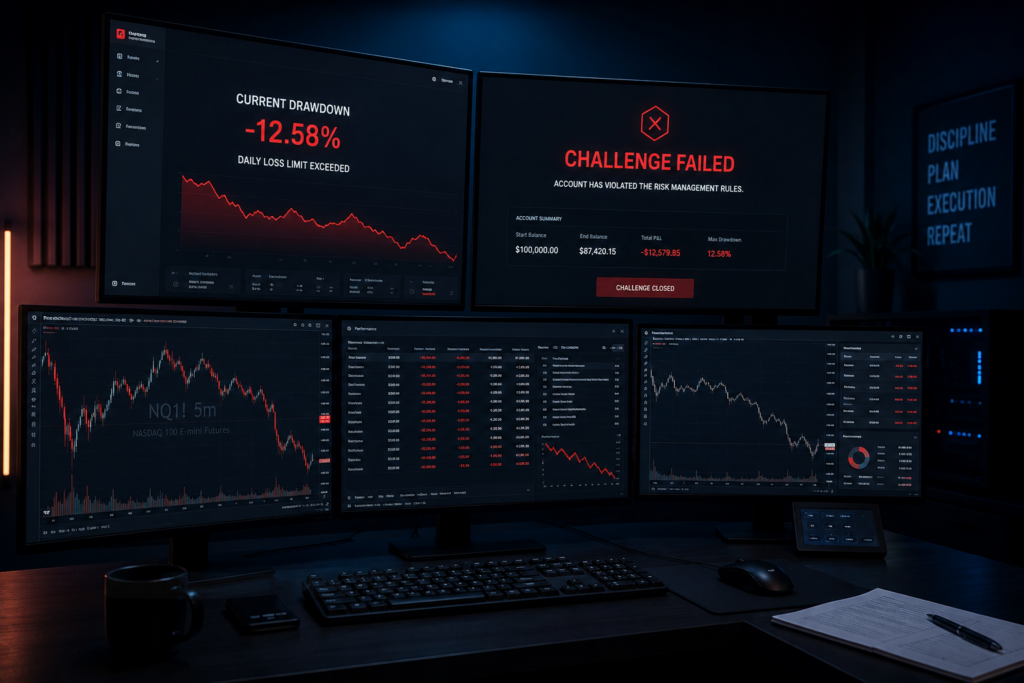
The account gets locked.
That is it.
No dramatic email. No phone call from a risk manager. No formal notification beyond a dashboard update.
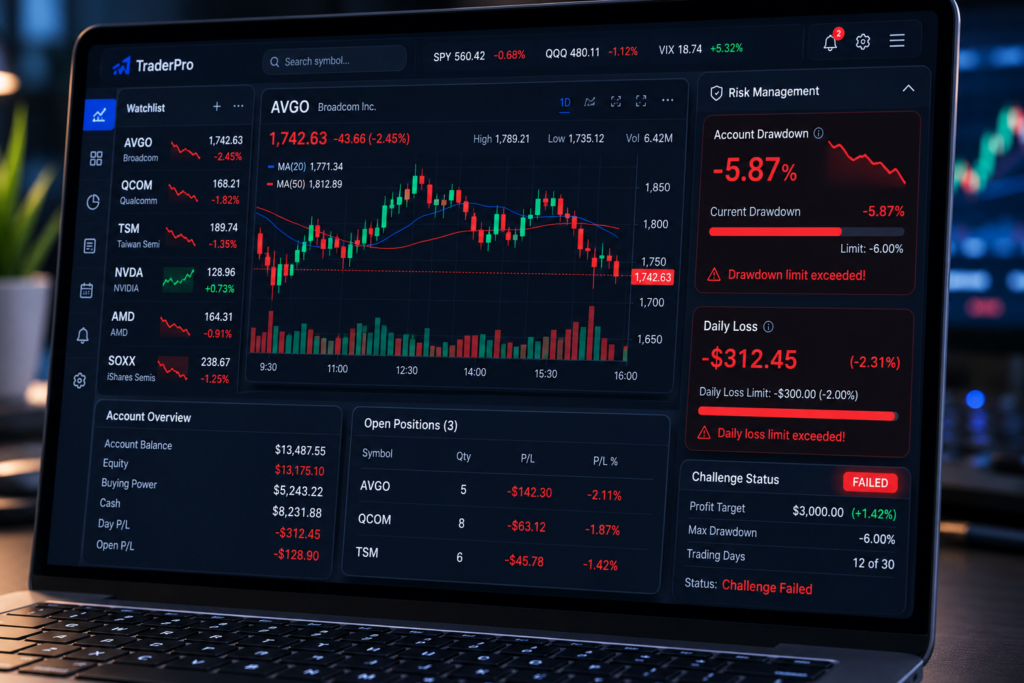
The account either hit a rule violation (daily loss limit, maximum drawdown) or the evaluation window closed without you reaching the profit target.
Either way: the challenge ends. The account closes.
Understanding the specific prop firm rules that trigger a failure is the first honest step toward not repeating the same mistake.
You Only Lose the Fee
This surprises more traders than it should.
When you fail a challenge, you do not lose:
- the firm’s trading capital
- your personal brokerage account
- anything beyond the challenge fee itself
The firm’s money was never yours to lose.
It was evaluation capital.
Your actual exposure is the fee you paid to enter. That is the ceiling.
(Unless you signed up for a specific reset plan with different terms. Always check.)
That framing matters because a lot of traders treat a failed challenge like a major financial disaster.
It is not. It is a fee, and it is the cost of learning under real conditions.
You Can Retry. Right Now If You Want.
Most firms let you purchase a new challenge immediately after failing.
Some offer discounted resets on the same account size.
Some run promotions where the retry is cheaper than the original entry.
Failing is not permanent.
It is just the end of that particular attempt.
Whether a 1-step or 2-step challenge makes more sense for your next attempt depends on where things broke down the first time.
If you want a clear framework before your next attempt, the One Stop Blueprint covers:
- challenge structure
- risk rules
- what actually separates funded traders from repeat failures.
And it is also free: get it here.
The Real Question Is Why You Failed the Prop Firm Challenge
This is where most traders skip the important part.
They fail. They feel frustrated. They buy another challenge immediately.
Same account size. Same strategy. Same habits. And…
Same result.
Because the problem was never the challenge itself.
The problem was something specific in the execution. And it will show up again unless you find it.
There are really only two categories of challenge failure:
Rule violation. You hit the daily loss limit or the total drawdown limit. The account closes because you crossed a defined line.
Performance failure. The evaluation window ended without you reaching the profit target. Or you survived but never built enough cushion and the account expired.
These are completely different problems.
A rule violation is usually an emotional event. One bad trade that spiraled.
A performance failure is usually a strategy or patience problem. Not enough edge, or not enough discipline to wait for it.
Getting clear on which one actually happened is the only honest starting point for the next attempt.
What Stock Traders Get Wrong Specifically
Most prop firm content online is built around forex trading patterns.
The failure examples are forex. The risk scenarios are forex.
Stock traders fail for different, more specific reasons.
Earnings gap risk.
NVDA can lose 8% in a single session on an earnings miss. AAPL can gap down 5% on unexpected guidance.
If you hold a position overnight through earnings inside a challenge, a gap event can blow your daily loss limit before the market even opens.
Forcing trades during dead hours.
Stocks have a very specific rhythm. Pre-market, the first 30 minutes after open, and the last hour are different animals.
The middle of the day is usually slow. Traders used to waiting for quality setups, start forcing trades during slow periods because the profit target is sitting there, and they feel behind.
Overconcentration on one name.
Trading one ticker you know well is a strength in normal trading. Inside a challenge, it becomes a liability if that stock has one bad day.
One oversized AAPL position in the wrong direction can end the account before you get a chance to recover.
All of these are fixable.
The article on passing a prop firm challenge trading only stocks covers the psychological patterns that specifically trip up stock traders inside the evaluation structure.
When Retrying Actually Makes Sense
Retrying makes sense when you have a real answer to one question: what specifically would be different this time?
Not “I will be more careful.”
Specific. Concrete. Different.
If you hit the daily loss limit because you averaged down into a losing position, the fix is a concrete rule: no averaging down, ever, inside a challenge.
If you ran out of evaluation time without hitting the target, the fix might be a different account size, a different strategy tempo, or a different approach to sizing early positions.
If you got within 1% of the drawdown limit multiple times and it finally caught you, the fix is tighter daily stop rules so the big loss never has a chance to develop.
That specificity is what makes the second attempt more than a repeat of the first.
The trading strategies that work inside prop firm challenges are not complicated.
But they require execution discipline that most traders only develop after experiencing what it feels like to lose an account to something preventable.
What Actually Works the Second Time
The traders who pass on the second or third attempt tend to have one thing in common:
They stopped trying to “beat the challenge.”
That mental frame is wrong from the start.
A challenge is not a competition against the firm.
It is a filter for emotional consistency.
The traders who eventually pass tend to:
- trade less frequently than they think they should
- stop for the day when they are ahead instead of pushing for more
- treat the profit target as a byproduct, not a daily objective
- protect downside first and let upside happen naturally
The guide on how to pass a prop firm challenge goes deeper on the consistency habits that separate one-time passers from traders who build a long-term funded career.
The Traders Who Eventually Pass All Failed First
That is not a motivational line.
It is just statistically true.
The difference is in how they processed the failure.
They didn’t think of it as a verdict. And it’s not.
It’s simply an audit.
“Where did the account actually die?”
“What was I thinking when I made that trade?”
“Was this a strategy problem or a behavior problem?”
That level of honesty about your own execution is harder than buying another challenge.
But it is the only thing that actually changes the outcome.
Failing a challenge is not a signal to quit.
It is information.
Use it as what it is.
Working through the challenge process and want a complete framework?
The One Stop Blueprint covers challenge structure, risk rules, and the funded account habits that matter long-term. Download it for free here.
Conclusion
Most traders fail their first challenge.
A lot fail their second one too.
The ones who eventually get funded are not the ones who never failed.
They are the ones who treated every failed attempt as a data point and came back with a different plan.
Failing a challenge costs you the fee.
Failing to learn from it costs you a lot more.


