You are down $400 in the morning.
Not fatal.
And you take another trade to get it back.
Down $900.
One more attempt.
Now you are at 80% of your max daily loss limit with 2 hours left in the session.
That is not just a bad morning. That is the exact sequence the max daily loss rule in a prop firm was designed to stop.
It does not care how good your strategy is. It acts in real time, on a single session.
What the Max Daily Loss Rule Actually Does
Every prop firm funded account comes with a cap on how much you can lose in a single trading day.
That cap is the max daily loss limit rule.
Hit it, and the account is either suspended or closed automatically.
No manual override. No conversation. The system executes.
The way that cap is calculated matters more than most traders realize.
Some prop firms set it as a fixed percentage of your starting balance on a given day.
Others use a trailing drawdown that adjusts as your equity moves higher.
The mechanics are different in ways that change how much real buffer you have at any given moment.
Prop firm rules explained with actual stock examples cover this in detail, including how the daily limit interacts with the overall max drawdown on your account.
Why Stocks Hit the Max Daily Loss Limit Faster
A currency pair moving 0.5% on a normal day is unremarkable.
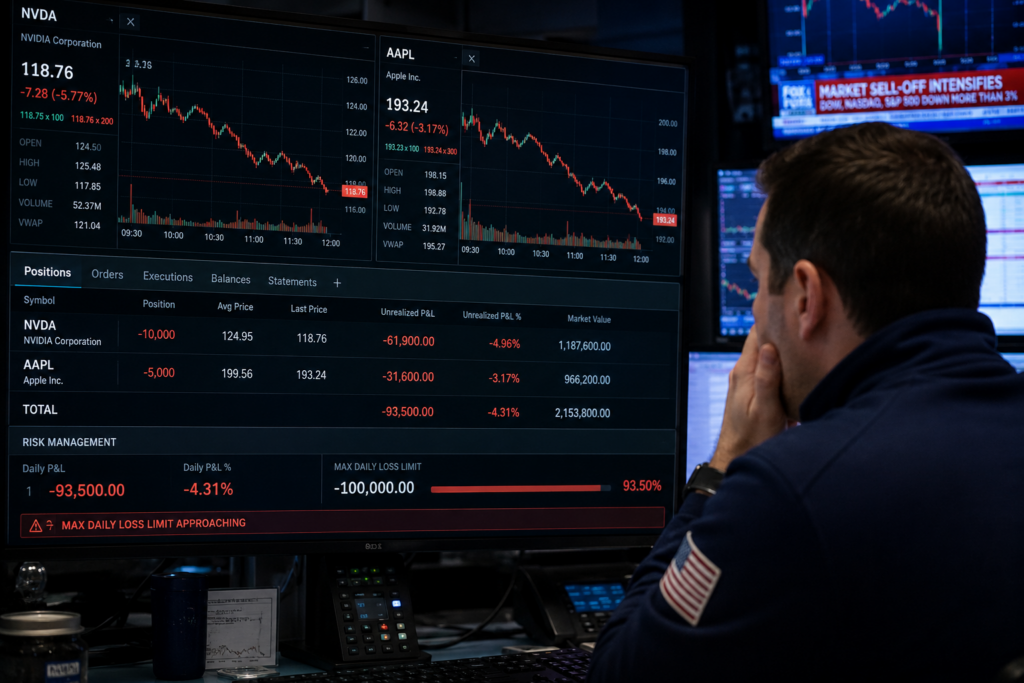
NVDA can move 3% in the first hour of trading.
AAPL can gap down 2% on an earnings miss before your stop order even processes.
That stock volatility changes the position sizing math completely.
The same number of shares you would use on a low-volatility instrument now carries 3 or 4 times the dollar risk per trade.
The max daily loss rule did not change. The dollar exposure per share did.
This is the adjustment traders coming from forex backgrounds miss. Same share-count logic, very different dollar outcome.
How to Size Around the Prop Firm Daily Loss Limit
There is a process that actually works.
It requires doing the math before the session opens, not during it.
Start with your daily loss limit. Not your prop firm account balance. The limit.
Decide what percentage of that limit you are willing to risk on a single trade. Most funded traders use 20 to 25%.
Calculate the maximum dollar loss if your stop gets hit on that trade.
Divide that dollar amount by your stop distance in dollars per share.
That number is your maximum share count for that trade.
Most traders start with a share count and figure out the risk afterward.
Funded traders work backward from the limit.
That difference is most of what separates the traders who stay funded from the ones who lose their accounts inside the first month.
If you have not run these numbers on your own account, that is the right starting point.
The One Stop Blueprint walks through exactly how funded traders think about position sizing, daily limits, and performance cycles before entering a trade.
Get the free Blueprint here and work through your numbers before the next session.
What to Do After a Bad Start
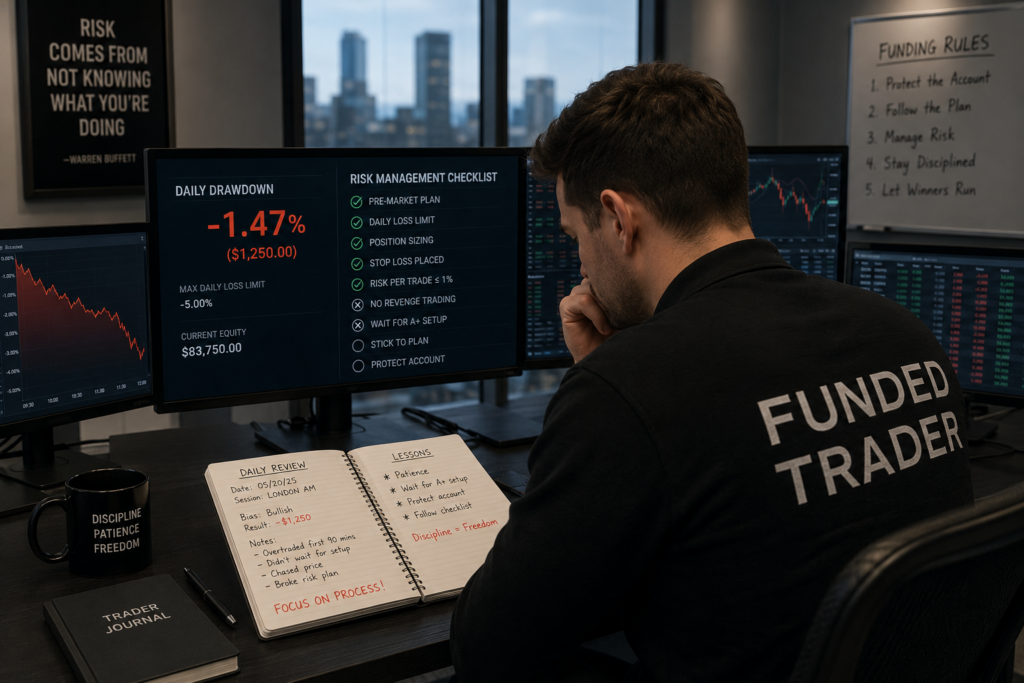
You are down 60% of your daily limit by 11 AM.
And there’s two real options.
Stop for the day.
Lock in the smaller loss. Come back tomorrow with a full limit and a clear head.
Keep trading at dramatically reduced size.
Accept that one more bad trade ends the session regardless of the setup.
Stopping is almost always the right call at that point.
The math does not cooperate once you are deep into a drawdown.
How drawdown compounds against recovery attempts is straightforward: a 10% loss requires an 11% gain to recover. A 25% loss requires 33%.
Chasing it makes the hole larger, and never smaller.
Most funded accounts do not get blown on the first bad trade. They get blown on the second or third trade of the same session.
The pattern of how funded accounts actually get closed almost always starts with a rough morning followed by a recovery attempt with an oversized position.
The Correlated Position Problem
One thing stock traders run into specifically.
When you hold positions in correlated names, NVDA and AMD at the same time, for example, a sector selloff hits both simultaneously.
Not one trade eating into your daily loss limit.
Two trades. Same adverse move. Same time.
That can look like two clean setups going into the open. By 10 AM it looks like one oversized position with nowhere to hide.
The trading strategies that hold up inside funded accounts, account for correlation risk, not just individual position risk.
Two solid setups in the same sector, entered at the same time, on a bad sector day, can consume your entire max daily loss limit faster than either trade would on its own.
Conclusion
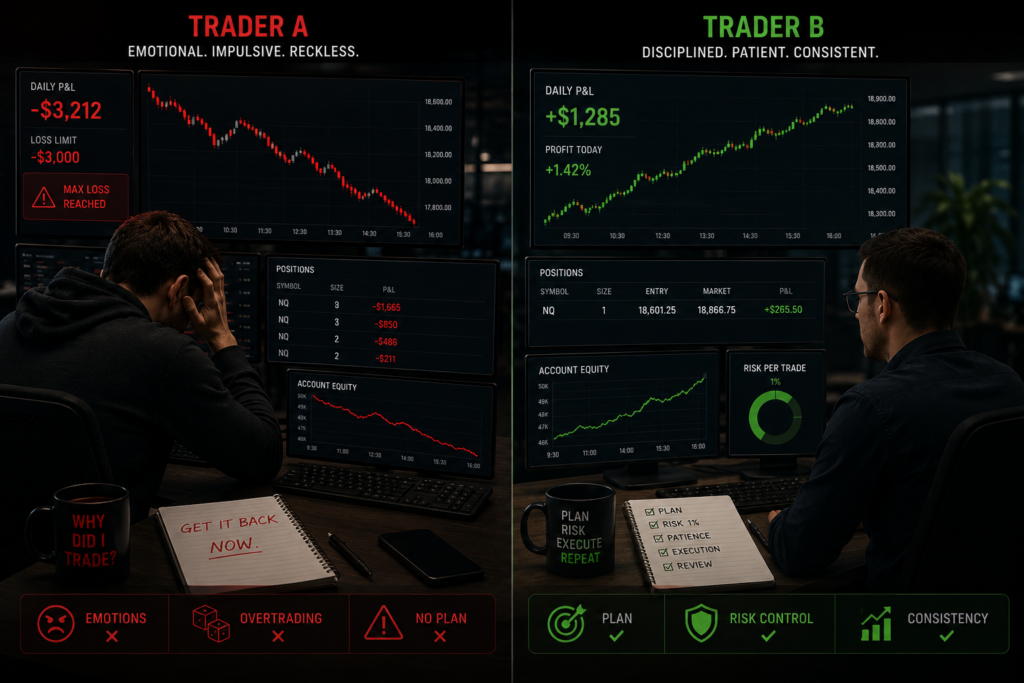
The max daily loss rule is not your opponent.
But it is not a safety net either. Reaching it closes the account.
Its job is to cap what one session can cost the firm. The only thing standing between a bad morning and a closed account is the personal limit you set below it.
The traders who stay funded long-term treat the daily limit like a budget.
They plan for it before the session opens.
They know exactly how much they can lose per trade and still have room left to operate.
And they know when to walk away before the system makes the decision for them.
OneStopProp gives stock traders access to NVDA, AAPL, MSFT, and now even SPCX inside a firm that was built with stock volatility in mind from the start.
Start your funded account challenge at OneStopProp and trade with rules that were designed for the assets you actually want to trade.