
Top Prop Firms for Stock Traders in 2026: The Real Short List
Most top prop firm lists are not built for stock traders.
They rank firms by account size, fee, and payout percentage.
All useful things.
But if you trade AAPL, NVDA, or MSFT, those rankings skip the one thing that changes the entire evaluation: whether you can actually trade the instruments you use.
This is a short list. Not a comprehensive ranking of 30 firms.
It’s a practical filter that gets you to the firms worth looking at before you spend money on a challenge.
Why Most Top Prop Firm Rankings Miss the Point for Stock Traders
Generic prop firm rankings treat all instruments the same.
They compare challenge fees and profit splits as if a forex trader and a stock trader are evaluating the same product.
They are not.
Most prop firms were built around forex. The stock section was added later. And sometimes it really shows.
A $100,000 funded account sounds identical across two firms until you realize one has NVDA available and one does not.
That difference is not a footnote. It is the entire decision.
Stock traders need a separate filter before any other comparison happens.
The Three-Question Filter to Find your Prop Firm
Before looking at profit targets, fees, or payouts, run three checks. In this order:
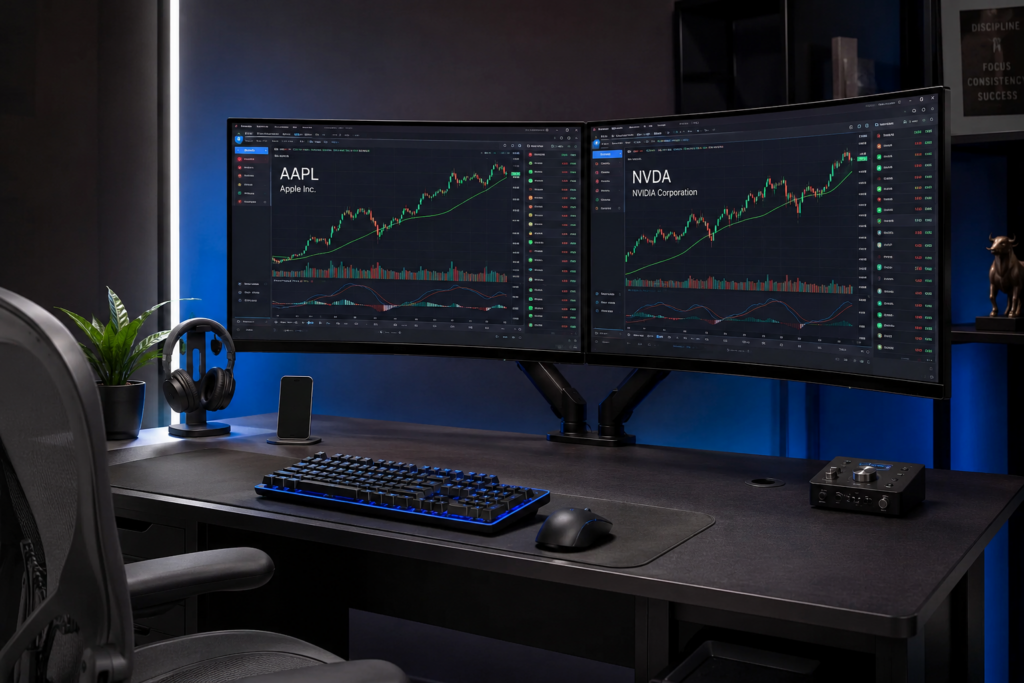
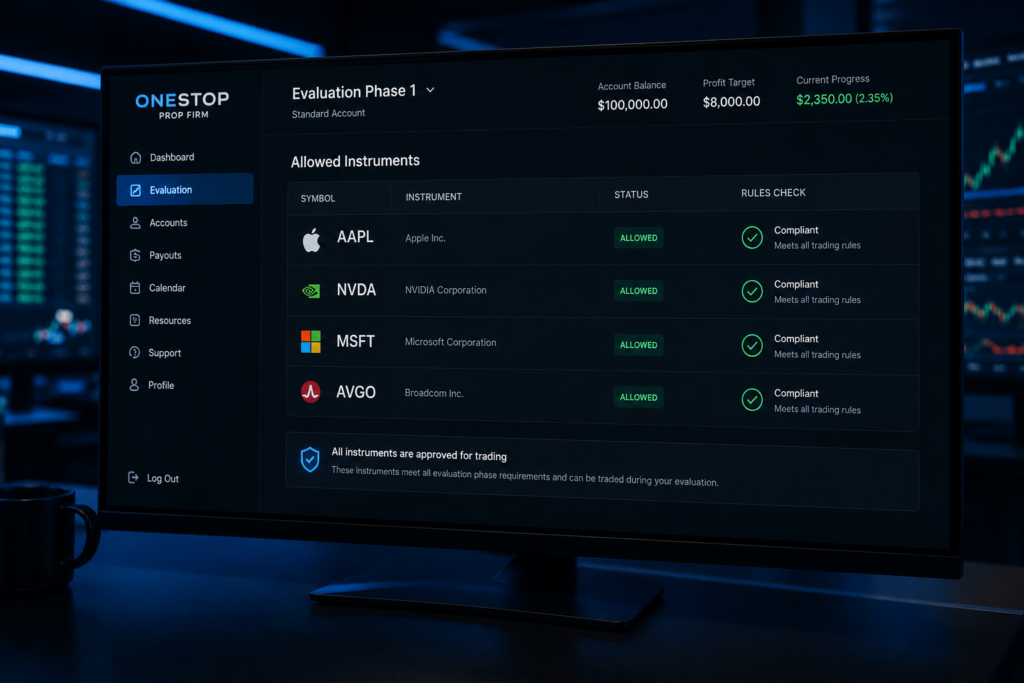
First: does this firm have the stocks you actually trade?
Not “stocks” as a category. Specific tickers. AAPL, NVDA, MSFT, AVGO, AMZN.
A lot of prop firms advertise stock access. When you open the instrument list, there are 8 symbols available.
That is not stock trading. That is a forex firm with a token equity section.
If you want a clear breakdown of which stocks hold up under prop firm rules, this guide to the best stocks to trade in a prop firm covers the specific names worth focusing on.
Second: how does the firm handle overnight gap risk?
Stocks gap between sessions. NVDA can open 8% lower the morning after a bad earnings report. AAPL has gapped on news with no warning.
If a firm counts that overnight move against your daily loss limit without any protection policy, that is a structural problem.
Forex pairs almost never move 5% overnight. Individual stocks do it regularly.
Understanding how the max daily loss rule interacts with gap events is critical before signing up. This breakdown of the max daily loss prop firm rule explains exactly how it plays out for stock traders.
Third: what are the minimum trading day requirements?
Some challenges require 10 days minimum. A few require 5.
If your style generates strong results in 3 focused sessions, a 10-day minimum means you are stuck manufacturing activity to hit a number.
Most liquid stock setups come in concentrated windows. You should not need to invent trades to satisfy an arbitrary day count.
Before evaluating any prop firm, it helps to have a clear picture of how prop firm rules actually apply to stock trading.
The One Stop Blueprint covers position sizing, daily loss management, and how to think about a funded account from day one. Free at onestopprop.com/newsletter.
The Short List After Applying the Filter
After running those three checks, the list of firms worth evaluating gets significantly shorter.
Here is what the landscape looks like for stock traders in 2026.
OneStopProp
The clearest case for stock traders specifically.
AAPL, NVDA, MSFT, and other major stocks are available inside the funded account. Not as a secondary option, but as a primary instrument class.
The one-step format means one evaluation phase, then funded.
OneStopProp also runs monthly competitions as a separate entry path. Different structure, same instruments and trading environment.
If you are deciding between a one-step challenge and a two-step structure, this comparison of 1-step vs 2-step prop firm challenges breaks down the mechanics directly.
For a stock trader who already knows their approach and wants a single focused evaluation on real equity instruments, this combination is direct.
FTMO
Strong track record. Long-established reputation in the prop space.
Primarily built around forex. Stock access exists, but the instrument depth is not the same as a stock-first environment.
For a trader focused on equities, it is worth pulling up the current instrument list before assuming stock coverage is comprehensive.
If you want a direct side-by-side, this breakdown of OneStopProp vs FTMO covers the key differences without the marketing noise.
Other Firms Worth Checking
There are other firms operating in 2026 that advertise stock access. Some newer entrants have more equity depth than their branding suggests.
The filter applies to all of them equally.
- Pull the instrument list. Verify the specific tickers you trade are there.
- Find the gap policy in writing. Not in a FAQ. In the actual challenge terms.
- Check the minimum trading day requirement before reading anything else about fees.
If a firm passes those three checks, it is worth a deeper look at profit targets, payout schedules, and fee structure.
Reversing that order wastes time on firms that will frustrate you before you ever get close to a funded account.

Conclusion
The top prop firm for a stock trader is the one that actually supports your instruments.
That sentence should be obvious. And it is not, because of how most prop firm lists are written.
Most rankings are built by forex-focused writers evaluating forex-built products. The stock trader angle is an afterthought.
Apply the three-question filter. Check:
- instruments
- the gap policy
- minimum trading days
After that, the fee and profit split comparison becomes meaningful.
Before that, you are just comparing marketing pages.
The One Stop Blueprint was built specifically for traders navigating funded accounts with a stock-first approach.
It covers account management, position sizing within drawdown limits, and how to think about scaling. Get it completely free at onestopprop.com/newsletter.


